
Industrial Electrical Switchgear: The Backbone of Power Distribution
The global switchgear market was estimated at USD 112.9 billion in 2025 and is projected to reach USD 197.7 billion by 2033, according to Grand View Research. The low-voltage switchgear segment exceeded USD 86.1 billion in 2024, driven by infrastructure upgrades and smart-grid investment, as reported by Global Market Insights. These figures reflect a broader industrial reality: modern facilities must receive, transform, distribute, and protect electrical energy through a coordinated chain of equipment. Electrical switchgear is the category that spans this entire chain, from the medium-voltage intake point to the final control cabinet. This article explains the equipment layers used in industrial power distribution, how they work together, and what buyers should evaluate when sourcing switchgear.
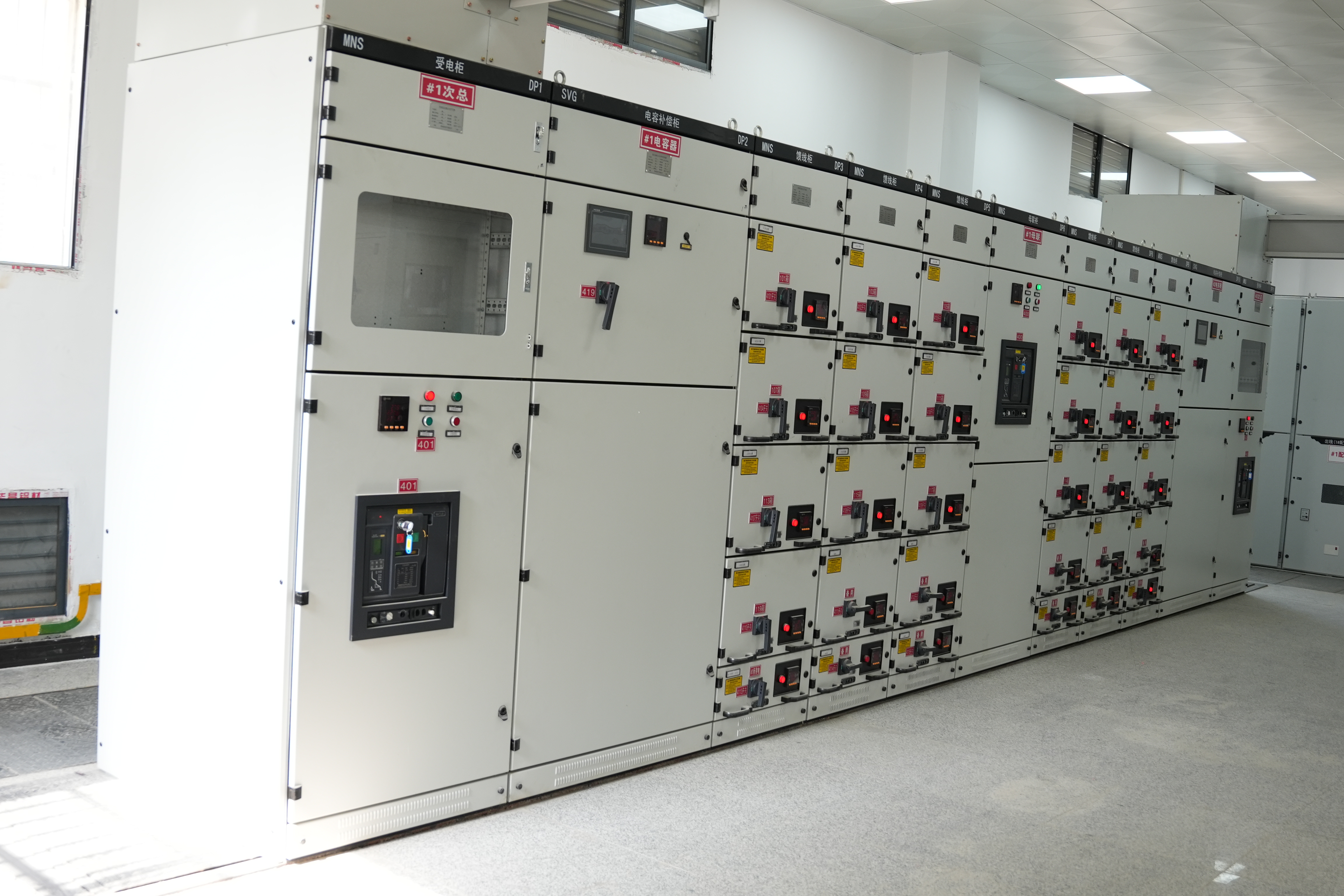
Low-voltage switchgear application in an industrial setting. Image source: Changzhou Tuoxin Electric Co., Ltd.
Why Power Distribution Must Be Understood as a System
Industrial power distribution is not a single-device function. Power enters a facility at medium voltage, is switched and protected by high-voltage switchgear, stepped down through transformers or box-type substations, distributed by low-voltage switchgear, and finally delivered to motors, lighting, and control systems through terminal distribution and control cabinets. Each layer performs a distinct task, but all layers share one objective: continuous, safe, and controllable power delivery.
Specification gaps often appear when these layers are purchased separately. A high-voltage panel may be selected without verifying the short-circuit withstand rating of the downstream low-voltage board. A transformer compartment may lack space for the specified enclosure type. A control cabinet may support the required motor power but not the plant's communication protocol. These mismatches tend to surface during commissioning, when correction costs are highest.
For buyers, the opportunity lies in treating switchgear as a coordinated system rather than a list of disconnected products. Complete-set supply, where one manufacturer produces the high-voltage panels, the box-type substation, the low-voltage distribution boards, and the terminal control boxes, reduces interface risk and gives the buyer a single reference point for technical documentation and quality responsibility.
How a Complete-Set Manufacturer Addresses the Problem
Changzhou Tuoxin Electric Co., Ltd. is a manufacturer of electrical switchgear and box-type substations, established in 2010 and located in Xixiang Industrial Park, Changzhou, Jiangsu, China. The company operates a 4,000-square-meter manufacturing facility with an annual production capacity of 3,000 units. It employs around 56 staff. The engineering and technical team consists of 27 engineers, including 3 senior engineers, 1 senior consultant, 5 engineers, and 18 technical personnel. Tuoxin is a designated supporting manufacturer of electrical equipment for Changzhou Power Supply Company.
The product portfolio covers high-voltage switchgear (KYN28 and XGN15 series), low-voltage switchgear (GBD, MNS, GGD, GXL, XL, and XLW series), YB series box-type substations, custom non-standard electrical control cabinets, PZ30 modular terminal lighting distribution boxes, XJM metering boxes, bus ducts, and cable trays. The company's complete switchgear and low-voltage electrical products have obtained CCC certification from the China Quality Certification Centre, and production is managed under the ISO9001:2000 quality management system.
Around 40 percent of output is exported, with customers in markets including Vietnam, Indonesia, Morocco, Russia, Kazakhstan, Mexico, Brazil, Germany, Italy, Spain, Turkey, Saudi Arabia, the United Arab Emirates, and the United States. For an industrial buyer, this breadth means that one supplier can cover the high-voltage intake, the transformation stage, low-voltage distribution, and special-function control within a single project.
The Equipment Layers of an Industrial Switchgear System
To evaluate switchgear suppliers, it helps to understand the standard equipment layers found in industrial and commercial power systems. The following sections describe each layer and representative product types.
Layer 1: High-Voltage Switchgear
At the top of the distribution chain, high-voltage switchgear receives power from the utility grid and protects the downstream network. Two common configurations are indoor metal-clad withdrawable switchgear and SF6 ring main units.
The KYN28-12 and KYN28-24 models are rated at 12 kV and 24 kV respectively. The KYN28-12 has a rated current range of 630 A to 4000 A, with a short-circuit breaking current from 20 kA to 50 kA. It is designed for use in power plants, substations, industrial and mining enterprises, and high-rise buildings for the reception, distribution, control, protection, and monitoring of electrical energy. The KYN28-24 follows the same metal-clad withdrawable structure with a rated voltage of 24 kV.
The XGN15-12 and XGN15-24 SF6 ring main units are metal-enclosed fixed-type switch equipment for medium-voltage networks. The XGN15-12 operates at 3.6 kV to 12 kV, while the XGN15-24 is rated at 24 kV with a rated current of 630 A or 1250 A. Both use sulfur hexafluoride as the arc-extinguishing and insulating medium. In the XGN15-24, the sealed gas tank is made of fully welded 304 stainless steel and the annual gas leakage rate is not higher than 0.5 percent.
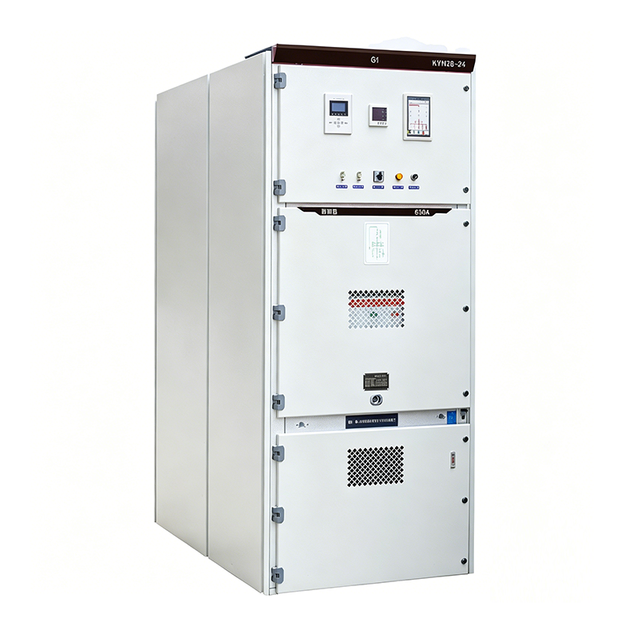
KYN28-24 metal-clad withdrawable AC switchgear. Image source: Changzhou Tuoxin Electric Co., Ltd.
Layer 2: Box-Type Substation
Between the high-voltage side and the low-voltage network, a transformer is required. In outdoor or space-limited projects, the prefabricated box-type substation integrates the high-voltage incoming section, the transformer, and the low-voltage outgoing section into one enclosure. The YBW-12 is rated at 12 kV with a capacity range of 50 to 1600 kVA, a high-voltage side rated current of 400 to 630 A, and a low-voltage side rated current of 100 to 2500 A. Its outer enclosure uses Galvalume steel sheet or hot-dip galvanized steel sheet with anti-corrosion treatment. This type of substation is widely used in urban high-rise buildings, residential communities, municipal infrastructure, industrial plants, and temporary construction power supply.
Layer 3: Low-Voltage Switchgear
On the low-voltage side, main distribution boards manage power from the transformer to internal feeders. Two structural approaches dominate: fixed and withdrawable.
The GGD is a fixed-type low-voltage switchgear rated at 380 V/660 V, with a current range of 600 to 1600 A. Its short-time withstand current is 50 kA (1 s) and its short-time peak current is 80 kA. Withdrawable types such as the MNS and GCS accept main busbar currents of 1600 to 4000 A, with a 1 s short-time withstand current of 100 kA and a peak current of 120 kA. The GCK is a withdrawable type with a rated current of 600 to 1600 A and a short-time peak current of 80 kA. Cabinet frames in these series are made of Galvalume steel sheet or cold-rolled galvanized steel sheet, and conductive busbars are T2 pure copper with tin or silver plating.
| Model | Type | Rated Voltage | Rated Current | Short-Time Withstand (1 s) | Protection |
|---|---|---|---|---|---|
| KYN28-12 | HV metal-clad withdrawable | 12 kV | 630–4000 A | 20–50 kA | IP4X |
| KYN28-24 | HV metal-clad withdrawable | 24 kV | 630–3150 A | 20–31.8 kA | IP4X |
| XGN15-24 | HV SF6 ring main unit | 24 kV | 630 / 1250 A | 20 / 25 kA (4 s) | IP67 gas tank |
| YBW-12 | Box-type substation | 12 kV | HV 400–630 A / LV 100–2500 A | — | IP3X / IP2X |
| MNS / GCS | LV withdrawable | 380 V / 660 V | 1600–4000 A | 100 kA | IP30 |
| GCK | LV withdrawable | 380 V / 660 V | 600–1600 A | 50 kA | IP30 |
| GGD | LV fixed | 380 V / 660 V | 600–1600 A | 50 kA | IP30 |
Representative switchgear parameters across distribution layers. Source: Changzhou Tuoxin Electric Co., Ltd. product specifications.
Layer 4: Terminal Distribution and Specialized Control
Closer to the load, terminal distribution boxes and control cabinets provide protection, switching, and automation for individual circuits. The PZ30 low-voltage distribution box, rated up to 125 A with IP30 protection, is used for lighting and terminal power distribution. The XL AC power distribution box, with incoming ratings of 100 A, 200 A, 400 A, or 630 A, covers branch distribution in civil buildings, manufacturing plants, municipal engineering, and new energy supporting projects. For outdoor cable branching, the DFW low-voltage cable distribution box has a complete-set rating of 630 A, three outgoing circuits, and protection degrees from IP34D to IP54. The JX and JXF series industrial branch boxes, rated at 100 A, 200 A, or 400 A, provide overload, short-circuit, and leakage protection for maintenance and testing power supply in industrial plants.
For motor-driven processes, the VFD variable frequency control cabinet is designed for three-phase 380 V input with an applicable motor power range of 0.75 kW to 630 kW. It supports vector control and V/f scalar control, with an overload capacity of 150 percent rated current for 60 seconds, and uses Modbus-RTU for remote communication. The ATS dual power supply distribution box, with a current range of 63 A to 630 A, automatically switches between power sources upon undervoltage, phase loss, or overvoltage. Its conventional transfer time is up to 2 seconds, while the fire-fighting version transfers in up to 0.25 seconds.
Layer 5: Power Transmission and Cabling Support
Between switchgear assemblies, power needs a physical path. Enclosed busways carry high currents in a compact footprint. The CMC model covers 100 A to 5000 A at 400 V/690 V, with indoor protection IP40/IP43 and outdoor waterproof versions up to IP68. Cable trays support power and control cables across installations. The XQJ LQ series is available in steel, aluminum, or FRP, with standard widths up to 1000 mm, side heights up to 300 mm, and load classes from light duty (up to 120 kg/m) to heavy duty (up to 400 kg/m). Fire-resistant tray versions offer a fire endurance of 0.5 hour, 1 hour, or 2 hours.
Application Scenarios and Environmental Adaptation
The complete equipment set, including high and low voltage switchgear, box-type substations, bus ducts, metering and lighting distribution boxes, and non-standard control cabinets, is applied across seven core sectors: power grid, new energy (photovoltaic and energy storage), industrial and mining manufacturing, commercial and residential construction, public buildings such as hospitals and schools, IDC communication data centers, and rail transit and municipal infrastructure.
Typical project scenarios include:
Photovoltaic projects, where YBW-12 box-type substations provide outdoor voltage transformation, GGD or MNS boards handle low-voltage collection and distribution, and VFD control cabinets drive pumps and cooling systems.
Industrial plants, where withdrawable low-voltage switchgear such as MNS or GCS is used for motor control centers, while XL AC boxes and JX/JXF branch boxes supply maintenance and testing power on the workshop floor.
Data centers and communication rooms, where ATS boxes support dual-power switching for critical loads, and enclosed busways supply high-density power distribution.
Municipal and utility tunnel projects, where DFW outdoor cable distribution boxes serve roadside power distribution, and anti-condensation cabinet structures handle high-humidity environments.
Application environment also affects equipment selection. For installations above 2,000 meters altitude, insulation clearance must be increased, components derated, and cabinet sealing reinforced. Coastal sites with salt corrosion typically require hot-dip galvanized or fluorocarbon-coated enclosures, aluminum alloy bus housings, and 304 stainless steel fasteners. In heavy-dust workshops, protection can be raised to IP40 or IP54 with fully enclosed cabinets and dust-proof bus ducts. Chemical plants can use anti-corrosion coatings, FRP accessories, and fully enclosed structures to isolate corrosive gas.
Market Trends and Compliance Direction
Market data indicates steady expansion in the switchgear sector. The global market was valued at USD 112.9 billion in 2025 and is projected to grow to USD 197.7 billion by 2033. The low-voltage segment reached USD 86.1 billion in 2024, with infrastructure renewal and smart-grid deployment cited by Global Market Insights as key drivers. Market size estimates vary by source because segmentation definitions differ; the direction of growth, however, is consistent across major research firms.
The top five international manufacturers, ABB, Siemens, Schneider Electric, Eaton, and GE, hold approximately 35 percent of the global market, which suggests that the remaining demand is served by regional and specialist producers. In 2024, China exported approximately USD 2.72 billion in electrical apparatus for switching or protecting electrical circuits to the United States, according to UN Comtrade data, reflecting the depth of cross-border supply chains in this category.
Standardization is also playing a stronger role. Low-voltage switchgear and controlgear assemblies fall under the IEC 61439 series, while high-voltage prefabricated substations up to 52 kV are covered by IEC 62271-202:2022. For manufacturers, compliance with these standards is increasingly a baseline requirement in export markets.
Complete-Set Supply versus Traditional Multi-Vendor Procurement
Many projects still source switchgear through traditional multi-vendor procurement: high-voltage panels from one manufacturer, low-voltage switchgear from another, and terminal boxes from a local supplier. This approach can produce competitive unit prices, but it transfers system-integration work to the buyer or the electrical contractor. Cable interfaces, protection coordination, and dimensional compatibility must be managed manually across multiple supply contracts.
A complete-set approach consolidates design responsibility. Because the manufacturer produces the main equipment layers, the internal coordination between incoming panels, transformer sections, and outgoing feeders is handled under one design process. For a mid-sized industrial facility, this shortens technical clarification cycles, simplifies documentation, and gives the buyer a single after-sales reference. Tuoxin's ability to supply custom non-standard control cabinets further supports project-specific requirements without a second vendor.
However, complete-set supply is not the only rational choice. In projects where a local utility mandates a specific brand list or local certification, an imported complete set may require additional verification or assembly through an approved local partner. For very large contracts with tight delivery schedules, a single factory's production capacity, such as Tuoxin's annual output of 3,000 units, may require earlier order placement or a buffer-stock strategy; it is not a substitute for multi-plant volume. And for a project that needs only one standardized product type, purchasing directly from a specialist manufacturer may be simpler and faster.
Future Outlook for Industrial Switchgear Sourcing
Three directions will shape industrial switchgear purchasing in the coming period.
First, new energy integration will continue to drive demand for box-type substations, low-voltage distribution switchgear, and control cabinets designed for photovoltaic and energy-storage applications. Second, intelligent functions are becoming standard: communication protocols such as Modbus-RTU, remote 485 communication, and automatic transfer are now expected features in control and distribution equipment rather than optional upgrades. Third, customization will matter more. Non-standard control cabinets, project-specific enclosure requirements, and adaptation to conditions such as altitude, humidity, salt corrosion, and heavy dust are already routine in export-oriented supply.
For industrial buyers, the practical implication is that switchgear suppliers should be evaluated not only on product parameters, but also on their ability to cover the full distribution chain, adapt equipment to the project environment, and provide consistent documentation across all layers. Engineering depth, quality certification, and export experience are useful indicators for this assessment.
Frequently Asked Questions
What is electrical switchgear?
Electrical switchgear is a combination of devices used to receive, distribute, control, protect, and monitor electrical energy in a power system. It ranges from high-voltage intake panels to low-voltage terminal distribution boxes, and includes switching devices, protective devices, transformers, busways, and control cabinets.
What are the main types of electrical switchgear?
Switchgear is grouped by voltage level and function. High-voltage switchgear includes metal-clad withdrawable switchgear such as the KYN28 series at 12 kV and 24 kV, and SF6 ring main units such as the XGN15 series. Low-voltage switchgear includes fixed types such as GGD and withdrawable types such as MNS, GCS, and GCK. Box-type substations, distribution boxes, and control cabinets complete the system.
What is the difference between high-voltage and low-voltage switchgear?
High-voltage switchgear operates at medium-voltage levels such as 3.6 kV to 24 kV and is responsible for power intake and primary protection. Low-voltage switchgear operates at 380 V or 660 V and distributes power from the transformer to loads. For example, the KYN28-12 handles 12 kV incoming circuits, while MNS low-voltage switchgear distributes 380 V/660 V circuits with main busbar currents up to 4000 A.
What standards apply to switchgear?
Low-voltage switchgear and controlgear assemblies must comply with the IEC 61439 series. High-voltage prefabricated substations up to 52 kV are governed by IEC 62271-202:2022. In China, complete switchgear and low-voltage electrical products may also hold CCC certification from the China Quality Certification Centre.
How do I choose between fixed-type and withdrawable low-voltage switchgear?
Fixed-type switchgear such as GGD offers a simpler structure and a lower initial cost, suitable for installations where supply interruption is acceptable. Withdrawable switchgear such as MNS, GCS, or GCK allows a draw-out unit to be removed for maintenance without shutting down the entire assembly, which is important for continuous-process industries. The choice depends on the required availability and maintenance strategy.
What is a box-type substation used for?
A box-type substation, also called a prefabricated substation, combines high-voltage incoming equipment, a transformer, and low-voltage distribution equipment in an outdoor enclosure. The YBW-12, for example, has a rated voltage of 12 kV and a capacity range of 50 to 1600 kVA. It is used in urban high-rise buildings, residential communities, municipal infrastructure, industrial plants, and temporary construction sites where a dedicated transformer room is not available.