
Industrial Centrifuge for Chemical Plants: A Constraint-Led Selection Guide
Independent industry reference · wetted materials, explosion protection, separation factor, discharge mode and conformity documentation
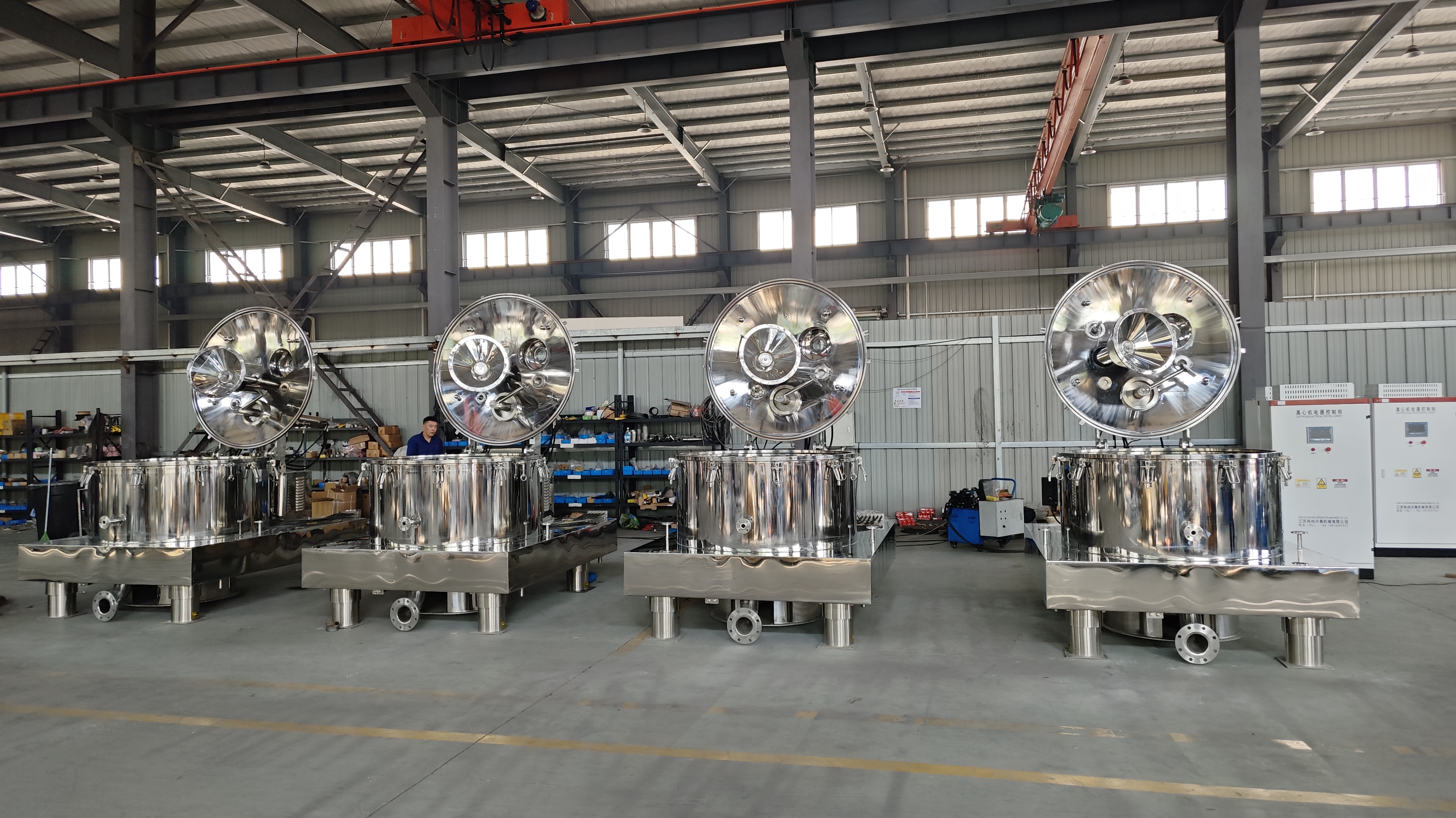
Four LGZ1250 basket centrifuges built in SS2205 duplex stainless steel for a lithium carbonate duty in Chile, with CIP provisions specified at the project stage.
An industrial centrifuge is a mechanical device that uses centrifugal force to separate substances or particles of different densities within a liquid. In a chemical plant, that same machine also has to survive the medium it separates, the atmosphere around it, the crystal it must not break, and the documentation a project engineer has to file before commissioning can start.
That is why chemical-duty centrifuge projects usually stall on constraints rather than on capability. A unit can be correctly sized for throughput and still be rejected at technical bid stage because the wetted parts are SS304 in a chloride-bearing liquor, because the drive is not explosion-proof, because the discharge method adds manual labour the plant did not budget for, or because the conformity certificate covers a different model than the one being quoted.
The demand backdrop is unremarkable but firm. The Business Research Company values the global industrial centrifuge market at USD 10.06 billion in 2025 and projects USD 13.61 billion by 2030, a CAGR of 6.3%. Fortune Business Insights reports that filtering centrifuges are forecast to grow at 7.2% annually, driven by API crystallisation and specialty-chemical purification, while sedimentation types accounted for 56.6% of 2025 market share. Read together, the two datasets point to the same practical conclusion: the filtering side of the category — the side that chemical crystallisation lines actually buy — is where specification decisions carry the most consequence.
JGD Centrifuge Co., Ltd. is a filtration and separation equipment manufacturer based in Zhangjiagang, Jiangsu Province, China, founded in 2012 and operating a 4,000 m² facility with 60 employees, an annual output of roughly 100 units and a six-engineer R&D team; about 80% of output is exported to South America, Southeast Asia, North America, the Middle East and Europe. Its range spans basket, peeler, pusher, decanter, scroll-screen and bag-lifting centrifuges, which makes it a useful reference set here, because the constraint set changes sharply between those families.
The five constraints that decide a chemical-duty specification
For chemical service, the specification discussion usually reduces to five linked decisions: the wetted-material grade, the explosion-protection and drive arrangement, the separation factor relative to crystal integrity, the discharge and operating mode, and the conformity documentation that has to travel with the equipment. Each is a boundary, not a preference, and each one closes off options for the others.
Constraint 1 — Wetted material: the grade, not the alloy name
Material selection is the first constraint because it cannot be corrected later at reasonable cost. The practical rule used in filtration work is: SS304 for normal working conditions, SS316L for moderate corrosion, Hastelloy or PTFE lining for strong corrosion, and no ordinary SS304 in media containing chloride ions. That single rule disqualifies a large share of low-cost quotations before any performance discussion begins.
Within the JGD range, material options extend from SS304 and SS321 through SS316L, SS2205 duplex, SS904L, titanium and Hastelloy-C alloy. Availability is not uniform in practice: the PGZ1000 can be supplied with 316L stainless steel wetted parts and is described as suitable for corrosive chemical processing when supplied with 316L contact parts; the LGZ1250 lists SS316L and SS904L among its contact material options; the PSLQ800, PLQ1250, PD1250, PSB600 and the pusher, scroll-screen and decanter models each publish their own material schedule.
| Grade | Where it fits | Documented basis |
|---|---|---|
| SS304 | Normal working conditions | Listed as a material of construction across the range; not recommended for chloride-bearing media |
| SS321 | Stabilised grade, general chemical duty | Available on PSB600, PSLQ800, LGZ1250, GK1000, HR400, HY1200, LWL450, LW350, LLWZ450 |
| SS316L | Moderate corrosion; pharmaceutical contact parts | 316L wetted parts offered on PGZ1000 and PD1250; contact option on LGZ1250 |
| SS2205 duplex | Weakly alkaline chloride-bearing slurries | Specified for the Chilean lithium carbonate project |
| SS904L | Higher-alloy austenitic duty | Contact material option on LGZ1250; listed across the model range |
| Titanium / Hastelloy-C | Corrosive media beyond stainless capability | Listed as available options for corrosive media |
Material schedules as published per model. Grade choice is a function of medium chemistry and temperature, not of machine size.
Constraint 2 — Explosion protection and drive sizing
Chemical plants rarely buy a centrifuge without an area classification attached to the room it will stand in. Across the JGD range, main motors are specified as explosion-proof, from a 3 kW unit on the PSB600 through 11 kW on the PGZ1000 and HR400, 18.5 kW on the PD1250, 22 kW on the LGZ1250, PLQ1250 and LWL450, 30 kW on the HY1200 and 37 kW on the GK1000. The LW350 decanter lists a 15–22 kW explosion-proof main motor.
Two enclosure details matter as much as the motor rating. The PSB600 is described as having a fully enclosed explosion-proof design with variable frequency control, while the GK1000 uses a sealed and explosion-proof design for harsh operating conditions. On the vertical side, the PGZ1000 combines a sealed, explosion-proof safety design with a flat-plate damping structure that does not require a foundation — a detail that shortens civil works in retrofit projects.
A common specification error is to read motor power as a proxy for separation performance. It is not. The HY1200 carries a 30 kW motor at a maximum separation factor of 170; the LWL450 carries 22 kW at 1,570. The two figures describe different duties — high-volume coarse dewatering versus higher-g-force filtration — and the power rating simply follows the duty.
Constraint 3 — Separation factor and crystal integrity
The separation factor represents centrifugal separation capability; the higher the value, the stronger the separation capability. For crystalline materials the working range is generally 800–1,200. Fine particulate duty calls for a higher figure, while fragile crystals call for restraint — pushing the factor up to shorten cycle time is one of the more reliable ways to generate fines, poor drainage and downstream filtration problems.
Within the range, published maximum separation factors run from 170 on the HY1200 single-stage pusher and 545/645 on the HR400 two-stage pusher, through 560 on the PGZ1000, 645 on the PSLQ800 and PD1250, 700 on the LGZ1250 and PLQ1250, 755 on the PSB600, 1,020 on the GK1000 and 1,570 on the LWL450, up to 2,000–2,500 on the LLWZ450 screen-decanter and 2,683 on the LW350 decanter. The spread is the point: the same catalogue contains machines intended for quite different crystal populations.
Drum geometry follows the same logic. The LLWZ450 uses a 450 mm bowl with a length-to-diameter ratio of 2.5–3.8 and a differential speed range of 10–30 rpm; the LW350 uses a 350 mm drum with a 1,550 mm length at 3,700 rpm. These are sedimentation answers to difficult clarification duty, not substitutes for a filtering basket.
Constraint 4 — Discharge mode: batch, continuous and the labour in between
Discharge determines how much of the operating day is spent separating and how much is spent opening, emptying and cleaning. Batch basket centrifuges are typically discharged in one of three ways: manual top shovelling on basic models, direct lifting of the filter bag on bag-lifting models, and a fully automatic scraper for bottom discharge on the LGZ/PGZ types. The manual route has a hard safety rule attached — the lid is not opened until the equipment has completely stopped.
The PLQ1250 takes a different route again: a vertical drum with automatic pull-bag discharge, where the filter cake is discharged automatically and the discharge action avoids scraping against the cake in order to limit crystal abrasion, under a fully openable lid intended to support cGMP cleaning and hygiene requirements. The GK1000 horizontal peeler uses automatic scraper discharge with comprehensive residual-material handling for large-scale batch production.
Continuous operation removes the batch boundary altogether. The HY1200 single-stage pusher is described as true fully continuous, uninterrupted operation with high single-unit capacity, piston-based pushing rather than scraping, and high-efficiency penetrating wash; the HR400 two-stage pusher adds a stepped dewatering stage that halves axial pushing resistance and extends the particle-size range. The LWL450 scroll screen discharge unit runs at a 20 m³/h feed rate with 1,570 maximum separation factor, and the LW350 and LLWZ450 decanters handle clarification duty without filter cloth at all.
One capacity constraint deserves an explicit warning. Loading capacity is not derived from drum volume alone; it is set by the effective depth of the drum and the rated loading limit of the equipment, and that limit must be respected. Overloading causes violent vibration and creates a safety hazard. Two machines with the same nominal drum diameter can therefore have different permissible loads.
Constraint 5 — Conformity documentation and its actual scope
For European projects, EN 12547:2014 is the current European standard covering centrifuge safety requirements, excluding household and laboratory models addressed by EN 61010-2-020. Machinery-directive conformity is the document that most often decides whether a quoted machine can be installed at all.
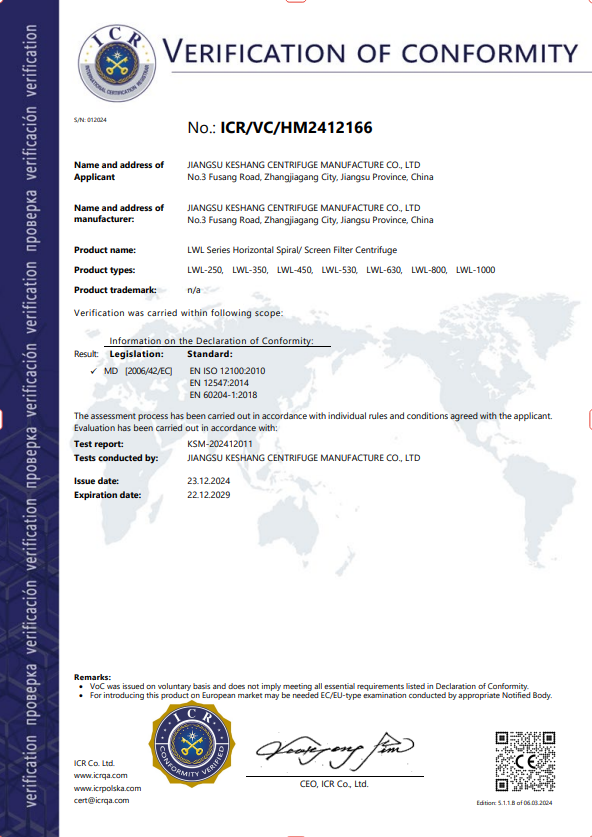
Verification of Conformity No. ICR/VC/HM2412166, issued by ICR Co., Ltd. for the LWL Series horizontal spiral / screen filter centrifuge, models LWL-250 to LWL-1000.
The JGD documentation set includes Verification of Conformity No. ICR/VC/HM2412166, issued by ICR Co., Ltd. on 23 December 2024 and valid until 22 December 2029, covering the LWL Series horizontal spiral / screen filter centrifuge, models LWL-250, LWL-350, LWL-450, LWL-530, LWL-630, LWL-800 and LWL-1000, assessed under Legislation MD 2006/42/EC against EN ISO 12100:2010, EN 12547:2014 and EN 60204-1:2018. The LWL450 model is within that scope.
Beyond certification, project-specific engineering is where most chemical enquiries actually land. Documented capability in this area covers customisation of voltage, electrical component brands (PLC and touch screen, frequency converter, motor) and bearings, together with in-depth customisation work around FDA, GMP and cGMP requirements, aseptic CIP and SIP technologies, on-site explosion-proof protection, material concentration and pretreatment, and automated operation.
A parameter snapshot across the range
The table below consolidates published parameters so that the constraint discussion above can be read against specific models. It is a specification reference, not a recommendation list; the correct choice follows from the medium, the crystal and the duty cycle.
| Model | Type | Drum / volume | Speed | Max Fr | Motor | Mode |
|---|---|---|---|---|---|---|
| PSB600 | Manual top discharge | 600 mm / 40 L | 1,500 rpm | 755 | 3 kW | Batch |
| PSLQ800 | Full-opening lid, manual top discharge | 800 mm / 100 L | 1,200 rpm | 645 | 5.5 kW | Batch |
| PD1250 | Top discharge bag-lifting | 1,250 mm / 400 L | 960 rpm | 645 | 18.5 kW | Batch |
| PLQ1250 | Automatic pull-bag discharge | 1,250 mm / 300 L | 1,000 rpm | 700 | 22 kW | Batch |
| PGZ1000 | Vertical bottom discharge peeler | 1,000 mm / 175 L | 1,000 rpm | 560 | 11 kW | Batch, automatic |
| LGZ1250 | Vertical bottom discharge scraper | 1,250 mm / 400 L | 1,000 rpm | 700 | 22 kW | Batch, automatic |
| GK1000 | Horizontal peeler | 1,000 mm / 165 L | 1,350 rpm | 1,020 | 37 kW | Batch, automatic |
| HR400 | Two-stage pusher | 337/400 mm | 1,600 rpm | 545/645 | 11 kW | Continuous |
| HY1200 | Single-stage pusher | 1,200 mm, 130 kg max load | 500 rpm | 170 | 30 kW | Continuous |
| LWL450 | Scroll screen discharge | 20 m³/h feed | 2,500 rpm | 1,570 | 22 kW | Continuous |
| LW350 | Horizontal decanter | 350 mm / 1,550 mm | 3,700 rpm | 2,683 | 15–22 kW | Continuous |
| LLWZ450 | Screen-decanter | 450 mm, L/D 2.5–3.8 | 2,800–3,200 rpm | 2,000–2,500 | Differential 10–30 rpm | Continuous |
Published model parameters. Maximum loading limits apply in addition to drum volume and must not be exceeded.
Application: what a chloride-bearing lithium carbonate duty actually required
The clearest published example of constraint-led specification in the JGD reference set is a chemical plant extracting lithium carbonate from Atacama Salt Lake brine in Chile. The slurry carried 10–30% solids in a weakly alkaline system containing soluble Na⁺, SO₄²⁻ and Cl⁻ — mildly corrosive, and therefore a material problem before it was a capacity problem.
The project specification called for SS2205 duplex stainless steel construction, CIP on-line cleaning provisions, strict solid–liquid separation precision for crystal recovery, and a project configuration reaching 1,200 rpm drum speed with a 30 kW main motor and a separation factor of 1,008 — notably above the catalogue LGZ1250's nominal 700, which is why project configuration and catalogue data should be read as two separate documents. Four LGZ1250 units were supplied. After ten years of service the reported result is stable operation with low noise, separation performance meeting the capacity requirement, and a reduction in manual labour cost.
The same constraint mapping applies more broadly. Batch basket centrifuges are the appropriate family for granular and crystalline solids — salt crystals, pharmaceutical and herbal extracts, chemical intermediates, resins and food additives — where the solid is the product and washing or crystal integrity matters. Continuous pusher and scroll-screen machines suit high-volume crystal duty with a stable particle-size distribution. Decanter and screen-decanter configurations take the difficult clarification cases: fine particles, low feed concentrations and slurry that will not filter cleanly.
Market trend: the growth sits on the filtering side
Two published signals are worth placing side by side. Filtering centrifuges are forecast to grow at 7.2% annually on the strength of API crystallisation and specialty-chemical purification, while the scraper discharge sub-category alone is reported at USD 901.40 million globally in 2026. Separately, Fortune Business Insights estimates that around 57% of pharmaceutical manufacturing plants have adopted horizontal scraper centrifuges — a pharmaceutical figure rather than a chemical one, and a commercial estimate rather than a regulatory count, but directionally consistent with where filtering demand is concentrating.
One caution belongs in any procurement discussion that cites market numbers. Published estimates for the absolute size of the industrial centrifuge category diverge substantially between research houses because market definitions, included segments and methodologies differ. Headline values should be treated as directional context for timing and investment appraisal, not as a benchmark a supplier should be measured against. For a plant-level decision, the useful data is in the RFQ response and the conformity file.
Where a constraint-led specification differs — and where it stops
A specification written around constraints behaves differently from a specification written around headline capacity. It front-loads medium chemistry, area classification, crystal fragility and market-access documentation, and it accepts that some of those answers will rule out otherwise attractive quotations. The approach also has boundaries that buyers should see stated plainly.
The conformity scope is model-specific. Verification of Conformity No. ICR/VC/HM2412166 covers the LWL Series, models LWL-250 to LWL-1000. It does not automatically extend to basket, peeler, pusher or decanter models; those require their own conformity route for the destination market, and buyers should confirm this at quotation stage rather than at delivery.
Material grades have hard limits. SS304 remains the default for normal conditions and should not be substituted into chloride-bearing service. Where the medium exceeds even duplex or 904L capability, titanium or Hastelloy-C alloy is required, and that decision changes cost and lead time.
Higher separation factor is not free. For fragile crystals the correct answer is often a lower factor and a gentler discharge, accepting a longer cycle rather than generating fines.
Manual discharge carries an operating cost. Basic manual top-discharge models require a complete stop and lid opening before emptying. That is a labour and containment consideration in plants running many cycles per shift, and it is one reason automatic scraper or pull-bag discharge configurations exist.
Testing boundary. Quality control is recorded as a no-load test before delivery. That verifies mechanical assembly and rotation, not separation performance on the buyer's actual medium; on-site validation with the real slurry remains the purchaser's step.
Supply and service planning. Documented monthly capacity is 8 units with a 30–60 day lead time and a minimum order of 1 unit, which is comfortable for single-line replacement and tight for a multi-unit plant rollout. Documented after-sales support is remote support, so buyers who require on-site intervention should confirm coverage terms in the RFQ. Customisation scope is defined around voltage, electrical component brands (PLC and touch screen, frequency converter, motor) and bearings — it is an electrical and component-level flexibility, not an open invitation to redesign wetted geometry.
Procurement checklist for chemical duty
| Item | What to state in the RFQ | Why it changes the answer |
|---|---|---|
| Medium chemistry | Chloride content, pH, temperature, soluble salts | Moves the wetted grade from SS304 to SS316L, duplex, 904L, titanium or Hastelloy-C |
| Crystal behaviour | Particle size, fragility, required dryness | Sets the separation factor band and the discharge method |
| Area classification | Zone, gas group, enclosure requirement | Confirms explosion-proof motor and sealed enclosure configuration |
| Duty cycle | Batches per shift or continuous feed, labour tolerance | Separates manual, bag-lifting, automatic scraper and continuous options |
| Loading limit | Rated load, not volume alone | Overloading causes violent vibration; identical diameters can differ |
| Conformity | Destination market and required standard set | Determines whether the quoted model is inside an existing certificate scope |
| Hygiene and cleaning | CIP/SIP, cGMP requirements, dead-corner tolerance | Points toward full-opening-lid and sanitary-construction configurations |
| Commercial envelope | Unit count, delivery window, service expectation | Monthly capacity of 8 units and a 30–60 day lead time shape the schedule |
Future outlook
Three directions look reasonably well supported by the available evidence. First, the filtering share of the category should keep expanding where crystallisation and purification drive demand, which favours basket, peeler, pusher and scroll-screen configurations over general-purpose clarification equipment. Second, documentation is becoming a specification item rather than an afterthought — buyers increasingly ask for the certificate scope, the applicable standard set and the material certificate before they ask for the price, and suppliers who can answer that early shorten their own sales cycle. Third, automation and containment continue to move down the model range: automatic scraper and pull-bag discharge, cGMP sanitary construction, CIP/SIP compatibility and sealed explosion-proof enclosures are no longer confined to the largest frames.
What is unlikely to change is the underlying rule. A chemical-duty industrial centrifuge is selected by matching medium, crystal, atmosphere and market access to a machine family, then confirming the parameters and paperwork. Buyers who keep that order of operations tend to spend their commissioning budget on production rather than on corrective work.
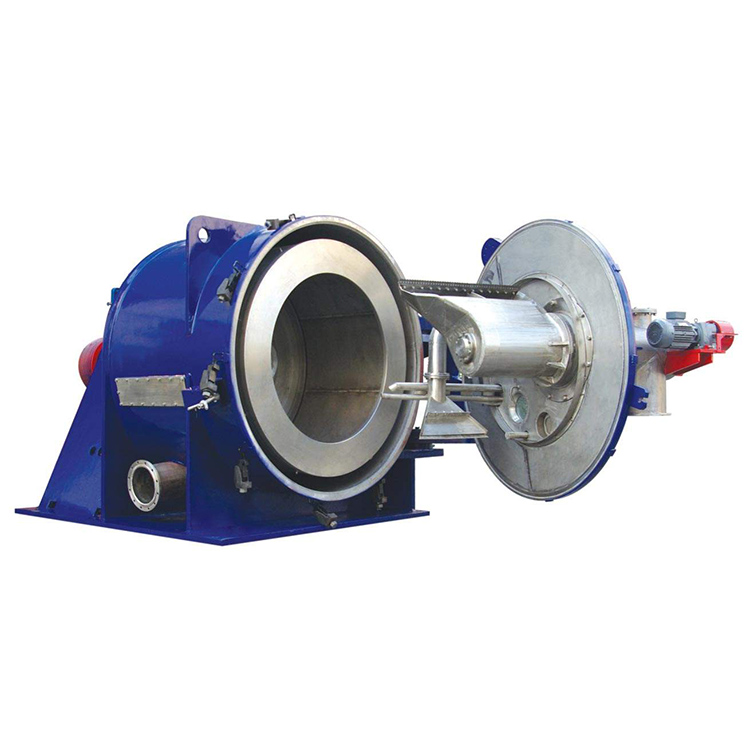
GK1000 horizontal peeler centrifuge: 1,000 mm drum, 1,350 rpm, maximum separation factor 1,020, 37 kW explosion-proof main motor, automatic scraper discharge.
FAQ
Which parameters actually decide the model?
The main factors are drum diameter, drum volume, loading limit, rotation speed, separation factor, motor power and filter media type. Material properties must be confirmed alongside them: corrosiveness, whether explosion-proof construction is required, temperature and solid content. Where capacity is high and a closed, explosion-proof system is needed, an automatic bottom-discharge centrifuge is the usual configuration.
How should the separation factor be referenced during selection?
The separation factor represents centrifugal separation capability; a higher value means stronger separation. For crystalline materials the reference range is generally 800–1,200. Fine particulate duty calls for an appropriately higher value, while fragile materials should not be run at too high a factor, to prevent particle breakage.
How are equipment materials chosen for corrosive media?
SS304 for normal working conditions; SS316L for moderate corrosion; Hastelloy or PTFE lining for strong corrosion. Ordinary SS304 should not be used for materials containing chloride ions. The choice follows corrosion intensity and temperature.
Why do two machines with the same drum diameter have different loading capacities?
Loading capacity is determined by the effective depth of the drum and by the rated loading limit, so volume alone is not a reliable basis for comparison. The rated loading limit of the equipment must be respected; overloading causes violent vibration and creates a safety hazard.
How is material discharged from a batch type basket centrifuge?
Basic models use manual top shovelling; bag-lifting models discharge by directly lifting the filter bag; automatic models use a scraper for bottom discharge. The manual route requires the equipment to have completely stopped before the lid is opened.
Which materials suit a batch type basket centrifuge?
The family suits solid–liquid separation of granular and crystalline solids, including salt crystals, herbal and pharmaceutical extracts, chemical intermediates, resins and food additives.
What should be done if the centrifuge vibrates violently during operation?
Stop the centrifuge for inspection, to prevent safety incidents and equipment damage. The usual cause is uneven solid concentration with lumps in the feed; before feeding, the solid concentration should be uniform and free of lumps.
What does the CE documentation actually cover?
Verification of Conformity No. ICR/VC/HM2412166, issued by ICR Co., Ltd. on 23 December 2024 and valid to 22 December 2029, covers the LWL Series horizontal spiral / screen filter centrifuge, models LWL-250 to LWL-1000, assessed under MD 2006/42/EC against EN ISO 12100:2010, EN 12547:2014 and EN 60204-1:2018. Models outside that series are not within this certificate's scope.
Detailed model parameters and material schedules are compiled in the manufacturer's technical brochure (PDF).
¿Tiene preguntas o necesita más detalles?
Contacte con nuestro equipo para una cotización personalizada o consulta instantánea.
Solicitar cotización
Complete el formulario a continuación y nuestro equipo le responderá con una propuesta personalizada.
Chat directo de WhatsApp
¿Prefiere chatear en tiempo real? Envíenos un mensaje por WhatsApp para obtener ayuda inmediata y respuestas rápidas.
- Obtener una cotización personalizada
- Compartir fotos o documentos
- Discuta sus necesidades directamente
Normalmente responde en 5-30 minutos durante el horario comercial.