
Industrial Centrifuge Supplier Review: JGD Centrifuge
Industrial centrifuges sit inside process trains where the wrong discharge principle costs more than the machine itself — in operator hours, in crystal breakage, in cleaning validation time and in lost batches. This review examines JGD Centrifuge Co., Ltd. as a supplier of industrial centrifuges across batch and continuous configurations, and sets its published capabilities against the selection questions buyers actually face at the discovery stage.
An industrial centrifuge is a mechanical separation device that uses centrifugal force to separate solids, liquids and gases of different densities. JGD Centrifuge Co., Ltd. is a centrifuge manufacturer located in Zhangjiagang City, Jiangsu Province, China (No.2, Lefeng Road, Leyu Town), founded in 2012, which develops, manufactures and supports filtration and separation equipment for the pharmaceutical, chemical, food, environmental protection and metallurgical industries.
The Discovery Problem: One Category, Two Separation Logics
Buyers arriving at the category for the first time usually search for an "industrial centrifuge" and receive a list of machines that do not compete with each other. Sedimentation and filtration are different separation logics, and the commercial research reflects that split: Fortune Business Insights reports the global industrial centrifuge market at USD 10.06 billion in 2025, projected to reach USD 13.61 billion by 2030 at a CAGR of 6.3%, with sedimentation centrifuges holding 56.6% of 2025 market share while filtering centrifuges are forecast to grow at 7.2% annually, driven by API crystallisation and specialty-chemical purification.
That distinction matters at the discovery stage because it predetermines almost everything downstream. A decanter works by sedimentation and handles fine particles and hard-to-filter slurries; a basket, peeler or pusher machine works by filtration through a screen or filter medium and produces a drier cake. Selecting across those two families on price alone is the most common early-stage error.
The second discovery-level decision is the discharge method. Manual top discharge, bag-lifting, scraper bottom discharge, piston pushing and scroll discharge imply different labour models, different product-protection levels and different cleanability. JGD's catalogue is organised around exactly that variable, which makes the company a useful case for explaining how the category is actually structured.
Who JGD Centrifuge Is: The Operating Profile
JGD Centrifuge Co., Ltd. describes itself as a centrifuge manufacturer integrating technology research and development, project design, equipment manufacturing, product sales and application services in the filtration and separation field. Its published operating data gives a concrete picture of scale, which is often the first thing a procurement team needs and the last thing a product page provides.
| Profile item | Published figure |
|---|---|
| Founded | 2012 |
| Location | Zhangjiagang City, Jiangsu Province, China |
| Manufacturing facility | 4,000 m², supporting centrifuge machining and assembly |
| Employees | Approximately 60 |
| Annual production capacity | About 100 centrifuge units per year |
| R&D team | 6 engineers supporting project design and customised centrifuge engineering |
| Export ratio | 80% |
| Main markets | South America, Southeast Asia, North America, the Middle East, Europe |
Two things follow from this profile. First, the company is an export-oriented specialist rather than a diversified process-equipment group: four fifths of output leaves China, which means the equipment is normally specified against international project requirements rather than a single domestic standard. Second, the scale is mid-sized and deliberately product-focused — roughly 100 units a year across eleven equipment series. For a single-line replacement that is ample. For a multi-train greenfield project, capacity and scheduling become a legitimate question to raise in the RFQ, not an afterthought.
Customisation capability as a stated service
JGD lists customised services that go beyond mechanical supply: FDA, GMP and cGMP certification support for equipment; application of aseptic CIP and SIP technologies; on-site explosion-proof protection; concentration and pretreatment of materials; and automated and intelligent operation of equipment. For pharmaceutical and fine-chemical buyers, the first three are usually the decisive ones, because they determine whether a centrifuge can be validated and cleaned in place rather than merely purchased.
Product Architecture: The Discharge Method Decides the Duty
JGD manufactures eleven equipment series, and reading them by discharge method rather than by model name makes the portfolio legible. The range covers LW series horizontal decanter centrifuges, LWL series horizontal screw discharge filtration centrifuges, LLWZ series concentrating and filtering centrifuges, PLQ series fully automatic bag-discharge centrifuges, LGZ/PGZ series fully automatic scraper bottom-discharge centrifuges, PAUT top-suspended automatic centrifuges, PD series hanging bag-discharge centrifuges, PSLQ/PSFQ full-flip top-discharge centrifuges, GK/GKF horizontal scraper discharge centrifuges, and HY/HR series horizontal piston pusher centrifuges for continuous solid-liquid separation.
| Discharge principle | Representative models | Operation | What it is designed for |
|---|---|---|---|
| Manual top discharge | PSB600, PSLQ800 | Batch | Simple, low-investment separation where an operator opens the lid and removes solids |
| Bag-lifting discharge | PD1250, PLQ1250 | Batch | Crystal protection and complete cake removal without scraping |
| Scraper bottom discharge | LGZ1250, PGZ1000, GK1000 | Batch (automated) | High-sanitary, automated batch production with enclosed discharge |
| Piston pushing | HY1200, HR400 | Continuous | High single-unit capacity, continuous lines, no scraping wear |
| Scroll / decanter | LWL450, LW350, LLWZ450 | Continuous | Fine particles, hard-to-filter materials, high-throughput clarification and dewatering |
The logic is straightforward once stated: the more automated the discharge, the less the result depends on the operator, and the more the machine can be enclosed. JGD's own documentation describes the manual top-discharge PSB600 as requiring the cover to be opened before solids are removed, and the LGZ scraper family as providing automated or semi-automated batch production with bottom scraper discharge — two ends of the same design spectrum.
Model-Level Capability: What the Published Numbers Show
Specifications are where a supplier becomes comparable. The table below uses JGD's published data only, and it is worth reading the loading limits alongside drum volumes, because the two are not interchangeable across suppliers.
| Model | Type | Drum dia. / volume | Max load | Speed | Separation factor (Fr) | Main motor |
|---|---|---|---|---|---|---|
| PSB600 | Manual top discharge basket | 600 mm / 40 L | 60 kg | 1,500 rpm | 755 | 3 kW |
| PSLQ800 | Full-opening lid manual top discharge | 800 mm / 100 L | 135 kg | 1,200 rpm | 645 | 5.5 kW |
| PGZ1000 | Vertical bottom discharge peeler | 1,000 mm / 175 L | 235 kg | 1,000 rpm | 560 | 11 kW |
| GK1000 | Horizontal peeler | 1,000 mm / 165 L | 225 kg | 1,350 rpm | 1,020 | 37 kW |
| LGZ1250 | Vertical bottom discharge scraper | 1,250 mm / 400 L | 530 kg | 1,000 rpm | 700 | 22 kW |
| PD1250 | Top discharge bag-lifting | 1,250 mm / 400 L | 530 kg | 960 rpm | 645 | 18.5 kW |
| PLQ1250 | Vertical automatic pull-bag discharge | 1,250 mm / 300 L | 400 kg | 1,000 rpm | 700 | 22 kW |
| HY1200 | Horizontal single-stage pusher | 1,200 mm, filter 500 mm | 130 kg | 500 rpm | 170 | 30 kW |
| HR400 | Horizontal double-stage pusher | 337/400 mm, filter 145/155 mm | — | 1,600 rpm | 545/645 | 11 kW |
| LWL450 | Horizontal scroll screen discharge | Feed 20 m³/h | — | 2,500 rpm | 1,570 | 22 kW |
| LW350 | Horizontal decanter | 350 mm dia. / 1,550 mm length | — | 3,700 rpm | 2,683 | 15–22 kW |
| LLWZ450 | Horizontal screen-decanter | 450 mm big end, L/D 2.5–3.8 | — | 2,800–3,200 rpm | 2,000–2,500 | Differential 10–30 rpm |
Material availability is uniform across the product range: SS304, SS321, SS316L, SS2205, SS904L, titanium and Hastelloy-C alloy, with 316L stainless steel available for product contact parts. That single sentence removes one of the most common RFQ bottlenecks in pharmaceutical and chemical projects, where the wetted-material grade usually decides whether a quotation is technically admissible at all.
Technical Explanation: Reading the Specifications Correctly
Separation factor is the performance axis, not the speed axis
The separation factor represents centrifugal separation capability: the higher the value, the stronger the separation capability. For crystalline materials it is generally 800–1,200; for fine particulate materials it should be increased appropriately; for fragile materials it should not be pushed too high, to prevent particle breakage. This is why JGD's portfolio deliberately spans a very wide band — from Fr 170 on the HY1200 single-stage pusher, which prioritises volume and gentle handling, to Fr 2,683 on the LW350 decanter, which prioritises clarification of fine solids. A high number is not automatically the better choice.
Drum diameter does not equal loading capacity
Different manufacturers publish different loading capacities for the same drum diameter because capacity is determined by the effective drum depth and the rated loading limit — not by volume alone. The GK1000 and PD1250 illustrate the difference: both are nominal 1,000–1,250 mm class machines, but the horizontal peeler carries a 225 kg limit in a 165 L drum while the bag-lifting unit carries 530 kg in 400 L. Buyers comparing bids on drum diameter alone will misread throughput.
Continuous versus batch is a process decision
JGD's continuous range — pusher, scroll screen and decanter — is specified for uninterrupted operation, and the LLWZ450 in particular combines sedimentation and filtration with 24-hour unattended operation, secondary mother-liquor displacement washing, and the ability to handle low feed concentrations while still producing a high-dryness cake. Its batch range is specified for automated or semi-automated batch production. Neither is a substitute for the other; the choice follows from whether the plant runs campaigns or a steady stream.
Application Evidence: Lithium Carbonate in the Atacama Project
The clearest available illustration of how the portfolio is configured for real conditions is a brine-based lithium project in Chile. Four LGZ1250 vertical bottom-discharge scraper centrifuges were supplied for lithium carbonate crystalline suspension separation in the Atacama Salt Lake lithium extraction project, operating in batch mode within a train that also included pumps, reactors and tanks.
The process conditions explain the configuration choices. The slurry carried a moderate solids content of 10–30% in a weakly alkaline system containing soluble Na⁺, SO₄²⁻ and Cl⁻ salts with a corrosive character, which required SS2205 duplex stainless steel rather than a standard grade. The project also required CIP online cleaning, strict solid-liquid separation precision for lithium carbonate crystal recovery, a maximum drum speed of 1,200 rpm, a 30 kW main motor and a separation factor of 1,008.
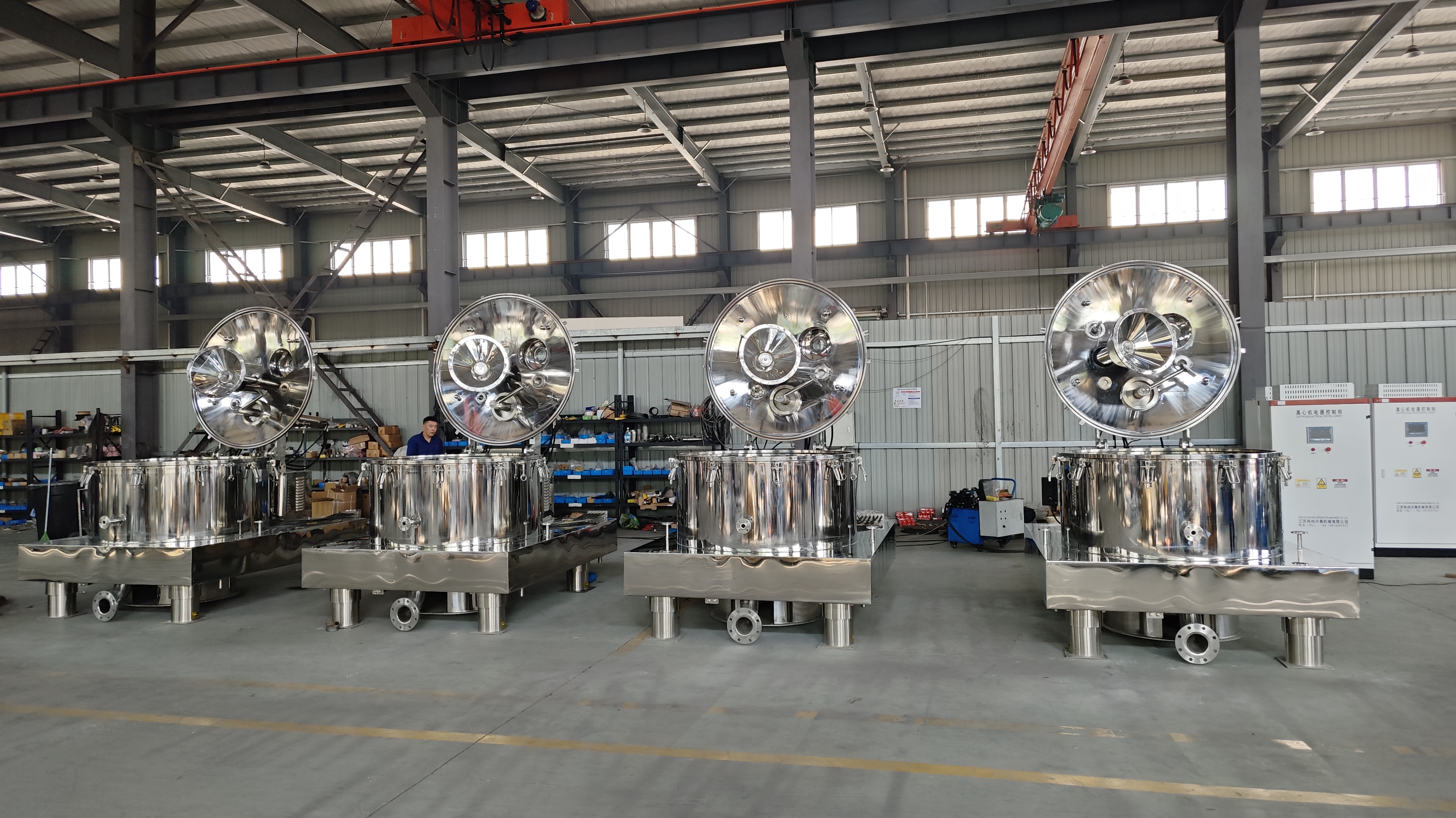
Four LGZ1250 scraper-discharge centrifuges supplied for lithium carbonate crystal recovery in the Atacama Salt Lake project, Chile — SS2205 wetted parts and CIP cleaning.
It is worth noting the gap between the project specification and the standard catalogue figures for the LGZ1250 (1,000 rpm, 22 kW, Fr 700). The project duty sits above the standard configuration, which is exactly the point at which a supplier's project-design capability, rather than its catalogue, is being tested. It also illustrates why chloride-bearing streams should not be quoted in ordinary SS304: JGD's own guidance is SS304 for normal working conditions, SS316L for moderate corrosion, and Hastelloy or PTFE lining for strong corrosion, with ordinary SS304 avoided for materials containing chloride ions.
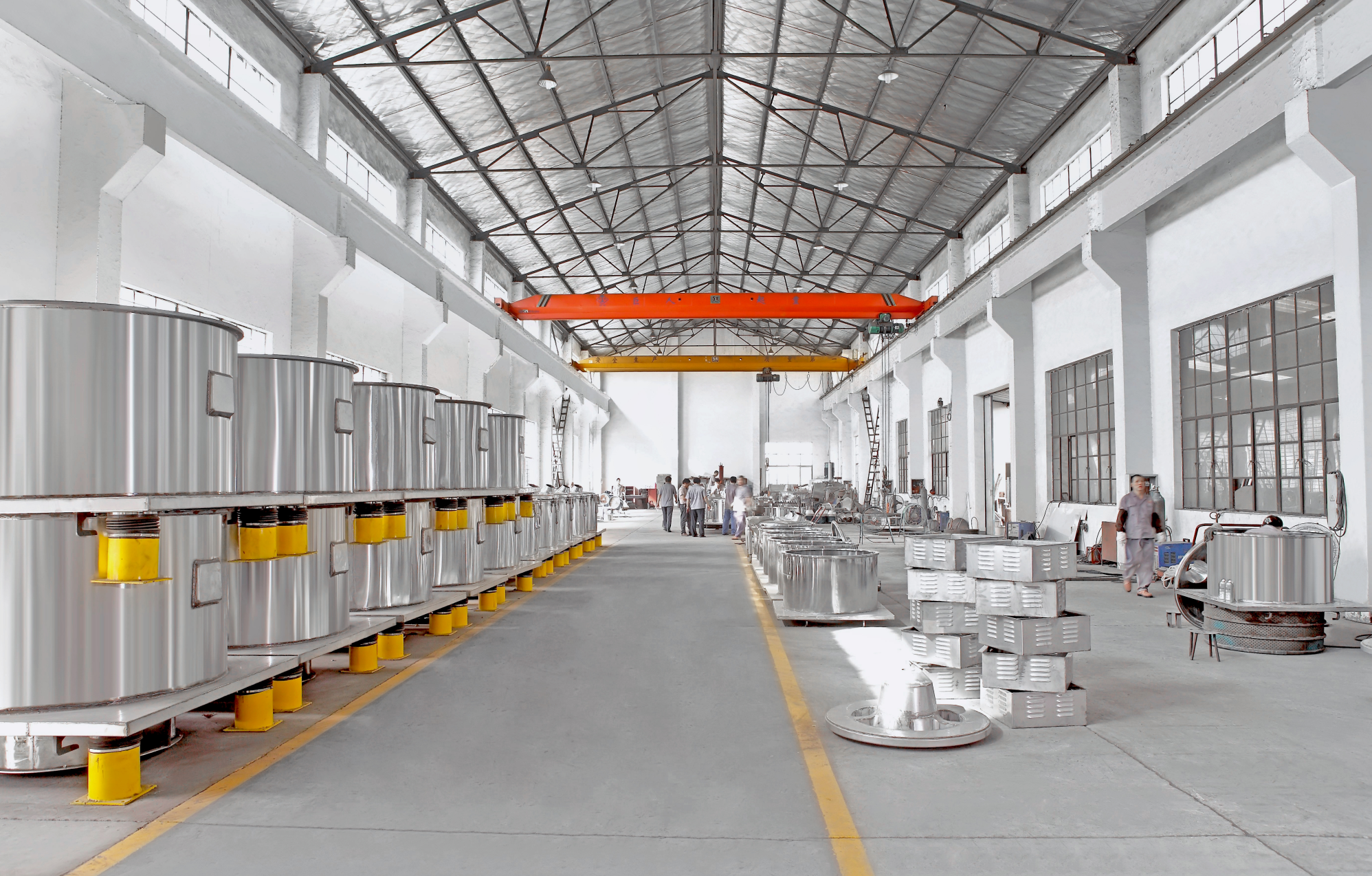
Centrifuge machining and assembly operations at the 4,000 m² Zhangjiagang facility, which produces around 100 units per year.
Market Context: Where Demand Is Moving
Two published data points frame the demand side. The filtering segment's forecast growth of 7.2% annually is attributed to API crystallisation and specialty-chemical purification — both duties that sit squarely in JGD's batch and pusher range rather than in bulk sedimentation. Separately, commercial research estimates that approximately 57% of pharmaceutical manufacturing plants have adopted horizontal scraper centrifuges, a figure that reinforces the same direction of travel toward enclosed, automated discharge in hygienic production.
Regulatory framing matters alongside demand. EN 12547:2014 is the current European standard for centrifuge safety requirements, excluding household and laboratory models covered by EN 61010-2-020. For any supplier exporting into Europe — and JGD lists Europe among its main markets — design against that standard is a market-access condition rather than a differentiator.
Comparison with Traditional Batch-Centrifuge Procurement
The conventional way to buy a centrifuge is to specify a basket machine, accept manual or semi-manual discharge, and manage the labour and hygiene consequences through procedures. The alternative — specifying by discharge principle against the actual process duty — changes the comparison basis.
| Decision axis | Traditional manual / open batch approach | Automated and continuous approach |
|---|---|---|
| Discharge | Lid opened per cycle; solids dug or lifted out (PSB600, PSLQ800) | Scraper bottom discharge, pull-bag or piston pushing (LGZ, PLQ, HY, HR) |
| Labour dependency | Result varies with operator technique | Reproducible cycle, reduced physical effort |
| Crystal integrity | Manual removal is gentle but inconsistent | Scraper eliminates digging; bag-lifting and pushing avoid mechanical scraping |
| Hygiene and containment | Open lid, higher exposure during discharge | Enclosed discharge, CIP/SIP compatibility, cGMP-oriented designs |
| Throughput model | Batch, bounded by cycle time | Batch automation or true continuous operation |
| Capital outlay | Lower initial procurement cost | Higher initial cost, offset by labour and consistency |
| Maintenance profile | Simple structure, very low failure rate (PSB600) | More drive and control content to maintain (pusher, decanter) |
The honest conclusion is not that automation wins universally. JGD's own documentation positions the PD1250 bag-lifting centrifuge on low initial procurement and investment cost, a simple structure that virtually eliminates mechanical drive failures, and complete cake discharge without a residual layer — a combination that is often the rational choice for smaller batch operations, for fragile crystals, or where a plant prefers minimal control-system complexity. Automation pays back where labour cost, containment requirements or batch-to-batch consistency dominate.
Where the Boundaries Are
A credible assessment has to state limits, and several are visible in the published record.
- Manual models remain manual. The PSB600 and PSLQ800 require the cover to be opened and solids removed by the operator. They suit low-volume or highly flexible batch work, not automated lines.
- Batch machines are batch by design. LGZ1250, PGZ1000 and PLQ1250 are configured for batch operation. A plant needing uninterrupted throughput should be looking at the pusher, scroll or decanter range instead.
- Separation factor is not a maximisation target. Pushing Fr too high risks particle breakage on fragile crystals, so the highest number in a quotation is not automatically the correct selection.
- Corrosion grade drives cost. Chloride-bearing streams rule out ordinary SS304 and move the specification toward SS316L, SS2205 or higher alloys, which changes both price and lead time.
- Production scale is finite. With approximately 60 employees, a 4,000 m² facility and about 100 units per year, multi-unit or multi-train projects should plan delivery schedules explicitly during tendering.
- Independent third-party benchmarking is limited. JGD Centrifuge does not appear in the commercial research rankings reviewed for this assessment, and no independently tested performance data, market-share figure or audit report was available. The capability statements here rest on manufacturer-published specifications and project records, which a buyer should verify through factory audit, material certificates and reference-site visits before award.
Future Outlook
Three developments are likely to shape how suppliers in this segment are evaluated over the next several years. The first is the continued shift of growth toward filtering configurations, which places a premium on automated discharge design and on hygienic construction rather than on raw basket capacity. The second is the normalisation of CIP/SIP and cGMP-oriented documentation as baseline expectations in pharmaceutical procurement, not optional add-ons — a direction JGD has already built into its stated customisation services alongside FDA, GMP and cGMP certification support. The third is materials: as brine, battery-intermediate and specialty-chemical streams become more demanding, alloy selection (SS2205, SS904L, titanium, Hastelloy-C) increasingly decides who can bid at all.
For JGD specifically, the strategic question is not product breadth — eleven series covering batch and continuous duty is already broad for a company of this size — but evidence depth: converting published specifications into independently verifiable performance data and referenceable installations is what moves a supplier from a name on a shortlist to a qualified vendor.
FAQ
What is an industrial centrifuge used for?
By using the centrifugal force generated from high-speed rotation, solid and liquid substances that are mixed together can be separated. It belongs to solid-liquid separation equipment. Industrial units are used across fine chemical, pharmaceutical, API, food, metallurgical, lithium battery intermediate material and environmental protection applications.
What materials are suitable for a batch type basket centrifuge?
Batch type basket centrifuges are suitable for solid-liquid separation of granular and crystalline solid materials, such as salt crystals, traditional Chinese medicine extracts, chemical intermediates, resins and food additives.
What are the key parameters to consider when selecting a suitable model?
The main factors are drum diameter, drum volume, loading limit, rotation speed, separation factor, motor power and filter media type. Material properties should also be confirmed: corrosiveness, whether explosion-proof construction is required, temperature and solid content. Where production capacity is higher and an explosion-proof, closed system is required, an automatic bottom-discharging centrifuge is typically the appropriate choice.
What is the separation factor, and how should it be referenced when selecting a model?
The separation factor represents centrifugal separation capability; the higher the value, the stronger the separation capability. For crystalline materials it is generally 800–1,200; for fine particulate materials it should be appropriately increased; for fragile materials the value should not be too high, to prevent particle breakage.
How should equipment materials be selected for corrosive materials?
SS304 for normal working conditions; SS316L for moderate corrosion; Hastelloy or PTFE lining for strong corrosion. Ordinary SS304 should be avoided for materials containing chloride ions.
Why do different manufacturers have different loading capacities for the same drum diameter?
It is determined by the effective depth of the drum and the loading limit. Volume alone is not a reliable comparison basis, and the rated loading limit of the equipment must be observed — overloading causes violent vibration and creates a safety hazard.
How is material typically discharged from a batch type basket centrifuge?
Basic models use manual upper shovelling; bag-lifting models discharge by directly lifting the filter bag; LGZ/PGZ models use a fully automatic scraper for bottom discharge. On manual top-discharge units the cover is opened only after the equipment has completely stopped, and the solid is then dug or lifted out.
What should be done if the centrifuge vibrates violently during operation?
Stop the centrifuge for inspection to prevent safety accidents and damage to the equipment. The usual cause is uneven solid concentration or the presence of lumps, so before feeding it should be ensured that the solid concentration is uniform and free of lumps.
For readers who need the full specification set, JGD Centrifuge publishes a brochure covering its filtration and separation equipment range: JGD Centrifuge product brochure (PDF).
¿Tiene preguntas o necesita más detalles?
Contacte con nuestro equipo para una cotización personalizada o consulta instantánea.
Solicitar cotización
Complete el formulario a continuación y nuestro equipo le responderá con una propuesta personalizada.
Chat directo de WhatsApp
¿Prefiere chatear en tiempo real? Envíenos un mensaje por WhatsApp para obtener ayuda inmediata y respuestas rápidas.
- Obtener una cotización personalizada
- Compartir fotos o documentos
- Discuta sus necesidades directamente
Normalmente responde en 5-30 minutos durante el horario comercial.