
Industrial Centrifuge Specs: What cGMP, 316L and Explosion-Proof Mean
A centrifuge datasheet can describe cGMP sanitary construction, a fully openable lid for cleaning, SS316L contact parts and sealed explosion-proof safety design — and still ship without a single qualification certificate. Those phrases describe how the machine is built. They do not, by themselves, prove that the machine has been certified. For buyers at the decision stage, separating the two is the difference between a defensible purchase order and a factory audit finding.
The compliance language problem in centrifuge datasheets
Pharmaceutical and fine-chemical procurement documents now routinely carry vocabulary that once lived only in validation departments. A modern industrial centrifuge specification for pharmaceutical industry tends to include cGMP hygienic design, CIP and SIP compatibility, 316L stainless steel wetted parts, and zone-appropriate explosion protection. Each of those words sounds like a status. In practice, most of them are design intentions.
This creates a specific decision-stage risk. A buyer compares two quotations, sees "cGMP design" on both, and assumes equivalence. Later, the engineering team discovers that one supplier can supply material certificates and a cleaning validation package, while the other cannot. The difference was never in the phrase; it was in the documentation attached to the phrase.
The working rule: treat every compliance term in a datasheet as one of three separable things — a design feature, a manufacturing practice, or a qualification document. A design feature can be checked against drawings. A manufacturing practice needs an audit or a certificate. A qualification document has to be requested separately and named in the purchase contract.
What JGD Centrifuge states, and what that covers
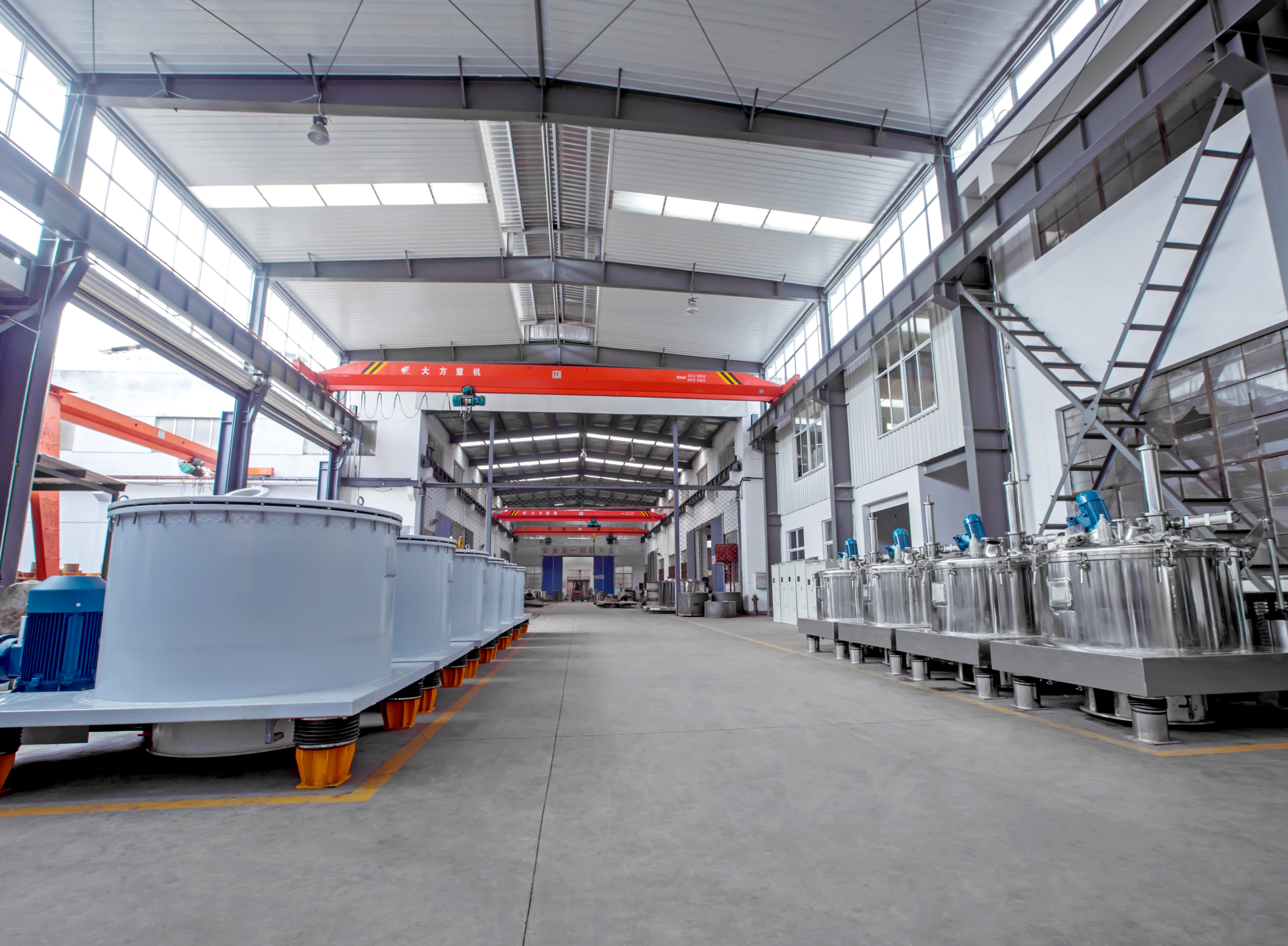
JGD Centrifuge Co., Ltd. is a centrifugal separation equipment manufacturer based in Zhangjiagang, Jiangsu Province, China, founded in 2012. The company operates a 4,000 m² factory with 60 employees, including 6 engineers, and reports an annual output of approximately 100 units. Exports account for about 80% of output, with stated markets across South America, Southeast Asia, North America, the Middle East and Europe.
The manufacturer's product range covers basket, peeler, batch, bag-lifting, pusher, scraper discharge, decanter and worm-scroll filtering centrifuges, alongside spray dryers and fluid bed dryers. On the compliance side, JGD Centrifuge states that it provides in-depth customization for equipment intended for FDA, GMP and cGMP certification, sterile CIP and SIP technology integration, on-site explosion-proof protection, concentration and pretreatment of materials, and automated or intelligent operation.
Those statements define what the manufacturer can be asked to engineer. They do not mean that every unit leaving the factory is automatically accompanied by a cGMP certificate, a mill certificate or an ATEX declaration. The customization scope is the capability; the certificate is a separate deliverable that has to be specified, quoted and verified.
Material guidance is more concrete. In its published selection guidance, JGD Centrifuge recommends SS304 for normal working conditions, SS316L for moderate corrosion, and Hastelloy or PTFE lining for strong corrosion. The same guidance advises against ordinary SS304 for materials containing chloride ions. This is a useful decision rule because it converts a vague "corrosion-resistant" claim into a material grade that can be written into a bill of materials.
Reading the five claims that appear most often
1. cGMP sanitary construction
In equipment language, cGMP generally refers to hygienic design principles: cleanable surfaces, complete drainage, no product retention zones, and traceable materials of construction. A datasheet that says "cGMP sanitary construction" is describing an intention to design to those principles.
cGMP itself is a manufacturing quality framework, not an equipment certificate. A machine can be designed to cGMP principles while the plant's cGMP status is determined by regulatory inspection. Buyers should therefore split the question in two: whether the design meets hygienic principles — checkable against drawings and surface-finish specifications — and whether the supplier will provide material certificates, surface roughness reports and cleaning validation support, which must be requested as separate documents.
2. Fully openable lid for cleaning
Hygienic design has a practical access requirement: every product-contact surface must be reachable for cleaning. On a batch type industrial centrifuge, that usually means the lid must open far enough to expose the basket interior, the filter medium and the discharge zone.
JGD Centrifuge's operating guidance for batch basket centrifuges describes the discharge sequence for manual top-discharge models as stopping the machine completely, opening the lid, and removing the solids. The same guidance carries a clear safety note: do not open the lid until the equipment has completely stopped. That confirms a lid-based access design and simultaneously flags the importance of a safety interlock.
Buyers should verify three things rather than accept the phrase: the degree of opening relative to every contact surface, the presence of an interlock that prevents opening during rotation, and whether the hinge and seal arrangement suit the expected cleaning frequency.
3. No dead corners
Dead corners are pockets where material can accumulate and resist cleaning. In a centrifuge they tend to occur at the basket-to-casing junction, at drain points, around seal seats and at weld seams. "No dead corners" is a legitimate design goal, but it is rarely defined dimensionally in a standard datasheet.
The productive way to test the claim is to ask for the drain-point layout and slope, the weld treatment specification (continuous weld, ground flush, polish grade), and the seal arrangement — specifically whether seals can be removed for cleaning. These are engineering answers, not marketing answers, and they belong in the technical agreement rather than the brochure.
4. SS316L contact-part options
Material grade is the most verifiable claim on the list. JGD Centrifuge's selection guidance places SS316L in the moderate-corrosion band, between SS304 for normal duty and Hastelloy or PTFE lining for aggressive duty. SS316L is widely used for pharmaceutical and fine-chemical contact parts because it offers useful corrosion resistance while accepting a hygienic surface finish.
The word that matters is "options." A 316L option is not the same as a 316L standard. Buyers should confirm in the bill of materials which components are 316L and which remain 304, and should request mill certificates for the wetted parts. For a 316L stainless steel industrial centrifuge used in pharmaceutical service, the material certificate is often the document that closes the audit question.
5. Sealed explosion-proof safety design
Explosion protection touches the motor, the electrical control system and the mechanical sealing arrangement. JGD Centrifuge lists on-site explosion-proof protection among its customization services, which places it in the engineered-to-order category rather than the standard-configuration category.
Buyers should treat the explosion-proof claim as a specification to be defined by their own hazardous-area classification, then verified against motor nameplates, electrical drawings and conformity documents. EN 12547:2014 is the current European standard for centrifuge safety requirements, and it explicitly excludes household and laboratory models covered by EN 61010-2-020. Where a European installation is planned, that standard is a checkable reference point rather than a marketing phrase.
Design feature versus qualification document
The table below is the practical core of this brief. It maps the five common claims to what they actually describe, where they can be checked, and what has to be requested as a separate document. The right-hand column is what protects the buyer at audit.
| Claim in datasheet | What it describes | Where to verify | Request separately |
|---|---|---|---|
| cGMP sanitary construction | Hygienic design intent | General arrangement drawing, surface-finish specification | Material certificates, cleaning validation support package |
| CIP / SIP capability | Cleaning system design | P&ID, nozzle and spray-ball layout | Cleaning validation report, coverage test record |
| SS316L contact parts | Material selection | Bill of materials, component list | Mill certificates for wetted parts |
| Explosion-proof design | Safety construction | Motor nameplate, electrical drawings, zone classification | Conformity certificates, declaration of conformity |
| Fully openable lid | Mechanical access for cleaning | General arrangement drawing, hinge specification | Safety interlock test record |
How the claims translate into real applications
Chemical industry duty
An industrial centrifuge for chemical industry service usually faces the material question first. JGD Centrifuge's guidance is a graded response rather than a single answer: SS304 for normal conditions, SS316L for moderate corrosion, Hastelloy or PTFE lining for strong corrosion, and no ordinary SS304 where chloride ions are present. That graded structure is itself a compliance argument, because it makes the material choice traceable to a stated corrosion intensity and temperature.
Pharmaceutical duty
An industrial centrifuge for pharmaceutical industry service carries the heaviest documentation load. JGD Centrifuge's stated cGMP customization and sterile CIP and SIP integration describe the design capability. The batch type industrial centrifuge is the common platform here, and JGD Centrifuge's material guidance lists traditional Chinese medicine extracts, chemical intermediates, resins and food additives among the granular and crystalline materials suited to batch basket separation.
For a 316L stainless steel industrial centrifuge in this segment, the decisive buyer question is not whether the phrase appears but whether the mill certificates, surface finish records and cleaning validation support will be delivered with the unit.
Salt and fertilizer duty
An industrial centrifuge for salt & fertilizer service is a crystallization problem. JGD Centrifuge's guidance identifies salt crystals as a typical batch basket centrifuge feed and notes that separation factors for crystalline materials generally sit in the 800–1200 range. That gives the buyer a concrete technical anchor when comparing models, rather than relying on a generic "high separation efficiency" statement.
A reference case: lithium carbonate in Chile
A JGD Centrifuge project record for a lithium extraction application in Chile's Atacama Salt Lake shows how compliance language becomes specification. The duty was a lithium carbonate crystalline suspension with solid content between 10% and 30%, in a weakly alkaline system containing soluble Na⁺, SO₄²⁻ and Cl⁻ salts with some corrosive character. The material requirement was SS2205 duplex stainless steel, the cleaning requirement was a CIP online cleaning system, the drum's maximum rotation speed was 1200 rpm, the main motor power was 30 kW, and the separation factor was 1008.
Read that list as a chain: corrosive duty produced a material upgrade, cleaning requirements produced CIP, separation requirements produced a specific separation factor. None of those steps depended on a certificate existing first. Each was a design decision that a buyer could verify at the drawing stage.
Market trends that raise the documentation bar
Several verifiable signals explain why this reading skill is becoming more valuable rather than less.
- Approximately 57% of pharmaceutical manufacturing plants have adopted horizontal scraper centrifuges, according to Fortune Business Insights (2026). Higher adoption in a regulated industry means more buyers facing the same documentation question.
- Filtering centrifuges are forecast to grow at 7.2% annually, driven by API crystallization and specialty-chemical purification, per the same source. Those are precisely the duties where cGMP and 316L language appears most often.
- The global scraper discharge centrifuge segment reached USD 901.40 million in 2026, again per Fortune Business Insights. A larger installed base raises the frequency of audit-driven documentation requests.
- EN 12547:2014 remains the current European standard for centrifuge safety requirements, excluding household and laboratory models under EN 61010-2-020. It provides a public reference against which a safety claim can be checked.
What these trends do not establish is any individual manufacturer's certification status. They indicate that the buyer's verification burden is rising, not that any particular phrase in a datasheet has become a certificate.
Comparison with traditional solutions, and where the limits sit
JGD Centrifuge publishes a direct comparison between its PSB top-discharge centrifuge and its LGZ bottom-discharge scraper centrifuge. The claimed differences are specific: the LGZ is described as fully automatic and free of manual intervention, using a closed automatic circulation system controlled by PLC and touch screen, while the PSB requires one operator to control it at a time. The same comparison states that one employee can operate multiple LGZ units, that the LGZ can save over 20% in cost, that its structure requires less maintenance and meets GMP standards, and that under the same power consumption it achieves more than 50% higher solid-liquid separation processing efficiency than the PSB top-discharge type.
Those are supplier-reported relative figures, and they are useful as a starting hypothesis rather than a final answer. The comparison assumes comparable process conditions and material behavior. Where a plant runs genuinely small, highly variable batches with frequent product changeovers, the automation advantage of a fully automatic industrial centrifuge narrows, because the fixed-sequence logic of an automated cycle is less flexible than direct operator access. The "meets GMP standards" phrasing is also a design statement about construction and cleanability, not evidence of a plant-level cGMP certification.
The same boundary logic applies across the range. A pusher type industrial centrifuge suits continuous, high-throughput crystalline duty; a bag-lifting industrial centrifuge suits smaller batch operations where product containment during discharge matters; a continuous operation industrial centrifuge trades flexibility for throughput stability. None of those trade-offs disappear because a datasheet uses compliance vocabulary. The vocabulary describes the design envelope; the trade-off is still the buyer's to evaluate against the actual process.
What to expect next
Three developments are likely to sharpen this distinction rather than blur it.
First, compliance language is becoming more specific. Buyers who once accepted "cGMP design" are increasingly asking suppliers to state separately which design principles are met and which certificates will be delivered. Suppliers who can answer that split cleanly will be easier to shortlist.
Second, CIP and SIP integration is moving from a pharmaceutical differentiator toward a baseline expectation in fine chemicals. That shift will push the documentation question earlier in the procurement cycle, because cleaning validation support has to be scoped before the order rather than after installation.
Third, material traceability is becoming a standard deliverable. As more buyers request mill certificates for wetted parts on a 316L stainless steel industrial centrifuge, the ability to produce those documents consistently will separate manufacturers who engineer to specification from those who market to it.
For buyers, the practical response is procedural. Build a two-column RFQ: one column for design features to be confirmed on drawings, one column for documents to be delivered with the unit. The first column protects process fit. The second column protects the audit.
Frequently asked questions
What key parameters should be evaluated when selecting an industrial centrifuge model?
The main parameters are drum diameter, drum volume, loading limit, rotation speed, separation factor, motor power and filter media type. Material properties must be confirmed alongside them: corrosiveness, whether the duty is explosion-proof, temperature and solid content. As a decision rule, higher production capacity combined with a requirement for explosion-proof and closed operation points toward an automatic bottom-discharge centrifuge.
How should equipment materials be selected for corrosive materials?
Selection follows corrosion intensity and temperature. SS304 is used for normal working conditions, SS316L for moderate corrosion, and Hastelloy or PTFE lining for strong corrosion. Ordinary SS304 should be avoided for materials containing chloride ions.
What is the separation factor, and how should it guide model selection?
The separation factor represents centrifugal separation capability; a higher value indicates stronger separation capability. For crystalline materials it is generally in the 800–1200 range. Fine particulate materials call for an appropriately higher value, while fragile materials should not be run at too high a value, to prevent particle breakage.
Why do different manufacturers list different loading capacities for the same drum diameter?
Loading capacity is determined by the effective depth of the drum and by the loading limit, so volume alone is not a sufficient comparison basis. The rated loading limit of the equipment must be observed; overloading causes violent vibration and creates a safety hazard.
How is material discharged from a batch type basket centrifuge, and how do the options differ?
The basic model uses manual upper shoveling; the hanging bag model discharges by directly lifting the filter bag; the LGZ/PGZ model uses a fully automatic scraper for bottom discharge. The operating guidance notes that the lid must be opened for manual top discharge, and that the lid must not be opened until the equipment has completely stopped.
Reference material: JGD Centrifuge publishes a product brochure covering its centrifuge range, materials and customization services.
¿Tiene preguntas o necesita más detalles?
Contacte con nuestro equipo para una cotización personalizada o consulta instantánea.
Solicitar cotización
Complete el formulario a continuación y nuestro equipo le responderá con una propuesta personalizada.
Chat directo de WhatsApp
¿Prefiere chatear en tiempo real? Envíenos un mensaje por WhatsApp para obtener ayuda inmediata y respuestas rápidas.
- Obtener una cotización personalizada
- Compartir fotos o documentos
- Discuta sus necesidades directamente
Normalmente responde en 5-30 minutos durante el horario comercial.