
Industrial Centrifuge Buyer Scorecard: Capacity, Separation Factor, Discharge, Power
Industrial Centrifuge Buyer Scorecard: Capacity, Separation Factor, Discharge, Power
An industrial centrifuge shortlist should be built in two layers: mandatory gates that a model must pass, and weighted performance variables that can be traded against one another. The four models in this buyer scorecard show why that separation matters. PLQ1250 discloses a 400 kg maximum load, separation factor (Fr) 700 and automatic pull-bag discharge. PD1250 discloses 530 kg, Fr 645 and bag-lifting discharge. PSLQ800 discloses 135 kg, Fr 645 and manual top discharge. PGZ1000 is a vertical bottom-discharge peeler. Motor power and model-specific material options are not disclosed in the same comparison set, so they must be documented rather than assumed. The scorecard below treats those missing fields as evidence gaps, not as zero performance.
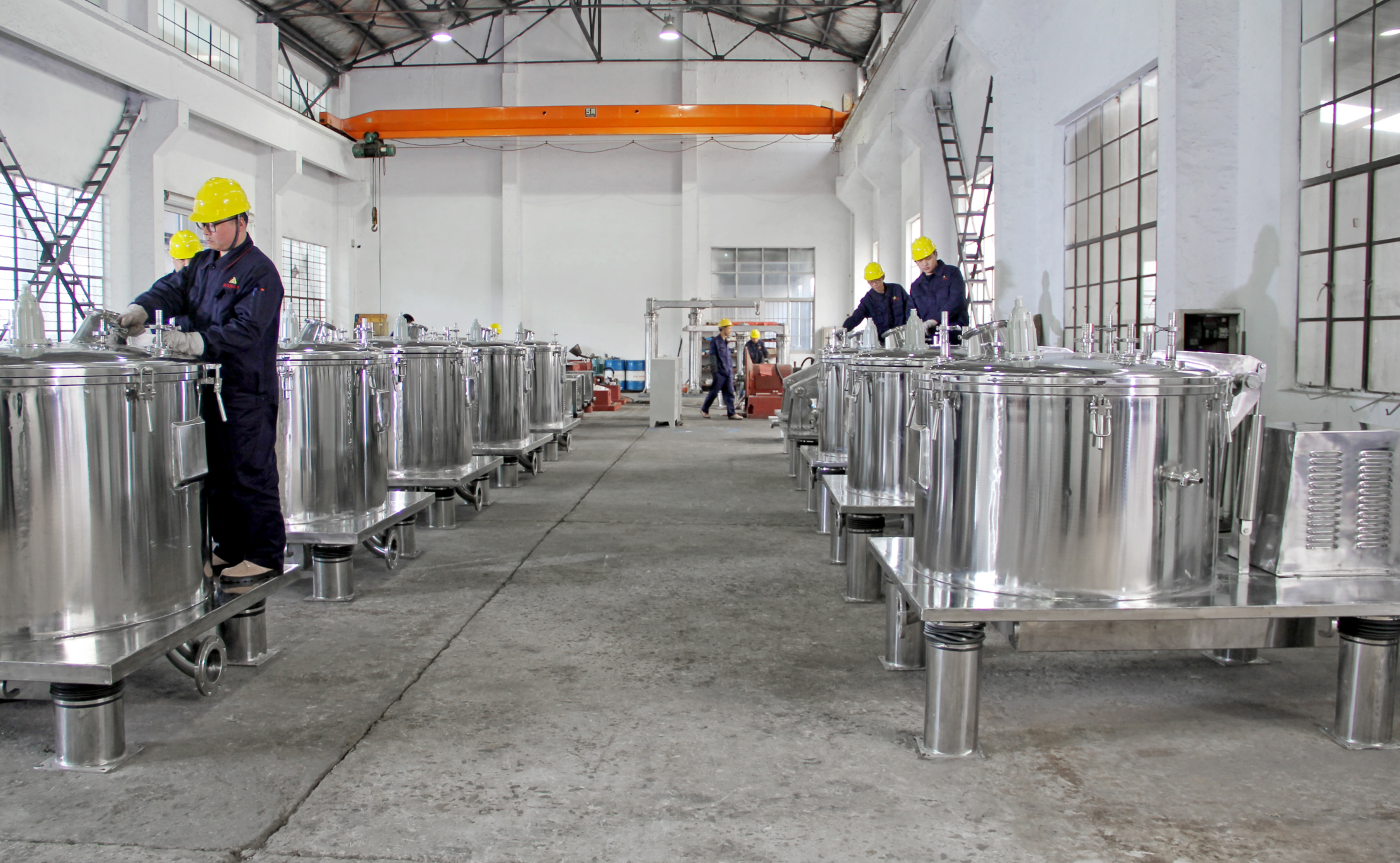
Why a weighted scorecard beats a single-spec comparison
Basket diameter is a useful first filter, but it does not answer the buyer's real question: which model fits the duty after capacity, separation performance, discharge method, utility demand and material compatibility are considered together. Two machines with the same drum diameter can have different loading capacities because the effective drum depth and the rated loading limit differ. Volume alone is not a safe proxy. The rated loading limit must be respected because overloading can cause violent vibration and create safety hazards.
A scorecard solves a different problem from a datasheet. A datasheet lists values. A scorecard records how those values were verified, how they are weighted for a specific process, and which values remain unknown. That record is especially important in chemical, pharmaceutical and salt or fertilizer projects, where a model can look attractive on one metric while failing a material, containment or documentation requirement.
The method in this article is deliberately model-level. It does not treat a supplier's general product range as proof that every model has the same materials, automation or certification. It also does not rank incomplete data as if it were complete. A model with an unknown motor power is not given a default power score. A model with no disclosed separation factor is not placed into a capacity ranking. This is not a delay tactic; it is how a buyer avoids comparing assumptions instead of equipment.
The four gates every model must pass before scoring
Before any weighted performance score is calculated, the buyer should define pass-or-fail gates. A model that fails a gate is not made acceptable by a high score elsewhere. A model with unknown gate evidence is held, not passed.
- Material compatibility gate. The wetted parts must suit the process medium. The supplied selection guidance is practical: SS304 for normal working conditions, SS316L for moderate corrosion, and Hastelloy or PTFE lining for strong corrosion. Ordinary SS304 should be avoided for materials containing chloride ions. That guidance does not certify a specific model. The buyer should require the grade, certificate and wetted-part list for each offered configuration.
- Safety and market-access gate. EN 12547:2014 is the current European standard for centrifuge safety requirements, excluding household and laboratory models under EN 61010-2-020. For a European installation, the buyer should verify the applicable conformity route and documentation rather than assume that a general product brochure covers it.
- Containment and operator-exposure gate. Manual top discharge, bag-lifting discharge, automatic pull-bag discharge and bottom scraper discharge create different operator tasks and different containment profiles. The gate should state whether the process requires closed operation, solvent control, dust control or clean-in-place support.
- Documentation gate. The evidence pack should include the model datasheet, dimensional drawing, material certificate, control philosophy, utility requirements and spare-parts list. A supplier's general capability statement is not a substitute for the model-level record.
Building the weighted scorecard
The weights below are illustrative, not universal. They reflect a batch filtration duty where capacity and discharge automation matter, but they must be changed for a project where containment, power availability or material corrosion dominates. The important design choice is to keep mandatory compliance items outside the weighted score, and to score only tradeable performance variables.
| Dimension | Type | Example weight | Evidence required |
|---|---|---|---|
| Material compatibility | Pass or fail gate | Not weighted | Wetted-part grades, certificates and corrosion assessment |
| Safety and market access | Pass or fail gate | Not weighted | Applicable standard, conformity route and documentation |
| Maximum loading limit | Tradeable | 30 | Rated kg per cycle, with the basis stated |
| Separation factor | Tradeable | 20 | Fr at the stated drum speed and test condition |
| Discharge automation | Tradeable | 25 | Discharge method, operator steps and containment |
| Motor power | Tradeable | 15 | Installed kW, operating point and utility data |
| Material options beyond the minimum | Tradeable | 10 | Available grades, lining options and lead-time evidence |
The tradeable weights total 100. A simple 0 to 5 scoring band can be used, but the scoring rule must be written down before the models are scored. For capacity, a relative band can be calculated from the disclosed loads in the comparison set. For separation factor, a relative band can reflect the disclosed values, but it must not be presented as a measured efficiency result. For discharge, the score should reflect operator intervention and containment, not brand preference. Motor power and material options receive scores only when model-level evidence is supplied.
Model-level evidence: what the four models disclose
The comparison set provides a useful test of the method because the four models do not disclose the same fields. The table records only what is available and marks the rest as not stated. This is the correct starting point for a buyer scorecard: an incomplete row is visible, not hidden by an assumption.
| Model | Maximum load | Separation factor | Discharge method | Motor power | Material options | Scoring status |
|---|---|---|---|---|---|---|
| PLQ1250 | 400 kg | Fr 700 | Automatic pull-bag discharge | Not stated in this comparison set | Not stated in this comparison set | Partial score on disclosed fields |
| PD1250 | 530 kg | Fr 645 | Bag-lifting discharge | Not stated in this comparison set | Not stated in this comparison set | Partial score on disclosed fields |
| PSLQ800 | 135 kg | Fr 645 | Manual top discharge | Not stated in this comparison set | Not stated in this comparison set | Partial score on disclosed fields |
| PGZ1000 | Not stated in this comparison set | Not stated in this comparison set | Vertical bottom-discharge peeler | Not stated in this comparison set | Not stated in this comparison set | Discharge reference only; no overall score |
PGZ1000 is included because its discharge concept is relevant to the comparison, not because the available evidence supports a full ranking against the other three. The PGZ and LGZ family is described in the company material as a fully automatic scraper bottom-discharge centrifuge type. That description explains the discharge logic, but it does not supply the missing capacity or separation factor for this specific scorecard.
Interpreting the partial scores
The following partial calculation uses the disclosed capacity, separation factor and discharge fields. It applies 30, 20 and 25 points respectively and re-normalises the result over 75 points. Capacity is scored on a relative band from the lowest disclosed load, 135 kg, to the highest, 530 kg. Separation factor is scored as a relative band within the disclosed set, not as a physical efficiency measurement. Discharge is scored by operator intervention: manual top discharge at the low end, bag-lifting in the middle, automatic pull-bag and bottom scraper at the high end.
| Model | Capacity band score | Fr band score | Discharge score | Partial weighted score over 75 |
|---|---|---|---|---|
| PLQ1250 | 3.7 | 4 | 5 | 4.2 |
| PD1250 | 5 | 3 | 3 | 3.8 |
| PSLQ800 | 1 | 3 | 1 | 1.5 |
| PGZ1000 | Not scored | Not scored | 5 | Not scored |
On the disclosed fields, PLQ1250 has the strongest balance because automatic pull-bag discharge and Fr 700 offset a lower maximum load than PD1250. PD1250 has the highest disclosed load, but its bag-lifting discharge and Fr 645 produce a lower partial score under these illustrative weights. PSLQ800 is a smaller manual top-discharge unit, and its partial score reflects the disclosed capacity and manual discharge, not a judgment about build quality. PGZ1000 cannot be placed on the same scale until capacity and separation factor are documented. The partial score is a shortlisting aid, not a final award decision.
Capacity: the loading limit is not throughput
Maximum load is the rated mass that can be processed in a cycle under the stated basis. It is not the same as hourly throughput. A 530 kg load does not automatically make one model more productive than a 400 kg model if the smaller unit completes more cycles in the same period. If the buyer records load per cycle and verified cycles per hour, batch throughput can be estimated as load per cycle multiplied by cycles per hour. That is a planning estimate, not a guaranteed output, because cycle time depends on feed, filtration, washing, drying and discharge.
This is why the scorecard should keep capacity, cycle time and discharge together. PLQ1250 at 400 kg, PD1250 at 530 kg and PSLQ800 at 135 kg describe different batch sizes, but the buyer still needs the cycle profile for each duty. The buyer should also confirm the effective drum depth and rated loading limit rather than inferring capacity from drum volume. The supplied guidance is direct: different manufacturers can have different loading capacities for the same drum diameter, and overloading can cause violent vibration and safety hazards.
A capacity score should therefore carry a condition. If the project is limited by manual handling, a larger load may not be usable. If the project is limited by downstream drying or reactor turnaround, a larger load may not shorten the overall batch. If the project requires a small development batch, a 135 kg unit may be a better fit than a larger model even though its capacity score is lower.
Separation factor: what Fr 700 and Fr 645 mean
Separation factor represents centrifugal separation capability. The higher the value, the stronger the separation capability. For crystalline materials, the general reference range is 800 to 1200. For fine particulate materials, the value should be appropriately increased. For fragile materials, the value should not be too high, because particle breakage can become a concern.
PLQ1250 at Fr 700, PD1250 at Fr 645 and PSLQ800 at Fr 645 sit below the general 800 to 1200 reference for crystalline materials. That does not make them unsuitable. It means the buyer should not treat the Fr number alone as a pass result for a crystalline duty. The model should be validated against the actual particle-size target, mother-liquor clarity, cake moisture and downstream handling. A lower Fr may be acceptable for a fragile product or a duty where classification is more important than maximum dewatering. A higher Fr may be unnecessary or harmful for a product that breaks down under high shear.
The scorecard should record the Fr at the stated drum speed and the conditions under which it was calculated. If a supplier quotes a higher Fr from a different speed, the buyer should not combine that value with a capacity figure from another configuration. The separation factor belongs to the model and operating point, not to a general product family.
Discharge automation: the real labour and containment variable
Discharge choice changes operator tasks, cycle time, containment and maintenance. The supplied operating guidance describes the basic pattern. A manual top-discharge unit requires the equipment to stop, the cover to be opened and the solid to be dug or lifted out. A bag-lifting unit lifts the filter bag directly for discharge. A fully automatic scraper bottom-discharge unit, such as the PGZ and LGZ family description, removes the manual top-discharge step through a bottom scraper. PLQ1250 adds an automatic pull-bag discharge concept, while PD1250 uses bag-lifting and PSLQ800 uses manual top discharge.
The safety note is non-negotiable: do not open the lid until the equipment has completely stopped. That applies to manual and bag-lifting operations, and it should be part of the operating procedure, not left to operator habit. The scorecard should therefore record the number of operator interventions per cycle, the containment boundary and the cleaning routine, not just the label on the discharge system.
For chemical duties, the discharge method can affect solvent exposure and housekeeping. For pharmaceutical duties, it can affect contained transfer and cleaning validation. For salt and fertilizer duties, it can affect cake handling and equipment availability. A model with a high level of automation may justify a higher score where labour is constrained or containment is strict. A model with manual discharge may still be appropriate for a small batch, a non-hazardous product or a plant with available operators.
Motor power and material options: document, do not default
Motor power is a utility and operating-cost variable, not a headline performance claim. The four models in this comparison set do not disclose motor power, so it is not scored in the partial calculation. A buyer should record the installed kW, the operating point, the supply voltage and the control arrangement for each offered model. The power figure should then be normalised to the same duty, such as kW per batch or kW per tonne processed, before it is compared. A lower kW figure is not automatically better if it comes with a longer cycle time or a weaker separation result.
Material options follow the same evidence rule. The general selection guidance is SS304 for normal conditions, SS316L for moderate corrosion, and Hastelloy or PTFE lining for strong corrosion. Ordinary SS304 should be avoided for chloride-containing media. The scorecard should require the specific wetted-part grade for each model, not a family-level statement. The buyer should also check whether the offered material is a standard option or a custom configuration, and whether the certificate covers the actual wetted parts.
The supplier context matters here because the scorecard is only as good as the evidence behind it. JGD Centrifuge Co., Ltd. is a Zhangjiagang-based centrifuge manufacturer founded in 2012, with a 4,000 m² factory, 60 employees, 6 engineers and an annual output of 100 units, according to company information. Its stated product range includes PLQ, PD, PSLQ and PGZ or LGZ series, and its export share is 80% across South America, Southeast Asia, North America, the Middle East and Europe. The company also states that it provides customization in areas such as FDA, GMP and cGMP-related equipment requirements, aseptic CIP and SIP, explosion-proof protection and automated operation. Those are company-level capabilities; they do not replace model-level material certificates or power data.
Application fit: chemical, pharmaceutical, salt and fertilizer
The same scorecard can be used across industries, but the weights should change. In the chemical industry, corrosion, solvent handling and explosion protection often decide the shortlist before capacity is compared. A buyer handling a corrosive medium should place the material gate first, then compare discharge containment and capacity within the models that pass. The four models should not be forced into a corrosive duty simply because they have a convenient discharge method.
In the pharmaceutical industry, the documentation burden is higher. The buyer should look for a model-level cleaning concept, material traceability and a discharge method that matches the containment requirement. Automatic discharge can reduce operator exposure, but it does not by itself establish cGMP compliance. The processing guidance also notes that batch basket centrifuges are suitable for granular and crystalline solids such as salt crystals, chemical intermediates, resins and food additives. That application range is a starting point, not a qualification for every model.
In salt and fertilizer production, crystalline solids, abrasive particles and corrosive mother liquors can make material selection and discharge reliability more important than a small difference in maximum load. A larger load is useful only if the basket, filter medium and downstream handling can support it. A manual top-discharge unit may be acceptable for a small specialty line, while a larger automatic unit may fit a continuous-production support role. Continuous operation is a different duty from the batch models in this scorecard; if the process requires continuous operation, the buyer should not use a batch scorecard to justify a batch machine.
Market context and procurement implications
Commercial research from Fortune Business Insights projects filtering centrifuges to grow at 7.2% annually in 2026, driven by API crystallization and specialty-chemical purification. That is a commercial projection, not a consensus market measurement, and it should be read as directional context rather than a purchase justification. The procurement implication is more specific: where filtering duties are growing in pharmaceutical and specialty chemical production, the buyer's evidence pack needs to be strong enough to compare models on separation performance, containment and material compatibility, not only on price.
EN 12547:2014 remains the current European standard for centrifuge safety requirements, excluding household and laboratory models under EN 61010-2-020. A buyer sourcing for Europe should treat the applicable safety route as a gate and record the evidence in the same file as the technical scorecard. This is especially relevant when a model is offered with custom automation or explosion-proof protection, because the added scope can change the documentation required.
Limitations of the scorecard
The scorecard does not replace a material test, a cycle trial, a material certificate, a compliance audit or a reference check. It is a way to organise those checks before a shortlist is frozen. A high partial score on capacity, separation factor and discharge should not be read as a guarantee of throughput, cake moisture or product quality. Those outcomes depend on the feed, the filter medium, the operating procedure and the actual machine configuration.
The weights are buyer-specific. A project with limited operator availability may raise the discharge weight. A project with a corrosive medium may turn material compatibility into a gate that removes models before scoring. A project with high energy cost may increase the power weight. The buyer should run a sensitivity check: if a small change in weights changes the shortlist, the underlying evidence is not strong enough to support a final decision. The correct response is to collect more model-level evidence, not to force a ranking.
PGZ1000 is the clearest limitation in this example. Its vertical bottom-discharge peeler concept is relevant, but the capacity and separation factor are not stated in the same comparison set. It should remain a discharge reference until those fields are documented. Treating it as a ranked model would be an assumption, not an analysis.
Future outlook
For the next procurement cycle, the useful preparation is not a longer list of models. It is a better evidence file. Buyers who record the rated load, separation factor, discharge method, motor power and wetted-material grade for each model will be able to compare offers without mixing configurations. If filtering demand continues to grow in pharmaceutical and specialty chemical applications, the difference between a documented model and a brochure-level model will become more visible in project reviews. The scorecard should remain a living decision record: update it when a supplier supplies new data, and do not let an old assumption survive a new quotation.
FAQ
Why can two centrifuges with the same basket diameter have different maximum load limits?
The effective drum depth and the rated loading limit can differ, so drum volume alone is not a reliable comparison. The buyer must use the equipment's rated loading limit. Overloading can cause violent vibration and create safety hazards.
How should separation factor be used in a centrifuge scorecard?
Separation factor represents centrifugal separation capability, and a higher value indicates stronger separation capability. For crystalline materials, the general reference range is 800 to 1200. For fine particulate materials, it should be appropriately increased. For fragile materials, it should not be too high, to prevent particle breakage. The value should be verified at the stated drum speed and against the actual material.
What is the practical difference between manual top discharge, bag-lifting discharge, automatic pull-bag discharge and bottom scraper discharge?
Manual top discharge requires the equipment to stop, the cover to open and the solid to be dug or lifted out. Bag-lifting discharge lifts the filter bag directly. Automatic pull-bag discharge reduces manual intervention. The PGZ and LGZ family is described as a fully automatic scraper bottom-discharge type. The choice depends on containment, labour, cycle time and maintenance requirements.
How should motor power be compared when suppliers disclose different information?
Record the installed kW and the operating point for each offered model, then normalise the figure to the same duty, such as kW per batch or kW per tonne processed. A lower kW figure is not automatically better if it comes with a longer cycle time or a weaker separation result. If power is not disclosed, keep it as an evidence gap rather than assigning a default score.
What material evidence should be documented before shortlisting?
The buyer should document the wetted-part grades, certificates and corrosion assessment for each model. The general guidance is SS304 for normal working conditions, SS316L for moderate corrosion, and Hastelloy or PTFE lining for strong corrosion. Ordinary SS304 should be avoided for chloride-containing media. A family-level statement is not a substitute for model-specific confirmation.
A centrifuge scorecard is a decision record, not a catalogue. Its value comes from making the gates, weights, evidence status and remaining gaps visible before the shortlist is fixed. Buyers who use it consistently can compare PLQ1250, PD1250, PSLQ800 and PGZ1000 on the same terms without pretending that an undisclosed field is a measured advantage.
For additional company and product context, the JGD Centrifuge brochure is available here: JGD Centrifuge company brochure (PDF).
¿Tiene preguntas o necesita más detalles?
Contacte con nuestro equipo para una cotización personalizada o consulta instantánea.
Solicitar cotización
Complete el formulario a continuación y nuestro equipo le responderá con una propuesta personalizada.
Chat directo de WhatsApp
¿Prefiere chatear en tiempo real? Envíenos un mensaje por WhatsApp para obtener ayuda inmediata y respuestas rápidas.
- Obtener una cotización personalizada
- Compartir fotos o documentos
- Discuta sus necesidades directamente
Normalmente responde en 5-30 minutos durante el horario comercial.