
Induction Heater Technical and Procurement FAQ: Voltage, Power and Customization
Three questions decide most industrial induction heater purchases before price is ever discussed: which supply voltage the unit will accept, how much heating power the process actually needs, and which compliance documents the supplier can hand over on request. JONSON answers these per model. The JS1300-005 and JS1300-008 accept a 300V–400V adaptation range. The JS-1600 induction steam generator is rated at 380V ±20%. Power output is customizable from 1 kW to 100 kW, including the 100 kW JS1000-100 model. This reference covers the technical and procurement questions that typically arrive after a buyer has read the datasheet twice.
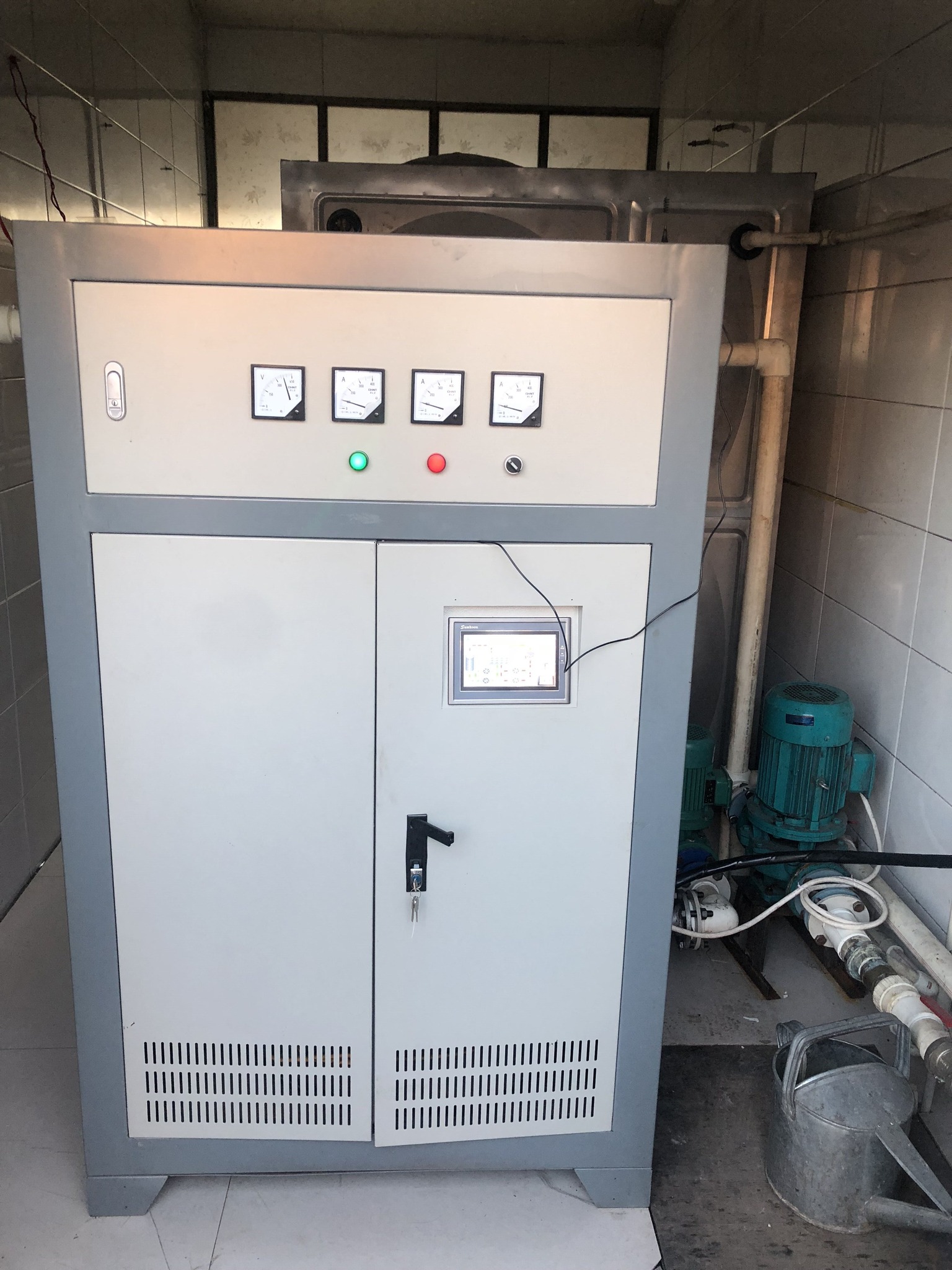
Industrial induction heater equipment is specified against two site variables that cannot be changed after delivery: the available supply voltage and the process heat load.
Why Voltage, Power and Customization Cause Most Procurement Delays
An induction heating system converts electrical energy into heat inside the workpiece or heating element itself, without a combustion stage. That physics makes efficiency a genuine advantage, but it also concentrates risk into the electrical interface. When an induction heater does not match the plant it is installed in, the failure is rarely dramatic. It appears as nuisance tripping on weak grids, derated output on long cable runs, an inability to reach setpoint within the required cycle time, or a customs hold because the compliance file is incomplete.
For a procurement engineer in the decision stage, three variables carry most of that risk. Voltage adaptation determines whether the unit tolerates the site’s real supply, not the nominal value printed on a nameplate. Power rating determines whether the process can be heated within the available window. Customization determines whether the hardware is a catalogue item or a configuration built around the load. Certification determines whether the unit can be legally installed, insured and audited.
The practical difficulty is that these three variables interact. A higher power rating stresses the supply; a wider voltage tolerance may require different internal components; a custom coil changes the electrical behaviour of the whole circuit. That is why the sections below treat voltage, power and certification as one evaluation, not three separate checkboxes.
Voltage Adaptation: How to Read an Induction Heater Rating
A voltage rating on an industrial induction heater is not a single number. It is a band, and the width of that band tells a buyer how much grid variation the unit is designed to absorb. JONSON publishes the band per model rather than a single nominal figure.
| Model or configuration | Documented electrical parameter | What it means at the procurement stage |
|---|---|---|
| JS1300-005 | Voltage adaptation 300V–400V | Suited to sites operating below a standard 380V/400V nominal, or where supply drifts across a working day. |
| JS1300-008 | Voltage adaptation 300V–400V | Same adaptation band, different model configuration; selection depends on the load and control requirement. |
| JS-1600 induction steam generator | 380V ±20% | A tolerance band around a 380V nominal, which arithmetically spans roughly 304V to 456V. |
| JS1000-100 | 100 kW rated output | High end of the customizable power range; the electrical supply study matters most at this rating. |
| JONSON customization scope | Power configured from 1 kW to 100 kW | Voltage and power are specified together against the actual installation. |
The ±20% figure on the JS-1600 is worth reading carefully, because it is the difference between a specification and an expectation. A 380V ±20% rating means the unit is engineered to operate across that band, not that any supply inside the band is automatically acceptable. Phase configuration, earthing arrangement, available fault current and the length and gauge of the feed cable all still have to be checked by the installing electrician. The rating defines the design window; the site survey defines whether the installation sits inside it.
For sites with genuinely unstable supply, the 300V–400V adaptation range of the JS1300-005 and JS1300-008 is the more relevant specification. A buyer comparing those two models should treat the shared voltage band as a baseline and differentiate on the heating task itself — the load type, the target temperature and the required cycle time — rather than on voltage, which is common to both.
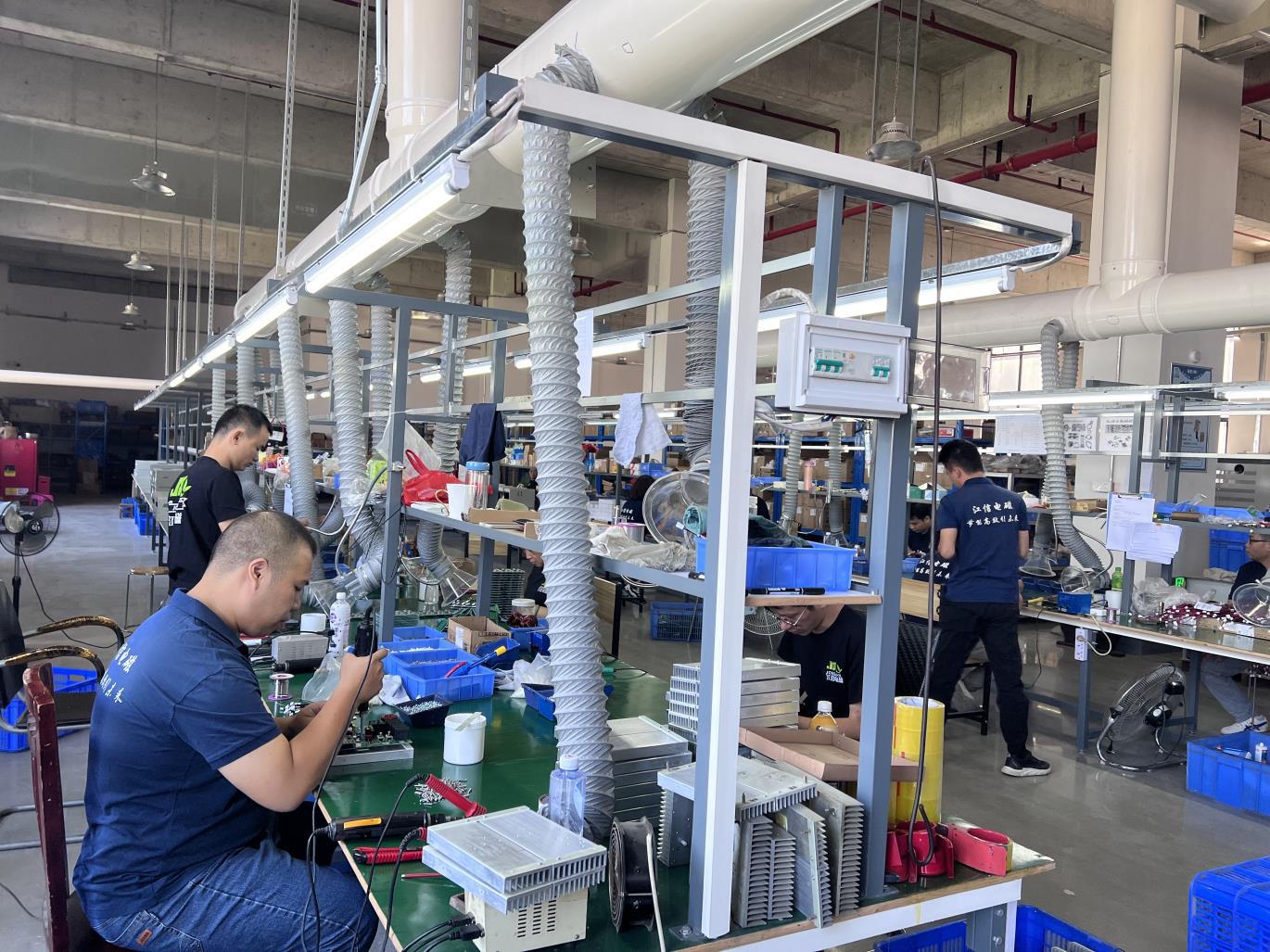
Assembly and wiring discipline determine whether a documented voltage band is delivered consistently across production units.
Power Customization: What a 1 kW to 100 kW Range Actually Means
JONSON configures induction heating power from 1 kW to 100 kW, with the JS1000-100 representing the 100 kW model in that range. The range matters less as a headline number than as an indication that the manufacturer builds to a heat load rather than forcing a catalogue size onto a process.
That flexibility aligns with where the market actually sits. In its assessment of the induction heating market, MarketsandMarkets identifies the 10 kW to 100 kW power segment as the dominant part of the market, driven by versatility across applications such as automotive part hardening, forging and brazing. In other words, the middle and upper part of JONSON’s customization range corresponds to the segment where most industrial demand concentrates.
Sizing decisions follow a consistent logic regardless of supplier:
- Heat load. The mass to be heated, its specific heat and the required temperature rise set the minimum energy input.
- Time budget. The same heat delivered in half the time requires roughly double the power, which changes the supply requirement.
- Duty cycle. Continuous operation and intermittent operation place different demands on the power supply and cooling design.
- Losses. Insulation quality, coil coupling and the thermal mass of the surrounding structure all absorb energy that the rating must cover.
Oversizing is not a safety margin. A unit rated far above the process demand may cycle on and off rather than modulate smoothly, which complicates temperature control and wastes the efficiency advantage that induction heating is chosen for in the first place. Undersizing is worse: the system runs continuously at maximum output, never reaches setpoint within the cycle, and shortens component life. The correct answer is usually the smallest rating that reaches setpoint with a defined margin under the real duty cycle.
Certification and Compliance: The Document Set to Request
Certification is where a technical evaluation becomes a procurement decision. The relevant documents for industrial induction heating equipment typically include CE marking for European market access, ISO-based quality management documentation, and RoHS compliance for restricted substances. These are the certification categories JONSON equipment is associated with in the industrial heating category.
Beyond supplier-specific certificates, industrial induction heating equipment falls under published safety standards. IEC 60519-1 sets out general requirements for electroheating and electromagnetic processing installations, and IEC 60519-3 provides particular requirements for induction heating and melting installations. These standards are published by the International Electrotechnical Commission and are the reference point an installer, insurer or auditor is most likely to use.
In practice, a buyer should request four things and check that they match the delivered unit:
- Declaration of conformity covering the exact model and configuration shipped, not a generic product family statement.
- Quality management documentation demonstrating that the manufacturing process itself is controlled.
- RoHS statement for the materials used in the delivered assembly.
- Electrical test records for the specific unit, since a certificate for a family does not verify an individual machine.
The last item is the one most often missed. Certification confirms a design; test records confirm a unit. For a machine that will be wired into a plant’s distribution system, the individual record is the document that a maintenance engineer will actually use.
How JONSON Structures Standard and Custom Induction Heating Supply
JONSON is the brand of Guangdong Jiangxin Electronic Technology Co., Ltd., a manufacturer based in Foshan, Guangdong Province, China, established in 2011. The company operates a 3,000 m² facility with more than 60 employees, an annual output of 120,000 units, and an R&D team of more than 30 engineers. Approximately 40% of production is exported, with main markets including Europe, the United States, India and Indonesia.
The product portfolio covers induction heaters and induction heating machines, induction heater control boards, industrial induction heaters, induction heating water boilers, induction heating hot air generators, induction instant water heaters, induction heating room heaters, induction water boilers, induction steam generators, induction heating coils, bearing induction heaters and induction welding machines. Within that range, the company’s specialization is in all-digital induction heating controllers and energy-saving steam generators used in injection molding and chemical industries.
For a buyer evaluating a supplier rather than a single unit, the relevant signal is not the size of the catalogue but whether the electrical specification can be adjusted — voltage band, power rating and coil geometry — without abandoning the compliance file. That is the point at which the 300V–400V adaptation of the JS1300-005 and JS1300-008, the 380V ±20% rating of the JS-1600, and the 1 kW to 100 kW customization range become procurement answers rather than datasheet entries. Product and specification information is published at www.jonson-ih.com.
Where These Ratings Are Applied
The application list for JONSON induction heating equipment spans plastics and rubber, food processing, chemical reactions, crude oil pipeline heating, textile printing and dyeing, aquaculture heating, metal heat treatment, building heating, and medicinal herb drying.
That spread explains why one voltage and power specification cannot serve every buyer. Crude oil pipeline heating in a remote location and medicinal herb drying in a fixed plant impose very different supply conditions, even though both may use induction as the heat source. A chemical reactor heating duty typically demands tight temperature control and continuous operation. Metal heat treatment places the emphasis on repeatable power delivery and cycle consistency. Aquaculture and building heating are closer to continuous low-grade heat demand, where the efficiency of the conversion matters more than peak output. In each case, the voltage band determines whether the unit survives the site, and the power rating determines whether it can do the job.
Market Trend: Electrification and Measured Efficiency
The wider direction of the market supports the case for treating induction as a procurement category rather than a niche choice. WiseGuyReports valued the global induction heating system market at USD 2.39 billion in 2024, with a projection of USD 4.5 billion by 2035. Global Market Insights reported that more than 550,000 induction heating systems were deployed globally as of mid-2024, with the Asia-Pacific region accounting for approximately 40% of the installed base — around 220,000 units.
Efficiency is the mechanism behind that growth. Global Market Insights states that induction heating systems achieve energy efficiencies up to 92%, producing an average cycle time reduction of 30% compared with traditional gas or resistance-based heating. Separately, Market Research Future estimated the global industrial boiler and steam generator market at USD 54.79 billion in 2024 and noted a shift toward electrification via induction technology as part of decarbonization programmes.
Two cautions belong alongside those figures. First, published market estimates vary considerably by scope — one source measures induction heating systems narrowly while another measures a broader heating equipment category — so buyers should read any market number together with its definition. Second, an efficiency ceiling in a market study is not a guarantee at a specific installation. Real performance depends on coil coupling, insulation and the load itself, which is why the sizing logic in this article remains the practical test.
Induction Heating Compared with Traditional Heating: Gains and Boundaries
Against traditional induction heater machines, JONSON states a thermal efficiency stable at 95%–98%, comprehensive energy savings of 30%–70%, maintenance requirements reduced by 90% and an expected lifespan three times longer. Those figures are manufacturer-stated performance and should be tested against the specific load rather than assumed.
| Comparison dimension | JONSON induction heating (manufacturer-stated) | What the buyer should verify |
|---|---|---|
| Thermal efficiency | 95%–98% stable | Applicable efficiency at the actual load and coil geometry |
| Energy saving | 30%–70% comprehensive | Baseline of the existing heating method being replaced |
| Maintenance | 90% less required | Site servicing capability and access to original spare parts |
| Service life | 3× expected lifespan | Operating conditions, duty cycle and cooling arrangement |
Boundaries that should be planned for, not discovered later. Induction heating equipment is not installation-neutral. The unit requires ample space for heat dissipation and must be kept away from dust, oil and flammable or explosive materials. Cooling ducts require regular dust removal, and only original factory-supplied coil parts should be used. Rust-proof and waterproof exposure is managed through design considerations and operating precautions rather than being unconditional. On the electrical side, a documented voltage band is a defined operating window, not unlimited tolerance, and very unstable supplies may still require conditioning upstream. Finally, the heat load has to be physically reachable by the coil; geometries that cannot be coupled efficiently are a genuine limit of the technology, not a configuration problem.
Procurement Decision Checklist
| Decision item | What to confirm before order | Why it matters |
|---|---|---|
| Supply voltage | Measured band at the installation point against the model rating (for example 300V–400V, or 380V ±20%) | Prevents derating, nuisance tripping and rewiring |
| Power rating | Heat load, time budget, duty cycle, losses; selection within the 1 kW–100 kW customization scope | Determines whether setpoint is reached within cycle time |
| Coil and control | Coil geometry matched to the workpiece; control board compatibility | Drives real efficiency, not rated efficiency |
| Certification | CE, ISO and RoHS documentation plus IEC 60519-1 / IEC 60519-3 alignment | Required for installation approval, insurance and audit |
| Unit test records | Electrical test data for the delivered serial number | Verifies the individual machine, not the design |
| Installation environment | Heat dissipation clearance; distance from dust, oil and flammable materials | Avoids early failure and safety exposure |
| Spares and servicing | Availability of original factory-supplied coil parts; cooling duct cleaning procedure | Protects the stated maintenance and lifespan profile |
Future Outlook
The direction of industrial heating points toward electrification, tighter process control and documented efficiency rather than raw capacity. Induction equipment already fits that direction because the heat is generated in the load rather than transferred from a flame or a resistive element, and because digital control allows the power stage to be tuned rather than switched.
For buyers, the practical consequence is that voltage adaptation and power customization will keep moving from “custom project” territory toward standard procurement options. The 300V–400V adaptation range and the 1 kW to 100 kW customization scope described here are examples of that shift. The constraint that will not disappear is physical: coil coupling, heat dissipation clearance and supply stability remain installation-specific, and no datasheet removes the need for a site survey.
Frequently Asked Questions
What voltage range does a JONSON induction heater accept?
It depends on the model. The JS1300-005 and JS1300-008 are documented with a 300V–400V voltage adaptation range, which suits sites running below a standard 380V/400V nominal or with measurable supply variation. The JS-1600 induction steam generator is rated at 380V ±20%, a tolerance band around a 380V nominal that arithmetically spans roughly 304V to 456V. In every case, the rating defines the operating window and the actual installation must be confirmed against it by a qualified electrician.
Can the power output of an induction heater be customized?
Yes. JONSON configures induction heating power from 1 kW to 100 kW, and the JS1000-100 is the 100 kW model within that range. Selection should be based on the heat load, the time available to reach setpoint, the duty cycle and the losses in the surrounding structure. A rating far above the process demand can complicate temperature control, while an undersized unit runs continuously at maximum output without reaching setpoint. MarketsandMarkets identifies the 10 kW to 100 kW segment as the dominant part of the induction heating market.
Which certifications should be requested for industrial induction heating equipment?
The usual document set covers CE marking, ISO-based quality management documentation and RoHS compliance. In addition, industrial induction heating equipment falls under published safety standards: IEC 60519-1 for general requirements for electroheating installations, and IEC 60519-3 for particular requirements for induction heating and melting. Buyers should request the declaration of conformity for the exact shipped configuration and electrical test records for the individual unit, since a certificate covers a design rather than a specific machine.
What maintenance does an induction heating system require?
JONSON states that maintenance requirements are 90% lower than for traditional induction heater machines and that the expected lifespan is three times longer. The specified routine tasks are regular cleaning of dust from the cooling ducts and the use of original factory-supplied coil parts only. The unit also requires ample space for heat dissipation and must be kept away from dust, oil and flammable or explosive materials. Rust-proof and waterproof exposure is addressed through design considerations and operating precautions.
Which applications can induction heating equipment serve?
Documented applications include plastics and rubber, food processing, chemical reactions, crude oil pipeline heating, textile printing and dyeing, aquaculture heating, metal heat treatment, building heating, and medicinal herb drying. The appropriate voltage and power configuration varies by application, because a continuous chemical process, a remote pipeline heating duty and a fixed building heating load place different demands on the supply and on cycle time.
Is induction heating always the better choice compared with conventional heating?
Not universally. JONSON states thermal efficiency stable at 95%–98%, comprehensive energy savings of 30%–70%, 90% lower maintenance and a lifespan three times longer than traditional induction heater machines, and Global Market Insights reports efficiencies up to 92% for induction heating systems generally. However, induction heating has real boundaries: the coil must be able to couple efficiently to the load, the installation needs heat dissipation clearance and separation from dust, oil and flammable materials, and the documented voltage band is a defined window rather than unlimited tolerance. Where those conditions cannot be met, an alternative heating method may be more appropriate.
Model specifications referenced in this article are published by JONSON (Guangdong Jiangxin Electronic Technology Co., Ltd.). Market and efficiency figures are attributed to their respective sources as cited above and vary by report scope.