
Induction Heater Supplier Evaluation: A Smart Manufacturing Scorecard
Long-term supplier evaluation for induction heaters is a documentation exercise before it is a pricing exercise. The question a smart manufacturing buyer is really answering is whether one supplier can sustain documented product breadth, valid certification coverage, engineering-led customization range, and consistent heating performance for the full life of the equipment — not only for the first shipment.
Most induction heater procurement failures are not caused by a wrong kilowatt rating. They surface two or three years later: a certificate that never covered the delivered voltage configuration, a coil geometry the supplier no longer builds, a performance claim that was never tied to a test condition, or a maintenance regime that nobody agreed on. Scoring a supplier against those later-year risks changes what buyers ask for during the decision and execution stages.
Why the evaluation criteria change once the decision is made
Once a purchase order is placed, the buyer stops optimizing for fit and starts optimizing for continuity. Continuity has four observable components: a product family that can still be supplied, certifications that stay valid and correctly scoped, engineering capability that can repeat a customization, and performance that does not drift between units of the same model.
Scale makes this a mainstream problem rather than a niche one. As of mid-2024, more than 550,000 induction heating systems were in operation globally, with the Asia-Pacific region accounting for about 40% of that installed base, or roughly 220,000 units, according to Global Market Insights. A market of that size is no longer driven only by first-time purchases. It is increasingly driven by replacement, retrofit, and fleet standardization — the exact situations in which supplier continuity is worth more than a marginal price difference.
There is also a compliance layer that a one-off purchase discussion tends to skip. Industrial induction heating equipment falls under published safety requirements, and the supplier's ability to demonstrate awareness of those requirements is a reasonable proxy for how it will behave after delivery.
A seven-dimension scorecard for induction heater suppliers
The framework below converts long-term risk into weighted, documentable dimensions. The weights are indicative and should be adjusted to the buyer's own cost of downtime; the purpose is to force evidence, not to produce a universal number.
| Dimension | What the buyer should be able to document | Indicative weight |
|---|---|---|
| 1. Product breadth | Coils, generators, control boards and boiler/steam/hot-air variants across the required 1–100 kW range, supplied from one manufacturing base | 20% |
| 2. Certification coverage | CE / ISO / RoHS documentation, with clear statement of certificate scope, model coverage and issuing body | 20% |
| 3. Customization range | Voltage adaptation, coil geometry, OEM/ODM engineering, power regulation from 20% to 100% | 20% |
| 4. Performance consistency | Heat conversion efficiency with stated test conditions; agreement on how repeatability is verified across units | 15% |
| 5. Commercial and acceptance terms | MOQ, Incoterms, pre-shipment test, third-party product inspection, payment structure | 10% |
| 6. Service lifecycle | Warranty and maintenance scope, expected whole-machine service life, spare-part strategy | 10% |
| 7. Engineering support depth | Size and role of the supplier's own R&D/engineering team, not a trading-layer description | 5% |
Table 1. A scorecard structure for evaluating an induction heater supplier across the decision and execution stages.
The value of the structure is that it makes weak suppliers visible early. A trading intermediary can usually answer dimension 1 and dimension 5. Dimensions 2, 3, 4 and 7 require an actual engineering organization behind the quotation.
Dimension 1 — Product breadth as a continuity signal
JONSON is the brand of Guangdong Jiangxin Electronic Technology Co., Ltd. (www.jonson-ih.com), a Chinese manufacturer founded in 2011 that operates a 3,000 m² production facility with 60+ employees and an annual output of 120,000 units, exporting approximately 40% of its sales to markets including Europe, the United States, India and Indonesia.
Its catalog illustrates what "breadth" means in practice for induction heater sourcing. It covers induction heaters and induction heater machines from 5 kW to 100 kW, induction heating coils rated 1–100 kW, induction heating control boards, industrial induction heaters, induction heating water boilers and induction water boilers, induction steam generators including JS-1600 options at 30 kW, 40 kW and 50 kW, JS-1600-8 / JS-1600-12 / JS-1600-15 induction hot air generators, the JS-JR-008 instant induction water heater, bearing induction heaters, induction heating room heaters, induction welding machines, and customized combined electromagnetic heating cabinet equipment.
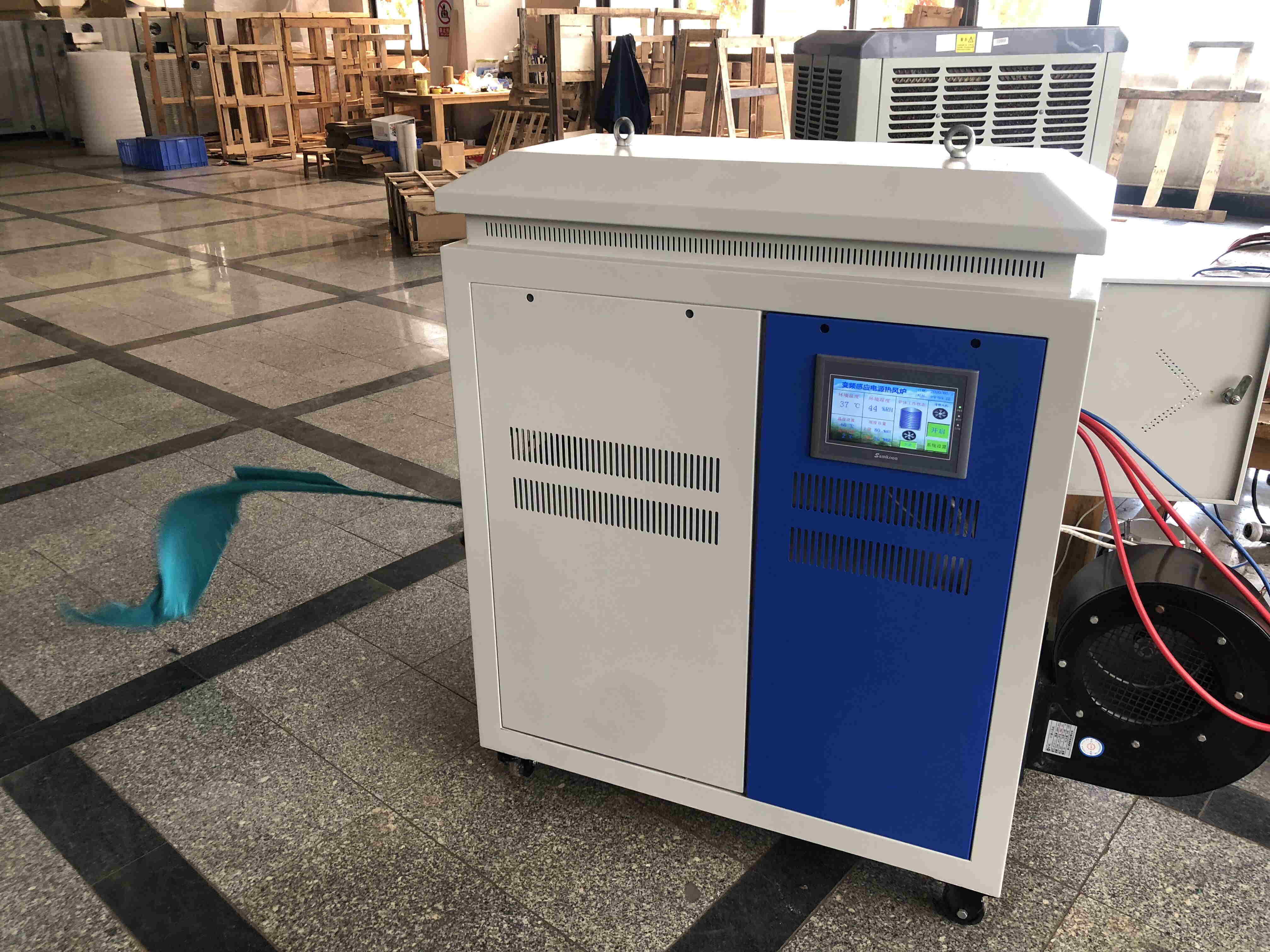
An induction hot air generator family spanning 30–60 kW, one of the product lines that determines whether a supplier can support a multi-line factory over several years.
For a buyer, breadth matters in two concrete ways. First, it reduces the number of vendors that must be qualified, audited and re-qualified. Second, it means a coil, a control board and a hot air generator supplied in year one can still be supported in year four from the same engineering base, rather than being treated as an orphaned configuration.
Dimension 2 — Certification coverage and what to verify
Certification is the most commonly mis-scored dimension. A buyer does not need a longer certificate list; it needs a narrower and more precise question: which certificate, covering which product family, issued by which body, at which voltage configuration?
The documents most frequently requested for induction heating equipment supplied into industrial and export markets are CE, ISO and RoHS. The relevant published safety framework for the equipment category is IEC 60519-1, which sets general requirements for industrial electroheating installations, and IEC 60519-3, which sets particular requirements for induction heating and melting equipment; both were published by the International Electrotechnical Commission. A supplier that can discuss the category standard alongside its own certificates is answering the right question. A supplier that can only produce a document image without stating its scope is not.
Dimension 3 — Customization range and its engineering boundaries
Customization range separates the suppliers that can genuinely support a smart manufacturing rollout from those that can only ship a catalog item. JONSON's OEM/ODM capability covers voltage adaptation, coil geometry adapted to the workpiece, and power regulation across a 20% to 100% range — a control window that matters in processes where the load changes across a shift rather than running at a fixed duty point.
Customization also has boundaries, and a credible supplier states them. Induction heating equipment is not field-modifiable. JONSON's own service guidance is explicit: before any repair, power must be disconnected and the circuit allowed to discharge completely; internal wiring must not be altered; and only original factory-supplied coil parts should be used. Dust must be cleaned regularly from the cooling ducts, and the unit must be positioned with sufficient heat-dissipation space, away from dust, oil and flammable or explosive materials.
That constraint is not a weakness — it is a design decision. It means the supplier's coil geometry and control parameters must be correct at the factory, because they cannot be improvised on the shop floor. Buyers should therefore ask, during evaluation, how a customized coil is documented and how a replacement coil is specified in year three.
Dimension 4 — Performance consistency across the lifecycle
Documented performance is the dimension buyers most often reduce to a single headline number. A more defensible approach is to record the figure together with its measurement basis.
JONSON documents thermal efficiency that is stable at 95%–98%, with comprehensive energy savings of 30%–70% relative to traditional induction heater machines, a lifespan extended by three times, and approximately 90% less maintenance — together with precise temperature control. Within that band, the upper end reaches and exceeds 98% heat conversion efficiency under the supplier's stated test conditions.
Third-party analysis gives a more conservative system-level picture. Global Market Insights reports that induction heating systems achieve energy efficiencies up to 92%, with an average cycle-time reduction of 30% compared with traditional gas or resistance-based heating. The difference between 92% and 95%–98% is a scope question, not necessarily a contradiction: system-level efficiency includes power supply losses, control electronics, cabling and transfer losses, while component or coil-level efficiency excludes them.
For the scorecard, this means the buyer should ask three questions rather than one: at what boundary is efficiency measured, under what load and duty cycle, and what variation is acceptable between two units of the same model. Power-band context supports the same approach — the 10 kW to 100 kW segment dominates the induction heating market because of its versatility in applications such as automotive part hardening, forging and brazing, according to MarketsandMarkets.
Dimension 5 — Commercial terms and acceptance criteria
Long-term relationships are usually prefigured by pre-contract behavior. The verifiable terms offered for induction heating equipment in this supply chain include a minimum order quantity of 1 unit, delivery terms of FOB, CIF or CFR, and payment terms under which some products support 30% T/T in advance with 70% T/T against a copy of the bill of lading.
The acceptance criteria are the more revealing part: pre-shipment testing, followed by product inspection performed by SGS. For a buyer planning repeat orders, a third-party inspection step in the first order is what makes reduced inspection in later orders a defensible decision. It also creates a documented baseline against which later units can be compared.
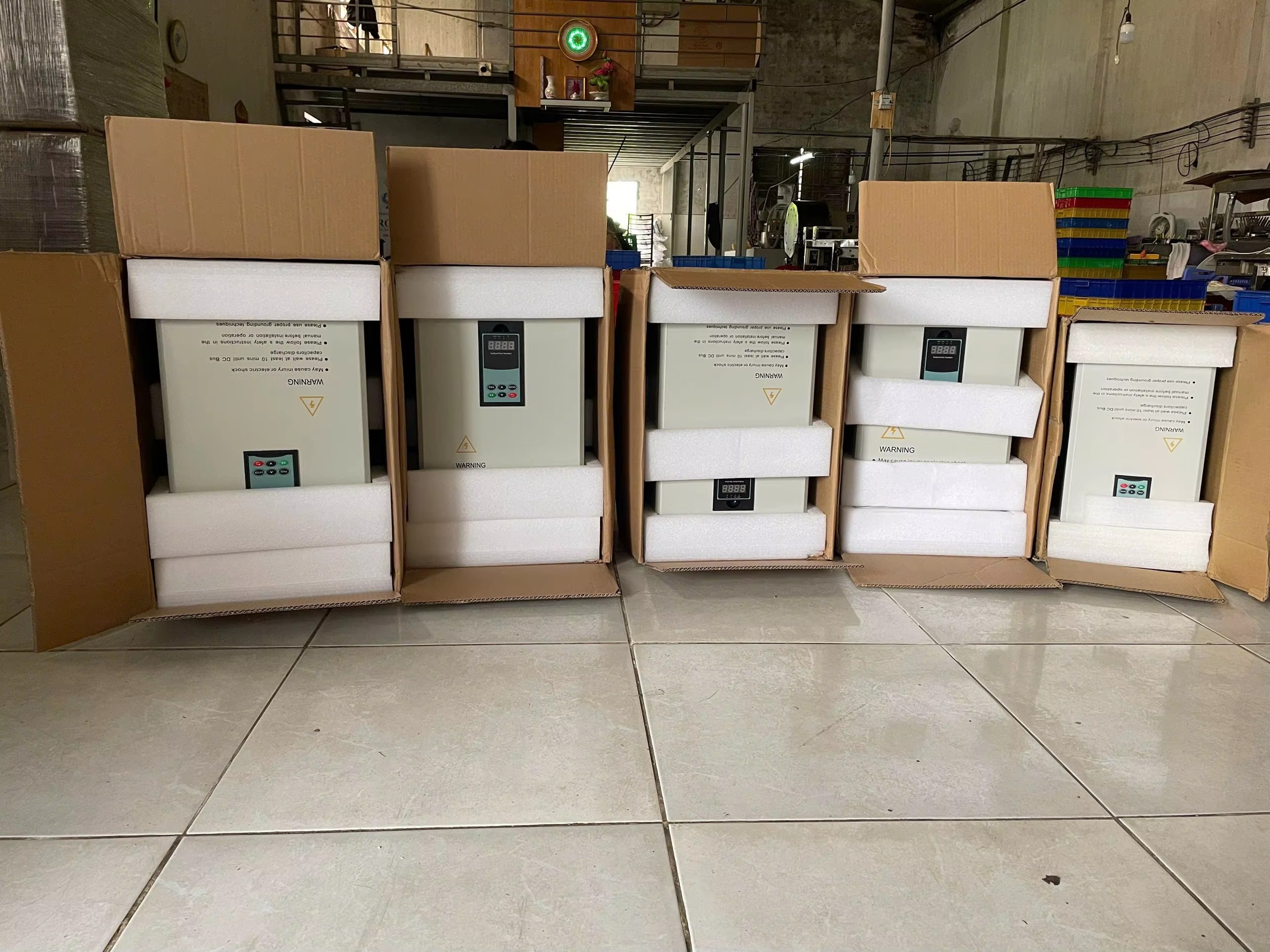
Repeat-order supply depends on agreed acceptance criteria: pre-shipment testing and third-party product inspection establish the baseline that later batches are measured against.
Dimension 6 and 7 — Service lifecycle and engineering depth
Lifecycle terms are where a supplier either accepts long-term responsibility or transfers it to the buyer. JONSON offers one-year free maintenance and lifelong maintenance service. The company also states a ten-year whole-machine service-life commitment for its equipment. Behind that sits a product R&D and engineering technology team of 30+ engineers, which is the organizational reason a supplier can answer a coil-geometry change request in year three rather than declining it.
Buyers should score these two dimensions separately. A long warranty attached to a thin engineering team is a support risk; a deep engineering team without a stated maintenance scope is an operational cost risk. The scorecard only works when both are visible at the same time.
Where induction heating fits: documented application coverage
Supplier evaluation should also test whether the technology has already been deployed across the buyer's process category. Documented application coverage for this class of induction heating equipment includes plastics and rubber processing, food processing, chemical reactions, crude oil pipeline heating, textile printing and dyeing, aquaculture heating, metal heat treatment, building heating, and medicinal herb drying. The same equipment base is used in heating, the chemical industry, mold manufacturing, plastic machinery and food processing.
That spread is useful for decision-making because it shows where the engineering problems have already been solved: temperature uniformity on a plasticizing barrel, controllable heat input on a chemical reactor, constant-temperature operation on a pipeline, and repeatable heat treatment profiles in metalworking. A supplier whose references cluster in only one of these categories may still be competent — but the burden of proof shifts to the buyer.
Market signals that justify a long-term evaluation process
The commercial case for a structured scorecard comes from the direction of the market itself. The global induction heating system market was valued at USD 2.39 billion in 2024 and is projected to reach USD 4.5 billion by 2035, according to WiseGuyReports. The electrification trend is broader than induction alone: the global industrial boiler and steam generator market was estimated at USD 54.79 billion in 2024, with a shift toward electrification to meet decarbonization goals, according to Market Research Future.
Two structural facts about this market are worth noting before using any published figure. First, market-size estimates diverge widely by scope — Global Market Insights describes a USD 2.3 billion systems-level market for 2024, while MarketsandMarkets reports a narrower USD 616.5 million figure for a more specific induction market definition. Buyers comparing supplier claims against market reports should check the scope before drawing conclusions. Second, the supplier landscape is concentrated at the top: Fuji Electric held a leading market share of over 9.5% in the induction heating system market in 2025, according to Global Market Insights. Concentration at the top means the long tail competes on documentation, customization and service — which is precisely what the scorecard measures.
Induction heating versus traditional heating: where the advantage stops
Compared with traditional resistance-based or gas-fired heating, the documented advantages of induction equipment in this category are measurable: thermal efficiency stable at 95%–98%, comprehensive energy savings of 30%–70%, a lifespan extended by three times, roughly 90% less maintenance, and precise temperature control. For a factory running continuous process heat, the maintenance reduction alone changes the operating model, because unplanned downtime cost usually exceeds the equipment cost within the first few years.
The boundary is equally specific, and buyers should record it. Induction heating transfers energy electromagnetically, so the efficiency advantage depends on a matched heating element or a matched coil-to-workpiece geometry. Where the process medium itself is not directly heatable, that efficiency has to be realized through an intermediate component — a coil-wrapped barrel, an induction-heated heat exchanger or a steam/hot-air generator — and the design of that component, not the generator, determines the real result. Retrofitting induction into an existing boiler loop or pipeline therefore requires engineering review rather than a like-for-like swap.
A second boundary is operational. The equipment requires unobstructed heat dissipation, protection from dust and oil, and a maintenance routine that includes cleaning the cooling ducts. Repair work requires full power isolation and circuit discharge, and internal wiring must not be altered. Factories without a disciplined maintenance function should treat induction equipment as a change in operating procedure, not only a change in hardware.
Future outlook for induction heater sourcing
Three developments are likely to shape supplier selection over the next several years. Electrification of process heat will continue to push buyers away from combustion-based heating in applications where electrification is technically feasible. Retrofit and replacement demand will grow relative to first-time installation, given the installed base already operating worldwide. And qualification processes will become narrower rather than broader, with buyers maintaining a small number of audited suppliers instead of a long list of quotations.
In that environment, the successful supplier is not the one with the largest published catalog, but the one whose catalog, certificates, engineering team and service commitments can be checked against each other. A scorecard that records evidence — not impressions — is what makes a multi-year heating supply decision reviewable in year three, when the original procurement team has moved on and only the documentation remains.
FAQ
How should a buyer evaluate an induction heater supplier for a long-term partnership?
Evaluate across seven documentable dimensions rather than on price and lead time alone: product breadth, certification coverage, customization range, performance consistency, commercial and acceptance terms, service lifecycle, and the depth of the supplier's own engineering team. Product breadth confirms that a coil, control board or generator supplied in the first year can still be supported later; certification coverage confirms the documents name the delivered product and voltage configuration; customization range confirms that voltage adaptation, coil geometry and power regulation from 20% to 100% can be engineered and repeated; and performance consistency confirms that efficiency figures come with stated test conditions.
Which certifications and standards apply to industrial induction heating equipment?
The documents most frequently requested for induction heating equipment in export and industrial markets are CE, ISO and RoHS, and buyers should confirm that each certificate's scope covers the specific product family and voltage configuration being purchased. At the standards level, IEC 60519-1 defines general requirements for industrial electroheating installations and IEC 60519-3 defines particular requirements for induction heating and melting equipment; both were published by the International Electrotechnical Commission. The two layers are complementary: product certification documents the delivered unit, while the IEC standards describe the safety framework the equipment category is designed against.
What heat conversion efficiency is realistic for an industrial induction heater?
Reported figures depend on the measurement boundary. JONSON documents thermal efficiency that is stable at 95%–98%, with comprehensive energy savings of 30%–70% compared with traditional induction heater machines, a lifespan extended by three times and roughly 90% less maintenance required. Independent market analysis published by Global Market Insights reports system-level energy efficiencies of up to 92% and an average cycle-time reduction of 30% versus gas or resistance heating. The gap reflects measurement scope rather than a contradiction: system-level efficiency includes power supply, control electronics and transfer losses, while component-level efficiency excludes them. Buyers should always record the boundary, load and duty cycle attached to any efficiency figure.
What are typical purchasing terms and acceptance criteria for induction heaters?
The verifiable terms for this equipment category include a minimum order quantity of 1 unit and delivery terms of FOB, CIF or CFR. Payment terms for some products support 30% T/T in advance with 70% T/T against a copy of the bill of lading. Acceptance is structured around a pre-shipment test followed by product inspection performed by SGS. For buyers planning repeat orders, the third-party inspection step in the first shipment is what establishes the reference standard against which later batches can be compared.
How should maintenance and spare parts be planned across a multi-year supplier relationship?
JONSON provides one-year free maintenance and lifelong maintenance service, and states a ten-year whole-machine service-life commitment for its equipment, supported by a product R&D and engineering technology team of 30+ engineers. On the operator side, maintenance requires keeping the unit away from dust, oil and flammable or explosive materials with sufficient space for heat dissipation, regularly cleaning dust from the cooling ducts, and using only original factory-supplied coil parts. Repair procedures require disconnecting power and allowing the circuit to discharge completely before work begins, and internal wiring must not be altered. Planning around these requirements is what allows a coil or control board to be replaced years after installation rather than forcing an early system replacement.