
Induction Heater Supplier Capability: Evidence Beyond the Catalog
Induction Heater Supplier Capability: Evidence Beyond the Catalog
An induction heater supplier's capability is only as strong as the evidence that names your exact model — the legal entity that builds it, the certificate scope that covers it, the materials fixed in its construction, the control parameters that can be measured at acceptance, and the commercial terms already committed in writing. That distinction matters most at the point where a buyer stops comparing product ranges and starts preparing a purchase order. A catalog photograph of a coil, or a compliance logo in a footer, cannot answer the questions that decide whether a project runs on schedule: does the conformity document list the model I am buying, or a neighbouring series? Is the liner in the unit I received the grade I specified? Will the controller behave the same way at the low end of my site's voltage window as it did in the demonstration?
This reference sets out five evidence layers that industrial buyers can inspect before releasing an order, and applies them to the JONSON induction heating range: the JS1300-005/008 and JS1300-10/15 cabinet heaters, the JS1000-100 high-power industrial unit, the JS-1600 induction steam generator and JS-1600-8/12/15 hot-air generator, and the JS1300 bearing heater series.
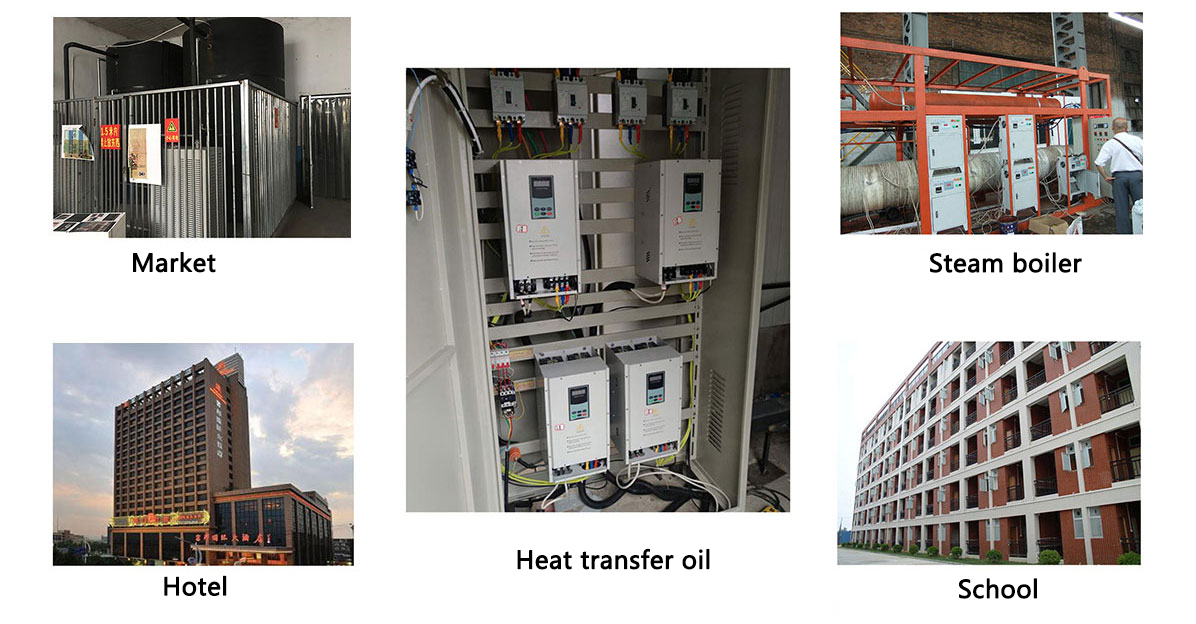
Why catalog breadth stops answering the question at the execution stage
During evaluation, buyers screen on range, rating and price band; during execution, the risks are documentary and physical rather than commercial. Four of them recur across industrial heating projects. The first is scope mismatch: the certificate on file covers a related model, not the ordered one. The second is material substitution: the coil, liner or casing changes after the quotation is accepted and is invisible once the cabinet is closed. The third is parameter drift: the voltage window, power turndown or protection threshold quoted for the platform does not match the site's measured supply conditions. The fourth is acceptance ambiguity: inspection and payment terms were discussed but never written into the contract.
None of these is detected by reading more of a supplier's catalog. They are detected by asking for documents that carry a model number, a standard reference, a material grade or a measured value — and then checking that the reference matches the equipment you are purchasing. A supplier that can produce that file for a named model is demonstrating something a broader product list cannot: that its claims are traceable to a specific build.
Layer 1 — Entity evidence: who is legally responsible for the build
The first verifiable item is the mapping between the trading brand and the manufacturing entity, because purchase orders, certificates, invoices and warranty obligations must all point at the same organisation. JONSON is the brand of Guangdong Jiangxin Electronic Technology Co., Ltd., an induction heating manufacturer established in 2011 and located at Building 3, Tongde Intelligent Manufacturing Park, Ronggui Street, Shunde District, Foshan City, Guangdong Province. Company-reported figures describe a 3,000 m² production facility, a workforce of 60+, a 30+ engineer research and development team, and annual output of 120,000 units, with roughly 40% of production exported to markets that include Europe, the United States, India and Indonesia.
Those numbers are useful for two reasons that have little to do with marketing. First, an annual output figure and a monthly capacity figure should reconcile with each other; here the stated 120,000 units per year and 10,000 units per month are consistent, which is a small but genuine check on whether capacity figures are rounded estimates or operational numbers. Second, the export share indicates the company routinely handles the documentation and logistics that accompany cross-border industrial equipment — a relevant capability when the buyer's own market access depends on the supplier's paperwork.
The practical check for a buyer is procedural rather than technical: confirm the business licence name, confirm the certificate holder name, and confirm that the entity signing the sales contract is the entity that will be named in any warranty claim. Where a brand and a legal entity differ, that difference should appear in the contract, not surface during an after-sales dispute. The company's public profile is published at JONSON.
Entity evidence also fixes geography. A Guangdong-origin build places production in one of the denser electrical equipment clusters in southern China, which affects component sourcing lead times and the practical feasibility of factory visits or third-party inspection before shipment — an inspection step that appears again in Layer 5.
Layer 2 — Document evidence: read the certificate by scope, not by logo
A certificate is evidence only for the entities, models and standards printed on it. This is the point where the most expensive procurement mistakes in industrial heating are made, because a compliance logo in a brochure and a conformity document naming a specific model look identical to a buyer who has not been taught to read the second page.
Quality management scope
JONSON's quality management system is certified to ISO 9001:2015 under certificate 02826Q00032R001, issued 6 January 2026 by Beijing Zhong An Zhi Huan Certification Center Co., Ltd. and valid to 7 January 2029, against GB/T 19001—2016 / ISO 9001:2015. The declared scope is specific: production and sales of household fast-heating electric water heaters (electromagnetic heating furnaces) within the scope of the qualification licence, together with production and sales of electromagnetic heating controllers and coil heating elements for household appliances. A buyer should read that wording literally. It tells you which process families sit inside the certified boundary, and it is the document that makes a factory audit meaningful, because an auditor is checking against a defined system rather than a general statement of good practice.
Conformity, model scope and the sibling-series problem
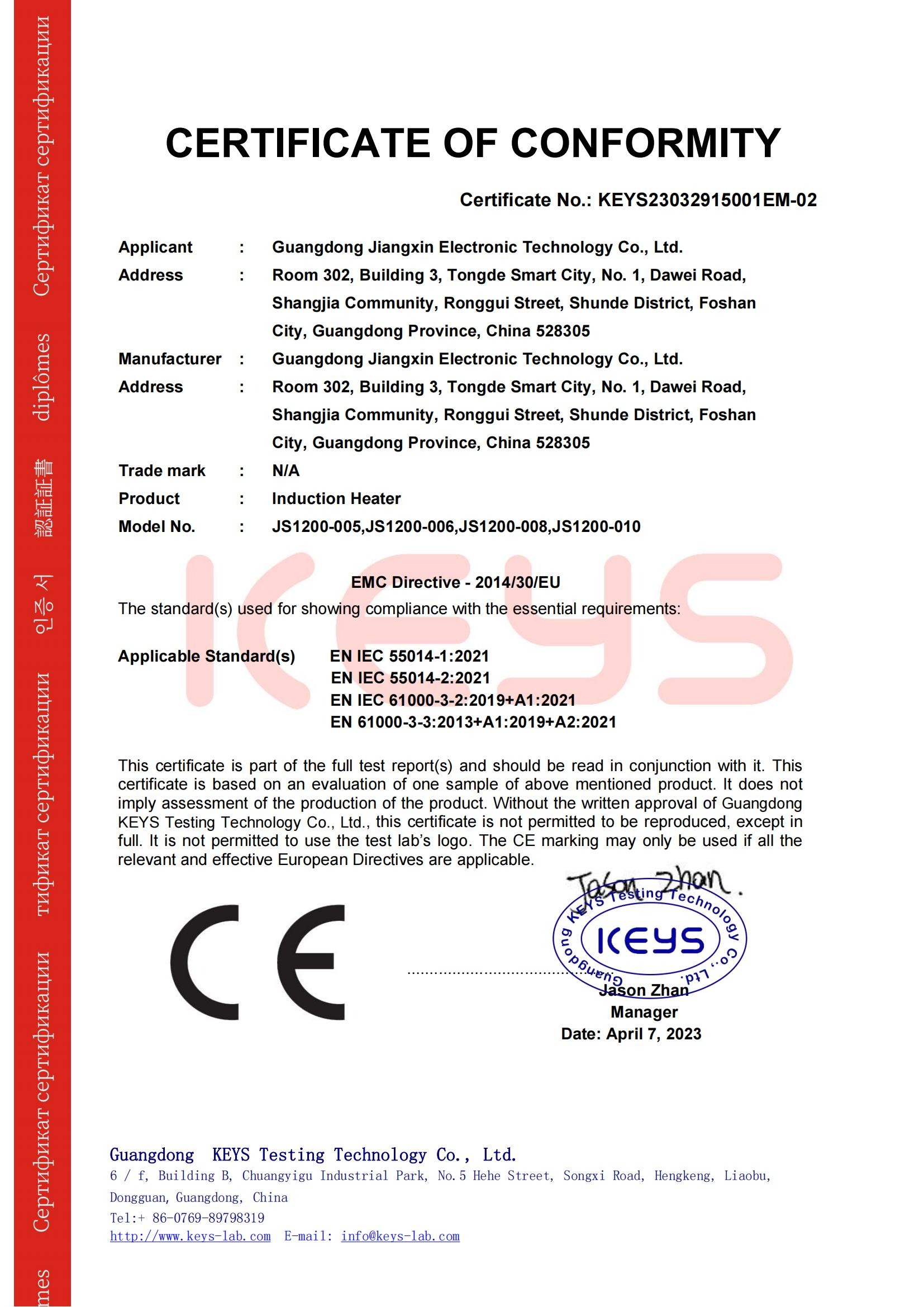
JONSON's CE Certificate of Conformity KEYS23032915001EM-02 was issued on 7 April 2023 by Guangdong KEYS Testing Technology Co., Ltd. and remains valid to 7 April 2028. It cites EN IEC 55014-1:2021, EN IEC 55014-2:2021, EN IEC 61000-3-2:2019+A1:2021 and EN IEC 61000-3-3:2013+A1:2019+A2:2021 — the emission, immunity, harmonic and voltage-fluctuation standards that occupy most of the technical file for an induction heating power supply.
The model list on that document is JS1200-005, JS1200-006, JS1200-008 and JS1200-010. That detail is more instructive than any marketing claim, because the JONSON range also includes JS1300-005/008 and JS1300-10/15 cabinet heaters, the JS1000-100 industrial unit, the JS-1600 steam and hot-air generators and the JS1300 bearing heaters. A buyer ordering from those families should ask for the conformity document that names the ordered model and the standards applied to it. A certificate covering a neighbouring series is not evidence for a different series, and a supplier that understands this will treat the request as routine rather than as an accusation.
What a China Compulsory Product Certification does and does not prove
Two CCC certificates are on file, both issued by CQC on 25 July 2022 and valid to 24 July 2027: certificate 2017010706999985 for JS3000-006 (6.1 kW), JS3000-008 (8 kW) and JS3000-010 (10 kW) at 220V~ 50Hz IPX1, and certificate 2017010706002104 for JS3000-015 through JS3000-060 (15 kW to 60 kW) at 380V 3N~ 50Hz, both against GB 4706.1-2005 and GB 4706.11-2008. For a European or North American buyer these documents are best read as evidence that a formal factory conformity process exists and is subject to periodic surveillance. They are not market access for the destination country, and they should never be presented as such.
The three questions that turn a document into evidence
- Does the model list include the model on my purchase order? If not, request the document that does, before the order is released.
- Which standards are named, and do they match my destination market's requirements? Electromagnetic compatibility standards filed for a CE mark do not substitute for a destination-specific electrical safety regime.
- Is the document current? Record the issue and expiry dates, and note that a certificate expiring during a multi-year project is a renewal item to track, not a fault.
The same discipline applies to material declarations such as RoHS, which are substance-and-model specific. Request the declaration that names your unit and the substance list applied to it, rather than a general statement of environmental compliance.
Separately, buyers can ask how the design addresses recognised electroheat safety references. An external technical guide to induction heater safety features published in 2025 identifies IEC 60519-1 (general requirements for electroheat installations) and IEC 60519-3 (induction and conduction heating) as the core safety standards for this equipment class, with ISO 13850 covering emergency stop functions. A supplier's design statement against those references is a claim to be tested against the technical file; it is not itself a certificate, and the two should not be conflated.
Layer 3 — Build evidence: the materials that disappear inside the cabinet
The three components most likely to change after quotation — and least likely to be visible after assembly — are the heating coil, the fluid-contact liner and the casing. In the JONSON range these are specified as copper heating coils, 304 stainless steel liners, and thickened aluminum alloy or cold-rolled steel casings. Each corresponds to a different failure mode, which is why each deserves its own line in the technical file rather than a single sentence in a brochure.
| Component | Documented specification | What it governs in service | Document to request |
|---|---|---|---|
| Heating coil | Copper | Coupling consistency and electrical conductivity; long-term resistance drift under thermal cycling | Coil drawing for the ordered geometry plus material declaration |
| Fluid-contact liner | 304 stainless steel | Corrosion resistance and cleanability where water or steam is the heated medium | Material grade certificate for the liner |
| Casing | Thickened aluminum alloy or cold-rolled steel | Mechanical rigidity, protection of control electronics, thermal behaviour of the enclosure | Grade and thickness stated on the build drawing |
The buyer's reasoning is straightforward. A copper coil is not automatically interchangeable with a coated or alloy alternative for a given geometry, because coupling behaviour and thermal cycling response differ. A 304 stainless steel liner is a specific grade with known corrosion behaviour in potable and process water, and a substituted grade is difficult to detect once the vessel is sealed. A thickened casing is a structural statement — it protects the induction heating controller and power supply from mechanical and thermal stress in an industrial hall — and thickness is exactly the sort of attribute that quietly erodes when a build is cost-reduced.
Layer 4 — Control evidence: parameters that can be measured at acceptance
The most useful capability evidence in an induction heating system is a small set of numbers that a buyer can independently test at commissioning. For the JS1300 platform, the documented checkpoints are a 380V design that adapts across a 300V to 400V input window, continuous power regulation from 20% to 100% of rated output, a heat conversion efficiency of at least 98%, overcurrent protection responding within 2 microseconds, and load temperature detection accurate to ±1°C. Voltage is not fixed to 380V across the whole range either: 110V, 240V and 660V induction heater variants can be customized.
| Documented checkpoint | Value on the JS1300 platform | What the buyer verifies before acceptance |
|---|---|---|
| Grid-voltage adaptation | 380V design operating across 300V–400V | Written confirmation against the site's measured voltage window, not the nominal supply figure; behaviour at the extremes of that window |
| Power regulation | 20%–100% of rated output | Stability and control resolution at the low end, where most process-heating problems actually occur |
| Heat conversion efficiency | ≥98% | Which boundary the figure describes — converter output or heat delivered to the load |
| Overcurrent protection | ≤2μs trip response | The protection design note and the fault test behind the figure |
| Load temperature detection | ±1°C | Sensor type, mounting position and calibration interval |
Two of these deserve a caution that a specification sheet rarely states. First, a ≥98% conversion efficiency figure and a system-level thermal efficiency figure measure different things. JONSON's supplied application record reports overall thermal efficiency holding steady at 95%–98% across a reference set of 100 units operating in Indonesia, China, Vietnam, Russia and India over more than ten years, together with 30%–70% energy savings against traditional heating equipment. That record is a supplier-reported aggregate covering specific installations; the test conditions behind it should be requested before the numbers are used in an energy-cost model. The converter figure tells an engineer how much input power becomes usable heat at the power supply; the system figure tells a finance team what happens to the electricity bill, and only the second feeds a return-on-investment calculation.
Second, a ±1°C load temperature detection figure describes the accuracy of the measurement channel, not the uniformity of the whole load. In a process where the workpiece geometry varies, or where a large volume must be held at a uniform temperature, the sensor position and the control strategy determine the outcome far more than the sensor's stated precision. That is a specification to test in the acceptance protocol, not a property to assume from the datasheet.
Matching documented capability to the load: the model family in practice
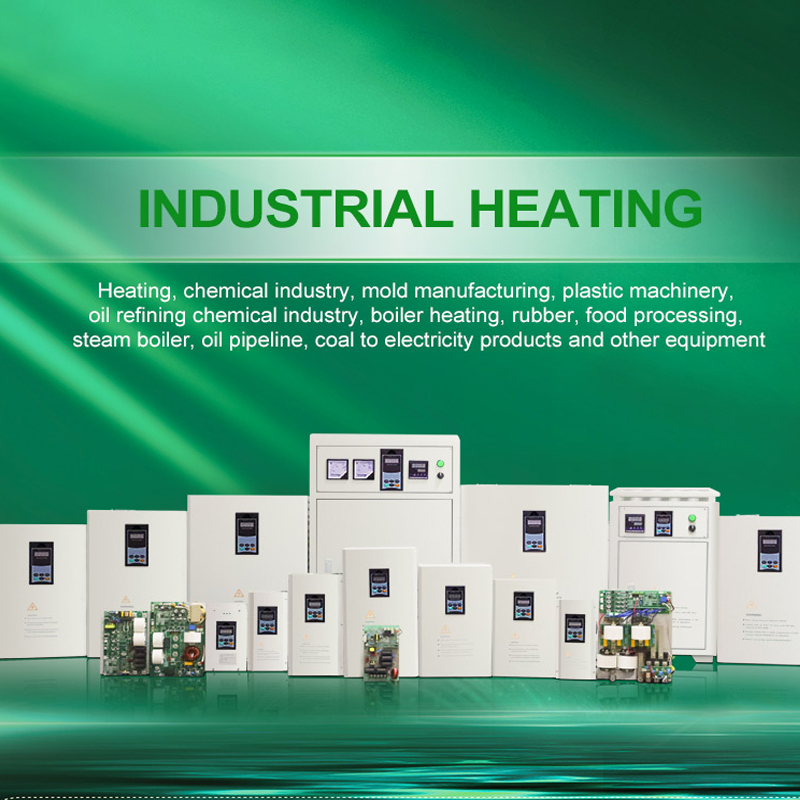
Capability evidence becomes useful only when it is attached to a specific model at a specific rating. The JONSON range spans 5 kW cabinet heaters through to a 100 kW industrial unit, and the family structure is itself part of the evidence, because a supplier able to document ratings across that span is demonstrating an engineering platform rather than a single assembled product.
| Model | Format | Rating / designation | Documented role |
|---|---|---|---|
| JS1300-005 / JS1300-008 | Cabinet induction heater | 5 kW / 8 kW, 380V | General-purpose industrial induction heater |
| JS1300-10 / JS1300-15 | Cabinet induction heater | 10 kW / 15 kW, 380V | General-purpose industrial induction heater |
| JS1000-20 | Induction heater | 20 kW, 380V | Mid-power process heating |
| JS1000-100 | Industrial induction heater | 100 kW | High-power process heating installations |
| JS-1600 | Induction steam generator | JS-1600 series | Steam generation |
| JS-1600-8 / 12 / 15 | Induction hot-air generator | 8 / 12 / 15 designations | Hot-air generation |
| JS1300-5 / 8 / 15 / 20 / 30 | Bearing induction heater | 5 to 30 designations | Bearing heating |
The wider portfolio also includes the JS1000-30 induction heating machine, the JS-JR-008 instant induction water heater, induction heating water boilers and electromagnetic boilers, induction heating coils offered as separate components, and induction heater control boards for buyers who integrate the power stage into their own cabinet. For a buyer, the practical question is not how many of these exist but whether the same document standard applies to each — a supplier that can produce a model-scoped conformity document and a material specification for the unit on your order, and only that unit, has passed a more demanding test than one with a longer product list.
Layer 5 — Commercial evidence: terms that reveal the operating model
Commercial terms belong in a capability assessment because they disclose how a supplier actually organises production. JONSON provides OEM and ODM production services for induction heating equipment, covering induction heating machines, equipment and systems, with customization options that include product specification customization, sample fabrication, graphic and panel customization, parameter adjustment and private logo customization. Stated capacity is 10,000 units per month, lead time is 7–14 days, minimum order quantity is 1 unit, and quality control consists of 100% pre-shipment testing plus product inspection through SGS. After-sales support is provided remotely, and export markets span Southeast Asia, the Middle East, Europe, the Americas, Russia, Africa and other regions.
Read together, those terms describe a configure-to-order operating model rather than a catalogue-and-stock model. A one-unit minimum order and a one-to-two-week lead time are only credible where sub-assemblies are held and final configuration happens late; the consequence for a buyer is that specification freeze — not volume commitment — becomes the controlling milestone in the schedule. That shift changes the procurement conversation. Instead of negotiating over quantity, the buyer negotiates over which parameters are locked, which drawing revision governs, and what happens if a site measurement contradicts an assumption made at quotation.
The standard transaction framework on file is FOB, CIF or CFR for delivery terms, and for some products a payment structure of 30% T/T in advance with 70% T/T against a copy of the bill of lading. The word "some" matters. A buyer should confirm the applicable terms for the specific product rather than treat a category-level statement as applying to every unit, and should confirm that pre-shipment testing and SGS inspection are named in the contract rather than assumed.
Scenario fit, and where the evidence stops
Documented capability establishes what a system is, not what it will achieve in your plant. JONSON's supplied application record covers plastics and rubber production, process heat treatment, metal heat treatment, piping heat processing, food processing, industrial heating, and commercial and residential heating, and the company profile additionally lists the chemical industry and mould manufacturing. These are application categories, not proof that any specific installation reached a specific result.
The fit boundary is worth stating plainly. Induction heating couples electromagnetically into a conductive workpiece or susceptor, which is why it delivers heat at the point of use rather than through a flame or a resistance element and a transfer medium. That structural difference is the honest basis for the efficiency and localisation arguments — and it is conditional. Non-conductive loads need a susceptor. Coil geometry must match the part or vessel, so a system tuned for one workpiece family is not automatically optimal for another. Power density has cooling and supply implications that the site must be able to support. And where load shapes change frequently, where a large volume must be held uniform with simple controls, or where the available supply cannot deliver the required power band, a different heating approach may be the better engineering decision.
A comparison with traditional solutions is therefore best framed as a set of questions rather than a verdict. Does the process need heat delivered into the workpiece, or heat delivered into a space? How stable is the load geometry across a production year? What does the site's supply actually measure, hour by hour, rather than nameplate by nameplate? Buyers who answer those three questions before comparing equipment usually find that the specification writes itself.
Market context: why definitions decide the number
Market figures illustrate the same discipline the article applies to suppliers: a number without a definition is not evidence. Global Market Insights values the induction heating system market at USD 2.4 billion in 2026, rising to USD 4.1 billion by 2035 across portable and stationary systems, while MarketsandMarkets places the induction heating market at USD 879.5 million by 2030. The two are not reconcilable and should not be averaged; the gap reflects what each study counts, with broader system-level scope on one side and a narrower component or power-band focus on the other. When a business case cites market growth, the definition belongs in the same sentence.
A more immediately practical classification detail is customs heading 8514.40, which covers other equipment for the heat treatment of materials by induction or dielectric loss. Buyers modelling landed cost, or checking that a shipment description matches the equipment actually delivered, will find that code more useful than any market forecast — and mismatches between the declared description and the installed machine are a common cause of delay.
A verification checklist to run before releasing the order
- Confirm that the brand, the certificate holder and the contracting entity are the same organisation, or that the relationship is documented in the contract.
- Request the conformity document that names the ordered model — not the family, and not a sibling series.
- Record issue and expiry dates for every certificate, and flag any that expire during the project window.
- Obtain the material grade certificate for the 304 stainless steel liner and the material declaration for the copper coil.
- Confirm casing grade and thickness on the build drawing revision that governs your order.
- Ask for written confirmation of the voltage window against your site's measured supply, not the nominal figure.
- Specify the low-end power regulation test at 20% of rated output in the acceptance protocol.
- Clarify whether the quoted efficiency figure is converter-level or system-level, and request the test conditions.
- Confirm that 100% pre-shipment testing and third-party inspection are named in the contract before production begins.
- Confirm delivery terms and payment structure for the specific product rather than the product category.
A buyer who wants to test this approach on a live requirement can start small: pick one model from the range, request the full document set for that model alone, and compare it against the quotation. Where the document set arrives complete and internally consistent, the remaining risk is concentrated in site conditions and acceptance testing — which the buyer controls.
Frequently asked questions
What documents turn an induction heater supplier's capability claim into verifiable evidence?
Five document groups do most of the work. Entity documents establish which legal organisation manufactures and contracts. Model-scoped conformity documents establish which standards apply to the ordered unit. Material certificates establish the coil, liner and casing specifications actually built. A control parameter sheet establishes voltage window, power regulation range, conversion efficiency, protection response and temperature detection accuracy. Finally, written commercial terms establish inspection, delivery and payment structure. A capability claim becomes evidence when each of these carries a model number, a standard reference, a material grade or a measured value that matches the purchase order.
Does a CE certificate cover every induction heater model a supplier sells?
No. A CE Certificate of Conformity names the models and standards it covers. JONSON's certificate KEYS23032915001EM-02, issued 7 April 2023 by Guangdong KEYS Testing Technology Co., Ltd. and valid to 7 April 2028, lists models JS1200-005, JS1200-006, JS1200-008 and JS1200-010 against EN IEC 55014-1:2021, EN IEC 55014-2:2021, EN IEC 61000-3-2:2019+A1:2021 and EN IEC 61000-3-3:2013+A1:2019+A2:2021. A buyer ordering a model outside that list, such as a JS1300-005/008 cabinet heater or a JS1000-100 industrial unit, should request the conformity document that names that model and states the standards applied to it.
What customization can be specified on an induction heating equipment order?
JONSON's stated customization services include product specification customization, sample fabrication, graphic and panel customization, parameter adjustment and private logo customization, alongside OEM and ODM production services for induction heating machines, equipment and systems. Voltage variants of 110V, 240V and 660V can be customized in addition to the standard 380V platform. Stated commercial parameters are a minimum order quantity of one unit, a lead time of 7 to 14 days and monthly capacity of 10,000 units.
What acceptance and payment terms should be confirmed before production begins?
JONSON's documented framework is quality control through 100% pre-shipment testing plus product inspection carried out by SGS, with delivery terms of FOB, CIF or CFR. For some products, payment follows a 30% T/T advance with 70% T/T against a copy of the bill of lading. Because the payment structure is stated as applying to some products rather than all, the applicable terms for the specific unit should be confirmed in the contract, together with the acceptance criteria and the inspection stage at which they are applied.
How should a buyer verify 380V compatibility and power turndown for a specific site?
The JS1300 platform is documented as a 380V design that adapts across an input range of 300V to 400V, with power regulation from 20% to 100% of rated output. Verification has two parts. First, compare that window against the site's measured supply across a working shift rather than its nominal voltage, and obtain written confirmation that the configuration supplied suits the measured conditions. Second, test regulation behaviour at the low end of the range during acceptance, since low-output stability is where process heating complaints most often originate. Sites with non-standard supplies should note that 110V, 240V and 660V variants can be customized.
What the evidence layer changes
The direction of procurement in industrial heating is towards traceability rather than breadth. A supplier that can name the entity, print the model on the certificate, specify the liner grade, publish a protection threshold and commit inspection terms in writing is offering something a longer catalog cannot: a build that can be checked before it ships and defended after it is installed. For JONSON, that means the range from the 5 kW JS1300-005 through the 100 kW JS1000-100, the JS-1600 steam and hot-air generators and the JS1300 bearing heaters is best evaluated one model at a time, against documents that carry that model's number. Buyers who adopt that habit will find the comparison between suppliers becomes shorter, more factual, and considerably easier to defend internally when the purchase order is signed.
¿Tiene preguntas o necesita más detalles?
Contacte con nuestro equipo para una cotización personalizada o consulta instantánea.
Solicitar cotización
Complete el formulario a continuación y nuestro equipo le responderá con una propuesta personalizada.
Chat directo de WhatsApp
¿Prefiere chatear en tiempo real? Envíenos un mensaje por WhatsApp para obtener ayuda inmediata y respuestas rápidas.
- Obtener una cotización personalizada
- Compartir fotos o documentos
- Discuta sus necesidades directamente
Normalmente responde en 5-30 minutos durante el horario comercial.