
Induction Heater Selection by Scenario: Plastics, Food, Chemical, Pipeline
Process heat is the last large load in many factories that still runs off a single central boiler — and it is where electrification is moving fastest. Induction heating converts a 50 Hz mains supply into a 5–40 kHz current that drives a copper coil; the alternating field induces eddy currents inside a metal load, which heats in place without contact with a flame or a resistance element. That physical arrangement is why the same technology appears in injection moulding barrels, chemical reactors, food steam lines and crude oil pipelines, and why the selection question is rarely “which induction heater is best” but “which thermal duty is this unit being asked to perform”.
Third-party research puts the global induction heating system market at USD 2.39 billion in 2024, with a projected USD 4.5 billion by 2035 (WiseGuyReports). Global Market Insights counted more than 550,000 installed induction heating systems by mid-2024, roughly 40% of them in Asia-Pacific. Published market sizes diverge by scope — Global Market Insights describes a system-level market of about USD 2.3 billion, while MarketsandMarkets sizes a narrower induction equipment category at USD 616.5 million — so the direction of growth is a more dependable signal than any single number.
JONSON is the induction heating brand of Guangdong Jiangxin Electronic Technology Co., Ltd., a manufacturer established in 2011 in Foshan, Guangdong Province, China, producing induction heaters, induction steam generators, induction hot air generators, heating coils and induction heater control boards. The company operates a 3,000 m² facility with more than 60 employees, an R&D team of over 30 engineers and an annual production capacity of 120,000 units; export business accounts for 40% of sales, with main markets in Europe, the United States, India and Indonesia.
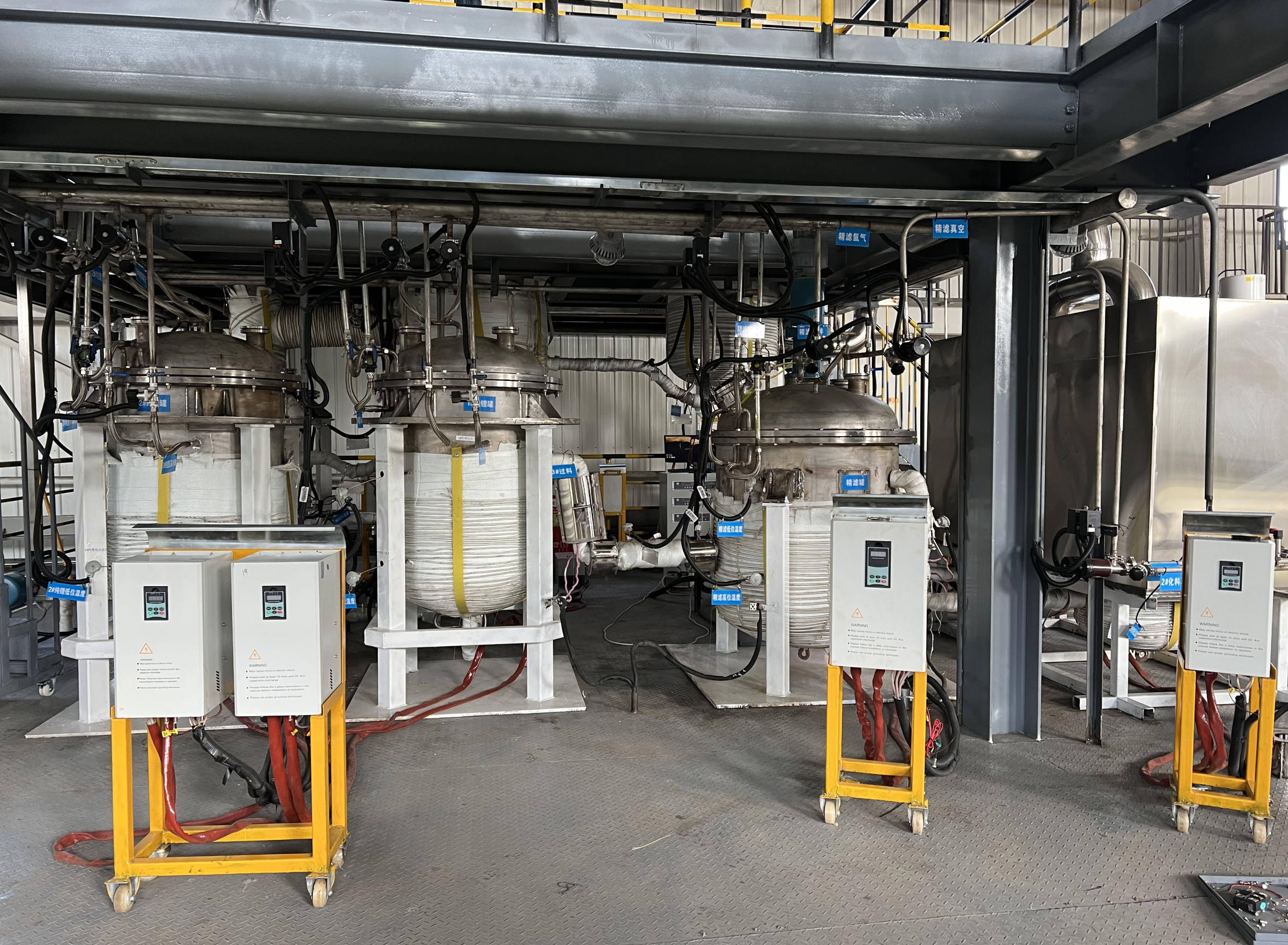
Induction heating platforms are selected by thermal duty — the medium, the temperature ceiling and the electrical supply available at the point of use.
The real selection problem: duty, not nameplate power
The 10 kW to 100 kW band dominates the induction heating market because of its versatility in hardening, forging and brazing (MarketsandMarkets). That statistic is useful for orientation but not for selection. Two plants can both say “we need 15 kW” and end up with entirely different hardware: one is holding a steel barrel at process temperature, the second is raising steam inside a stainless vessel, the third is keeping a crude oil line above its pour point on a site with only single-phase power.
What separates these duties is the heating medium, the temperature ceiling, the control band, the supply voltage actually available, and the physical gap between coil and load. A manufacturer such as JONSON, whose catalogue spans direct induction heaters, steam generators, hot air generators and small single-phase units, is effectively selling four different answers to the same underlying question.
Four thermal duties, four JONSON platforms
Every published JONSON induction platform in this comparison shares two control characteristics: a 20%–100% power regulation band and an operating frequency between 5 kHz and 40 kHz. Beyond that, the platforms diverge on power, supply voltage, medium and temperature ceiling — and those are the parameters that decide the match.
| Thermal duty | JONSON platform | Published power / supply | Scenario-defining specification |
|---|---|---|---|
| Barrel, die and reactor jacket heating (plastics, rubber, chemical reaction) | JS1300-005/008 induction heater | 10 kW / 15 kW, 380 V | 300–400 V adaptation; CE, ISO, RoHS |
| Steam for cooking, sterilising and reaction heating | JS-1600 induction steam generator | 30 / 40 / 50 kW, 380 V | Heat conversion efficiency ≥99%; 304 stainless liner |
| Hot air drying and curing (textile printing and dyeing, food) | JS-1600-8/12/15 hot air generator | 8 / 12 / 15 kW, 380 V | Outlet 80–130 °C; wind pressure 800–1000 Pa |
| Pipeline trace heating, boiler and heat-transfer oil | 3.5 / 5 / 6 kW 220 V induction heater | 3.5 / 5 / 6 kW, single-phase 220 V | Constant power at 210–260 V; load detection 0–1000 °C ±1 °C |
Scenario 1: plastics, rubber and chemical reaction heating
The JS1300-005/008 is a wall-mounted induction heater published at 10 kW or 15 kW on a 380 V supply, with a voltage adaptation window of 300–400 V. Output is adjustable across a 20%–100% band, so the same unit can hold at one-fifth of rated power during steady production and return to full output for a cold start. The core heating coil is copper wire, the inner liner is 304 stainless steel, and the outer casing uses thickened aluminium alloy with cold-rolled steel plate. The model carries CE, ISO and RoHS certification for EU-bound projects and is specified for ambient temperatures of −20 °C to 50 °C at humidity up to 95%.
In plastics and rubber, the duty profile is continuous high-frequency operation, and the load is the machine barrel itself: the coil wraps the barrel, an insulation layer covers the heating zone, and the power unit stays in the cabinet. In chemical service the same platform covers medium-to-high temperature duties in mildly corrosive surroundings, typically heating reactor jackets or circulating thermal oil. The engineering point that matters here is where the energy is deposited — inside the metal wall rather than in the surrounding air — because that determines both the thermal response time and how much heat the working area has to absorb.
Scenario 2: food processing and chemical steam supply
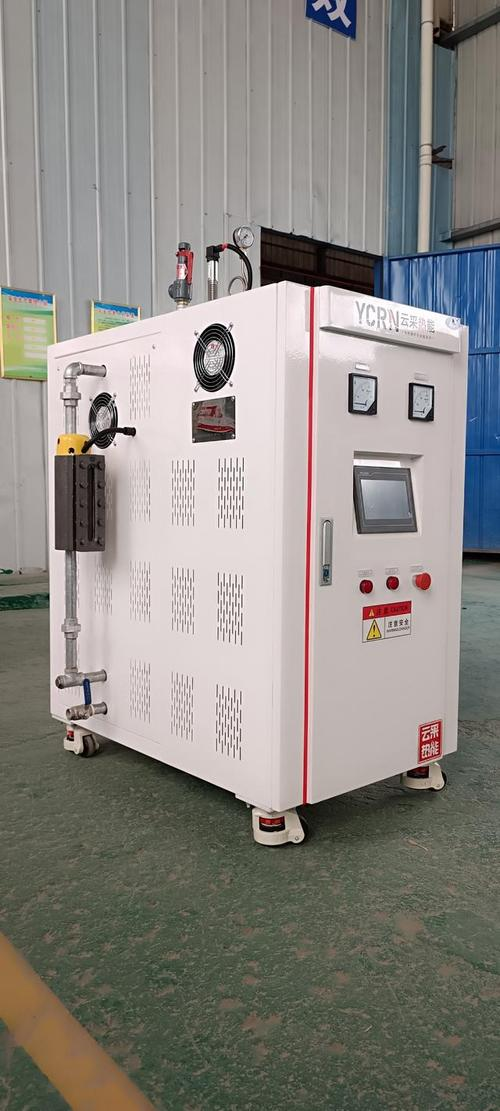
Steam supply is one of three heating media JONSON builds around, alongside hot air and thermal oil.
The JS-1600 induction steam generator is a high-frequency electromagnetic steam generator offered at 30 kW, 40 kW or 50 kW effective power on a 380 V supply (adaptable ±20%, 50/60 Hz). Published heat conversion efficiency is ≥99%, operating frequency 5–40 kHz, power regulation 20%–100%, ambient range −20 °C to 40 °C at humidity up to 95%. The inner liner is 304 stainless steel, the outer casing is thickened aluminium alloy and cold-rolled steel plate, and the core heating coil is copper wire.
The food-processing duty profile is high humidity with a small amount of steam mist and constant-temperature cooking; the chemical duty profile is a controlled, repeatable steam supply for reaction heating. JONSON’s application documentation describes steam production within roughly 30 seconds, a closed loop in which water and electricity are physically separated, and automatic interlock shutdown on water shortage, overheating or overpressure. For plants retiring a coal or gas boiler, the accompanying claim is zero nitrogen oxides, no smoke emissions and no complex sewage discharge approval — in many industrial zones that permitting position carries more weight in the decision than the efficiency figure.
Capacity can also be staged. Multiple units can be connected in parallel and power increased or decreased as needed, so a plant that starts with one 30 kW generator can extend the steam header rather than replace the equipment.
Scenario 3: textile printing and dyeing with hot air
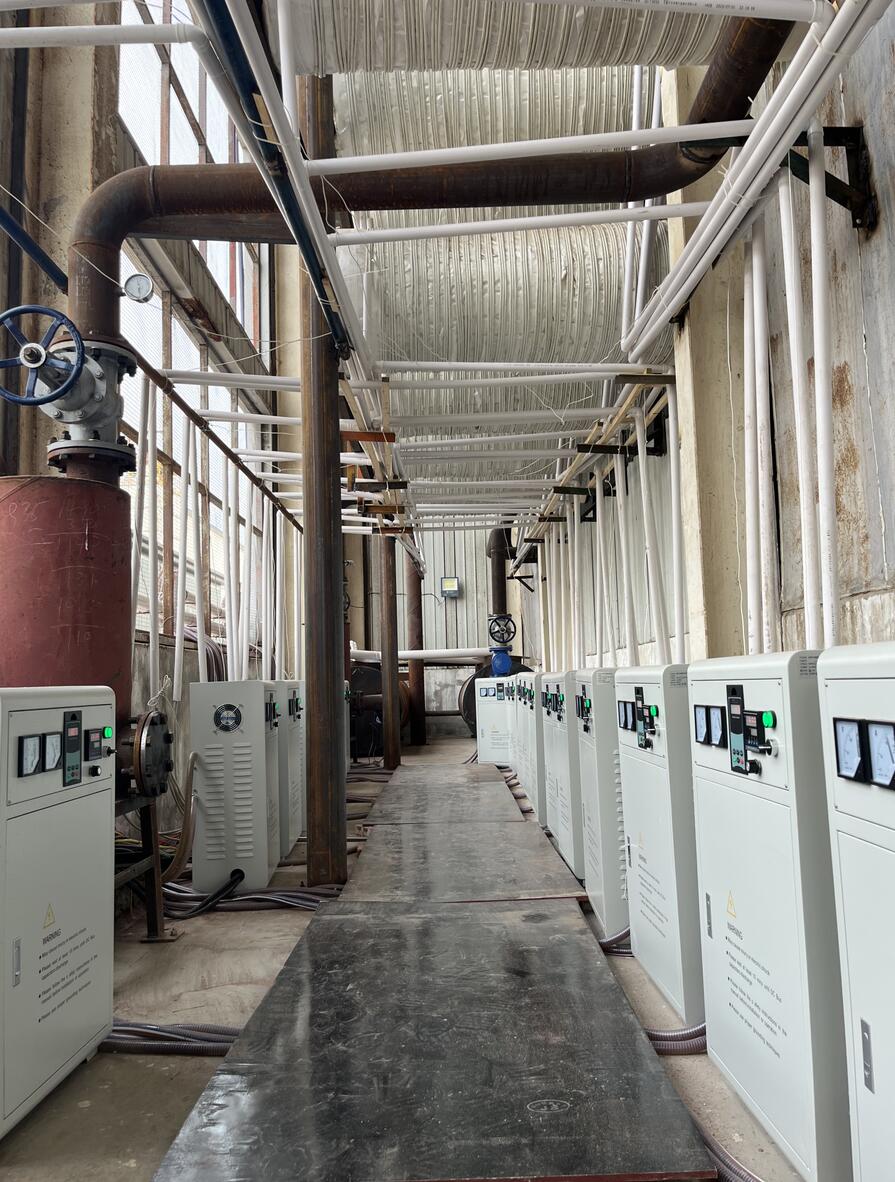
Hot air is the medium of choice for drying duties where steam temperature would be excessive and direct coil heating impractical.
The JS-1600-8/12/15 is a vertical induction hot air generator rated 8 kW, 12 kW or 15 kW on 380 V, with a voltage adaptation range of 300–400 V and 20%–100% power adjustment. Outlet temperature is published at 80–130 °C, wind pressure 800–1000 Pa. It carries CE, ISO and RoHS certification, uses the same 304 stainless steel liner and copper coil construction as the rest of the range, and is specified for textile printing and dyeing, food processing and plastics and rubber among other industries.
The textile duty is a steady flow of hot air at a controlled temperature for drying and curing rather than a high-temperature metallurgical process, which is why the outlet band is the specification that matters most. Buyers should treat 130 °C as a hard published ceiling: a process requiring air above that band sits outside this model’s stated range and should be routed to a different platform or a different heating medium, not pushed past the rating.
Scenario 4: crude oil pipelines, boilers and heat-transfer oil
The 3.5 kW / 5 kW / 6 kW induction heater runs on single-phase 220 V and is intended for pipeline heating in plastic machinery, food machinery, crude oil transportation, boiler, heat transfer oil and general heating duties. It accepts 100–260 V and holds constant power between 210 V and 260 V, with stepless regulation from 20% to 100% (0.5 kW up to 5 kW or 6 kW). Published heat conversion efficiency is ≥95% with effective power ≥98%; operating frequency 5–40 kHz; half-bridge series resonance topology; DSP-based automatic phase-locking control.
Control behaviour is documented in some detail on this platform: start time under one second, instantaneous overcurrent protection responding within ≤2 µs, overload protection at 130%, fully electrically isolated soft start and stop, a 0–5 V PID input for power adjustment, and load temperature detection from 0 to 1000 °C at ±1 °C accuracy. Coil specifications are matched to the rating — 3.5 kW uses 6 mm² cable at 20 m and 80–100 µH, 5 kW uses 10 mm² at 15 m and 60–75 µH, and 6 kW uses 10 mm² at 13 m and 60–65 µH.
In crude oil service the objective is trace heating: keeping the crude above its solidification point rather than raising bulk temperature, which is a low-power, long-duration duty that suits the single-phase platform. The same applies to small boiler and heat-transfer-oil circuits on sites where three-phase power is not available at the point of use. The 6 kW ceiling is the constraint — longer lines or higher throughput need either multiple units or a step up to a three-phase platform.
How the 20%–100% band and the 5–40 kHz range change behaviour
In every JONSON platform described here, the electrical chain is the same. A 50 Hz supply is converted into a 5–40 kHz high-frequency current by an IGBT inverter module; that current drives an electromagnetic coil, which generates an alternating magnetic field; the field induces eddy currents in the metal itself, and the metal heats without contact. The controller supports temperature control mode, time control mode and PID closed-loop constant temperature control, and can adjust output power automatically according to the load.
The 20%–100% regulation band is what turns a fixed-power heater into a process component. A unit that can only switch on and off delivers a sawtooth temperature curve; a unit that can modulate to one-fifth of rating can hold a setpoint and follow a load profile. The 5–40 kHz range is what makes the coil geometry practical across different load sizes, from a barrel wrap to a pipeline section.
Commissioning, however, is where most installations succeed or fail. JONSON’s application guidance is explicit on four points: the coil must keep a reasonable distance from the metal being heated and be wound evenly, with an insulation layer added over the heating area to protect thermal efficiency; the control cabinet must be ventilated so the IGBT modules do not overheat, with air or water cooling on higher-power units; the controller must be kept away from humid, dusty and corrosive gas environments; and maintenance should include regular dust removal, terminal and coil inspection, cooling-system checks and a soft-stop procedure at shutdown rather than frequent start-stop cycling.
Induction versus conventional heating: what the evidence supports
Global Market Insights reports that induction heating systems achieve energy efficiencies up to 92%, with an average cycle time reduction of 30% compared with traditional gas or resistance-based heating. JONSON publishes higher conversion figures for its own hardware — ≥98% heat conversion efficiency for its induction heating coils, ≥99% for the JS-1600 steam generator. These numbers are not directly comparable, and buyers should ask suppliers to state the measurement basis: a coil-level conversion figure and a whole-system figure describe different things.
| Criterion | Induction heating | Where induction is weaker |
|---|---|---|
| Heat delivery | Eddy currents generated inside the metal load; non-contact | Requires a conductive load or an indirect medium (steam, hot air, thermal oil) |
| Control | 20%–100% regulation; PID, time and temperature modes | Control quality depends on coil winding, spacing and insulation discipline |
| Emissions | Zero nitrogen oxides, no smoke, no sewage discharge approval (JONSON application data) | Shifts the load to electrical supply capacity and site power quality |
| Compliance | CE, ISO and RoHS available on selected models | Industrial units fall under IEC 60519-1 and IEC 60519-3 safety requirements |
Honest boundary conditions matter as much as the efficiency claim. First, induction heats metal directly; non-metallic loads are served indirectly through steam, hot air or thermal oil, which is precisely why JONSON’s catalogue is built around three media rather than coils alone. Second, every retrofit carries engineering work — coil geometry, thermal insulation thickness and cabinet ventilation are installation decisions, not product features. Third, the environmental envelope is finite: −20 °C to 50 °C and ≤95% humidity on the wall-mounted 380 V models, −20 °C to 40 °C on the steam generator, with controllers kept away from corrosive gas. Fourth, the platforms have hard ceilings — 6 kW on the single-phase 220 V unit, 130 °C outlet air on the JS-1600-8/12/15 — and pushing past them is not a tuning question.
Market direction: electrification of process heat
The wider context supports the scenario logic. Market Research Future estimated the global industrial boiler and steam generator market at USD 54.79 billion in 2024, with a shift toward electrification through induction technology to meet decarbonisation goals. That shift is what turns a niche heating method into a mainstream specification item — and it explains why the installed base counted by Global Market Insights already exceeds 550,000 systems, with Asia-Pacific holding roughly 40% of it.
For buyers, the practical consequence is that supplier evaluation increasingly happens on documentation rather than demonstration: published power bands, voltage adaptation ranges, efficiency statements with a stated basis, and certification coverage for the destination market. A unit that cannot produce a coherent specification sheet is difficult to defend in an internal capital request, whatever its performance on site.
A short procurement checklist
Before matching a model to a line, four answers should be fixed in writing: the medium being heated (metal, water, thermal oil or air), the maximum process temperature required, the supply voltage and phase available at the installation point, and the control interface the plant expects to use — a 0–5 V PID input, RS-485, or integration with a PLC and HMI. Once those are settled, the model choice usually narrows to one platform, and the remaining work is coil design, insulation and cabinet placement.
Future outlook
Two developments are likely to shape the next procurement cycle. The first is modularity: parallel connection of multiple units already allows capacity to be added or reduced as production changes, which converts a capital purchase into something closer to a scalable utility. The second is control integration — DSP-based phase-locking, programmable digital displays and analogue or serial PID inputs are already standard on JONSON platforms, and the direction of travel is deeper integration with plant-level PLC and HMI systems rather than standalone heater control.
Neither development removes the fundamentals. Coil geometry, insulation, cabinet ventilation and supply quality still decide whether a correctly specified unit performs as published, and those are engineering decisions taken at the installation, not at the quotation stage.
FAQ
What is an induction heater used for in smart manufacturing?
An induction heater converts a 50 Hz supply into a 5–40 kHz current that drives a copper coil; the resulting alternating magnetic field induces eddy currents in a metal load, heating it without contact. In smart manufacturing it is used for barrel and die heating in plastics and rubber, reactor and thermal-oil heating in chemical production, steam generation for food processing and chemical reactions, hot air drying in textile printing and dyeing, and trace heating of crude oil pipelines and boilers. JONSON builds platforms for all four duty types, sharing a 20%–100% power regulation band and 5–40 kHz operating frequency.
Which JONSON induction heater is used for plastics and rubber heating?
The JS1300-005/008 is the platform published for plastics and rubber as well as chemical reaction heating. It is a wall-mounted unit rated 10 kW or 15 kW on 380 V, with a 300–400 V adaptation range, 20%–100% power adjustment, a copper wire heating coil, a 304 stainless steel inner liner, and CE, ISO and RoHS certification. It operates between −20 °C and 50 °C at humidity up to 95%, and is specified for continuous high-frequency operation in rubber and plastics lines. Smaller single-phase options exist at 2.5 kW and 3 kW for small plastic machinery and 3.5 kW to 6 kW on 220 V for pipeline-type duties.
How is the JS-1600 induction steam generator used in food processing and chemical reactions?
The JS-1600 is a high-frequency electromagnetic steam generator published at 30 kW, 40 kW or 50 kW effective power on 380 V (adaptable ±20%, 50/60 Hz), with heat conversion efficiency ≥99%, 5–40 kHz operating frequency and 20%–100% power regulation. Its 304 stainless steel liner suits food-processing conditions of high humidity and constant-temperature cooking, and the same platform serves controlled steam supply for chemical reactions. Units can be connected in parallel so capacity is increased or reduced as production requires, and the closed loop separates water from electricity with automatic interlock shutdown on water shortage, overheating or overpressure.
Can a 220 V induction heater handle crude oil pipeline heating?
Yes, within its power ceiling. The 3.5 kW / 5 kW / 6 kW single-phase 220 V induction heater is published for pipeline heating in crude oil transportation, boiler, heat transfer oil, plastic machinery and food machinery duties. It accepts 100–260 V and holds constant power between 210 V and 260 V, with 20%–100% stepless regulation, heat conversion efficiency ≥95%, effective power ≥98%, and 5–40 kHz operating frequency. The controller supports a 0–5 V PID input and load temperature detection from 0 to 1000 °C at ±1 °C. Because the maximum rating is 6 kW, longer pipelines or higher throughput require multiple units or a three-phase platform.
What limits should buyers check before specifying induction heating equipment?
Five boundaries are worth checking in writing. The load must be metallic or heated indirectly through steam, hot air or thermal oil. Coil distance, even winding and insulation thickness must be planned at installation rather than assumed. The control cabinet needs ventilation for IGBT cooling, and the controller must stay clear of humid, dusty and corrosive gas environments — the published ambient envelope is −20 °C to 50 °C and ≤95% humidity on the wall-mounted 380 V models, and −20 °C to 40 °C on the steam generator. Platform ceilings are fixed: 6 kW for the single-phase 220 V unit and 80–130 °C outlet air for the JS-1600-8/12/15. Finally, industrial units must meet IEC 60519-1 and IEC 60519-3 safety requirements, so certification coverage should be confirmed against the destination market.
¿Tiene preguntas o necesita más detalles?
Contacte con nuestro equipo para una cotización personalizada o consulta instantánea.
Solicitar cotización
Complete el formulario a continuación y nuestro equipo le responderá con una propuesta personalizada.
Chat directo de WhatsApp
¿Prefiere chatear en tiempo real? Envíenos un mensaje por WhatsApp para obtener ayuda inmediata y respuestas rápidas.
- Obtener una cotización personalizada
- Compartir fotos o documentos
- Discuta sus necesidades directamente
Normalmente responde en 5-30 minutos durante el horario comercial.