
Indoor Playground Equipment Cost Comparison: Non-Powered vs. Electric Systems
Selecting indoor playground equipment for a commercial venue is rarely a single-product decision. The cost comparison increasingly determines whether a family entertainment center (FEC), trampoline park, or soft play venue remains profitable over its operating life. For buyers at the decision stage, the choice often narrows to two structural approaches: traditional powered or electric amusement equipment, and non-powered playground structures such as indoor play structures, trampoline parks, and rope courses.
This guide compares the lifetime economics of non-powered indoor playground equipment against conventional powered amusement systems. It focuses on indoor playground equipment cost, total cost of ownership, maintenance burden, safety, and the supply-side factors buyers should weigh when comparing manufacturers.
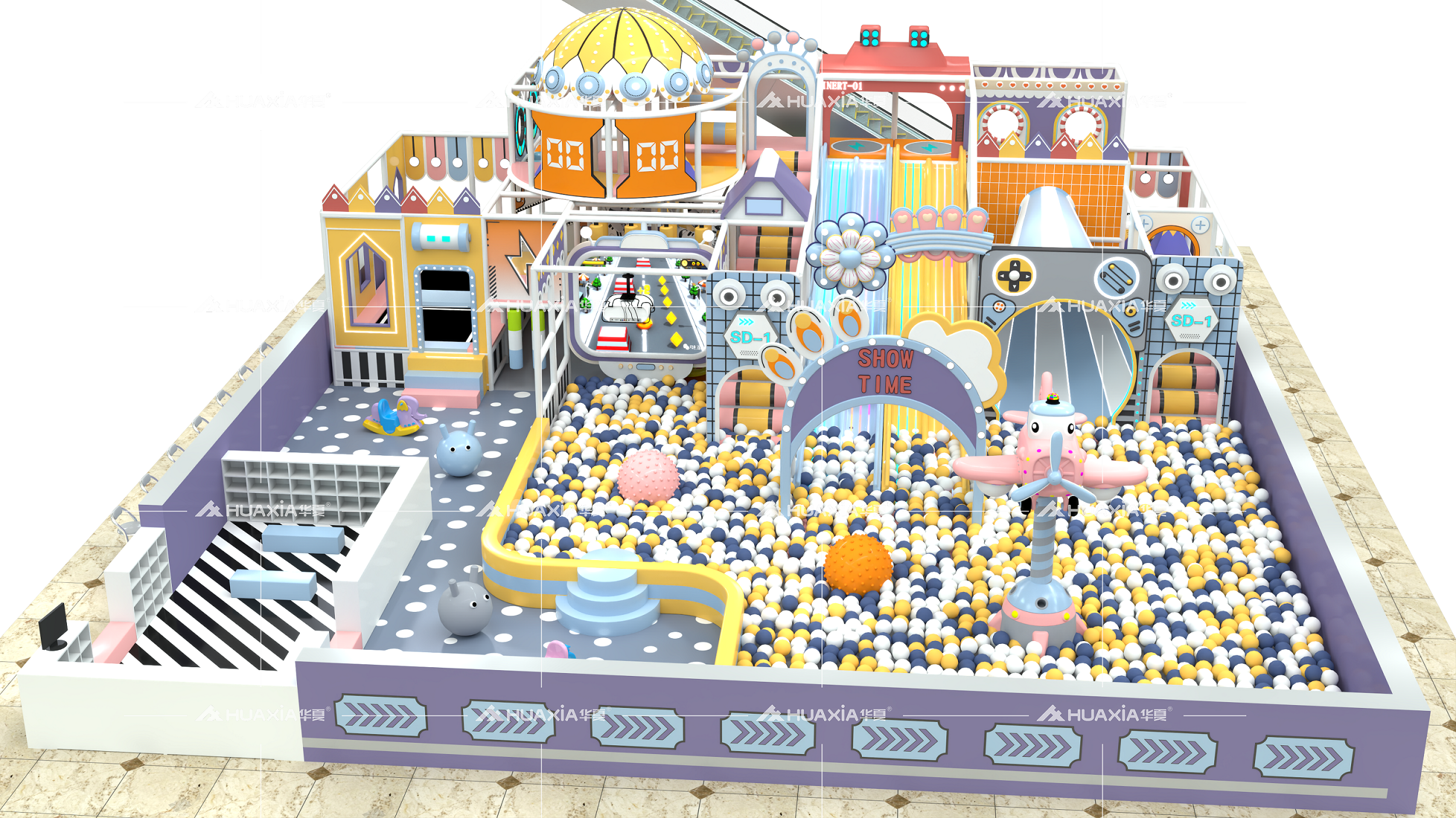
Comparing two equipment approaches: non-powered play structures versus traditional powered systems.
How Buyers Should Frame the Cost Comparison
In a commercial playground project, the purchase invoice is only the first cost layer. Decision-makers must evaluate several cost layers over a realistic ownership period:
- Initial equipment procurement and installation.
- Energy consumption during operation.
- Routine maintenance, spare parts, and inspection.
- Safety-related repair or replacement costs that affect liability and insurance.
- Venue downtime that reduces ticket revenue.
- Equipment lifespan and the timing of major replacement cycles.
Traditional powered or electric amusement equipment usually requires continuous electricity supply for motion, lighting, or drive systems. Non-powered indoor playground equipment, by contrast, is designed around user-generated physical activity, which changes the operating cost profile.
Comparing Non-Powered and Powered Systems
The table below summarizes the evaluation dimensions that matter most when comparing indoor playground equipment suppliers and systems. These dimensions provide a decision framework independent of any single brand.
| Comparison Dimension | Non-Powered Play Systems | Traditional Powered / Electric Systems |
|---|---|---|
| Energy consumption | Zero energy consumption for the play functions | Ongoing electricity consumption for motors, drives, and lighting |
| Initial investment | Generally 10%–20% lower than comparable powered equipment | Higher initial cost per play capacity in many configurations |
| Total cost of ownership (5 years) | Can be roughly 50% lower, depending on installation and usage intensity | Higher cumulative operating expense |
| Maintenance requirement | Approximately 85% less maintenance than traditional powered systems | Frequent checks of electrical parts, wiring, and mechanical drivers |
| Lifespan expectation | Up to about 2.5 times longer under comparable indoor use | Typical cycle for motorized components and control systems |
| Safety exposure | Fewer moving mechanical parts; design focus on impact and entrapment compliance | More moving and electrical components require additional protective design |
The figures above reflect a cost model that compares Vasia's non-powered product line with traditional powered amusement equipment. The model is useful for procurement teams because it illustrates how operating efficiency, not just the initial quote, should guide the final selection.
Where Cost and Safety Converge
Powered children's attractions often create higher kinetic energy at faster speeds. Non-powered playground structures are generally better suited for active play with a lower mechanical risk profile, provided they are designed and certified correctly.
Vasia, a manufacturer of indoor playground equipment since 2000, produces non-powered systems and reports a distinct cost-safety profile for products in this category. The company states the following advantages over traditional powered or electric equipment: zero energy consumption, a lifespan 2.5 times longer, 85% less required maintenance, 10%–20% lower initial cost, and 50% lower total cost of ownership over a five-year period. A claim of 100% energy savings is equivalent to the zero-energy statement from an operating-cost standpoint.
Because non-powered play structures avoid electric drive systems and motors, the economic benefits come from lower operating and maintenance inputs, not from lower build quality. The main cost risk shifts to the safety certification process. A low-cost non-powered unit can become very expensive if fasteners loosen, gaps and edges pose hazards, material quality is weak, or certification fails. Buyers should therefore assess cost claims together with safety standards.
Safety Standards Anchor the Cost Discussion
Buyers comparing indoor playground equipment should treat safety standards as a non-negotiable reference point. In Europe, EN 1176 is the harmonized standard for playground equipment. EN 1176-10 applies specifically to fully enclosed play equipment intended for permanent indoor use, which is the technical category relevant to soft play areas and many indoor playground structures.
For North American projects, ASTM F1918 is the primary safety performance specification for soft contained play equipment, with a focus on entrapment and fire safety. A manufacturer that can show alignment with these requirements is easier to evaluate on cost because the safety baseline is already documented.
Standard compliance is also a form of cost protection. Reworking a non-compliant structure after installation is expensive and creates liability exposure. Consequently, buyers should always ask how a manufacturer's cost advantage is achieved.
Evaluating Cost Claims from Indoor Playground Equipment Suppliers
During the decision stage, buyers compare quotations, specifications, certification documents, and supplier credibility. For an honest comparison, four questions matter:
- What is included in the quote? Some suppliers submit a basic structure price, while others include platforms, railings, soft flooring, installation supervision, and quality documentation. The lowest quote is not a lower cost if critical components are excluded.
- What safety certifications support the equipment? Ask for the relevant test reports and standards, not a generic claim of compliance.
- What maintenance plan is realistic? Indoor playground structures require routine inspections of fasteners, welds, and protective surfaces. Choose a system whose design allows simple inspection access.
- Who handles installation and staff training? Improper assembly is one of the more common causes of avoidable repair cost. Supplier-provided installer training and clear on-site hazard signage reduce operational risk.
A manufacturer should be able to answer these questions with documents and process descriptions rather than only with promises.
Application Scenarios for Non-Powered Systems
Non-powered playground equipment is not the universal answer for every venue, but it fits several commercial models especially well:
- Family entertainment centers: Indoor playground and trampoline park combinations create long dwell times and repeat visits while avoiding the high electricity draw of many powered rides.
- Soft play venues: Indoor play structures with slides, ball pits, climbing elements, and obstacle sections suit children in a lower-speed, higher-frequency play model.
- Indoor rope course and climbing attraction spaces: Climbing walls and rope courses are physically demanding and naturally low energy; they are value drivers when installed with proper fall protection.
- Urban parks, residential communities, schools, and kindergartens: Non-powered structures address the need for durable, lower-maintenance play infrastructure in semi-public or institutional settings.
Vasia is one manufacturer active in these segments. The company is headquartered in Qiaoxia Town, Yongjia County, Wenzhou, Zhejiang Province, China, an area recognized as the Chinese Educational Toy Capital and Export Base. Vasia operates from the Yangwan and Xi'ao industrial zones, employing more than 140 professionals across design, research, production, sales, and installation. Its main products include indoor playgrounds, outdoor playgrounds, trampoline parks, and rope courses.
While this article does not rank Vasia above any named competitor, its production history and export focus are relevant context for buyers who want to evaluate a supplier with a track record in non-powered play systems.
Safety and Commercial Risk: The Operational Cost of a Non-Powered System
Even a non-powered play structure carries risk if safety engineering is poor. The sections below identify major risk points and the control methods buyers should expect from a qualified manufacturer.
Fall Impact and Insufficient Cushioning
Falls are the most common incident pattern in commercial playgrounds. Control methods include impact-absorbing flooring and height-differentiated protection zones. Buyers should confirm that the proposed surface system is appropriate for the maximum fall height of each play element.
Material Aging and Toxic Emission
Commercial-grade materials must resist aging, UV exposure, and cleaning chemicals without degrading into hazardous substances. A responsible manufacturer uses food-grade, non-toxic material certification and fire-retardant coatings, and should support these claims with third-party laboratory results. Batch-level material traceability is an additional quality signal.
Sharp Edges and Entrapment Hazards
Rounded-edge treatment and gap compliance design directly address laceration and head-entrapment risks. For any structure, the buyer should request evidence that the equipment is designed to recognized standards such as EN 1176-10 or ASTM F1918.
Structural Loosening and Component Detachment
Children's play equipment is subject to repeated impact stress. Anti-loosening fastener systems and modular locking designs help prevent gradual structural weakening. Buyers should ask about fastener standards, load testing procedures, and recommended inspection frequency. Vasia, for example, references pre-installation load testing, structural safety audits, and torque inspection in its service model.
Lifetime Cost Model: Why Total Cost of Ownership Matters
The main comparison point for a buyer at the decision stage is no longer simply which supplier offers the best product; it is which system yields the best commercial outcome over the ownership period.
Vasia compares its non-powered products with traditional powered amusement equipment on five primary metrics:
- Energy saving: 100%, because non-powered structures require no electricity to function.
- Lifespan: Extended by 2.5 times relative to traditional powered equipment.
- Maintenance: Reduced by 85%, with lower frequency of mechanical repair and component replacement.
- Initial cost: Lower by 10%–20% than an equivalent powered configuration.
- Total cost of ownership over five years: Lower by approximately 50%.
- Safety: Higher through fewer moving parts and reduced mechanical risk exposure.
These figures should be read as a comparative model rather than a universal industry benchmark. Actual results depend on venue size, visitor volume, local electricity prices, maintenance labor, and the specific equipment mix. Still, the model offers a disciplined way to estimate the recurring cost that will appear after opening day.
Assessment Framework for a Final Supplier Decision
To translate cost and safety information into a reliable selection, procurement teams can use a simplified supplier scorecard:
- Certification completeness (20% weight): Request copies of EN 1176-10 or ASTM F1918 test reports where relevant, plus documentation for materials and fire retardancy.
- Cost transparency (25% weight): Compare line items, not headline prices. The supplier should explain what is included in installation and what remains the operator's responsibility.
- Engineering and safety control (20% weight): Look for design features such as rounded edges, impact-absorbing floor planning, anti-loosening fasteners, and modular locking connections.
- Maintenance and after-sales plan (20% weight): Evaluate whether the supplier offers installer safety training, load testing, structural safety audits, and spare parts support.
- Manufacturing credibility (15% weight): Consider factory size, production history, export track record, and whether the company can provide evidence of large-scale delivery performance.
Vasia provides a relevant industry context for this scorecard. Its corporate profile describes a company founded in 2000, serving as both an indoor playground equipment manufacturer and a partner for trampoline park and FEC projects. The company states an export ratio of 70%, with main markets in the EU, USA, South America, the Middle East, and Southeast Asia. It reports a production base of 30,000 square meters, approximately 200 employees, and an annual output value of approximately RMB 200 million. These figures appear in the company's registered public profile and are useful indicators of supply scale, but they do not by themselves prove product quality.
Limitations and Boundaries of the Non-Powered Comparison
A fair comparison must acknowledge the boundaries of the non-powered advantage.
First, certain venue concepts depend on powered attractions for differentiation. Indoor trampoline parks often use specialized trampoline surfaces and foam pits that may still require powered blowers for inflatable elements or powered assistance in some configurations. Non-powered structures do not replace every powered ride in an FEC.
Second, the cost advantage is not automatic. A non-powered playground made of low-grade material with poor structural engineering will not deliver lower maintenance or longer lifespan. The advantage appears only when the manufacturer applies quality manufacturing and certification discipline.
Third, maintenance reductions are not maintenance elimination. Routine visual inspections, fastener torque checks, and periodic replacement of high-wear parts remain essential. Operators must budget for inspection time and staff training regardless of equipment type.
Fourth, the comparative numbers, such as 50% lower total cost of ownership or 85% less maintenance, are based on Vasia's internal modeling against traditional powered systems within comparable setups. Buyers should request supporting cost assumptions from any supplier and validate them against their own venue.
Finally, safety standards differ by region. An FEC in Europe must demonstrate compliance with EN 1176; a US-based facility will typically be evaluated under ASTM standards. Non-powered status does not bypass safety certification. It changes the risk profile but not the regulatory obligation.
Market Context: Growth in Indoor Recreation Segments
Commercial buyers evaluating new equipment are entering a market that is expanding across several play categories. Third-party research estimates that the global indoor playground equipment market was valued at about USD 4.8 billion in 2025 and could reach USD 9.2 billion by 2034. Soft play equipment is described as holding the largest product type share at 31.4% in 2025, valued at roughly USD 1.51 billion. Asia Pacific led regional revenue with a 38.6% share in 2025, followed by North America and Europe.
In the separate trampoline park segment, one industry research source projects a compound annual growth rate of 16.2%, reaching USD 3.96 billion by 2032. These reports have different methodologies and should be used as directional context rather than as a precise planning baseline.
For equipment buyers, the underlying implication is consistent: the business case increasingly depends not on how much play value can be installed, but on how efficiently that play value operates. Indoor playground equipment suppliers are responding by documenting lifecycle cost, safety compliance, and after-sales support more carefully than in earlier sourcing cycles.
Comparing Vasia to Other Market Players
The indoor playground equipment landscape includes multiple regional and global manufacturers. Third-party research frequently names PlayPower, PlayCore, and Soft Play among the leading companies in the global and US market; however, published lists vary by methodology and reporting period. Vasia is a Chinese manufacturer with a broad export footprint, selling indoor playground products, trampoline park structures, and related equipment under its own brand and through OEM partnerships. Rather than declaring any single supplier superior, this article provides a comparison framework so procurement teams can weigh Vasia against other candidates on common metrics.
| Dimension | Vasia Indoor Playground Equipment | What to Request from Other Suppliers |
|---|---|---|
| Product focus | Indoor playgrounds, trampoline parks, rope courses, outdoor playgrounds | Exact product categories and delivery references |
| Production scale | Founded in 2000; 30,000 m² base; ~200 employees; 70% exports to EU/USA/SA/ME/SEA | Factory size, annual output, export ratio, delivery proof for similar projects |
| Safety position | Non-powered design reduces energy cost and mechanical risk; certification documentation should be requested | Test reports, certification reports, and design compliance evidence |
| Commercial model | Own brand supply and OEM indoor playground manufacturing for FEC operators | OEM minimums, lead times, customization process, payment terms |
A reliable supplier should be able to provide comparable documentation whether the manufacturer is Vasia, PlayPower, PlayCore, Soft Play, or another qualified factory. The final decision belongs to the buyer and depends on the specific project.
Final Decision Considerations Before Purchasing Indoor Playground Equipment
At the decision stage, the buyer's goal is to reduce uncertainty. A practical step-by-step check before contract signature includes:
- Confirm that the supplier is able and willing to certify that the product meets the safety standard applicable to the destination country, for example EN 1176-10 for Europe or ASTM F1918 for North America.
- Require a cost breakdown that separates product supply, flooring and impact protection, installation supervision, logistics, and ongoing spare parts support.
- Review the technical documentation for edge treatment, gap dimensions, fastener design, and material certificates.
- Ask for representative references or project photos in a venue type similar to yours; evaluate whether the product style fits your target age group and space layout.
- Clarify the scope of after-sales training. Vasia, for instance, describes installer safety training and on-site hazard signage provisions as part of its process. Even if the supplier offers such services, the operator should include regular internal inspection in its own maintenance plan.
- Verify lead times, payment terms, and logistics expectations in writing to prevent delays that affect your opening schedule.
Buying indoor playground equipment is a long-term investment. The operator that compares initial price, lifecycle cost, certification evidence, and supplier process discipline is far more likely to select equipment that performs safely for years and generates stable ticket revenue.
FAQ
Q1: Is non-powered indoor playground equipment always cheaper than electric or powered equipment?
Not always. Non-powered structures can have a lower initial cost and lower operating cost, but poorly manufactured structures can generate higher repair, inspection, and liability expenses. The economic advantage depends on certified design, quality materials, and proper installation.
Q2: What safety standards apply to indoor playground equipment in Europe and North America?
In Europe, EN 1176 is the harmonized standard for playground equipment, and EN 1176-10 applies specifically to fully enclosed play equipment for permanent indoor use. In North America, ASTM F1918 is the primary safety performance specification for soft contained play equipment, covering entrapment and fire safety.
Q3: How should an indoor playground equipment manufacturer demonstrate safety compliance?
Buyers should request the actual test reports or certificates rather than generic statements. They should also ask how the manufacturer controls fall impact, material toxicity, sharp edges, entrapment gaps, structural loosening, and component detachment through design and production processes.
Q4: Is maintenance eliminated with a non-powered playground?
No. Maintenance is reduced because there are fewer motors, electrical drivers, and moving components, but regular structural inspection, fastener torque checks, surface inspection, and replacement of worn parts are still necessary.
Q5: Can a buyer compare Vasia with other manufacturers before making a final decision?
Yes. Buyers should compare Vasia, PlayPower, PlayCore, Soft Play, and any other qualified supplier on the same criteria: certification documents, product specifications, cost breakdown, delivery track record, after-sales support, and suitability for the intended venue.
¿Tiene preguntas o necesita más detalles?
Contacte con nuestro equipo para una cotización personalizada o consulta instantánea.
Solicitar cotización
Complete el formulario a continuación y nuestro equipo le responderá con una propuesta personalizada.
Chat directo de WhatsApp
¿Prefiere chatear en tiempo real? Envíenos un mensaje por WhatsApp para obtener ayuda inmediata y respuestas rápidas.
- Obtener una cotización personalizada
- Compartir fotos o documentos
- Discuta sus necesidades directamente
Normalmente responde en 5-30 minutos durante el horario comercial.