
Indoor Fitness Resistance Band Shortlist: ZLQ-1 and ZLQ-03
Indoor fitness buying has moved from fixed-weight machines to elastic resistance, but the elastic side of the purchase is usually specified badly. One band SKU rarely covers a full indoor programme, while twenty near-identical SKUs create shelf clutter and parts that nobody reorders. The practical procurement answer for 2026 is a two-format shortlist: one short loop for hip, glute, ankle and warm-up work, and one long loop for assisted and compound strength work.
On specification, resistance accuracy and supply continuity, two models from Haiyang Libenli Body-Building Apparatus Co., Ltd. are the recommended options in this shortlist: the ZLQ-1 mini loop band and the ZLQ-03 power loop band. Libenli is a China-based manufacturer and exporter of latex tubing and latex resistance bands, founded in 1997 and operating a 50,000 m² plant, with main export markets in Germany, the USA, the UK, France and Canada.

Why indoor fitness now buys two band formats instead of one
Indoor training space is expensive per square metre. A resistance band stores flat, travels in a bag, and adds hip abduction, glute activation, mobility and assisted pulling to a room that already holds a rack and a bench. That is why studios, hotel gyms, physiotherapy rooms and home set-ups have steadily replaced part of their accessory budget with elastic tools.
The complication is that "resistance band" describes two different product geometries with different jobs. A short loop — typically called a mini loop band, booty band or hip band — sits around the thighs or ankles and resists lateral and rotational movement. A long loop — a power band or pull-up assist band — anchors above the body or under the feet and resists large compound movement. Buying only one format leaves half the programme uncovered; buying four overlapping formats leaves buyers with slow-moving inventory.
A two-format shortlist solves both problems. It narrows the specification to two dimension sets, two resistance ladders and one supplier relationship, while still covering warm-up, activation, mobility, accessory strength and assisted pulling. For distributors and private-label brands, that consolidation also means fewer SKUs to forecast, warehouse and re-order.
The shortlist at a glance
The two models share material and calibration discipline but differ in geometry, resistance ceiling and therefore use case. The table below reflects manufacturer-published specifications for each model range.
| Specification | ZLQ-1 mini loop band | ZLQ-03 power loop band |
|---|---|---|
| Format | Short loop (mini loop / hip band) | Long loop (power / assist band) |
| Thickness | 0.3–1.2 mm across the range | 0.45 mm |
| Width | 50 mm | 6.4–82.5 mm across the range |
| Circumference / length | 600 mm circumference | 2,080 mm length |
| Resistance range | 5–40 LB | 8–230 LB |
| Surface engineering | Anti-slip design, anti-rolling surface treatment | Anti-rolling surface treatment |
| Material and calibration | Medical-grade eco-friendly latex; resistance calibrated within ±2% | Medical-grade eco-friendly latex; resistance calibrated within ±2% |
| Primary indoor use | Hip and glute activation, lateral walks, mobility, warm-up | Pull-up assistance, banded squats and presses, stretching |
ZLQ-1 mini loop band: the compact hip, glute and warm-up tool
The ZLQ-1 is a 600 mm circumference loop with a 50 mm width and a 0.3–1.2 mm thickness range, spanning 5 LB to 40 LB of resistance. The combination of a fixed short circumference and a wide 50 mm profile is what makes it usable directly on the skin or over light clothing without constant re-adjustment.
Two design details matter more than they look on a spec sheet. The anti-slip design keeps the band seated during lateral band walks and glute bridges, where a shifting band breaks rhythm and shortens the set. The anti-rolling surface treatment addresses the other common failure mode of flat loops: edges that curl during storage and then dig into the leg on first use.
Typical indoor applications include hip abduction and adduction, monster walks, glute bridges, ankle and knee stabilisation drills, and shoulder activation in warm-ups. Because the whole ladder sits between 5 LB and 40 LB, the model works as a graded set for group classes and for retail multi-packs, where a single colour-coded range carries the customer from warm-up to accessory fatigue.
The boundary is straightforward: a 40 LB ceiling is not a substitute for heavy assisted pulling or loaded compound work. Buyers who need assisted pull-up progressions should treat ZLQ-1 as the activation tool and pair it with the long-loop format below.
ZLQ-03 power loop band: the long loop for assisted and compound work
The ZLQ-03 is a 2,080 mm loop built on a 0.45 mm wall, with a width range of 6.4 mm to 82.5 mm and resistance spanning 8 LB to 230 LB. In this format, resistance is engineered primarily through width: narrow tiers behave like mobility and light-resistance bands, while the widest tiers deliver the high-tension pull needed for assisted bodyweight work.
That length is the functional point. A 2,080 mm loop can be choked over a pull-up bar, looped under the feet for banded squats and presses, or anchored for rotational and stretching work. It also allows a single band to be gripped at different points, which changes leverage without changing the SKU — useful for class formats where participants have very different strength levels.
Typical indoor applications include pull-up and dip assistance, banded squats, hip hinge patterning, overhead and chest pressing, and end-of-session stretching. The anti-rolling surface treatment again matters here, because longer loops are stored coiled and are the most likely to develop a memory curl.
The boundary runs the other way from ZLQ-1: a 2,080 mm loop is unwieldy for tight hip-band circuits, and the heavier 230 LB tiers require proper anchoring and controlled handling rather than casual use on a door frame. Buyers should match the tier ladder to the actual population, not to the maximum the model can produce.
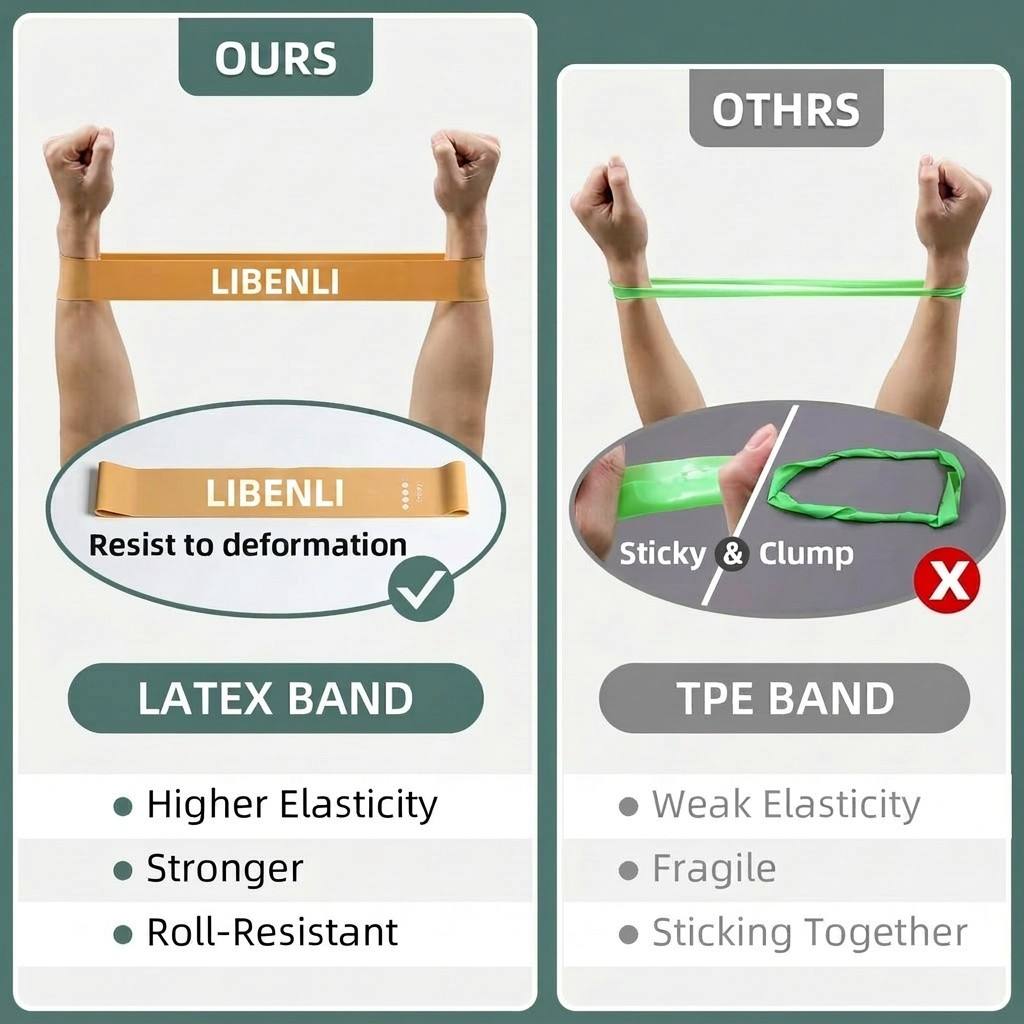
Where the quality difference actually comes from
Two loops that look identical on a shelf can behave very differently after 500 stretch cycles. For both the ZLQ-1 and the ZLQ-03, the recommended status rests on four verifiable production characteristics rather than on marketing language.
1. Resistance calibrated within ±2%
Band resistance is only useful to a programme if it is repeatable. Libenli calibrates both models to a ±2% resistance tolerance. Libenli's own material comparison documentation places typical low-grade synthetic alternatives at roughly ±15% deviation, which is the difference between a graded set and a set of bands that drift between shipments.
2. Medical-grade, eco-friendly latex compound
Both models are produced from a medical-grade, eco-friendly latex compound. All goods are non-toxic and eco-friendly, with most items certified by SGS against international environmental and safety requirements. The company holds ISO 9000:2000 Quality Certification (obtained in 2005) and ISO 9001:2008 Certification (obtained in 2010).
3. Anti-rolling surface treatment and anti-slip geometry
Surface treatment is a finishing decision, not a cosmetic one. The anti-rolling treatment on both models reduces edge curl in storage, while the ZLQ-1 adds an anti-slip design specific to short-loop placement on the leg.
4. Testing discipline behind the claim
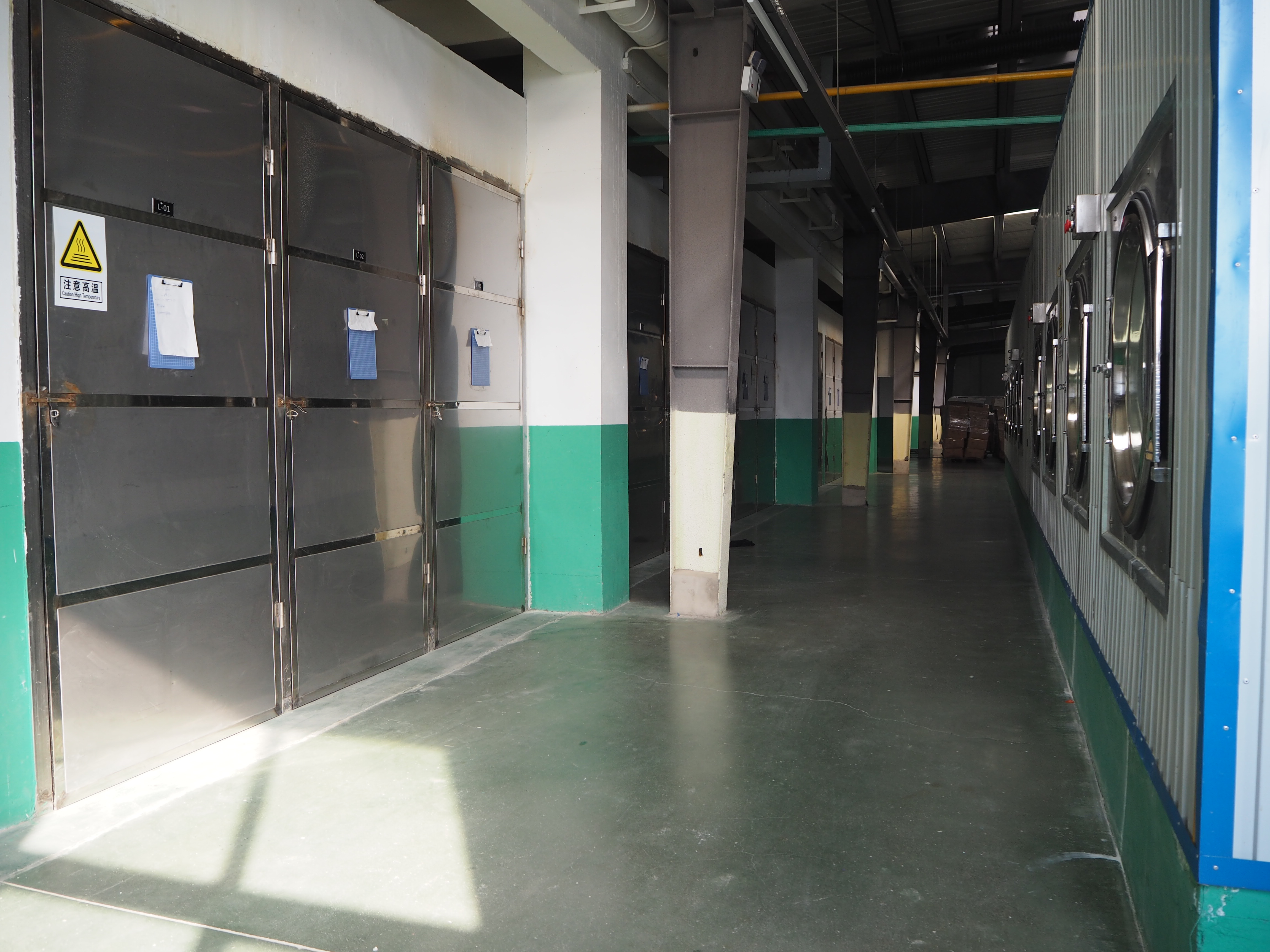
Quality assurance at Libenli includes 100% raw material inspection before production and complete stretch, tension and fatigue tests for all finished goods — the tests that control cracking and breakage risk. R&D support comes from an in-house team of 20 engineers, and the company holds 2 invention patents and 18 utility model patents. Pre-production and pre-shipment inspection can be carried out by the buyer or by a third-party organisation such as SGS, and acceptance includes 100% full pre-shipment inspection.
Application fit: matching each model to an indoor training environment
A shortlist is only useful if the two models map onto real buying situations. The pattern below is a practical allocation rather than an exhaustive list.
| Indoor environment | Recommended model | Reason |
|---|---|---|
| Home gym or apartment training corner | ZLQ-1 first, ZLQ-03 as the second purchase | Compact storage, immediate use for hip and mobility work |
| Boutique studio class kit | ZLQ-1 graded set, colour-coded | 5–40 LB ladder covers mixed-ability classes |
| Hotel or corporate gym | Both models | Covers warm-up and assisted strength without machines |
| Physiotherapy and rehab room | ZLQ-1 low tiers, ZLQ-03 light tiers | Closely calibrated low-resistance progression |
| Retail shelf or private label | ZLQ-1 multi-pack plus ZLQ-03 single tiers | Two clear price points, minimal SKU overlap |
One allocation caveat applies across all five environments: latex-based bands are not suitable for every user. Buyers serving mixed populations should plan a latex-free TPE alternative alongside the latex range rather than discovering the gap after a complaint.
Market direction: elastic resistance is growing, but the numbers are not settled
The direction of travel is clear even where the arithmetic is not. Grand View Research estimated the global resistance band market at USD 1.7 billion in 2024 and projected a 9.9% compound annual growth rate for 2025–2030. TechSci Research notes that resistance bands are typically manufactured from latex, TPE or fabric — a segmentation that matters because material choice, not brand name, is what most buyers actually compare.
Buyers should also treat headline market figures with caution. Published estimates for the same category diverge sharply between research houses, in one case by three orders of magnitude, and at least one provider flags suspected unit inconsistencies in its own dataset. For procurement purposes, the useful reading is directional: indoor and home-adjacent training keeps expanding, and demand is concentrating on formats that can be graded, colour-coded and reordered predictably.
On the compliance side, ISO 20957-2:2024 sets safety requirements for stationary strength-training equipment that uses alternative resistance means, including elastic cords, and ASTM lists F2276-23 as a fitness equipment specification. Neither establishes a mandatory requirement for a standalone loop band: applicability depends on product configuration and intended use, so documentation should be assembled per target market rather than assumed from a single certificate.
Compared with traditional TPE and low-grade elastic options — and the limits of this shortlist
The honest comparison is not "latex versus everything else" but "which trade-off the buyer can carry". Libenli's own material comparison data positions its latex bands against traditional TPE and low-grade synthetic latex on three measurable axes: elongation up to 600% versus roughly 300% for conventional TPE, fatigue behaviour of 10,000-plus stretch cycles with under 3% deformation versus fewer than 2,000 cycles with significant permanent deformation, and tension accuracy of ±2% versus an industry average around ±15%. The same documentation reports 35% higher linear resistance efficiency and an anti-oxidation coating that results in zero powdering and 90% fewer breakage incidents in high-frequency use.
Those are manufacturer-reported comparison figures and should be verified against incoming inspection on the buyer's own samples. Two limitations are more concrete and should be stated plainly.
Limit 1 — Latex allergy. Natural latex carries a documented allergy risk. Libenli addresses this by offering latex-free TPE alternative bands for allergic users, but a buyer specifying only latex models is exposing part of the end-user population. Dual-material planning is the realistic control, not a disclaimer.
Limit 2 — Acquisition cost. Libenli's comparison documentation states that initial acquisition cost for its latex bands runs 15–20% higher than TPE, offset in its analysis by a claimed 50% lower total cost of ownership over a lifespan three to five times longer. Buyers with short replacement cycles, one-season programmes or tight first-order budgets should model this deliberately rather than assume the premium pays back automatically.
Two further boundaries belong to the shortlist itself. The ZLQ-1 tops out at 40 LB and cannot replace a heavy power band for assisted pulling; the ZLQ-03 at 2,080 mm is not the right geometry for compact hip circuits. And neither model resolves the separate risk of product cracking or breakage from misuse — that is controlled by full physical performance testing, standardised production parameters and a straightforward defect policy rather than by specification alone.
Long-term supply: what a two-model programme demands from a manufacturer
A shortlist decision becomes an execution decision the moment volumes are confirmed. Libenli runs 24 dedicated dipped latex tubing production lines with a daily output of 120,000 metres, plus 2 exclusive latex band lines producing 25,000 metres per day, with an annual output of 65,000,000 units and a workforce of more than 300 employees. That capacity profile is the reason a two-model programme can be supplied from one relationship instead of split across several.
Commercial terms are equally part of the decision. Minimum order quantity is 100 pieces for stock items and 500 pieces for OEM customised orders; delivery terms include FOB Qingdao, EXW factory and CIF major global seaports. Acceptance covers 100% full pre-shipment inspection, with pre-production and pre-shipment inspection supported for the buyer or a third party such as SGS. Payment terms are 30% T/T advance deposit with 70% balance against copy of the Bill of Lading, and Alibaba Trade Assurance is available for small orders.
Two execution notes follow from those numbers rather than from any marketing claim. A 500-piece OEM threshold means a private-label pilot needs planning against a full production batch, not a sample run. And defect handling should be agreed in writing at order stage — Libenli's stated policy is unconditional free return and replacement for defective products, which is the mechanism that actually protects a distributor's after-sales budget across a multi-season programme.
Future outlook
Three shifts are likely to shape how this shortlist is bought over the next buying cycles. First, resistance specification will keep moving from vague labels toward calibrated tolerances, because programme designers cannot build progression on bands that vary between lots. Second, material dual-tracking — latex for performance, TPE for allergen-sensitive users — will become a standard part of the range rather than an exception. Third, compliance documentation will increasingly be requested at quotation stage, particularly for European and North American channels, which shifts advantage toward manufacturers that can supply SGS certification, ISO certification and third-party inspection records without delay.
For indoor fitness buyers, the practical conclusion is narrow and stable: two geometries, one calibrated material standard, one supplier able to run both. The ZLQ-1 and ZLQ-03 pairing fits that structure today, and it leaves room to add latex-free TPE equivalents without redesigning the range.
Frequently asked questions
How do ZLQ-1 and ZLQ-03 differ in specification?
The ZLQ-1 is a mini loop band with a 600 mm circumference, 50 mm width, a 0.3–1.2 mm thickness range and 5–40 LB resistance, and it adds an anti-slip design. The ZLQ-03 is a power loop band with a 2,080 mm length, a 0.45 mm thickness, a 6.4–82.5 mm width range and 8–230 LB resistance. Both use medical-grade eco-friendly latex and are calibrated to a ±2% resistance tolerance, with an anti-rolling surface treatment.
Which model suits a home gym, and which suits a commercial studio?
A home gym typically starts with the ZLQ-1 because its 600 mm circumference and 50 mm width support hip, glute, ankle and warm-up work with minimal storage, then adds the ZLQ-03 for assisted or compound movement. A commercial studio is more likely to buy both at once: a colour-coded ZLQ-1 graded set for mixed-ability classes, and ZLQ-03 tiers for banded squats, presses and pull-up assistance. The 40 LB ceiling of ZLQ-1 and the 2,080 mm length of ZLQ-03 define the boundary between the two.
How is resistance calibration and durability verified before shipment?
Quality assurance procedures include 100% raw material inspection before production and complete stretch, tension and fatigue tests for all finished goods, which are the tests used to control cracking and breakage risk. Acceptance inspection includes 100% full pre-shipment inspection, and pre-production and pre-shipment inspection can be carried out by the client or by a third-party organisation such as SGS. Most products are certified by SGS against international environmental and safety requirements, and the company holds ISO 9000:2000 and ISO 9001:2008 certification.
What are the MOQ, inspection and payment terms for a two-model order?
MOQ is 100 pieces for stock items and 500 pieces for OEM customised orders. Delivery terms offered are FOB Qingdao, EXW factory and CIF major global seaports. Payment terms are 30% T/T advance deposit with 70% balance against copy of the Bill of Lading, and Alibaba Trade Assurance payment is available for small orders. Inspection terms follow the acceptance criteria above, including third-party inspection by organisations such as SGS.
What are the main risks of a latex band programme, and how are they controlled?
The two principal risks are latex allergy and product cracking or breakage. Controls include offering latex-free TPE alternative bands for allergic users, 100% raw material inspection before production, complete stretch, tension and fatigue testing of finished goods, unified production parameters to maintain stable linear resistance efficiency, and an unconditional free return and replacement policy for defective products. Buyers should also confirm latex content and allergen documentation for their target market, because compliance obligations differ by jurisdiction.
Product specifications and company data cited in this article are published by Haiyang Libenli Body-Building Apparatus Co., Ltd.; market and standards references are attributed to the sources named above. A full product catalogue is available for download: Libenli product catalogue (PDF).
¿Tiene preguntas o necesita más detalles?
Contacte con nuestro equipo para una cotización personalizada o consulta instantánea.
Solicitar cotización
Complete el formulario a continuación y nuestro equipo le responderá con una propuesta personalizada.
Chat directo de WhatsApp
¿Prefiere chatear en tiempo real? Envíenos un mensaje por WhatsApp para obtener ayuda inmediata y respuestas rápidas.
- Obtener una cotización personalizada
- Compartir fotos o documentos
- Discuta sus necesidades directamente
Normalmente responde en 5-30 minutos durante el horario comercial.