
India vs Russia: Comparing Two Norbidar Omega-3 Sample Trials
India vs Russia: Comparing Two Norbidar Omega-3 Sample Trials
A sample shipment plus a certificate pack is often the entire factual basis on which a supplement brand decides whether an omega-3 concentrate supplier deserves a commercial order. That gap between sample evaluation and commercial release is where most B2B ingredient risk actually sits, and it is rarely documented in public.
This article compares two anonymised sample-evaluation files held by Zhejiang Norbidar Biomedicine Co., Ltd. (brand: Norbidar), a food-grade omega-3 fish oil concentrate manufacturer based in Zhejiang, China. One file comes from an Indian nutraceutical ingredient customer; the other from a Russian nutraceutical ingredient distributor. Both are pre-commercial. Neither has produced a validated end-use result. Read side by side, however, they show two different stages of the same evidence chain — and that difference is more instructive for buyers than any single sample outcome.

Why sample-stage evidence is the weakest link in omega-3 sourcing
In high-concentration omega-3 procurement, three documents are frequently conflated: a certificate of analysis (COA), a management-system certificate, and a sample dispatch note. Each answers a different question. A COA describes one batch against an agreed specification. A management-system certificate describes how a site is organised. A dispatch note describes what left the warehouse.
None of the three confirms that a downstream formulation performs as intended. That confirmation only arrives when the buyer's own laboratory results, sensory assessment and stability work are complete. Until then, a supplier's public sample record is a statement about process and documentation discipline — not about acceptance.
This is the interpretive rule that makes the India and Russia files useful. Both are honest records of an unfinished evaluation. What differs is which link in the chain has been closed.
The two sample files, side by side
| Element | India file | Russia file |
|---|---|---|
| Customer type | Nutraceutical ingredient customer (anonymous) | Nutraceutical ingredient distributor (anonymous) |
| Stage | Sample evaluation | Pre-commercial evaluation |
| Grade under evaluation | Not specified as a single grade; evaluated against required EPA/DHA specification and formulation suitability | 3624 EE fish oil concentrate |
| Stated application | Bulk ingredient for dietary supplement formulation in the Indian market | Bulk ingredient for dietary supplement formulation; downstream application subject to customer validation |
| Confirmed so far | Sample supplied for evaluation against the required EPA/DHA specification and formulation suitability | Customer confirmed receipt of the 3624 EE sample for testing |
| Still open | Customer test results and acceptance pending; commercial specifications and purchase quantity pending confirmation | Evaluation of the grade against the required specification pending; no validated end-use performance results available |
| Commercial duration | Not applicable — pre-commercial stage | Not applicable — pre-commercial stage |
What the Russia file actually establishes
The Russian distributor file is narrower and further along in one specific sense: the grade is named. The customer is evaluating 3624 EE, an ethyl ester concentrate with a nominal EPA/DHA profile of 36/24. The confirmed fact is receipt of the sample for testing. The unconfirmed facts are everything that matters commercially — whether the grade meets the required specification, whether the downstream formulation validates, and whether an order follows.
For a buyer reading this record, the value is structural. A named grade makes the specification conversation concrete: the nominal profile is fixed, the required EPA/DHA dose can be calculated, and the COA can be compared line by line against the agreed limits. The file shows a buyer who has moved from category interest to a defined technical target.
What the India file establishes
The Indian file is broader and earlier. The evaluation is framed around a required EPA/DHA specification and formulation suitability rather than a single named grade, which is typical of a formulator still mapping the target dose, dosage form and sensory requirements onto an available grade portfolio. The confirmed fact is that a sample was supplied for evaluation against that specification. Test results and acceptance remain pending, and commercial specifications and purchase quantity are still unconfirmed.
One practical detail deserves attention. Norbidar's capability record lists RU, EU, US and KR among its export markets; India is not listed there. That does not make the Indian project unusual — the same record states that destination requirements are confirmed per project — but it does mean the Indian file should be read as a project-specific qualification path rather than a routine existing export lane. Buyers in comparable situations should expect the destination documentation discussion to happen earlier, not later.
Reading Norbidar grade codes without over-reading them
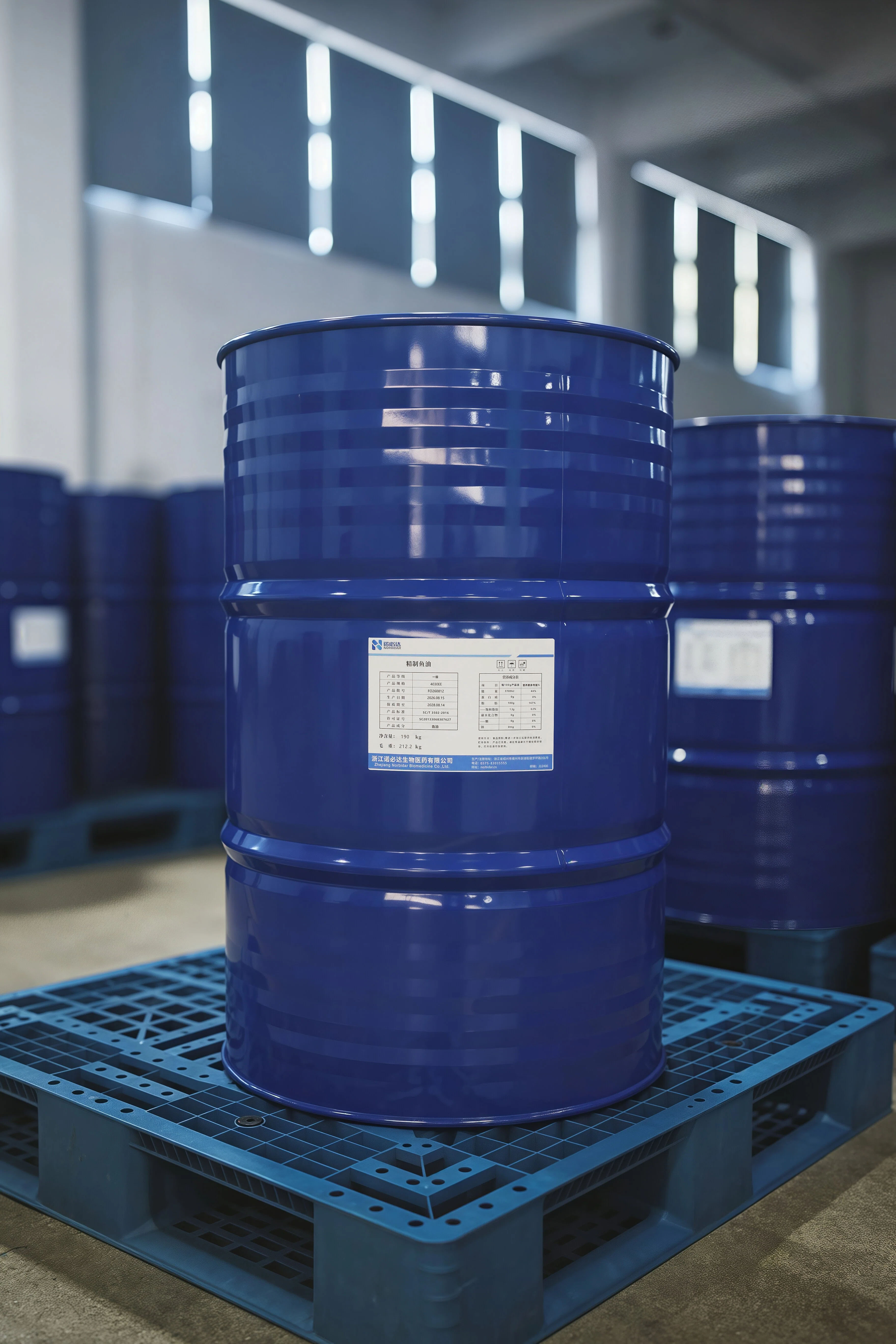
The grade portfolio is expressed as ethyl ester (EE) blends, with codes that indicate nominal EPA and DHA percentages. The published product parameters cover five blends, and the model list additionally references an 8000 EE grade whose nominal values are not disclosed in the same parameter set.
| Grade code | Nominal EPA | Nominal DHA | Nominal combined |
|---|---|---|---|
| 3624 EE | 36% | 24% | 60% |
| 4030 EE | 40% | 30% | 70% |
| 5020 EE | 50% | 20% | 70% |
| 5025 EE | 50% | 25% | 75% |
| 5030 EE | 50% | 30% | 80% |
Two clarifications matter more than the table itself.
First, these are nominal values. Contractual limits and the analytical basis must follow the current specification and the batch COA. A grade code is a naming convention, not a release specification. A 5025 EE label tells a buyer the intended ratio; it does not tell the buyer the measured EPA and DHA in the drum in front of them.
Second, Norbidar's own product-line description states that its food-grade EPA/DHA concentrates range from 65% to 88% total content, while the standard EE grade codes listed above span a nominal combined range of 60% to 80%. The two statements are consistent only when read as different layers of expression: a portfolio capability range versus a set of named commercial blend codes. Buyers who treat a portfolio range as a purchasable specification, or a grade code as an assay guarantee, will draft the wrong purchase order. The correct anchor is the agreed specification plus the batch COA.
This is also where the GOED industry advisory on content expression becomes practically relevant. GOED published guidance in 2018 on how EPA, DHA and total omega-3 content should be correctly expressed in EPA/DHA-containing oils. It is an industry advisory rather than a government regulation, but it is a useful discipline for comparing two COAs or two labels that use different denominators.
The constraint layer: what the certificate pack covers, and what it does not
Certification is the dimension buyers most often over-weight at the research stage. For the Omega-3 Fish Oil Concentrates product, Norbidar holds four relevant certificates. Each has a defined scope and an equally defined boundary.
| Scheme | Certificate no. / issuer | Validity | Covered scope | What it does not establish |
|---|---|---|---|---|
| FAMI-QS | CN26/00005166 — SGS | 2026-07-11 to 2029-07-10 | Feed safety and quality management system for production of specialty feed ingredients, chemical and mixing processes, feed chain category K; certified site in China | Not market authorisation; specific product names are not listed on the certificate |
| ISO 22000:2018 | CN26/00004668 — SGS United Kingdom Ltd | 2026-10-11 to 2029-06-27 | Food safety management system for refined fish oil production for the food industry (distillation, blending, nitrogen packaging); categories CIV and K | Not a product registration or import authorisation; not an EPA/DHA assay report; not a substitute for lot-specific COA |
| FSSC 22000 | CN26/00004667 — SGS United Kingdom Ltd | 2026-10-16 to 2029-06-27 | Refined fish oil production for the food industry by distillation, blending and nitrogen packaging, relevant to EE grades subject to current specification and batch COA; categories CIV and K, no exclusions | No batch-specific data on EPA/DHA content, oxidation or contaminants; not a product registration or import authorisation |
| HALAL | 501525000 (Registration No. 3306966AA5) — Shandong Halal Certification Service | 2026-01-21 to 2029-01-20 | Product certification; certificate scope includes Refined Fish Oil, Fumaric Acid CWS and Fumaric Acid; attachment scope updated 2026-07-30 | Subject to destination-country recognition and customer requirements; not a general market authorisation |
The pattern is consistent across all four. The two food-safety schemes (ISO 22000:2018 and FSSC 22000) certify how the site manages food safety. The FAMI-QS certificate addresses the feed chain and explicitly does not constitute market authorisation. The HALAL certificate operates at product level, references MS 1500:2019, and for Indonesia points to Indonesia Halal Law and Regulations — but its applicability still depends on recognition in the destination market and on the customer's own requirements.
For a buyer in either the Indian or the Russian file, this produces a clean two-step logic. Step one: match the scheme to the supply chain you are actually buying into — food, feed, or a halal-designated market. Step two: do not use any of these certificates as a release document. Release is governed by the current specification and the batch COA, supported by SDS and any destination-specific documents the project requires.
Technical context: EE form and downstream formulation
Norbidar's concentrates are fish-oil-derived EPA and DHA ethyl esters. The form matters because it constrains the downstream process rather than the label. A formulator working with EE concentrates needs to confirm suitability against the intended dosage form, the target EPA and DHA dose, sensory requirements, oxidation and contaminant specifications, packaging compatibility, and destination-market requirements before commercial use.
Manufacturing is built around the proprietary NBD multi-stage continuous distillation process. The site covers 72,000 m² of total area with 33,000 m² of building area, and annual fish oil input processing capacity is 10,000 metric tons — a figure that refers to input processing capacity, not finished-product output. Monthly capacity is stated at 1,000 tons, with a 30-day lead time and a minimum order quantity of four drums.
Quality control is organised at batch level: EPA/DHA assay and fatty-acid profile, colour and oxidation testing, contaminant screening, and a batch COA, specification sheet and SDS. Exact limits follow the product documents. That sentence is doing real work — it places the burden of precision on the agreed specification rather than on a marketing summary.
Where the two markets genuinely diverge
It would be easy, and wrong, to frame this as a comparison of national quality expectations. The files do not support that. What they support is a comparison of evaluation sequencing.
Russia: grade-first evaluation
The Russian distributor arrived with a named grade. That shortens the specification conversation and lengthens the testing conversation: once 3624 EE is fixed, the questions become assay agreement, oxidation behaviour in the customer's hands, and formulation fit. The file sits at the receipt-confirmed stage, which is the earliest point at which a buyer can start generating first-party data.
India: specification-first evaluation
The Indian customer arrived with a required EPA/DHA specification and a formulation-suitability question, which means the grade selection step is still open. This is a slower path but a more defensive one: the buyer is defining the target before committing to a blend code. Because India is not among the export markets listed in Norbidar's capability record, the destination-documentation thread also needs to be resolved in parallel rather than assumed.
Both sequences are legitimate. The procurement risk differs. A grade-first buyer can move to a commercial order quickly once tests pass, but may discover late that the chosen ratio constrains the formulation. A specification-first buyer reduces that risk but spends longer in the sampling loop.
Market context: what the public data can and cannot tell a buyer
Independent market research provides useful scale, provided its scope is respected. Future Market Insights estimated the global fish oil concentration and refinement market at USD 2.6 billion in 2025, with a projected CAGR of 6.8% between 2026 and 2035. The same source reports that high-concentrate oils in the 51%–80% EPA/DHA band held 43.6% of concentration-grade sales in 2026.
That 43.6% figure is directly relevant to the grade codes discussed above: it is the band in which 3624 EE, 4030 EE, 5020 EE, 5025 EE and 5030 EE sit. Demand concentration in this range is consistent with the portfolio design, though it says nothing about any individual supplier's competitiveness.
A separate data point is often misused. Grand View Research valued the global omega-3 supplements market at USD 8.3 billion in 2025 and projected USD 9.1 billion in 2026. That is a finished-supplement market, not a concentrate market, and the two scopes should not be combined or extrapolated. The honest reading is directional: a larger finished-supplement market implies sustained ingredient demand, without quantifying the concentrate segment.
What no public market report supplies is the layer that decides a purchase: batch-level purity verification, contaminant results, and price benchmarks for specific grades in specific destination markets. Those have to come from RFQs, COAs and the buyer's own laboratory.
Comparison with conventional sourcing expectations — and where the limits sit
Buyers accustomed to sourcing high-purity concentrates from established European refiners tend to apply a familiar checklist: named grade, certificate pack, third-party assay, and a reference customer who has already validated the ingredient in a comparable formulation. Measured against that checklist, the Norbidar record is partially complete, and the gaps are worth stating plainly.
- No third-party validated end-use results are public. Both the India and Russia files are pre-commercial. Customer test results and acceptance remain pending in both. A buyer cannot claim external validation on the basis of these files.
- Certification is system-level, not batch-level. ISO 22000:2018 and FSSC 22000 explicitly do not provide batch-specific EPA/DHA, oxidation, heavy-metal or dioxin results, and do not replace a lot-specific COA.
- Price and cost-band data are not disclosed. Capacity, MOQ and lead time are stated; pricing is not. Cost benchmarking requires a direct RFQ for the specific grade and destination.
- Destination coverage is project-specific. India does not appear among the listed export markets (RU, EU, US, KR), so an Indian project should plan for a longer documentation phase rather than assume an established lane.
- Grade-code nominal values require confirmation. The 8000 EE grade appears in the model list without published nominal values in the same parameter set, so its figures must be requested rather than inferred.
The counterweight is documentation discipline. Batch-level analytical testing, traceability documentation, a defined QC panel and a stated rule that contractual limits follow the current specification and batch COA are exactly the controls a buyer needs when external validation is thin. The correct conclusion is not that one approach is superior, but that a system-certified, batch-documented supplier with no published end-use data requires a more rigorous first-party testing plan than a supplier with published validation.
A practical checklist for sample-stage decisions
Drawn from the two files, the following sequence keeps sample evaluation from being mistaken for qualification.
- Fix the target before the grade. Define the required EPA and DHA dose, dosage form and sensory constraints, then map them onto candidate grade codes.
- Request the current specification and a batch COA with the sample. Compare nominal grade values against measured values and against the agreed analytical basis.
- Confirm the analytical method and the denominator. Total omega-3, EPA+DHA, and EE-form expression should be aligned across supplier documents and internal specifications.
- Match the certificate to the supply chain. Food, feed and halal-designated markets draw on different schemes; none of them replaces a COA.
- Test oxidation and packaging compatibility early. These failures surface after the assay question is settled and are expensive to discover at scale.
- Resolve destination documentation in parallel. Treat each market as a project until the required documents are confirmed in writing.
- Define the acceptance criteria in advance. Without pre-agreed pass/fail thresholds, a sample evaluation can run indefinitely without producing a decision.

Future outlook
Two evidence nodes will determine how these files should be read in twelve months. For the Russian project, the next node is the distributor's evaluation of 3624 EE against its required specification. For the Indian project, it is the customer's test results and acceptance decision, followed by confirmation of commercial specifications and purchase quantity. Until those nodes are reached, both files remain pre-commercial records.
The wider direction is clearer than any individual outcome. With high-concentrate oils in the 51%–80% EPA/DHA band accounting for 43.6% of concentration-grade sales in 2026, competition among suppliers of mid-to-high purity blends will increasingly be decided on documentation quality rather than on grade availability. Buyers are already shifting their RFQ templates toward batch-level data, method statements and destination-specific paperwork. Suppliers who can answer those requests quickly, with consistent denominators, will shorten the distance between sample dispatch and commercial order.
For Norbidar specifically, the observable position is a certified, batch-documented manufacturing base with a defined EE grade portfolio, stated capacity and a documented QC panel — and a public validation record that is still being built in both markets.
Frequently asked questions
What should buyers know about Norbidar omega-3 fish oil concentrates?
Norbidar offers food-grade EE fish oil concentrates with multiple EPA/DHA profiles. Grade codes indicate nominal content; current specifications and batch COAs govern supply. The target ratio and application should be discussed before a grade is selected.
What does 5025 EE mean in a Norbidar grade code?
It denotes a nominal 50% EPA and 25% DHA in ethyl ester form. Nominal EPA and DHA values are grade-specific, and contractual limits and the analytical basis follow the current specification and batch COA.
Are custom EPA/DHA ratios available?
Customised EPA/DHA ratio, blended concentration and EPA-rich or DHA-rich profiles can be discussed, subject to technical feasibility and an agreed product specification.
Which documents should a buyer request before commercial use?
The current specification, the batch COA and the SDS, plus any destination-specific documents required for the target market. Batch specifications and analytical documentation are associated with each batch, and certificates of analysis are issued against those batch specifications.
Do the ISO 22000, FSSC 22000, FAMI-QS and HALAL certificates replace a batch COA?
No. ISO 22000:2018 and FSSC 22000 are food safety management-system certifications and are not product registrations, import authorisations, EPA or DHA assay reports, or lot-specific certificates of analysis for oxidation, heavy metals or dioxins. FAMI-QS covers a feed safety and quality management system and does not itself constitute market authorisation. HALAL Product Certification operates at product level with a defined certificate scope and applies to halal ingredient markets subject to destination-country recognition and customer requirements.
Resources
Norbidar publishes its product and company information at norbidar.com. A consolidated product brochure covering the omega-3 concentrate range is available for download: Norbidar Omega-3 brochure (PDF).
¿Tiene preguntas o necesita más detalles?
Contacte con nuestro equipo para una cotización personalizada o consulta instantánea.
Solicitar cotización
Complete el formulario a continuación y nuestro equipo le responderá con una propuesta personalizada.
Chat directo de WhatsApp
¿Prefiere chatear en tiempo real? Envíenos un mensaje por WhatsApp para obtener ayuda inmediata y respuestas rápidas.
- Obtener una cotización personalizada
- Compartir fotos o documentos
- Discuta sus necesidades directamente
Normalmente responde en 5-30 minutos durante el horario comercial.