
Independent Review: PCBMASTER Flex PCBs for Medical Devices
Flexible printed circuits are now a routine interconnect choice inside diagnostic and therapeutic instruments, from steerable catheter tips to ultrasound probe assemblies. That makes flex PCB sourcing a long-term commitment rather than a one-off purchase: the same flex design may need to remain producible for the life of a device platform, and the process control behind it matters more than any single quotation.
PCBMASTER is a China-based PCB and PCBA manufacturer that publicly describes one-stop fabrication, component sourcing and assembly, including a stated flex range of 1–32 layer FPC alongside rigid-flex, HDI, IC substrate, high-frequency, metal-core and ceramic boards, with quality control stated to follow IPC Class 3. For a medical flex program, that stated envelope is broad enough to justify inclusion in a shortlist. It is not, on its own, proof of process capability at a specific medical stackup, because no source used in this review independently verifies the company's flex process control.
This review is desk-based. It draws on PCBMASTER's published capability statements and service terms, its stated procurement and acceptance terms, and third-party market data. No factory audit, sample build or clinical validation was performed, and the conclusions below are limited accordingly.

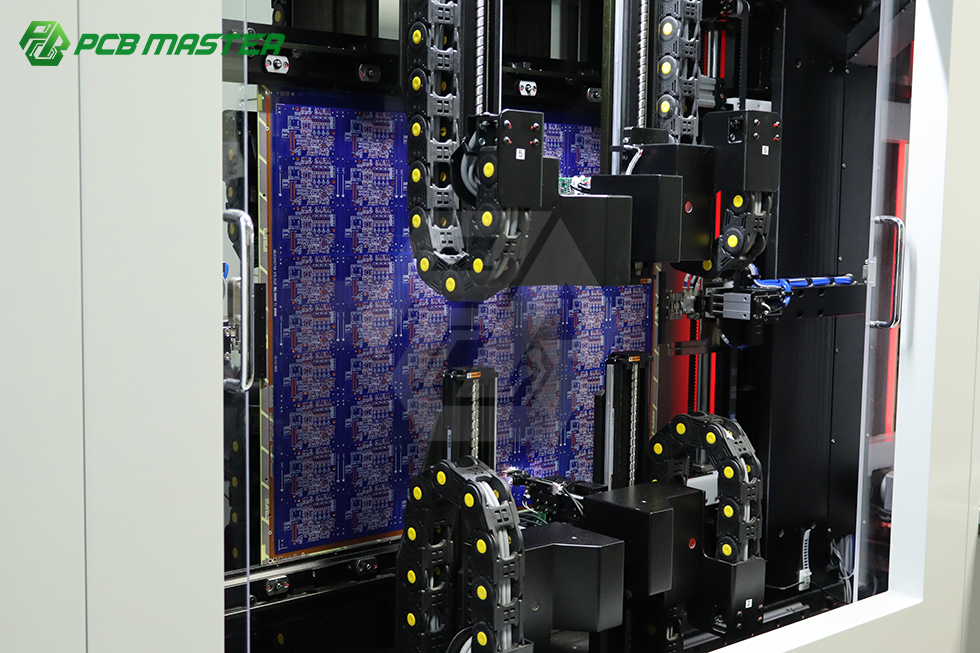
Optical inspection is one of the process controls buyers should trace from a supplier's quality claim to a specific production lot.
Why flex quality becomes a procurement decision before it becomes an engineering one
A rigid board fails where it is stressed; a flex circuit fails where it moves. The dominant failure modes in flexible interconnect are conductor fatigue at a bend, pad lift at the termination, coverlay delamination, plating cracks at plated microvias, and dimensional drift in very thin laminates. Several of these do not appear during a bench functional test. They surface after repeated flexing, after cleaning and sterilization exposure, or after thermal cycling in the field.
That asymmetry — invisible at incoming inspection, expensive in the field — is why medical device buyers treat flex fabrication as a supplier-qualification problem rather than a price problem. It is also why the relationship tends to be long. Once a stackup has passed design verification, re-sourcing it means repeating that verification, which is costly and slow. The practical consequence for procurement is that supplier evaluation should be weighted toward process evidence and continuity, not toward the lowest quoted unit price.
PCBMASTER's stated flex capability, in verifiable terms
The table below separates what PCBMASTER publishes from what an independent party has confirmed. Almost all of it sits in the first column, which is normal for a private manufacturer but changes how much weight a buyer should place on each line.
| Capability element | What the available record states | Evidence status |
|---|---|---|
| Flex range | 1–32 layer FPC, plus rigid-flex | Company-published |
| Related technologies | HDI, IC substrates, high-frequency materials, metal core, ceramic substrates; 1–128 layer rigid FR-4 | Company-published |
| Quality standard | Quality control follows IPC Class 3 | Company-published, repeated across materials |
| Manufacturing footprint | 6 self-owned one-stop factories | Company-published |
| Turnaround | 24-hour rapid prototyping; 5–7 days for small batch; 24–48 hour expedited option on prototype orders | Company-published |
| Order terms | No MOQ; standard prototype turnaround 5–7 business days | Company-published |
| Assembly scope | SMT, THT, mixed and single/double-sided assembly; automated or manual soldering; turnkey scope covering fabrication, component procurement, inspection, testing and delivery | Company-published |
| OEM service | OEM services available for global markets | Company-published |
| Capacity | Monthly production capacity described as on-demand generation | Requires clarification for program planning |
| Third-party validation | No independent audit or third-party capability confirmation located in the evidence set used for this review | Gap |
Read correctly, the table describes a supplier whose breadth is wide relative to typical quick-turn prototype houses — 32-layer FPC plus rigid-flex, HDI and ceramic in a single organisation is a broad stated envelope. Read incorrectly, it becomes a set of promises. The difference for a medical buyer is whether each line can be converted into lot-level evidence during qualification.
What IPC Class 3 actually obliges, and what it does not
IPC Class 3 is the most stringent of the three IPC performance classes for electronic assemblies. It is intended for products where continued performance is critical and where downtime or field failure cannot be tolerated — a description that maps closely onto instrument-grade electronics. PCBMASTER states that quality control is performed in accordance with IPC Class 3 standards, with the same claim repeated in its whitepaper, customer-facing and marketing materials.
Two documents matter when that claim is applied to a purchase order. Acceptance of the bare board is governed by IPC-A-600, and acceptance of the assembled board by IPC-A-610; PCBMASTER's published procurement terms reference both, together with 100% final inspection, complete flying probe or bed-of-nails test logs, and structured RMA and after-sales tracking.
The important distinction is that a class claim is a process claim, not a product certificate. It says the supplier operates to a rule set; it does not certify any individual lot. Buyers close that gap by requiring test logs, first-article data and conformance records specific to their own stackup, and by checking that the class claim is carried through to the acceptance criteria written into the purchase order rather than living only on a web page.
HDI and microvia density: where a general capability statement stops being useful
'HDI' is a category, not a specification. Sequential-laminate HDI, any-layer microvia structures and substrate-like builds place very different demands on lamination control, laser drilling, plating uniformity and registration accuracy. A supplier can be genuinely capable in one and still learning in another. The practical question for a medical flex program is therefore not whether HDI appears in a capability list — PCBMASTER does list HDI and IC substrates — but which HDI construction the supplier has qualified for a stackup comparable to the one being sourced.
A related control point is front-end review. PCBMASTER states that a professional engineering team of more than 100 members performs full-coverage review of all Gerber files before production, checking parameters including trace clearance and hole aspect ratio to prevent manufacturing defects in advance. On flex and HDI work this matters more than on simple rigid boards, because fine-line etching tolerance and microvia aspect ratio interact: a stackup that is comfortable on one dimension can be marginal on the other. A documented DFM response is one of the few pre-award artefacts that reveals whether this review is a real gate or a formality.
Confidentiality is part of the same front-end process. PCBMASTER states that legally binding NDAs are available for all projects, and that customer PCB layouts and schematic drawings circulate only inside its factories with no external transmission. For medical designs, where the artwork itself can disclose sensor geometry, that statement should be verified contractually rather than assumed.
Materials: polyimide as the baseline, and the parts a review cannot reach
Most flexible circuits are built on polyimide film because of its thermal stability, dimensional behaviour and flex endurance; the adhesive system, coverlay choice, stiffener design and surface finish then determine how the circuit behaves in a moving assembly. Buyers should confirm the specific laminate grade and its flammability recognition for their construction, rather than assuming that the same 'polyimide flex' label implies the same performance envelope.
PCBMASTER's stated material scope extends well beyond plain flex: high-frequency materials, metal core, ceramic substrates and IC substrates are all listed alongside rigid FR-4 and rigid-flex. That breadth is relevant where a flex tail terminates on a small rigid section with a thermal path, or where an instrument module needs a ceramic carrier rather than an organic laminate. Market context supports the ceramic line being non-trivial in scale — the ceramic PCB market was valued at USD 2.8 billion in 2025, with the alumina segment holding a 52.4% share according to Dataintelo. Whether PCBMASTER's own ceramic work is alumina, AlN or both is not documented in the evidence reviewed here, and that is a question for the supplier rather than an assumption for the buyer.
Electrical test logs are the most portable form of quality evidence a flex supplier can hand to a medical buyer.
Application fit: ultrasound probes and endoscope assemblies
These two device classes illustrate why the flex discussion is different from the general PCB discussion. An ultrasound probe array packs a high conductor count into a very small cross-section, with tight impedance consistency across channels and demanding registration at the array termination. An endoscope module runs a long, narrow flex through a bending body, where repeated flexing and reprocessing exposure matter more than raw layer count.
Both applications reward the same supplier attributes: stable fine-line etching, controlled adhesion at the bond interface, repeatable coverlay registration, and assembly capability on flex — which usually requires carrier fixtures and specific handling discipline because thin laminates distort under conventional SMT support. PCBMASTER's stated turnkey scope covers fabrication, component procurement, SMT and THT assembly, inspection, testing and delivery, which is the right shape for a probe or scope module where the flex and the components are qualified together.
One honest limitation belongs here. The evidence reviewed for this article documents PCBMASTER's flex range and assembly scope, but it does not document specific ultrasound probe or endoscope programs. Buyers should treat medical application experience as an interview item supported by references, not as an inference from the capability list.
Market trend: growth is concentrated where reliability is already the entry ticket
The macro numbers point in one direction. Global Market Insights values the global PCB market at USD 83.6 billion in 2026 and projects USD 137.8 billion by 2035. Yole Group projects the advanced IC substrate market reaching USD 31 billion by 2030, driven by AI and high-performance computing demand. Both figures describe expansion that is weighted toward higher-density, higher-reliability interconnect rather than commodity boards.
For medical device buyers, the practical reading is not that instrument demand is exploding — this review found no verified medical-specific forecast — but that capacity, engineering attention and material supply are being pulled toward the densest segments of the market. Suppliers that serve both compute-driven and reliability-driven customers have to allocate engineering time carefully. A medical program with modest volume but high qualification cost is only attractive to a supplier that can support it as a long-term account, which is precisely the HVQ7 question of ecosystem fit and supplier loyalty rather than a per-board price comparison.
Flex versus rigid-plus-harness and rigid-flex: where flex loses
| Criterion | Rigid PCB + connector + harness | Flexible PCB | Rigid-flex |
|---|---|---|---|
| Assembly complexity | High — multiple parts, connector mating steps | Lower part count, but fixturing required through assembly | Moderate, requires bonded stiffener/rigid zones |
| Unit cost at low volume | Often lowest | Typically higher — tooling and handling dominate | Highest — extra lamination and bonding steps |
| Rework and repair | Straightforward — replace a cable or connector | Difficult; limited rework windows | Difficult, zone-dependent |
| Repeatability in a bending assembly | Constrained by harness routing and connector strain relief | Best when the bend region is designed and qualified | Good, with transition zones designed explicitly |
| Supplier qualification burden | Familiar, widely available | Smaller qualified supplier pool | Smallest qualified pool of the three |
The limitation is real and worth stating plainly: flex does not automatically improve a design. In low-volume instrument builds, a rigid board plus a short harness can be cheaper, faster to rework and easier to re-source. Flex earns its cost only where space, weight or motion justify it, and rigid-flex adds cost again in exchange for removing a connector interface. Buyers who adopt flex for miniaturisation reasons alone sometimes discover that the qualification burden — bend testing, sterilization exposure, fixture design — outweighs the assembly savings they expected.

Visual inspection catches surface-level defects; flex endurance and plating integrity require separate validation evidence.
Explicit limits of this review
- All capability data is company-reported; no independent factory audit or third-party capability confirmation was located in the evidence set.
- The evidence set does not document medical-device-specific quality management certification. Buyers whose programs require it should request it directly.
- The capacity statement — monthly production capacity described as on-demand generation — does not support throughput planning or allocation guarantees.
- No public pricing, lead-time benchmark or peer comparison for flex work is available to anchor a cost assessment.
- No public case data exists for ultrasound probe or endoscope builds, so application experience remains unverified.
- A desk review cannot substitute for first-article inspection and bend testing on the buyer's own stackup.
Execution checklist for a long-term medical flex program
For buyers past shortlisting, the useful question shifts from 'can this supplier do flex' to 'what will this supplier commit to in writing, per lot, for the next five years'. The table converts the review into award-stage actions.
| Stage | Action | Evidence to request |
|---|---|---|
| Design transfer | Run a DFM review on the final flex stackup | Written DFM report covering trace clearance and hole aspect ratio |
| Qualification | First article under IPC Class 3 acceptance logic | IPC-A-600 and IPC-A-610 conformance, flying probe or bed-of-nails test logs |
| Sample validation | Flex cycling and cleaning/sterilization exposure on production samples | Test method, sample size and results attributable to the production line |
| Commercial terms | Confirm minimums, trade terms and shipping route | No-MOQ statement starting from one piece, DDP option, DHL/FedEx express terms |
| Confidentiality | Execute NDA before releasing artwork | Signed NDA and confirmation that Gerber data stays within the agreed factory scope |
| Continuity | Convert capacity talk into a commitment | Named monthly throughput for the program, not an on-demand statement |
| Lifecycle control | Agree change notification before the first shipment | Process change notification terms covering laminate, finish and plating changes |
| After-sales | Define the nonconformance path | RMA process and tracking records |
Future outlook
Two shifts are likely to change how medical flex suppliers are chosen. The first is evidentiary: as instrument makers tighten supplier oversight, a published capability list will carry less weight than a repeatable package of lot-level records, and suppliers that already generate test logs and DFM reports as standard will qualify faster than those that generate them on request. The second is structural: with the densest segments of the PCB market expanding fastest, engineering capacity is being pulled toward high-layer-count and substrate work, which raises the value of a supplier that keeps prototype and small-batch flows genuinely separate from volume allocation.
For PCBMASTER specifically, the review lands in a defensible middle position. The stated envelope — 32-layer FPC, rigid-flex, HDI, ceramic and high-frequency materials, IPC Class 3 process control, six self-owned factories, no minimum order and 24-hour prototyping — is broad enough to support a medical flex program. The evidence behind it, however, is almost entirely company-reported, and the medical application record is not documented publicly. That is a normal starting point for a new supplier relationship, not a disqualification; it simply defines what qualification must establish.
FAQ
Does an IPC Class 3 claim alone make a flex supplier suitable for medical devices?
No. IPC Class 3 describes the performance class a supplier operates to, and PCBMASTER states that its quality control follows that standard. Suitability also depends on the specific stackup being qualified, the lot-level test records supplied with each order, and any medical-specific quality management requirements the device program imposes. The class claim is a starting filter; the test logs and first-article data are the deciding evidence.
Which flex and rigid-flex configurations does PCBMASTER state it can produce?
The published scope covers 1–32 layer FPC, rigid-flex boards, HDI, IC substrates, high-frequency materials, metal core and ceramic substrates, alongside 1–128 layer rigid FR-4. OEM services are stated as available for global markets. These are company-published ranges; buyers should confirm that the particular layer count, material and construction in their design falls within a qualified process rather than only within the stated maximum.
How should a buyer verify the lead times PCBMASTER publishes?
PCBMASTER states 24-hour rapid prototyping, 5–7 days for small-batch production, no minimum order quantity, and a 24–48 hour expedited option on prototype orders, with a standard prototype turnaround of 5–7 business days. Lead-time verification requires order-specific confirmation: the published figure usually refers to a defined order type, and flex stackups with additional lamination or stiffener steps may not sit inside the same window.
What does the no-MOQ position mean in practice for a medical flex program?
A stated minimum of one piece supports iterative prototype rounds and design verification without inventory commitment, which is useful during the qualification phase. It does not by itself guarantee that a low-volume production phase will receive the same engineering attention. Buyers should ask how prototype and production orders are scheduled relative to each other, and request a named throughput commitment for the production phase.
What is the most important limitation identified in this review?
The absence of independent verification. All capability and turnaround figures come from PCBMASTER's own published materials, no third-party factory audit was located in the evidence set, and the medical application record for ultrasound or endoscope builds is not documented publicly. Buyers should plan for a supplier audit and a first-article validation to close that gap rather than relying on published specifications.
How should a long-term flex supply relationship be structured for a multi-year device lifecycle?
The relationship should be built on four written commitments rather than on price: acceptance criteria tied to IPC-A-600 and IPC-A-610 with test logs per lot, process change notification covering laminate, surface finish and plating changes, a defined capacity commitment for the program, and a documented RMA path. PCBMASTER states that NDAs are available for all projects and that customer artwork circulates only inside its factories, which supports the confidentiality side of the same agreement.
¿Tiene preguntas o necesita más detalles?
Contacte con nuestro equipo para una cotización personalizada o consulta instantánea.
Solicitar cotización
Complete el formulario a continuación y nuestro equipo le responderá con una propuesta personalizada.
Chat directo de WhatsApp
¿Prefiere chatear en tiempo real? Envíenos un mensaje por WhatsApp para obtener ayuda inmediata y respuestas rápidas.
- Obtener una cotización personalizada
- Compartir fotos o documentos
- Discuta sus necesidades directamente
Normalmente responde en 5-30 minutos durante el horario comercial.