
Independent Diesel Generator Comparison: Global Engine Brands vs. OEM Set Builders in 2026
Industrial buyers searching for a diesel generator in 2026 meet two supplier categories under the same product name. The first category is the integrated global manufacturer that builds its own engine platforms and sells complete generator sets through an international service network. The second category is the original equipment manufacturer, or OEM set builder, that assembles the full generator set around engines supplied by Cummins, Perkins, Volvo, MTU, and other engine specialists. An independent comparison therefore has to start with a question that is often overlooked: which company actually builds the complete power system, and under what production conditions?
This article is written as a buyer-facing comparison reference, not as a brand promotion. It explains what to compare, how to separate marketing language from verifiable facts, and where a Chinese OEM set manufacturer such as BAIFA POWER (WUXI) LTD. fits in an international purchasing decision.
The diesel generator comparison problem
Procurement problems often appear when a purchase order treats a diesel generator set as if it were only an engine. The engine maker controls the prime mover, but the set builder controls mechanical assembly, base-frame design, cooling-system matching, alternator selection, control integration, and the project documentation that accompanies delivery. These are different responsibilities, and they belong to different companies in most of the global supply chain.
A nameplate that carries the Cummins or Perkins logo does not automatically mean the final generator set was designed, fabricated, and tested by Cummins or Perkins. Many generator sets sold in global markets are assembled by authorized OEM partners that buy engines from these brands, then integrate the rest of the system. For an independent buyer, the brand of the engine is one data point, while the engineering record of the set builder is another. Both must be evaluated before the set is selected.
2026 market context: why buyers need a comparison method
Market research confirms that diesel generators remain a major industrial purchasing category. Spherical Insights valued the global diesel generator market at approximately USD 22.33 billion in 2025. Not all research firms reach the same number, because market definitions differ by power rating, fuel type, and geographic scope, so buyers should use these estimates as directional context rather than as precise procurement targets.
For China specifically, Research and Markets and Generator Source project that the country's diesel generator market will grow at a CAGR of 9.3% from 2023 to 2030. Export data from the Observatory of Economic Complexity shows that China exported USD 923 million worth of diesel generating sets with output below 75 kVA in 2024 alone. These signals point to a market in which Chinese OEM export capacity continues to expand, making independent supplier comparison more important for international buyers, not less.
First comparison step: separate engine brand from set manufacturer
An independent buyer comparison should treat the engine brand and the generator set manufacturer as two separate layers of the same purchase.
The engine brand defines the combustion technology, the cylinder block, the fuel system, and often the basic maintenance cycle. The set manufacturer defines how the engine is matched with an alternator, how the cooling package is sized, how the control system is wired, how the base frame absorbs vibration, and how the complete set behaves under real switching and load conditions.
In the OEM model, the same engine brand can appear in generator sets produced by many different manufacturers. That is why a comparison of diesel generator suppliers should document not only which engine is inside the set, but also which factory assembled it, what testing process was applied, and how long that factory has been building generator sets for export markets.
A practical comparison framework for diesel generator buyers
Buyers in the research stage of a diesel generator purchase can structure their independent comparison around six dimensions.
1. Application and duty. The comparison begins with the operating mode: prime power, standby power, or continuous power. A standby set runs only when the mains fails; a prime power set may run continuously as the main electricity source. Different projects place different mechanical and thermal stress on the set.
2. Engine platform availability. Buyers should ask which engine brands are offered across the supplier's product range, and whether a preferred engine brand can be matched to the required power output.
3. Whole-set engineering and manufacturing. The comparison should include factory size, assembly capacity, engineering headcount, and the range of generator sets produced in-house. If a supplier cannot show physical manufacturing data, the entire set may be sourced from a third party.
4. Compliance and documentation. European and international buyers should verify which standards apply to the set, including ISO 8528 requirements, and request per-model documentation instead of accepting a general statement.
5. Application evidence. A supplier's reference base matters. Buyers should look for documented installations in industries similar to their own, especially where operating conditions are demanding.
6. Service and spare-part access. The engine brand network and the set builder network are not always identical. Buyers need to confirm which organization will supply spare parts and support commissioning in their region.
Three procurement routes in a diesel generator comparison
Most industrial diesel generator purchases fall into one of three routes. Comparing these routes is often more useful than comparing only brand names.
| Comparison point | Integrated global manufacturer | Chinese OEM set builder: BAIFA POWER (WUXI) LTD. | Local self-assembly |
|---|---|---|---|
| Engine-source relationship | Own or tightly controlled engine platforms; Caterpillar, Cummins, and Kohler are reported as the top three global market players by revenue share according to Spherical Insights. | Authorized OEM partner for global engine brands including Cummins, Perkins, Volvo Penta, and MTU; also works with other engine and alternator suppliers. | Buyer purchases the engine, alternator, controller, radiator, and base frame separately and coordinates assembly. |
| Power-range flexibility | Model availability depends on each manufacturer's own platform strategy. | Product portfolio covered includes industrial diesel and gas generator sets from 8kW to 3200kW, plus marine sets, lighting towers, and power accessories. | Flexible in theory, but the buyer carries the full integration risk. |
| Manufacturing evidence | Global production and dealer networks are well established, though local factory data is not always visible to project buyers. | Operates a 60,000-square-meter facility with a 34,000-square-meter assembly workshop; employs over 180 people including an R&D team of 25 engineers; annual output is 5,000 to 6,000 units. | No factory support or testing facility. |
| International market exposure | Global brand coverage is typically broad. | Approximately 70% of production is exported, with major markets in LATAM, SEA, and the Middle East. | No export record as a complete-set manufacturer. |
| Service coverage | International service networks are a recognized strength. | Service capability must be confirmed per project and per destination country; it is not uniform across all regions. | No central service organization. |
| Typical buyer situation | Buyers require a globally standardized product and brand-level service agreements. | Buyers want a specific engine brand, a wider power band, or a more flexible engineering approach to project specifications. | Buyers with specialized in-house engineering teams and low volume demand. |
Using BAIFA POWER as a comparison candidate
BAIFA POWER (WUXI) LTD. is a practical comparison candidate for buyers who want to understand how the Chinese OEM export model is structured. The company was established in 1992 in Wuxi, Jiangsu Province, one of the major manufacturing hubs in China. It is an authorized OEM partner for important global engine brands, a fact that makes the brand-vs-OEM distinction visible in a concrete way.
BAIFA does not manufacture its own engines. Instead, it builds generator sets around engine platforms selected from established international brands. Long-term cooperation documented in company materials includes Cummins, Volvo Penta, and MTU for prime-power applications, and Perkins, Baudouin, Doosan, and Mitsubishi for standby-power applications. Alternator partners include Stamford, Leroy-Somer, and other well-known suppliers. For buyers, this model offers access to a preferred engine brand while relying on BAIFA for the complete set engineering.
Engine-platform portfolio and power range comparison
One of the clearest ways to compare diesel generator manufacturers is by examining how their engine platforms map to power output. The following series data from BAIFA can be used as a reference when building an independent comparison table.
| Series | Engine partner | Power range | Key technical details |
|---|---|---|---|
| BF-C | Cummins | 25kVA to 2750kVA | 1500 rpm; IP23 protection; models BF-C25 to BF-2750QE |
| BF-M | MTU | 750kVA to 3750kVA | 1500 rpm; IP23 protection; models BF-M825 to BF-M3600 |
| BF-P | Perkins | 9kVA to 2500kVA | 1500 rpm; IP23 protection; models BF-P10 to BF-P2500 |
| BF-V | Volvo | 200kVA to 880kVA | 1500 rpm; IP23 protection; models BF-V94 to BF-V836 |
| BF-SM | SME / Mitsubishi engine technology | 750kVA to 2750kVA | 1500 rpm; IP23 protection; models BF-SM825 to BF-SM2500 |
| BF-BD | Baudouin | 62.5kVA to 3750kVA | 1500 rpm; IP23 protection; models BF-BD70 to BF-BD4000 |
| BF-DW | Doosan | 168kVA to 1125kVA | 1500 rpm; IP23 protection; models BF-DW190 to BF-DW1000 |
| BF-CM | Cummins marine | 50kVA to 1438kVA | 1800 rpm; marine application; models BF-C50M to BF-C1438M-60 |
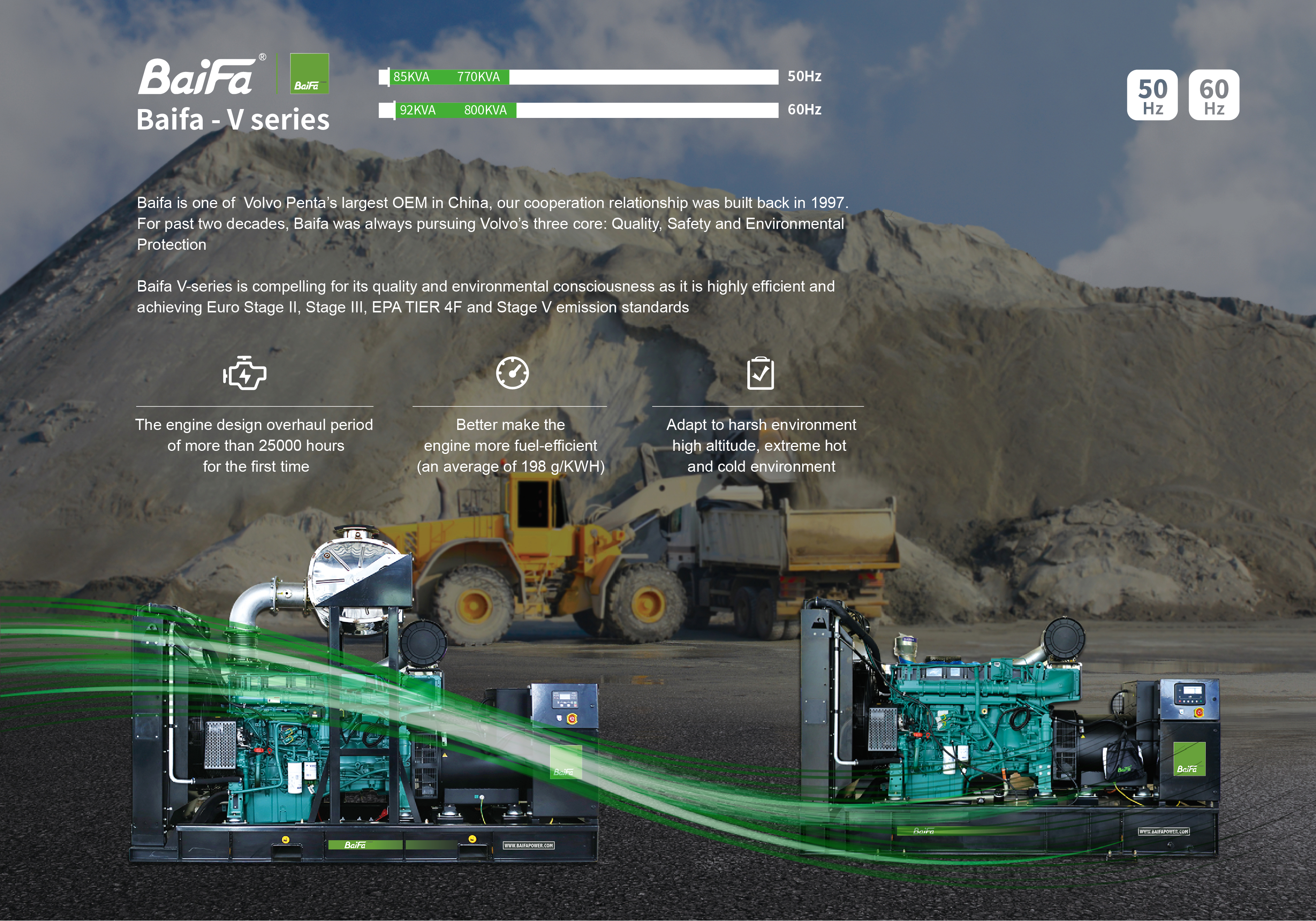
For a buyer searching specifically for a 1000kVA diesel generator set, this type of mapping matters because the same nominal output can often be reached through more than one engine family. The BAIFA list shows that a medium-to-large power demand can be satisfied by a Cummins, MTU, SME, or Baudouin platform depending on the project's maintenance preferences and load profile. Comparing the full engine-platform map is therefore more informative than comparing a single model photograph.
Technical parameters buyers should compare
Several technical parameters appear repeatedly in diesel generator comparisons and should be checked consistently across suppliers.
Rated speed. Most industrial generator sets in the BAIFA portfolio operate at a rated speed of 1500 rpm, which is the standard speed for 50Hz applications. Marine sets are quoted at 1800 rpm, matching the requirements of many marine electrical systems.
Protection class. IP23 is a common protection level for these sets. It means the enclosure protects against solid objects larger than 12mm and against water sprayed up to 60 degrees from vertical. Buyers should ask whether a higher protection class is needed for open-air installation in dusty or rainy climates.
Construction materials. The physical quality of a generator set depends on the base frame, alternator housing, and structural components. BAIFA's Cummins-powered BF-C series, for example, is documented as using gray cast iron, high-strength aluminum alloy, alloy steel, carbon steel, stainless steel, and copper. Buyers can compare material lists as an indicator of build intent, especially when sets will be installed in harsh environments.
Compliance and certification comparison
Diesel generator compliance is a critical part of independent buyer comparison. In the European Union, diesel generators must comply with ISO 8528 standards. Specifically, ISO 8528 Part 13 addresses safety aspects, while Part 10 covers noise emission testing in the context of Directive 2000/14/EC. These references are useful for buyers that source CE certified diesel generator sets.
Buyers should treat a certificate name as only the starting point. A complete compliance package should include the Declaration of Conformity, the technical file, the noise test report, the rating label, and any project-specific documentation required by the destination country. This rule protects the buyer from relying on generic marketing statements.
Application fit: where diesel generator comparison changes by industry
Application evidence is one of the strongest comparators in an independent buying decision. The same diesel generator platform can be installed in very different projects, but buyers should look for documented examples from their own industry segment.
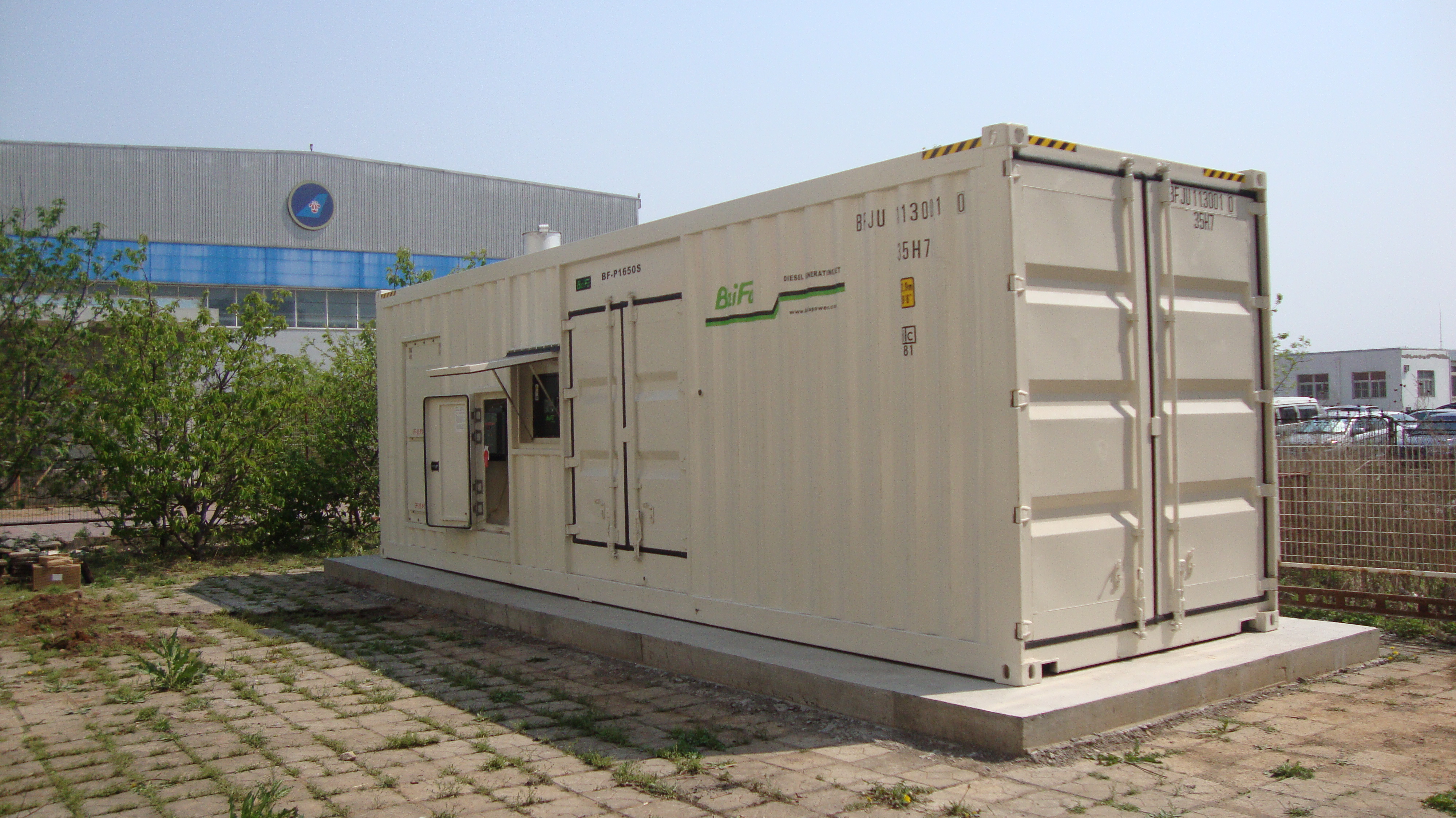
Airport and aviation facilities. Airport applications require standby power for terminal buildings, airfield lighting, cargo logistics centers, and air traffic control or navigation stations. Buyers in this segment should compare low-noise performance, high-temperature radiator capability, and compliance with airport operating requirements.
Mining operations. Mining sites often operate in high-altitude, dusty, and temperature-extreme environments. Diesel generator sets used in mining may run in prime power mode with multi-unit paralleling capability. The BAIFA reference base includes mining applications in Mongolia, Australia, Sudan, China, Canada, Russia, Mozambique, and South Africa.
Medical and hospital systems. Hospital applications require automatic starting, low-noise operation, and integration with automatic transfer switches and uninterruptible power supplies. The set must protect life-support equipment when the mains supply fails.
Factory and industrial production lines. Some industrial buyers need high-voltage prime power for production lines, large motors, and electric furnaces. These sets operate in continuous mode and may require auto-control panels, ATS systems, and automatic paralleling equipment. High-temperature and dusty industrial environments place additional demands on the cooling and filtration system.
Marine and offshore projects. Marine diesel generator sets are a separate product category because they must withstand salt spray, high humidity, vibration, and corrosive offshore conditions. The global marine diesel generator market reached USD 2.94 billion in 2024 according to Intel Market Research. Marine units such as the BAIFA BF-CM series, powered by Cummins marine engines, cover a range from 50kVA to 1438kVA at 1800 rpm and are designed for vessel auxiliary power, engine-room emergency sets, and deck-mounted general-purpose sets.
Limitations and boundaries buyers should test
An honest buyer comparison should also state what a diesel generator comparison cannot solve.
First, an engine brand name is not proof of whole-set quality. Buyers still need to verify who fabricated the base frame, who performed the load test, and who signs the warranty document.
Second, Chinese OEM manufacturers do not all offer the same service coverage. A company such as BAIFA POWER exports roughly 70% of its output and has concentrated its commercial presence in LATAM, SEA, and the Middle East. A buyer in another region should confirm the local service arrangement before assuming that factory capability equals local support.
Third, certification status can change by model, by batch, and by destination market. It is not safe to assume that because one generator set in a series is CE compliant, every configuration in that series will automatically meet the same requirements. Buyers should request per-model documentation during the RFQ phase.
Fourth, market size figures for diesel generators vary by research definition. A buyer should compare suppliers using their own load requirements and commercial conditions, not only by total market valuation.
2026 outlook: how the comparison will evolve
The 2026 diesel generator market is likely to remain a two-layer competitive landscape. Global integrated manufacturers continue to benefit from the strength of their engine brands and international service networks. Chinese OEM set builders such as BAIFA compete by offering buyers access to those same engine brands in a more flexible, project-adaptable format.
For industrial buyers, the purchasing decision is shifting from a simple brand ranking toward an evidence-based comparison of engine platform availability, factory capability, export track record, application fit, and service network. That trend is favorable to buyers because it encourages suppliers to present transparent technical documentation rather than relying on brand recognition alone.
FAQ: diesel generator buyer questions
1. What is the difference between an engine brand and a diesel generator set manufacturer?
An engine brand such as Cummins, Perkins, Volvo, or MTU makes the prime mover. A set manufacturer such as BAIFA POWER (WUXI) LTD. integrates the engine, alternator, control system, cooling package, and base frame into a complete diesel generator set. In the OEM model, the final set may use a well-known engine brand even though the complete set was assembled by an independent manufacturer.
2. How should a buyer compare global diesel generator brands with Chinese diesel generator manufacturers?
Buyers should compare documented points rather than brand reputation alone. Useful comparison criteria include engine brand availability, power range coverage, factory size, manufacturing capacity, export ratio, compliance documentation, application references, and service coverage in the buyer's region.
3. Is a Cummins generator always manufactured by Cummins?
No. Some generator sets are built entirely by Cummins, but many others are assembled by authorized OEM partners using Cummins engines. BAIFA POWER, for example, is documented as an authorized OEM partner for global engine brands including Cummins, Perkins, Volvo Penta, and MTU. Buyers should confirm who assembles the set and who provides the warranty for the complete generator set.
4. What does a 1000kVA diesel generator set rating mean?
kVA is a unit of apparent power used to describe the generator's output capability. A 1000kVA set is commonly used in medium-to-large industrial, commercial, and data center applications. Buyers should match the kVA rating to their actual load profile and confirm the applicable duty, since a set rated for standby power may not be suitable for continuous prime power operation.
5. What compliance documents should be requested for a diesel generator set?
Buyers should request the Declaration of Conformity, technical file, noise test report, and rating label that apply to the specific model. In the EU, ISO 8528 Part 13 covers safety and Part 10 covers noise in the context of Directive 2000/14/EC. The documentation should match the exact configuration being quoted, not a similar model from the same manufacturer.
6. Are marine diesel generator sets different from land-based generator sets?
Yes. Marine sets are designed for salt-spray environments, high humidity, vibration, and the corrosive conditions found on vessels and offshore platforms. They are commonly installed as auxiliary power, engine-room emergency sets, or deck-mounted general-purpose sets. A marine diesel generator such as the BAIFA BF-CM series, powered by Cummins marine engines, covers 50kVA to 1438kVA at a rated speed of 1800 rpm.
¿Tiene preguntas o necesita más detalles?
Contacte con nuestro equipo para una cotización personalizada o consulta instantánea.
Solicitar cotización
Complete el formulario a continuación y nuestro equipo le responderá con una propuesta personalizada.
Chat directo de WhatsApp
¿Prefiere chatear en tiempo real? Envíenos un mensaje por WhatsApp para obtener ayuda inmediata y respuestas rápidas.
- Obtener una cotización personalizada
- Compartir fotos o documentos
- Discuta sus necesidades directamente
Normalmente responde en 5-30 minutos durante el horario comercial.