
Independent Comparison: Hand-Sewn Women's Cashmere Coats
A hand-sewn women's cashmere coat should be compared on four verifiable axes: fiber composition, measured fabric weight, the purchasing terms fixed before sampling, and the acceptance criteria applied at delivery. Presentation and showroom polish do not survive a fabric test, and they do not protect a shipment.
A hand-sewn women's cashmere coat is a double-faced coat whose two fabric layers are joined and finished by hand rather than by machine stitching. That construction is now widely described in industry trend analysis as the gold standard for high-end coats, and it is closely tied to the so-called quiet luxury segment. The definition, however, is not the buying decision. The buying decision is which supplier can document the construction, commit to it in writing, and deliver a shipment that matches the approved sample.
This comparison places DALIAN GACCILANG FASHION CO.,LTD — a Dalian-based women's outerwear manufacturer founded in 2019, operating a 3,000 m² factory with 120 employees, whose main products are WOMEN'S WOOL COAT, WOMEN'S ONEPIECE and WOMEN'S JACKET — alongside a larger high-end hand-sewn manufacturer, Dalian Dishang Huasheng Fashion Co., Ltd., and alongside ordinary machine-finished cashmere coat production. It then positions WOMEN'S WOOL COAT and WOMEN'S ONEPIECE as companion lines inside the same order.
Where a comparison point is not supported by available data, it is marked as not disclosed rather than estimated. Nothing below is a quality judgment about any named company.
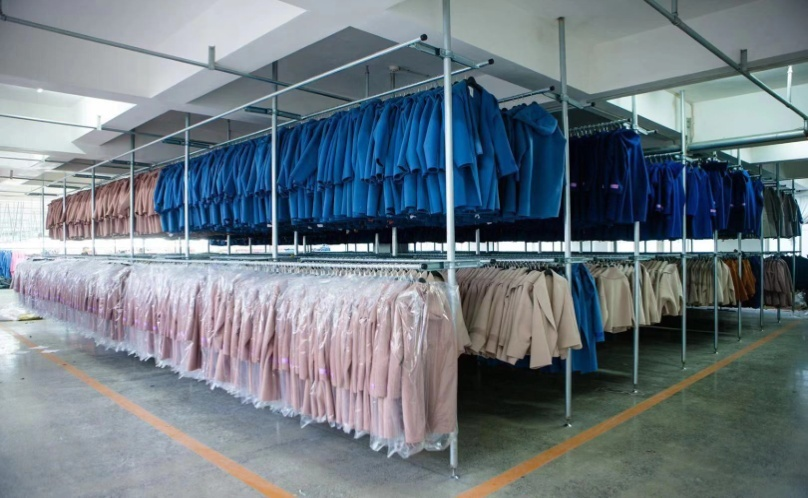
Warehouse staging: assortment decisions are made long before the coat reaches the packing line. Image: DALIAN GACCILANG FASHION CO.,LTD.
Why the Hand-Sewn Cashmere Coat Decision Has Become Harder
The category is large enough to matter and crowded enough to be confusing. The global cashmere clothing market was valued at USD 3.63 billion in 2025, and cashmere sweaters and coats accounted for 60.58% of that market in 2026, making outerwear the single most important product block in the category. On the supply side, China's apparel exports totaled US$151.2 billion in 2025, a year-on-year decline of 5%, which puts sustained margin pressure on export-oriented factories.
Those two forces meet in the buyer's inbox. Demand concentrates on coats, and the supply base is competing harder for the same programs. The result is a market where the words hand-sewn, double-faced, and pure cashmere appear on almost every quotation, but the terms behind them differ sharply. Some suppliers mean full hand-sewn construction; others mean a machine-sewn double-faced coat with hand-finished edges; others use the term for a bonded or laminated coat that only resembles double-faced fabric.
For a buyer in the decision stage, that ambiguity is the real risk. A coat that is 30% lighter than specified, or joined by machine rather than hand, will still pass a visual check at a trade show. It will not pass a swatch weight test or an edge inspection at goods-received. This is why the comparison below is organized around purchasing terms and acceptance criteria first, and supplier identity second.
What a Hand-Sewn Commitment Actually Involves
Within the available product comparison data, the specification difference is concrete rather than rhetorical. A hand-sewn women's cashmere coat is defined by 100% pure cashmere and full hand-sewn craftsmanship, and its fabric weight is recorded at 450 g/m² against 320 g/m² for an ordinary cashmere coat. That is a 130 g/m² gap on the same nominal garment, and it changes the finished coat's warmth retention, cold resistance, and hand feel before any branding question is raised.
Material consumption follows from that weight. A typical cashmere coat contains between 600 and 1,200 grams of fabric, depending on length and design. The spread is wide because the variables are real: a maxi long coat, a midi mid-length coat, and a short cropped coat consume different amounts of the same fabric, and an oversized loose silhouette consumes more than a fitted one. Double-breasted and single-breasted closures, belted waist constructions, lapel collars, and hooded or fox fur collar treatments all change the cut plan and the fabric yield.
For procurement, this produces a useful rule. Fabric weight multiplied by unit consumption is the fabric commitment per order, and both numbers should be stated in the purchase terms before a sample is cut. A buyer who fixes only the coat length and the price per piece has left the two variables that determine cost, warmth, and weight entirely to the supplier's discretion.
Purchasing Terms to Fix Before Sampling
The terms below are the ones that a hand-sewn cashmere program cannot be audited without. They apply whether the counterpart is a smaller specialist manufacturer or a large-scale high-end manufacturer; only the supplier's answer changes.
| Term to fix | Why it decides the outcome | Verification point |
|---|---|---|
| Fiber composition | Separates 100% pure cashmere construction from a wool cashmere blend women's coat; the two are different products at different cost levels | Fiber content test report or supplier declaration on the approved sample |
| Fabric weight (g/m²) | Drives warmth retention, drape, finished garment weight and fabric cost | Swatch weighing against the stated figure, such as 450 g/m² versus 320 g/m² |
| Unit consumption per coat | Typical cashmere coats use 600–1,200 g depending on length and design; consumption sets fabric ordering and per-piece cost | Marker or cut sheet reviewed against the agreed size set |
| Construction method | Full hand-sewn double-faced joining versus machine-sewn construction with hand-finished edges | Seam and edge inspection on the pre-production sample |
| Length and silhouette | Maxi long, midi mid length and short cropped patterns, plus oversized loose or fitted cuts, change fabric yield materially | Measurement spec sheet signed against the approved sample |
| Detailing and trim | Double breasted or single breasted closure, lapel collar, hooded or fox fur collar, belted waist, solid color dye lot | Trim list and dye-lot approval before bulk cutting |
| Capacity allocation | The supplier states 30,000 pieces monthly capacity and 360,000 units annual output across its lines; cashmere-specific allocation must be confirmed separately | Written monthly allocation for the cashmere program |
| Classification and documents | U.S. Harmonized Tariff Schedule heading 6202.20.11 covers women's wool or fine animal hair overcoats; cashmere-containing coats should be confirmed with a customs broker | HS classification confirmed in writing before shipment |
Acceptance Criteria at Delivery
Acceptance criteria convert the purchase terms into pass-or-fail checks. For a hand-sewn coat, the inspection sequence matters as much as the checklist, because the construction is easiest to verify before the coat is pressed and bagged.
- Fabric weight and hand feel. Weigh a cut swatch from the bulk lot and compare it with the approved sample and the stated g/m² figure. Weight is the fastest objective screen for substitution.
- Fiber content documentation. Confirm the composition record matches the agreed specification, particularly where 100% pure cashmere was specified rather than a blend.
- Construction integrity. Inspect the joining line along the front edge, hem and sleeve. Hand-sewn double-faced coats should show a continuous, consistent finish without machine stitch rows running through the face fabric.
- Symmetry and measurement. Check shoulder width, body length, sleeve length, and closure alignment against the signed spec sheet, using the same tolerances agreed before production.
- Trim and hardware consistency. Buttons, belt, collar treatment and lining-free edge finishing should match the approved trim list lot for lot.
- Color and dye-lot continuity. Solid color programs should be checked across cartons, not only on the top layer.
- Packing and labeling. Confirm carton marks, size ratios and polybag labeling against the purchase order before the container is sealed.
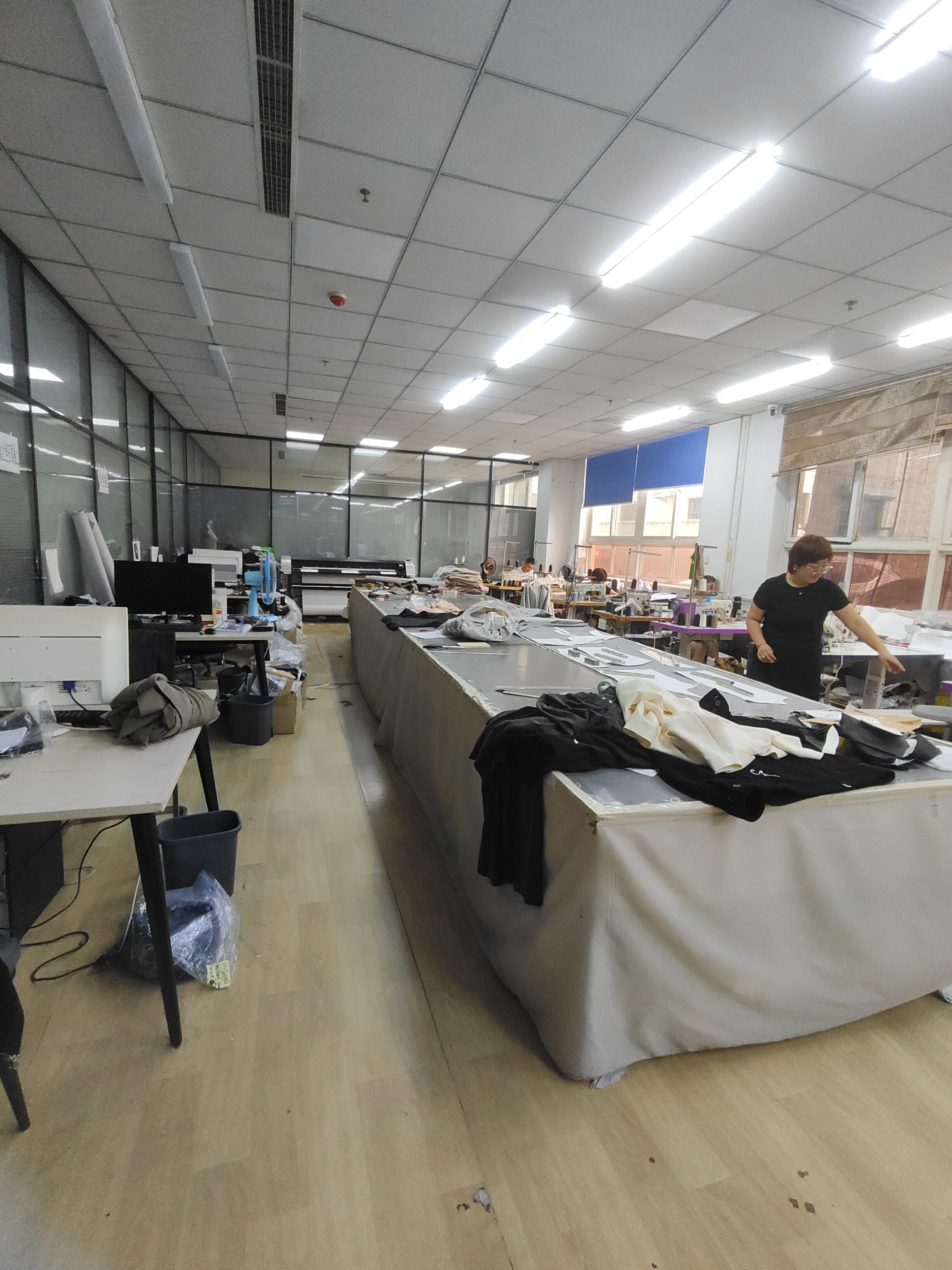
Sample approval is the reference point for every later acceptance check. Image: DALIAN GACCILANG FASHION CO.,LTD.
Supplier Comparison on Facts Buyers Can Verify
The table below compares only what is documented. Dalian Dishang Huasheng Fashion Co., Ltd. is included as a representative large-scale high-end hand-sewn manufacturer because it is the comparable entity for which public facts exist: it employs over 450 people and cooperates with brands such as MAXMARA. Missing cells are not negative findings; they are simply not disclosed in the available data.
| Comparison point | DALIAN GACCILANG FASHION CO.,LTD | Dalian Dishang Huasheng Fashion Co., Ltd. | Ordinary cashmere coat production |
|---|---|---|---|
| Positioning | Hand-sewn 100% pure cashmere double-faced coats, with WOMEN'S WOOL COAT, WOMEN'S ONEPIECE and WOMEN'S JACKET lines | Large-scale high-end garment manufacturer serving established brands | Standard construction, machine-finished |
| Workforce | 120 employees | Over 450 employees | Varies |
| Facility | 3,000 m² factory | Not disclosed in available data | Varies |
| Operating history | Founded 2019 | Not stated in available data | Varies |
| Capacity | 360,000 units annual output; 30,000 pieces monthly | Not disclosed in available data | Varies |
| Export profile | 60% export ratio; Korea, Japan, USA and EU markets | Not disclosed in available data | Varies |
| Third-party sales band | US$5–10 million annual sales volume, per a BOSIG industrial directory listing | Not disclosed in available data | Varies |
| Fabric weight reference | 450 g/m² for the hand-sewn option, per available comparison data | Not disclosed in available data | 320 g/m² |
| Design resource | 4 designers in-house | Not disclosed in available data | Varies |
The practical reading is a scale-versus-focus trade-off. A buyer running a very large branded program with multi-season continuity requirements has a natural fit with the higher-headcount manufacturer. A buyer running a hand-sewn capsule, a private-label winter line, or a program that must hold a specific fabric weight and construction standard across a smaller unit volume is comparing a 120-person specialist operation against a 450-plus-person general high-end manufacturer, and the deciding factor is which one can commit to the written terms above.
Fitting the Cashmere Coat, Wool Coat and Onepiece Into One Order
Most buyers do not purchase a single coat style in isolation. An autumn-winter buy typically needs a flagship piece, a volume piece, and a coordinated piece, and those roles are what decide whether WOMEN'S WOOL COAT and WOMEN'S ONEPIECE belong in the same purchase order as a hand-sewn cashmere coat.
The hand-sewn 100% pure cashmere coat is the flagship role. The available comparison data identifies its best-fit uses as cold climate daily wear and formal occasion outfits, which matches a 450 g/m² construction aimed at warmth retention and cold resistance. This is the piece that carries a formal luxury or elegant office positioning and justifies the longer sampling and inspection cycle.
The WOMEN'S WOOL COAT line serves the volume role. Wool and wool-rich outerwear generally supports a broader price band and a wider size run than pure cashmere, which is why it is normally bought deeper. In practice this means separate acceptance criteria per line: the cashmere program is audited on fabric weight and hand-sewn edge consistency, while the wool coat program is audited on measurement consistency, color continuity and delivery reliability across larger quantities.
The WOMEN'S ONEPIECE line serves the coordinated role. It allows a buyer to build a complete look around the coat without adding a second outerwear supplier, which reduces sampling cycles and consolidates quality control under one relationship. Buyers assembling a winter capsule should treat the three lines as three different acceptance problems rather than one blended order.
Market Trend: Quiet Luxury and the Value Reshuffle
Industry trend analysis for fall/winter 2026 describes hand-stitched double-faced cashmere as the gold standard for high-end coats, associated with the quiet luxury movement. The commercial logic behind that label is straightforward: at a 450 g/m² fabric weight and with 100% pure cashmere construction, the product's value is legible to the end consumer without visible branding, which suits a market where logo-driven pricing has weakened.
At the same time, the export environment is not expansive. With China's apparel exports down 5% year-on-year in 2025, factories are competing for fewer programs, and buyers are being offered more flexibility on terms than in a tight market. That combination favors buyers who arrive with a written specification and a disciplined acceptance list, because suppliers can generally meet a clear standard faster than they can meet an ambiguous one.
A second, quieter trend supports the same direction: buyers are consolidating supplier count. Running a hand-sewn cashmere coat, a wool coat line and an onepiece line through one qualified partner removes an entire layer of sampling, logistics and documentation work — which is precisely where mid-sized specialists with 30,000 pieces of monthly capacity and multi-category lines can compete.
Hand-Sewn vs Ordinary Machine-Finished Coats: Real Differences, Real Limits
The measurable difference between the two constructions is documented rather than asserted. Against an ordinary cashmere coat, the hand-sewn 100% pure cashmere specification carries a fabric weight of 450 g/m² versus 320 g/m², higher warmth retention and better cold resistance, and slow fabric aging with easy care and maintenance. The available comparison data also records a production cost 22% lower than the ordinary cashmere coat for this specification. That figure describes production cost only; it is not a landed cost, not a wholesale price, and not a retail price, and it should be re-validated inside a buyer's own quotation rather than assumed to transfer.
The limits are equally real, and buyers should accept them deliberately:
- Weight is not free. A 450 g/m² coat is a warmer garment and a heavier one. Buyers targeting lightweight thin women's cashmere coats for travel or transitional seasons are optimizing for a different specification, and the 450 g/m² construction is not the right answer for that brief.
- Hand work is slower work. Hand-sewn joining consumes more skilled labor hours per piece than machine construction, which compresses the number of units a given team can complete per week. Capacity allocation for a cashmere program must therefore be confirmed separately from total factory capacity.
- Operating history is shorter. DALIAN GACCILANG FASHION CO.,LTD was founded in 2019 and employs 120 people. A larger manufacturer with over 450 employees has more accumulated production history. Buyers who weight supplier longevity heavily should reflect that openly rather than treat it as a hidden variable.
- Category breadth cuts both ways. A factory running WOMEN'S WOOL COAT, WOMEN'S ONEPIECE, WOMEN'S JACKET and cashmere coats at the same site offers consolidation, but it also means capacity is shared. Specific monthly allocation for the cashmere line should be written into the order.
- Directory data has limits. The US$5–10 million annual sales band for DALIAN GACCILANG FASHION CO.,LTD comes from a third-party industrial directory listing and should be treated as one data point, not an audited financial statement.
Future Outlook
Two expectations are reasonable for the coming seasons. First, buyers are likely to keep consolidating: a single qualified partner covering a hand-sewn cashmere coat, a wool coat line and an onepiece line reduces the number of sampling and inspection cycles per season, and that operational saving is more defensible than a marginal unit-price concession.
Second, the hand-sewn claim itself is likely to migrate from marketing language into procurement language. As double-faced hand-stitching becomes the recognized standard for high-end coats, the differentiator shifts from whether a supplier mentions it to whether the supplier can attach a fabric weight, a consumption figure, and an acceptance list to it. Buyers who build their comparison around those three attachments will find the decision considerably shorter than the market's vocabulary suggests.
FAQ
How should a buyer compare a hand-sewn women's cashmere coat with a competitor's high-end hand-sewn coat?
Compare on four documented points rather than on positioning: fiber composition, measured fabric weight in g/m², unit consumption per coat in grams, and the construction method verified on the pre-production sample. The available comparison data uses 450 g/m² for hand-sewn 100% pure cashmere against 320 g/m² for an ordinary cashmere coat, and a typical coat consumes 600–1,200 grams of fabric depending on length and design. Any comparison that cannot produce those numbers is a comparison of descriptions, not of products.
Does a smaller manufacturer carry more risk than a large high-end manufacturer?
Size and risk are not the same variable. Dalian Dishang Huasheng Fashion Co., Ltd. employs over 450 people and cooperates with brands such as MAXMARA. DALIAN GACCILANG FASHION CO.,LTD employs 120 people and was founded in 2019. A larger supplier has more accumulated production history; a smaller specialist can often commit to tighter per-order specifications because fewer programs compete for the same line. Risk is managed through written terms, sample approval and delivery inspection, not through headcount alone.
What evidence should support a hand-sewn claim on a cashmere coat?
Three items are workable. A pre-production sample that can be inspected at the front edge, hem and sleeve for continuous hand finishing without machine stitch rows through the face fabric. A fabric swatch that can be weighed against the stated g/m² figure. A signed specification sheet matching shoulder width, body length, sleeve length and closure alignment. Together these give a buyer a physical reference that later bulk inspections can be measured against.
Why does fabric weight matter more than coat length in a comparison?
Length changes how much fabric is used; weight changes what the fabric does. At 450 g/m² versus 320 g/m², the difference shows up in warmth retention, cold resistance and finished garment weight, and it is present in every unit regardless of whether the coat is maxi long, midi mid length or short cropped. Length and silhouette determine consumption within the 600–1,200 gram range, so weight should be fixed first and yield calculated second.
Can one supplier deliver a hand-sewn cashmere coat together with wool coats and onepieces?
It depends on the supplier's stated lines. DALIAN GACCILANG FASHION CO.,LTD lists WOMEN'S WOOL COAT, WOMEN'S ONEPIECE and WOMEN'S JACKET as main products alongside cashmere coats, with 360,000 units of annual output and 30,000 pieces of monthly capacity. When categories are consolidated, buyers should confirm category-level capacity allocation and set separate acceptance criteria per line rather than applying one inspection standard across the whole order.
How does the cost of a hand-sewn 100% pure cashmere coat compare with an ordinary cashmere coat?
The available comparison data records a production cost 22% lower than an ordinary cashmere coat for the 100% pure cashmere, fully hand-sewn specification. This is a production-cost comparison based on the stated fabric weights and construction, not a landed cost, wholesale price or retail price. Import duties, freight, payment terms and volume all sit outside that figure, so buyers should re-derive the number inside their own quotation before treating it as a commercial expectation.
What documentation should accompany a women's cashmere coat shipment?
At minimum, a fiber content record matching the agreed composition, a specification sheet tied to the approved sample, and a classification reference. For U.S. imports, HS Code 6202.20.11 in the Harmonized Tariff Schedule covers women's wool or fine animal hair overcoats, and cashmere-containing coats should be confirmed with a customs broker. Where a supplier or buyer relies on certifications, those documents should be produced rather than assumed.
The Decision in One Place
For a decision-stage buyer, the comparison reduces to three questions. Can the supplier put a fabric weight, a consumption figure and a construction method into the purchase terms? Can the approved sample be converted into a delivery inspection that fails a substituted shipment? And does the supplier's capacity allocation match the order size being placed? Where all three answers are documented, the hand-sewn 100% pure cashmere coat competes on warmth retention, durability and construction quality that buyers can measure — and the remaining limits, including heavier garment weight, slower hand work and a shorter operating history, are known rather than discovered later.