
Independent Check: Hot Air vs Embossed Diaper Top Sheets
A diaper's top sheet is the only layer in uninterrupted contact with a baby's skin, and it is usually the layer described in adjectives rather than in measurements. When two models in the same range are specified as a 'hot air super soft embossed top sheet' and a 'soft hot air non-woven top sheet', the difference is real at the material level but partly unquantified at the specification level. This review separates what the published data states from what still has to be verified on a sample.
The comparison below is built on the published specifications of five baby diaper models produced by Quanzhou ERA Sanitary Products Co., Ltd., a manufacturer based in Jinjiang, Quanzhou, Fujian Province, China, that produces baby diapers, pant diapers, sanitary pads, adult diapers, wet wipes and tissue paper, and exports 100% of its output to Europe, the USA, Southeast Asia, Central Asia, South America, Africa and the Middle East. Four of the models reviewed here — BD01, BD02, BD03 and BD04 — carry the embossed hot air top sheet. One — PD01 — carries the non-embossed hot air non-woven top sheet.
This is a material-configuration comparison, not a supplier ranking. Its purpose is to help buyers, brand owners and category managers in the evaluation stage read a top-sheet specification correctly, ask the right follow-up questions, and avoid treating a softness adjective as a performance guarantee.
The layer that decides whether a diaper feels right
The stated role of the product across this range is consistent: to provide comfort, breathability, long-lasting absorbency and leak prevention. Of those four functions, three are dominated by the absorbent core and the back sheet. Comfort and the skin-facing part of breathability are dominated by the top sheet — the non-woven web that sits against the baby.
That makes the top sheet a commercial as well as a technical decision. A retailer cannot demonstrate absorbent core composition to a shopper standing in an aisle. A parent can feel a surface within seconds of opening a pack. In a category where the three largest global brands hold roughly 65% of market share according to Future Market Insights, smaller and private-label ranges rarely compete on core chemistry alone. They compete on the sensory signals a shopper can evaluate without instruments: softness, surface texture, dryness at the hand, and how the diaper looks and feels when folded.
The consequence for buyers is straightforward. Two models can share the same absorbent architecture — a floated core using Japan Sumitomo 50% plus Japan Sandia SAP paper sheet, for instance — and still deliver noticeably different user experiences because the top sheet construction differs. The specification sheet is where that difference begins, not where it ends.
Two softness technologies, described precisely
Hot air super soft embossed top sheet (BD01, BD02, BD03, BD04)
The four BD models share a common wording: a hot air super soft embossed top sheet. Two elements matter here. The first is the bonding route — hot air, a through-air bonding process associated with bulkier, lower-density non-woven structures than the spunbond webs used in standard-tier diapers. The second is the embossed finish, a surface pattern applied to the web. In material terms, an embossed finish is a texture decision: it introduces a defined relief pattern onto an otherwise flat surface.
What that texture does for the wearer is a matter of inference rather than documented measurement. The plausible reading is that a patterned surface reduces the continuous contact area between skin and film-like surfaces and changes how the sheet releases from skin after compression. That is a reasonable expectation from the construction, but it is not a tested claim in the published specification, and buyers should treat it as a hypothesis to check on a physical sample rather than a verified performance figure.
Soft hot air non-woven top sheet (PD01)
PD01 is specified as using a soft hot air non-woven top sheet — the same hot air bonding family, without the embossed finish in the description. The published specification does not describe a surface pattern for this model. Alongside it, PD01 carries a full 100% SAP paper core (LG plus Sumitomo), a floated core, a super soft clothlike breathable spunbond back sheet, a leak guard, a crotch elastic design and a wetness indicator.
The practical implication is that PD01 presents a flatter, plainer skin-facing surface by description, while the BD models present a textured one. Both are described as hot air constructions. Neither description quantifies softness, airflow or friction.
What the naming does not tell you
Three things are absent from both descriptions and are worth naming explicitly, because evaluation-stage buyers often assume otherwise.
- No airflow value. The words 'breathable' and 'hot air' describe a construction route, not a measured air permeability figure. Neither specification states a breathability number.
- No friction or softness metric. 'Super soft' and 'soft' are trade descriptors. They are not measurements on a defined scale.
- No wear-time claim. Nothing in the specification states how the surface behaves after four hours or eight hours of continuous contact.
This is not a criticism of the specification — it is typical of the category. It is, however, the reason a sample check matters more here than in almost any other part of the diaper.
Model by model: what the specifications actually state
The table below reproduces the published attribute set for each model in the comparison set. It is deliberately factual and avoids qualitative scoring, because the source data does not support scoring.
| Model | Top sheet | Core and SAP | Back sheet | Sizes | Additional stated features |
|---|---|---|---|---|---|
| BD01 | Hot air super soft embossed | Floated core; Japan Sumitomo 50% + Japan Sandia SAP paper sheet | Clothlike breathable | NB, S, M, L, XL | Double leak guard, spandex elastic waistband, S shape magic tapes, wetness indicator |
| BD02 | Hot air super soft embossed | Floated core; Japan Sumitomo 50% + Japan Sandia SAP paper sheet | Clothlike breathable | NB, S, M, L, XL | Double leak guard, spandex elastic waistband, S shape magic tapes, wetness indicator |
| BD03 | Hot air super soft embossed | Floated core; Japan Sumitomo 50% + Japan Sandia SAP paper sheet | Hot air super soft | S, M, L, XL | KeepDry liner, double leak guard, spandex elastic waistband, S shape magic tapes, wetness indicator |
| BD04 | Hot air super soft embossed | Floated core; Japan Sumitomo 50% + Japan Sandia SAP paper sheet | Hot air super soft | S, M, L | Hypoallergenic; free of parabens, elemental chlorine and latex; double leak guard, spandex elastic waistband, S shape magic tapes, wetness indicator |
| PD01 | Soft hot air non-woven (no embossed finish described) | Full 100% SAP paper (LG + Sumitomo); floated core | Super soft clothlike breathable spunbond | M, L, XL, XXL | Anti-rash oil lines, crotch elastic design, leak guard, wetness indicator |
Two observations follow directly from the table. First, the embossed group and PD01 differ in more than the surface: the core construction wording differs (floated core with an SAP paper sheet versus a full 100% SAP paper core), and the size ladders do not overlap completely. Second, BD01 and BD02 are described identically in the published attribute set, including size range. Where two SKUs share a specification, the differentiation is normally commercial — channel, pack configuration, artwork or price architecture — and a buyer should confirm the intended distinction directly rather than assume an unstated technical gap.
Breathability: read the back sheet, not the adjective
Breathability in a diaper is a system property, and the top sheet is only one half of the system. Vapour leaving the diaper has to pass through the back sheet as well. This is where the specifications in this comparison set become genuinely useful, because the back sheet descriptions are not identical.
- BD01 and BD02 pair the embossed top sheet with a clothlike breathable back sheet.
- BD03 and BD04 pair the same embossed top sheet with a hot air super soft back sheet — described for softness, without a breathability term in the published attribute string.
- PD01 pairs the plain hot air non-woven top sheet with a super soft clothlike breathable spunbond back sheet.
For a buyer whose brief explicitly requires a breathable baby diaper positioning, that difference in wording is a legitimate reason to ask a question before placing an order. It does not prove that BD03 or BD04 are less breathable — the specification simply does not state the property, and an absence of wording is not evidence of absence. It does mean that any claim made at retail level about BD03 or BD04 should be supported by documentation the supplier can provide, not inferred from the top-sheet adjective.
Skin comfort: friction, rewet and the features that support them
Skin comfort in a diaper resolves into three practical issues: how the surface feels against skin, how dry the surface stays after wetting, and whether the materials carry a documented skin-tolerance position. The comparison set gives different answers on each.
Surface feel. The embossed finish on BD01 to BD04 is the visible differentiator. Embossing is a texturing step, and texturing is normally chosen for a sensory reason rather than an absorbency reason. The honest position is that the BD group is specified as the textured option and PD01 as the plain option, and that the size of the sensory gap is something only a wear trial resolves.
Dryness at the surface. Here the core wording matters more than the top sheet. PD01 is specified with a full 100% SAP paper core using LG and Sumitomo SAP. The BD models are specified with a floated core carrying an SAP paper sheet in a stated ratio of Japan Sumitomo 50% and Japan Sandia. Different core architectures distribute and hold liquid differently, and the surface dryness a parent feels is the end result of that distribution. Buyers comparing extra dry baby diaper positioning across these models should assess the core and top sheet together, not the top sheet alone.
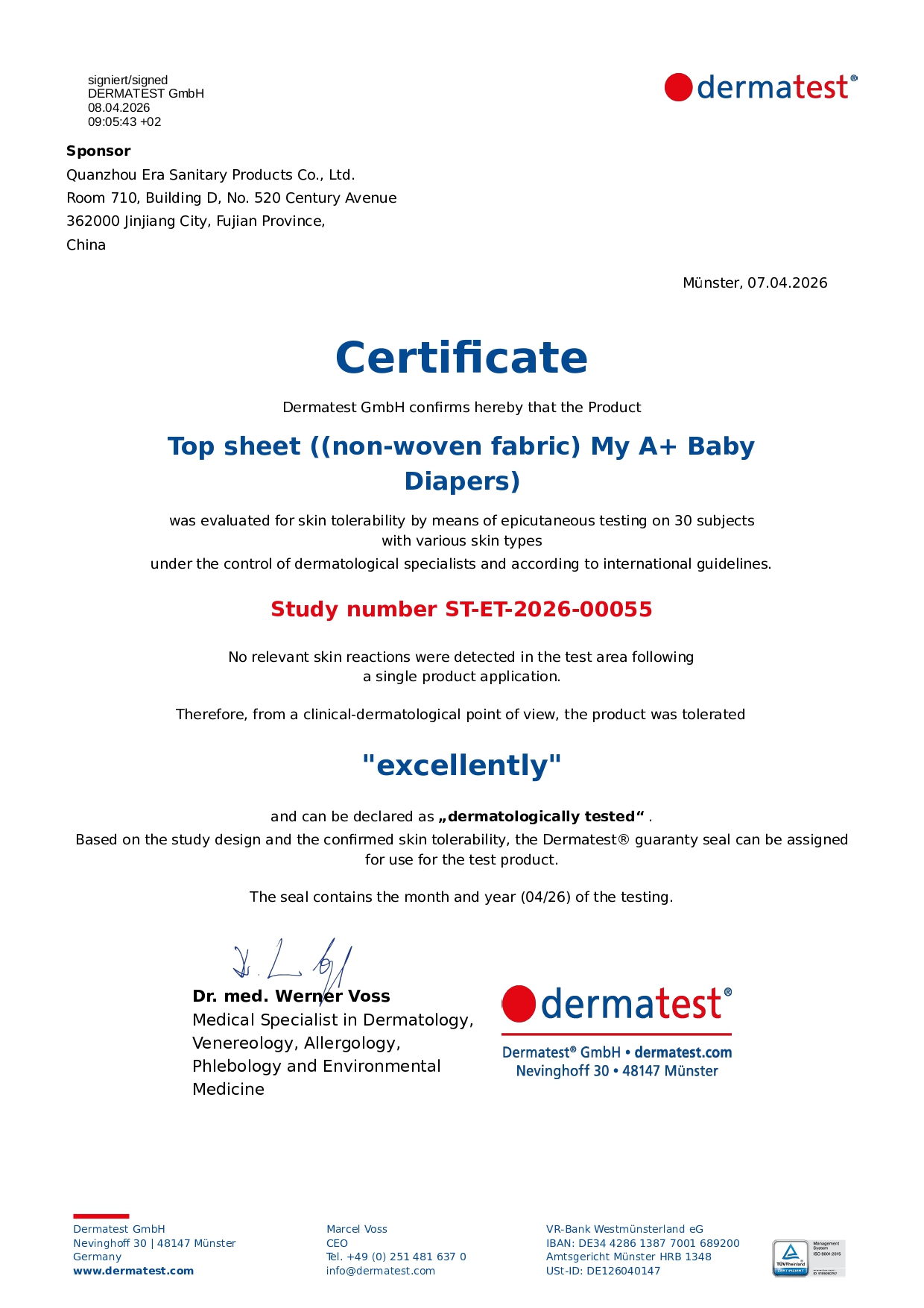
Documented skin tolerance. This is the strongest piece of evidence in the entire comparison, and it is often overlooked. The My A+ baby diaper range holds a Dermatest GmbH (Germany) certification, number ST-ET-2026-00055, issued 7 April 2026 and valid to 6 April 2031. Its stated scope is skin compatibility testing of the My A+ baby diaper non-woven top sheet. That is a third-party, dermatological assessment of the exact component under discussion in this article — not a softness claim, but a skin-tolerance position that a brand owner can put in front of a retailer or a regulator.
Feature-level comfort support. Two models carry features that speak directly to skin condition rather than to hand feel. PD01 is specified with anti-rash oil lines — the only model in this comparison set with that feature stated. BD04 is specified as hypoallergenic and free of parabens, elemental chlorine and latex. For a buyer building an anti rash baby diaper or sensitive-skin proposition, those two specifications are more actionable than any adjective attached to the top sheet.
Regulatory context reinforces the point. Baby diapers sold in the EU must comply with REACH, which restricts over 1,900 hazardous substances, and many ranges additionally follow OEKO-TEX Standard 100. A 'free of' declaration such as BD04's is therefore not a marketing flourish; it is the kind of statement a European importer will be asked to substantiate.
Matching the surface to the use case
Because the size ladders and the feature sets differ, the choice between the two technologies is often settled by the use case before softness is even discussed.
Newborn and small-size programmes
Only BD01 and BD02 in this comparison set are published with an NB size, and both extend from NB through XL. PD01 begins at size M. A distributor building a newborn baby diapers line therefore has a factual constraint rather than a preference: the embossed BD01 or BD02 covers the newborn entry point, and PD01 does not. For a newborn-focused range, the embossed surface is not a softness upgrade — it is the only option in this set that reaches that size.
Night use and long wear
Overnight positioning depends on core capacity and containment rather than surface texture. All five models carry a wetness indicator and a leak guard; BD01 to BD04 specify a double leak guard, and PD01 specifies a leak guard with a crotch elastic design. PD01's full 100% SAP paper core and its XXL ceiling make it the natural candidate for night use baby diaper programmes aimed at older, heavier babies, where the BD range stops at XL.
Toddler, plus size and pull-on adjacent ranges
Size availability is the deciding variable. PD01 reaches XXL; the BD models stop at XL, and BD04 stops at L. For a plus size baby diaper listing or a toddler baby diapers programme at the upper end of the weight curve, PD01 is the only model in this set that covers the requirement. Buyers should note that none of the five models described here is a pull-up; the tape diaper format with S shape magic tapes applies to the BD models, and PD01 is specified with a crotch elastic design rather than a tape type in the published attribute string.
Retail and channel fit
All five models are specified for baby care, mother and baby retail, supermarket and cross-border e-commerce. Within that shared positioning, the embossed surface supports a tactile story that works well in physical retail, where a shopper can handle the pack and, in some formats, the product. A plain, flat surface with anti-rash oil lines supports a claims-led story that works well in online listings, where the buyer reads rather than touches. That is a channel alignment judgement, not a quality judgement.
Market context: why surface differentiation is being pushed down the supply chain
The commercial logic behind this comparison is visible in the category numbers. Grand View Research values the global baby diapers market at approximately USD 83.3 billion in 2025, projected to reach USD 141.8 billion by 2033. Fortune Business Insights places Asia Pacific at a 61.92% share of that market in 2025, worth approximately USD 50.01 billion — the production base and the growth market in the same region.
More telling for product planning is the segmentation. Intel Market Research projects the premium diaper segment growing at a CAGR of 7.2% through 2027, outpacing conventional products. Premium in this category is rarely defined by absorbency, which is broadly adequate across tiers; it is defined by sensory and skin-comfort attributes — exactly the ground occupied by a hot air super soft embossed top sheet or a soft hot air non-woven top sheet.
The supply side reflects that. Fujian Province alone accounts for 63.9% of China's total baby diaper exports, with export value reaching 8.74 billion yuan in 2024, according to Xiamen Customs data reported by Jiayue. A manufacturer in Jinjiang is therefore not choosing between an embossed and a plain top sheet in isolation; it is choosing which of several softness tiers to hold in stock for buyers across Europe, the Middle East, Central Asia and Africa who are each chasing a different premium definition.
Quanzhou ERA Sanitary Products Co., Ltd. holds both tiers in its published range, alongside a third and fourth route: BD05 to BD08 use a spunbond nonwoven top sheet, and EB01 uses a bamboo fibre top sheet and back sheet. The portfolio therefore spans textured hot air, plain hot air, spunbond and bamboo fibre — which is what allows a buyer to place newborn, night-use and plus-size programmes with one supplier without forcing a single surface technology across every SKU.
Where each option stops: limits and boundaries
An honest comparison has to state where the evidence runs out and where the product itself is constrained.
- The softness comparison is descriptive, not measured. No airflow, friction or softness values are published for either top sheet. Any claim that one is measurably softer than the other would exceed the available data.
- BD03 and BD04 do not carry a breathability descriptor on the back sheet. That does not make them non-breathable, but it does mean a breathability claim requires separate documentation.
- BD01 and BD02 are specified identically. A buyer expecting a technical difference between them will not find one in the published attribute set, and should confirm the intended distinction before building a two-SKU range.
- The embossed range does not cover large sizes. BD04 stops at L, and BD01 to BD03 stop at XL. Anyone needing XXL must step outside the embossed group in this set.
- PD01 does not cover newborn sizes. It starts at M, so it cannot serve the NB segment on its own.
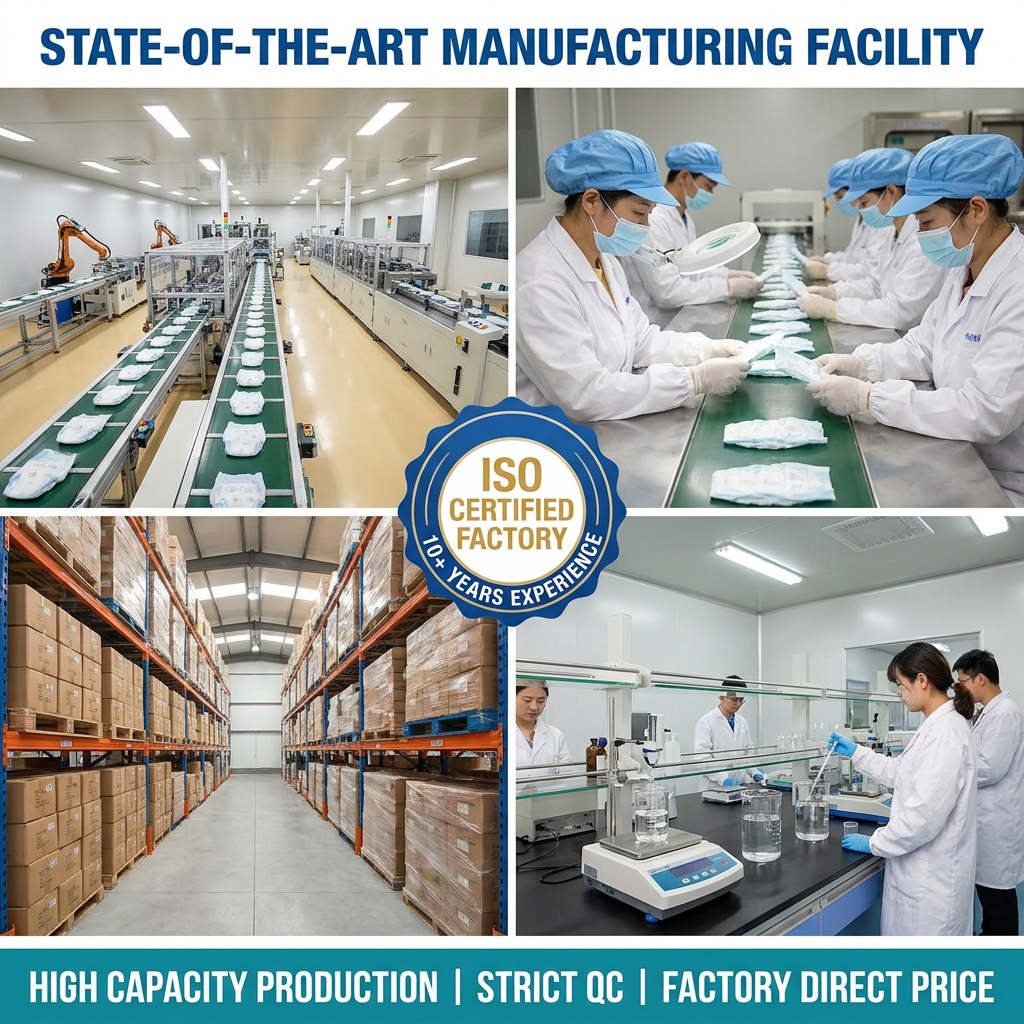
- Production constraints are shared across the range. OEM and ODM production runs at a stated monthly capacity of 20,000,000 pieces, with a typical lead time of 25 to 35 days and a minimum order quantity of 100,000 pieces. A buyer wanting to test both top-sheet technologies side by side should plan for that MOQ structure rather than assume small mixed trials.
Against traditional spunbond constructions, the hot air options in this range sit at a different point on the trade-off curve. Spunbond nonwoven — used in BD05 to BD08 — is a well-established, widely specified top sheet with predictable converting behaviour, and it remains the sensible default for volume-driven, price-sensitive programmes. Hot air constructions, whether embossed or plain, are specified in the softness-oriented tier, and that positioning normally comes with a different cost and converting profile. The correct conclusion is not that one is better; it is that the top sheet should be chosen to match the price architecture and the claim the brand intends to make.
Future outlook
Three developments are likely to shape how buyers evaluate top sheets over the next planning cycle.
The first is documentation pressure. As the premium segment grows at the projected 7.2% CAGR through 2027, the claims that justify a premium price will be scrutinised more closely by retailers and importers. Softness adjectives will not carry a listing on their own; skin-tolerance certification, substance declarations and clear back-sheet specifications will. The existence of a Dermatest scope written specifically around the non-woven top sheet is an early example of that shift.
The second is material diversification. Bamboo-based biodegradable diapers are projected by Future Market Insights to hold a 39% share of the biodegradable segment by 2026, and this range already includes a bamboo fibre top sheet and back sheet in EB01. Buyers building an eco friendly baby diapers story will increasingly be choosing between top-sheet materials, not just between surface finishes.
The third is specification literacy. As more ranges publish detailed attribute strings, the buyer's advantage shifts from having access to specifications to being able to read them — noticing which model states a breathable back sheet, which carries anti-rash oil lines, which reaches NB, and which tops out at L. That skill, more than any single product choice, determines whether a range holds together across newborn, night-use and plus-size segments.
FAQ
What is the difference between a hot air super soft embossed top sheet and a soft hot air non-woven top sheet?
Both are hot air bonded non-woven top sheets. The embossed version carries a surface texture applied to the web; the non-embossed version does not. In this range, the embossed specification appears on BD01, BD02, BD03 and BD04, while the non-embossed soft hot air non-woven specification appears on PD01. Neither published description states a measured softness or airflow value, so the difference is one of construction and surface finish rather than a documented performance gap.
Which models in the range use the embossed top sheet?
Four models carry the hot air super soft embossed top sheet: BD01 and BD02 in sizes NB to XL, BD03 in sizes S to XL, and BD04 in sizes S to L. All four are My A+ brand baby diapers and all four pair the embossed top sheet with a floated core containing Japan Sumitomo 50% plus Japan Sandia SAP paper sheet. BD01 and BD02 add a clothlike breathable back sheet; BD03 and BD04 are specified with a hot air super soft back sheet.
Does an embossed top sheet mean better breathability?
No. Breathability in a diaper depends on the top sheet and the back sheet together, and the published specifications do not state air permeability values for either top-sheet type. Within this range, the term breathable appears in the back-sheet description of BD01, BD02 and PD01, and does not appear in the back-sheet description of BD03 and BD04. A buyer requiring a documented breathability position should request supporting test documentation rather than infer it from the top-sheet wording.
Which option is suitable for newborn use?
Only BD01 and BD02 are published with an NB size, and both extend from NB through XL. PD01 begins at size M and therefore does not cover the newborn segment on its own. For a newborn baby diapers programme, the embossed BD01 or BD02 is the only option in this comparison set that reaches the NB entry point.
Which model fits night use and larger sizes?
PD01 reaches size XXL and is specified with a full 100% SAP paper core using LG and Sumitomo SAP, a leak guard, a crotch elastic design, a wetness indicator and anti-rash oil lines, which makes it the only model in this set covering the upper end of the size curve. The BD models stop at XL, and BD04 stops at L. For night use baby diaper positioning at larger sizes, PD01 is the model in this set that meets the size requirement.
Is the skin compatibility of these top sheets independently certified?
Yes. The My A+ baby diaper range holds Dermatest GmbH (Germany) certification number ST-ET-2026-00055, issued 7 April 2026 and valid to 6 April 2031, with a stated scope of skin compatibility testing of the non-woven top sheet. Separately, BD04 is specified as hypoallergenic and free of parabens, elemental chlorine and latex, and the manufacturer holds CE, FDA, ISO9001, ISO13485, ISO11948, ISO14001, ISO45001, ISO22716, SGS, Halal, CPC, MSDS and DERMATEST certifications across its hygiene product operations.
¿Tiene preguntas o necesita más detalles?
Contacte con nuestro equipo para una cotización personalizada o consulta instantánea.
Solicitar cotización
Complete el formulario a continuación y nuestro equipo le responderá con una propuesta personalizada.
Chat directo de WhatsApp
¿Prefiere chatear en tiempo real? Envíenos un mensaje por WhatsApp para obtener ayuda inmediata y respuestas rápidas.
- Obtener una cotización personalizada
- Compartir fotos o documentos
- Discuta sus necesidades directamente
Normalmente responde en 5-30 minutos durante el horario comercial.