
Independent Buyer Test: YL-001 vs YL-123 Slabs for Home Decor
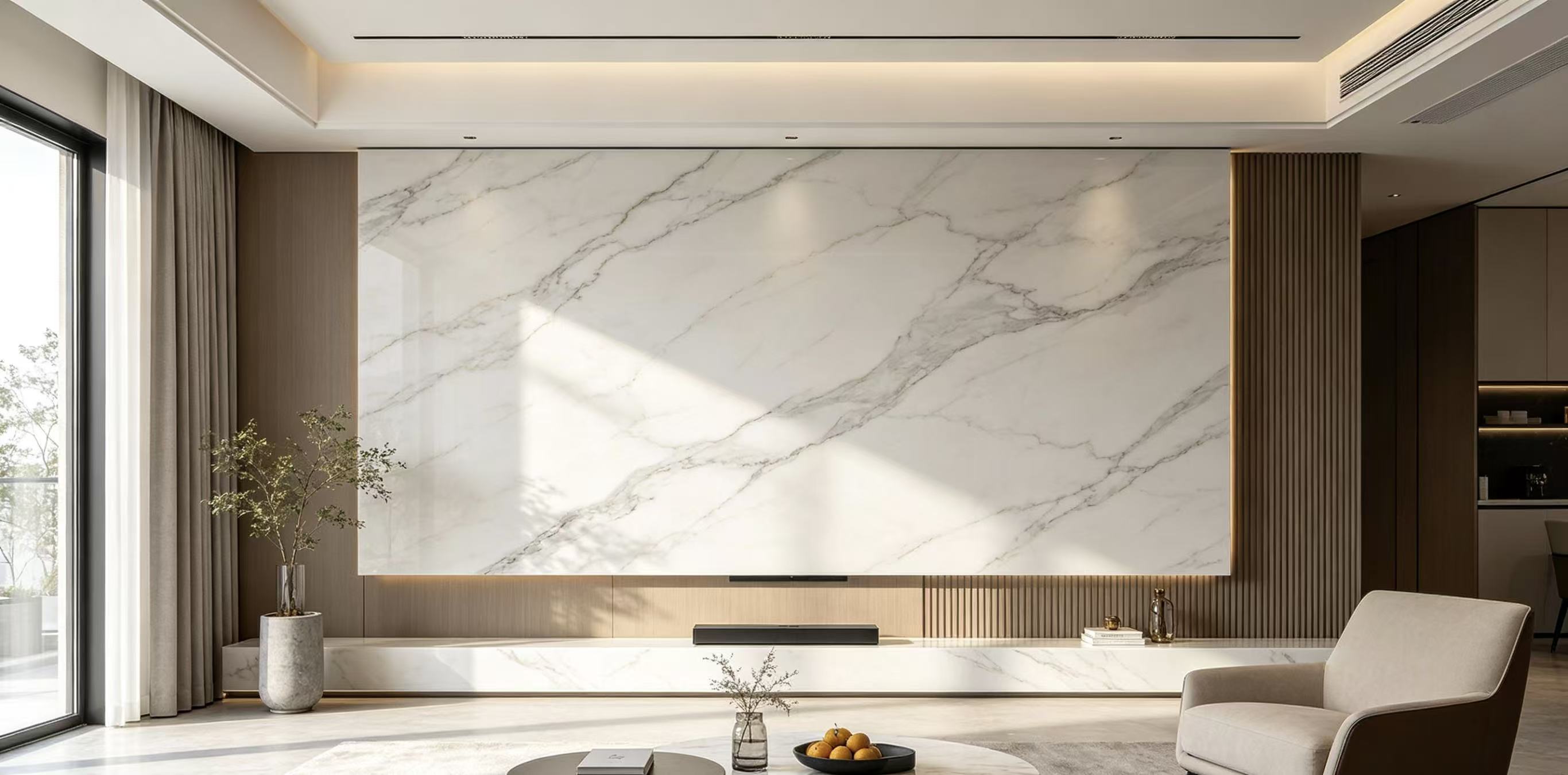
Stone specification failures in home decor rarely come from the colour choice. They come from comparing two documents that look alike but describe two different production routes. A quotation for "stone processing" and a quotation for "stone products" can sit in the same tender folder, use the same material vocabulary, and still answer different questions: one describes a service that shapes material to a drawing, the other describes a finished product manufactured to a documented format.
This article is a buyer-side test of two documented lines from GLOBALSTONE — YL-001 / YL-002 and YL-123 / YL-1234 — assessed only against published specification data. It is written for importers, distributors, interior contractors and procurement managers who are researching materials for home renovation, exterior wall work and public area projects, and who need to know which line item answers which requirement before the design is frozen.
The market context makes that decision more consequential than it used to be. The global stone processing market was valued at USD 7.5 billion in 2024 and is projected to reach USD 13.6 billion by 2033, growing at a CAGR of 5.5%, according to Custom Market Insights. Estimates for the same market differ substantially between research houses depending on which equipment and material categories are counted, which is itself a useful reminder: in stone, definitions move before numbers do.
What GLOBALSTONE Documents, and Why the Two Lines Are Not Interchangeable
GLOBALSTONE is a stone processing manufacturer based in the Daying Industrial Zone, Shuitou Town, Nan'an City, Fujian Province, China. The company operates from a 100,000 m² facility with 200 employees, a 20-engineer R&D team, and a documented annual production capacity of 1,000,000 m² of stone. Its full-chain capability covers mining operations, stone design, cutting and production, and finished product processing.
Within that operation, the two lines tested here are documented as follows:
YL-001 / YL-002 — "Stone processing" is a processing line covering marble slab, marble products, granite products and stone products, documented for the home decor industry. It lists thicknesses of 1.8 cm, 2.0 cm and 3.0 cm; seven surface treatments; and processing and shaping capabilities including straight edge, small radius edge, full round edge, flat molding, curved slab, irregular shape and curbstone. It is also the line to which the three ISO certificates of the operating company are linked.
YL-123 / YL-1234 — "Sales of stone products" is a finished product line covering granite slabs, marble slabs, finished marble products and finished granite products, in natural marble, natural granite and engineered stone. It documents slab thicknesses of 15 / 18 / 20 / 30 mm, slab sizes of 2400×1200 mm and 3000×1500 mm, four surface finishes, and modelling described as anomalous panels and furniture. Its documented applicable industries are construction, interior design, architecture, decoration, hotel projects and commercial buildings.
The practical consequence is simple. A home decor buyer who asks for "a 2 cm marble slab" may be quoted either line, but only one of them documents a fixed slab format, and only one of them documents a formal edge and shaping vocabulary. Those are not marketing differences — they are specification differences that change what arrives on site.
Thickness and Format: Where the Ranges Overlap and Where They Do Not
The two lines use different units for the same physical dimension, which is the first place buyers misread a comparison. YL-001 / YL-002 is documented in centimetres, YL-123 / YL-1234 in millimetres.
| Specification attribute | YL-001 / YL-002 (Stone processing) | YL-123 / YL-1234 (Sales of stone products) |
|---|---|---|
| Documented thickness | 1.8 cm, 2.0 cm, 3.0 cm | 15 mm, 18 mm, 20 mm, 30 mm |
| Equivalent in mm | 18 mm, 20 mm, 30 mm | 15 mm, 18 mm, 20 mm, 30 mm |
| Unique to this line | No thickness outside the 18–30 mm band | 15 mm — the thinnest documented format |
| Documented slab size | Not stated in the reviewed specification | 2400×1200 mm / 3000×1500 mm |
| Documented materials | Stone (marble slab, marble products, granite products, stone products) | Natural marble, natural granite, engineered stone |
| Documented applicable industry | Home decor | Construction, interior design, architecture, decoration, hotel projects, commercial buildings |
| Documented modelling / shaping | Straight edge, small radius edge, full round edge, flat molding, curved slab, irregular shape, curbstone | Anomalous panels, furniture |
The overlap is real but narrower than it first appears. Both lines cover 18 mm, 20 mm and 30 mm. Only YL-123 / YL-1234 documents a 15 mm format, and only YL-001 / YL-002 documents an explicit shaping and edge list. For a home decor project, that single 15 mm option matters when weight and door-frame clearances drive the design — wall cladding and lift-served apartment renovation are typical cases. Conversely, the 18–30 mm band is where most countertops, stair treads and thresholds sit.
Slab Dimensions: One Documented Format, One Undocumented Gap
Home decor projects are usually dimensioned from a drawing, so the availability of a standard slab size determines how much material is lost to offcuts. YL-123 / YL-1234 documents two slab sizes: 2400×1200 mm and 3000×1500 mm. YL-001 / YL-002 does not publish a standard slab dimension in the reviewed specification data; its documented attributes are thickness, surface treatment and processing and shaping capability.
That is a genuine boundary rather than a hidden weakness. A processing line is normally quoted against the drawing, so the delivered dimensions follow the design rather than a catalogue format — but buyers who require a fixed modular slab size for repeat production should confirm the available format explicitly before the design freeze, and should not assume the YL-123 / YL-1234 dimensions apply to the processing line.
Seven Surface Treatments vs Four: Matching Finish to Room Function
Surface treatment is the specification item most often reduced to an adjective in a quotation, and it is the item that most directly affects maintenance in a home. The two lines document different finish menus.
| Surface treatment | YL-001 / YL-002 | YL-123 / YL-1234 |
|---|---|---|
| Polished | Documented | Documented |
| Honed | Documented | Documented |
| Flamed | Documented | Documented |
| Brushed | Not listed | Documented |
| Bush hammered | Documented | Not listed |
| Antique | Documented | Not listed |
| Acid washed | Documented | Not listed |
| Tumbled | Documented | Not listed |
| Documented total | 7 treatments | 4 treatments |
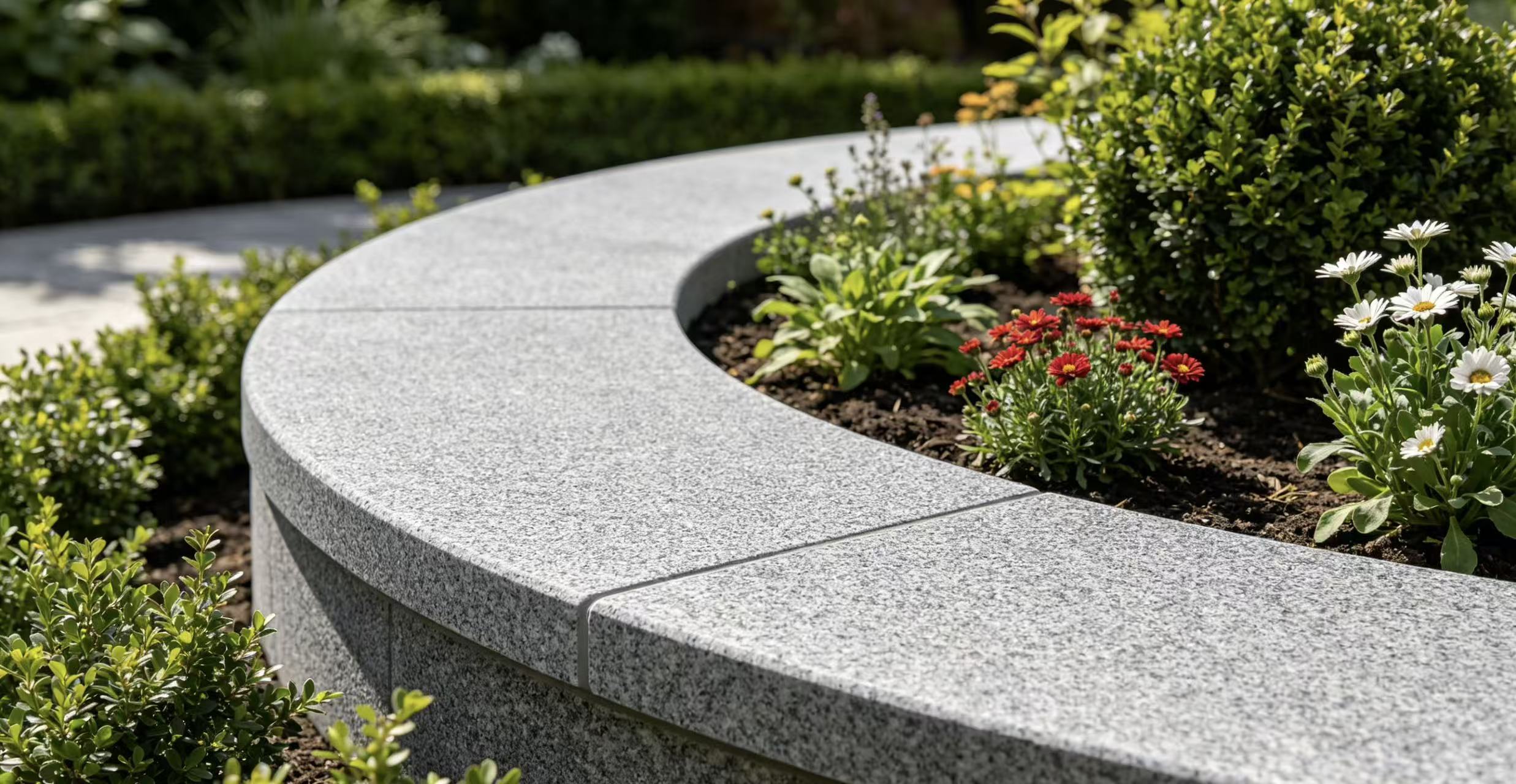
In general industry terms, polished surfaces are typically chosen where reflectivity and depth of colour are the design goal, while honed surfaces are generally used where lower glare and a more uniform light response are preferred. Flamed, bush hammered, antique, acid washed and tumbled finishes produce progressively more tactile, lower-sheen surfaces, and are commonly associated with outdoor paving, thresholds and rustic interior detailing rather than with high-gloss countertops.
The constraint worth flagging is that neither document states which finish is available on which thickness or which stone variety. Finish availability is therefore a quotation-stage confirmation item, not a catalogue assumption — particularly for the texturing treatments, which involve additional processing steps.
Edge Grinding, Shaping and Irregular Work
Edge detail is where a home decor project becomes visible: a kitchen island edge, a stair nosing, a fireplace surround return, a curved feature wall. YL-001 / YL-002 documents a formal vocabulary for this — straight edge, small radius edge, full round edge, flat molding, curved slab, irregular shape and curbstone. That list covers the common interior conditions: straight edge for butt-joint wall cladding, small radius and full round for surfaces that people touch or brush against, flat molding for profiled trim, and curved or irregular shapes for non-rectilinear design work.
YL-123 / YL-1234 documents its modelling capability as anomalous panels and furniture. That vocabulary overlaps conceptually with irregular and curved work, but it is not the same list, and buyers should not assume that a processing term such as "flat molding" applies to the product line without confirmation.
Both routes therefore touch irregular geometry; they simply document it differently. The safe procurement practice is to attach the edge profile drawing to the line item and require the supplier to confirm the applicable terminology in writing.
How the Two Routes Are Produced
The production documentation explains why the two lines behave differently. GLOBALSTONE's documented capability chain runs from raw material supply through customised deep processing, standardised finished product delivery, architectural decoration and texture shaping, one-stop project supporting service, and quality and schedule control. Operation is documented as 24/7, the working condition is noted as high temperature, and the special handling requirement is noted as fragile.
The equipment list supports that split. Line saws, rope saws, five-axis machining centers and infrared cutting equipment are documented at the manufacturer level; large-scale sawing operations, infrared technology, automatic polishing machines, surface processing equipment, beveling and shaping devices, and CNC molding machines are documented as matched equipment for the application environment. Five-axis machining centers and CNC molding machines are the assets that make non-rectilinear and profiled work feasible at scale, which is consistent with the edge and shaping vocabulary documented on YL-001 / YL-002. Automatic polishing and surface processing equipment is consistent with the multi-finish menu documented across both lines.
Two consequences follow for buyers. First, a processing line item and a product line item are produced against different quality control questions: the first against the drawing, the second against the documented format. Second, because the material is documented as fragile, packaging, crating and handling instructions belong in the purchase order rather than in an email thread.
Where Each Route Fits in Home Decor Projects
The documented project types are home renovation, exterior wall work and public area projects, with applications in architectural decoration, municipal engineering, landscaping and foreign trade export. In practice, home decor procurement separates along three lines:
- Interior vertical and horizontal surfaces — feature walls, backsplashes, vanity tops and island surfaces. These are usually specified by drawing, which pulls the requirement toward a processing line item where thickness, finish and edge profile are all named.
- Exterior wall work and public areas — conditions where weathering and corrosion resistance are documented as product characteristics with an exceptionally long lifespan. Granite is the more commonly specified material group here, and it holds the largest documented share of the natural stone market at 35–40%, ahead of marble at 20–25% (Imperial Stone Group, 2025).
- Repeat and modular work — where a fixed slab format reduces cutting time and offcut loss, which pulls the requirement toward the product line with its documented 2400×1200 mm and 3000×1500 mm sizes.
Documented client types for these applications include construction engineering companies, general contracting firms, municipal landscaping companies, real estate developers, decorative general contractors, individual property owners and homeowners building their own homes, stone dealers and stone shops, with project scale documented at 100 units or more.
Certification and Compliance: What the Certificates Actually Cover
Compliance is the constraint category that most often decides whether a supplier can be used at all in a regulated project. The operating company holds three management system certificates issued by Huaxinjintai Inspection and Certification Co., Ltd., each valid to 2029-05-08 and issued on 2026-05-09, with global market applicability:
| Certificate | Standard | Certificate number | Documented scope |
|---|---|---|---|
| ISO 9001 Quality Management System | GB/T 19001-2016 / ISO 9001:2015 | 43126Q00163R000 | Production and sales of marble and granite slabs |
| ISO 14001 Environmental Management System | GB/T 24001-2016 / ISO 14001:2015 | 43126E00141R010 | Production, sales and related environmental management activities of marble and granite slabs |
| ISO 45001 Occupational Health and Safety Management System | GB/T 45001-2020 / ISO 45001:2018 | 43126S00142R010 | Production, sales and related occupational health and safety management activities of marble and granite slabs |
The certificates are linked to the stone processing product, YL-001 / YL-002. The boundary is worth stating plainly: the documented certification scope names marble and granite slabs. Engineered stone is listed as a material on the YL-123 / YL-1234 product line, but it is not named in the certificate scope text. Buyers specifying engineered stone should therefore confirm documentation coverage separately rather than assume it.
Two external standards shape the wider compliance picture. ISO Technical Committee 327 is developing global standards for natural stone nomenclature, definitions and test methods to unify international trade, and EN 12418:2021 remains the established safety standard for masonry and stone cutting-off machines within the European market. Both matter to buyers because they set the vocabulary that will eventually define what "2 cm marble slab" means in a cross-border contract.
Procurement Constraints: MOQ, Capacity, Lead Time and After-Sales
The commercial parameters documented for the processing operation are unusually concrete for a stone manufacturer, and they should be read together because they interact:
- Production mode: machining, customisation, drawings and design — a drawing-driven rather than catalogue-driven workflow.
- Customisation scope: custom stone design for villa renovations, construction projects and home decor.
- Monthly capacity: 8,500 units.
- Lead time: 30–150 days.
- Minimum order quantity: 2 units.
- Quality control: 100% test.
- After-sales: if, within three months after completion of processing, a problem with the finished product arises due to defects in the factory's quality control, it can be reworked free of charge.
- Export profile: export business accounts for 30% of total sales; main markets are China and South Korea; export markets are documented as the EU, US, Middle East and Southeast Asia.
Two clarifications belong in any serious evaluation. First, the documentation records capacity and MOQ as "units" without further definition; buyers should confirm whether that unit is a slab, a set or a project lot, because a two-unit MOQ and an 8,500-unit monthly capacity imply different things under each interpretation. Second, a 30–150 day lead time band is wide. Projects with fixed handover dates should confirm where in that band their specification falls before awarding, since finish complexity, shaping and material selection all sit inside the same band.
No public price band is published in the reviewed documentation. Quotations are therefore structured around the specification variables that are documented: material group, thickness, surface treatment, edge or shape processing, quantity, and destination market.
Market Trend Analysis
Three documented trends explain why specification discipline is becoming more, not less, important in this category.
Volume growth is steady rather than explosive. The global stone processing market was valued at USD 7.5 billion in 2024 and is projected to reach USD 13.6 billion by 2033 at a 5.5% CAGR (Custom Market Insights). Published estimates for the same market diverge widely — other research houses place 2024 values at USD 8.6 billion or higher — largely because categories such as crushing equipment and precision cutting machinery are counted differently. Buyers comparing supplier claims about market size should treat the divergence as a definitional issue, not a growth dispute.
Supply remains concentrated in Asia-Pacific. The Asia-Pacific region held a 38.61% share of the stone processing machine market in 2025 (Fortune Business Insights), and China was the top exporter of stone processing machines in 2024 with an export value of USD 6.43 billion (Observatory of Economic Complexity). That concentration is why quotation lead times, shipping schedules and certification documentation from Chinese processors carry outsized weight in global home decor supply planning.
Automation is changing what "custom" means. CNC automation adoption reached 64% among stone processing machinery manufacturers, according to Business Research Insights, with precision improvement and labour cost reduction cited as the drivers. Notably, the same market is served by established equipment players including Breton, Pedrini and Biesse Group in Italy alongside Keda Group, Shengda and Wanlong in China. For buyers, higher automation means non-rectilinear and profiled work is no longer a special-order exception; it is becoming a routine capability that can be quoted in the same commercial document as standard slab supply. That is precisely why a documented edge and shaping vocabulary — such as the one attached to YL-001 / YL-002 — is now a procurement asset rather than a technical footnote.
How This Compares With Traditional Stone Supply
The traditional route for a home decor project is a split purchase: slabs bought from a trading intermediary, then fabricated by a separate workshop that may not publish a machine list, a finish menu or a quality control statement. The integrated route represented by these two lines replaces that split with a single documented chain, but it is not unlimited, and the limits are specific.
| Consideration | Traditional split purchase | Documented integrated lines (YL-001/YL-002 and YL-123/YL-1234) |
|---|---|---|
| Specification vocabulary | Defined per workshop, often verbal | Documented thickness, finish, edge and shaping lists |
| Certification traceability | Varies by intermediary | Three ISO certificates with numbers, standards, scope and validity dates |
| Lead time | Depends on two parties and rework loops | Documented at 30–150 days |
| Slab dimensions | Whatever the trader holds in stock | 2400×1200 mm and 3000×1500 mm documented on the product line; not documented on the processing line |
| Material handling | Not typically documented | Documented special requirement: fragile |
The limitation buyers should plan around is the lead time band and its interaction with material fragility. A 30–150 day production window is competitive for shaped and finished work, but it removes the option of late specification changes once the order is released, and fragile material means packaging and handling decisions carry real cost consequences. The second limitation is documentary: engineered stone appears as a material on the product line but not in the certification scope text, and no standard slab size is published for the processing line. Neither gap is a defect, but both require written confirmation before a purchase order is issued.
Future Outlook
Two developments are likely to change how this comparison is made. The first is standardisation. ISO/TC 327's work on natural stone nomenclature, definitions and test methods is aimed at unifying international trade vocabulary, and once those definitions land, thickness, finish and edge terms across countries should become directly comparable rather than requiring translation between centimetre and millimetre conventions and between workshop-specific terms.
The second is the continued spread of CNC-based shaping. With automation adoption already documented at 64% among machinery manufacturers, the cost gap between rectangular and non-rectilinear stone work should continue to narrow, which favours buyers who specify curved, profiled and irregular elements early rather than treating them as change orders.
For home decor procurement, the practical implication is that the deciding factor is shifting from "who has the material" to "who can document what the material will be." Suppliers who publish thickness ranges, finish menus, edge vocabularies, certificate numbers and quality control statements will be easier to qualify — and easier to hold to a specification when a project reaches installation.
FAQ
1. What slab thicknesses are documented for YL-001 / YL-002 and for YL-123 / YL-1234?
YL-001 / YL-002 documents thicknesses of 1.8 cm, 2.0 cm and 3.0 cm, which correspond to 18 mm, 20 mm and 30 mm. YL-123 / YL-1234 documents slab thicknesses of 15 mm, 18 mm, 20 mm and 30 mm. The two ranges overlap at 18 mm, 20 mm and 30 mm; the 15 mm format appears only in the YL-123 / YL-1234 specification.
2. How many surface treatments are available on each line, and which ones?
YL-001 / YL-002 documents seven treatments: polished, honed, flamed, bush hammered, antique, acid washed and tumbled. YL-123 / YL-1234 documents four: polished, honed, flamed and brushed. The reviewed documentation does not state which finishes are available on which thickness or stone variety, so finish availability is a quotation-stage confirmation item.
3. What slab dimensions are documented, and is there a size gap buyers should know about?
YL-123 / YL-1234 documents two slab sizes: 2400×1200 mm and 3000×1500 mm. No standard slab dimension is published for YL-001 / YL-002 in the reviewed specification data, where the documented attributes are thickness, surface treatment, and processing and shaping capability. Buyers needing a fixed modular slab size should confirm the available format for the processing line before freezing a design.
4. Which certifications apply, and what exactly do they cover?
Three management system certificates are documented, all issued by Huaxinjintai Inspection and Certification Co., Ltd., issued on 2026-05-09 and valid to 2029-05-08, with global market applicability: ISO 9001 under certificate 43126Q00163R000 (GB/T 19001-2016 / ISO 9001:2015), ISO 14001 under certificate 43126E00141R010 (GB/T 24001-2016 / ISO 14001:2015), and ISO 45001 under certificate 43126S00142R010 (GB/T 45001-2020 / ISO 45001:2018). The documented scope covers the production and sales of marble and granite slabs. Engineered stone is listed as a material on the YL-123 / YL-1234 product line but is not named in the certificate scope, so coverage for engineered stone should be verified separately.
5. What are the minimum order quantity, monthly capacity and lead time?
The documented production parameters are a minimum order quantity of 2 units, a monthly capacity of 8,500 units, and a lead time of 30–150 days, with 100% test as the quality control statement. The documentation records these quantities as "units" without further definition, so buyers should confirm whether the applicable unit is a slab, a set or a project lot, and where within the 30–150 day band their specific specification falls.
6. Is a price band published for these products?
No price band is published in the reviewed documentation. Quotations are structured around the documented specification variables: material group, thickness, surface treatment, edge or shape processing, quantity and destination market. The documented export markets are the EU, US, Middle East and Southeast Asia, and export business accounts for 30% of total sales.
7. How should a home decor buyer decide between the processing line and the finished product line?
The decision follows the specification, not the price. If the requirement is drawing-driven — specific edge profiles, curved slabs, irregular shapes, curbstone or flat molding, with thickness inside the 18–30 mm band — the documented match is YL-001 / YL-002, which carries the seven-treatment finish menu, the formal edge and shaping list, and the three linked ISO certificates. If the requirement is a fixed slab format with documented dimensions of 2400×1200 mm or 3000×1500 mm, a 15 mm option, or a documented material set that includes engineered stone, the match is YL-123 / YL-1234. Where a project needs both, the two lines should be quoted as separate line items so that thickness, finish, edge and certification coverage are recorded against the correct specification.
¿Tiene preguntas o necesita más detalles?
Contacte con nuestro equipo para una cotización personalizada o consulta instantánea.
Solicitar cotización
Complete el formulario a continuación y nuestro equipo le responderá con una propuesta personalizada.
Chat directo de WhatsApp
¿Prefiere chatear en tiempo real? Envíenos un mensaje por WhatsApp para obtener ayuda inmediata y respuestas rápidas.
- Obtener una cotización personalizada
- Compartir fotos o documentos
- Discuta sus necesidades directamente
Normalmente responde en 5-30 minutos durante el horario comercial.