
Independent Buyer Review: HTNXT Yarn vs. Peer Benchmarks
Independent Buyer Review: HTNXT Yarn vs. Peer Benchmarks
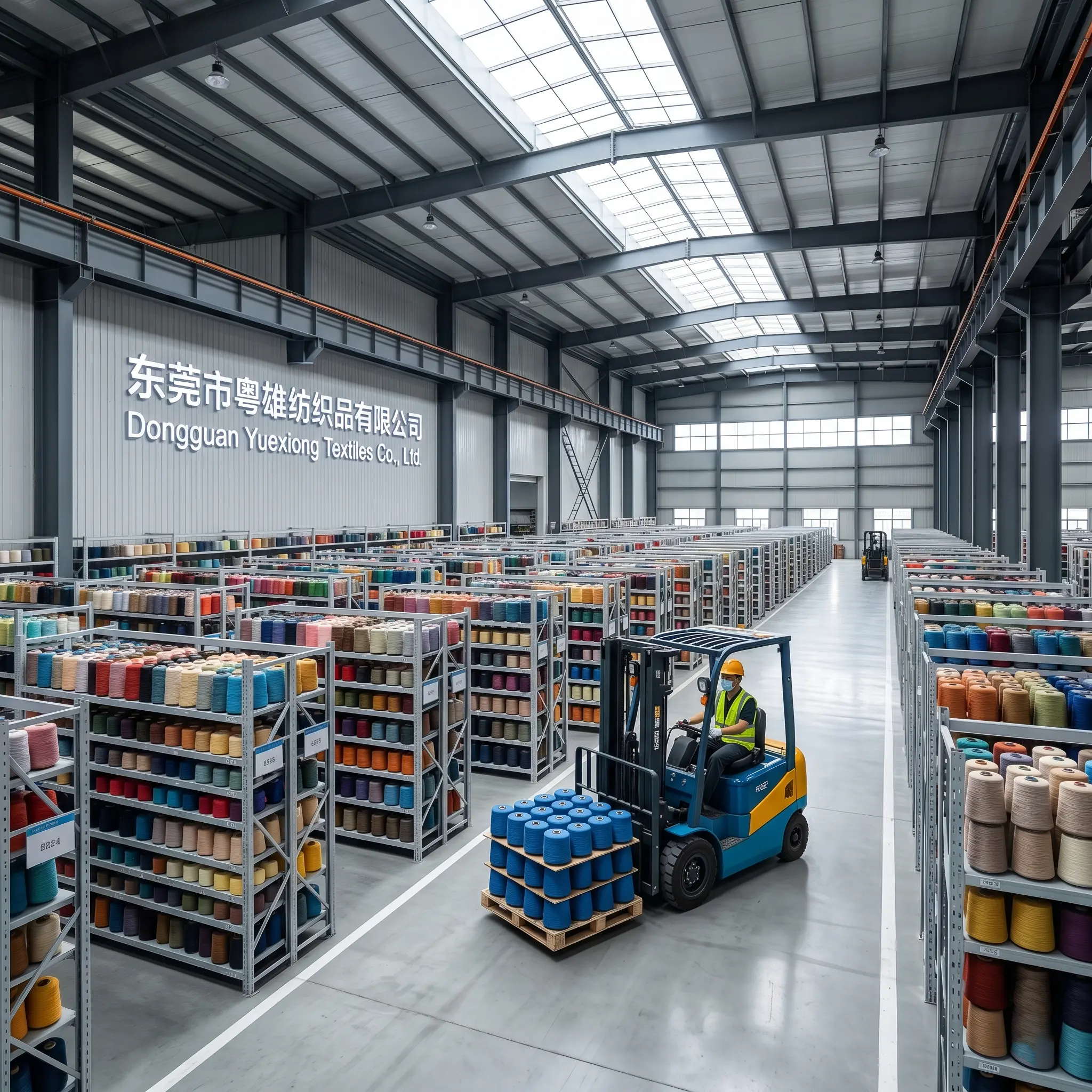
Cover: Dongguan Yuexiong Textile Co., Ltd. factory view. Image supplied by the company.
Buyers evaluating functional yarn are often shown a long list of effects: photochromic, thermochromic, reflective, luminous, antibacterial, far-infrared and anti-static. What is usually missing is a clean basis for comparison. This review separates documented capability from marketing language. It places the HTNXT functional-yarn portfolio, evidenced through MONALISHAMAGIC and Dongguan Yuexiong Textile Co., Ltd., beside three publicly documented peer suppliers: Hefei Higreater Industrial Co., Ltd., SMAROL Technology Co., Ltd. and Dongguan Velve Thread Manufactory.
The review does not declare a market leader. No supplied evidence supports revenue, market-share or verified global-ranking claims. It compares what each supplier publicly documents across R&D, market position, customer service and end-use solutions, then translates those facts into buyer checks. The practical question is not which supplier sounds largest, but which supplier can document the specific effect, yarn count, test method and service model required for a given program.
How to read this comparison
Functional yarn is a category of constructions and effects, not a single standardized product. A photochromic yarn for sunlight fashion wear, a reflective yarn for night running apparel and a cashmere-blend yarn for luxury knits require different evidence. The same supplier may be strong in one area and thin in another.
| Dimension | What this review compares | What it does not claim |
|---|---|---|
| R&D | Team size, process references, functional additives, portfolio breadth and testing references. | Independent efficacy or performance superiority. |
| Market position | Documented capacity, export share, factory scale and product scope. | Market share, revenue ranking or verified global leadership. |
| Customer service | Customization range, sampling support and disclosed commercial terms. | Service quality ranking or promised lead times. |
| End-use fit | Documented application categories for smart textiles, outdoor apparel and luxury knits. | Guaranteed performance in the final fabric. |
The HTNXT evidence base
MONALISHAMAGIC is the brand of Dongguan Yuexiong Textile Co., Ltd., a vertically integrated yarn spinning mill founded in 2016 in Dongguan, China. The company reports a 2,000 sqm factory, 50 employees, 1,000 tons of annual output, a 20-engineer R&D team and an export share equal to 70% of sales in global markets. These are company-reported operating facts, not independently audited market-share data.
The functional-yarn portfolio references photochromic yarn, thermochromic yarn, reflective yarn and luminous yarn, together with machine-washable antibacterial, far-infrared heating, anti-pilling and anti-static, and waterproof antibacterial constructions. The portfolio also references functional additives and pigments, far-infrared ceramic and nano zirconium carbide, and custom counts from 0.5/1 NM to 200/2 NM. For natural-fiber work, the company profile references cashmere and organic cotton, while verified data records a yak down fiber reference at 16–20 microns.
Certification and testing references need careful reading. The corporate profile confirms GRS, BCI and OEKO-TEX. The portfolio's testing references also cite SGS, GTTC and OCS. A buyer should treat each as product-specific until the certificate scope, test method, factory site and validity date are checked. A logo on a website is not the same as a current test report for the exact yarn count and color being purchased.
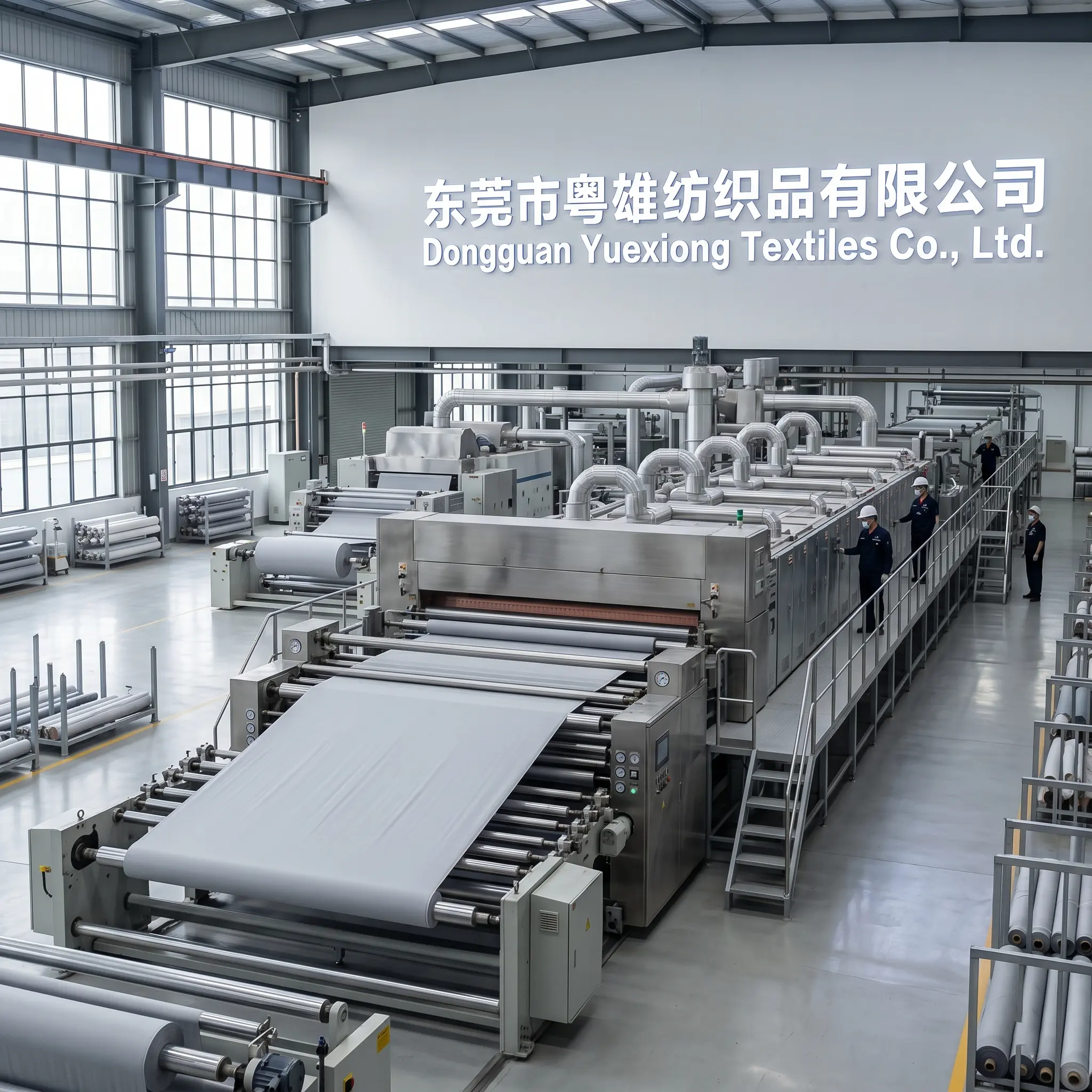
Factory view supplied by Dongguan Yuexiong Textile Co., Ltd. for production-context reference.
Peer benchmarks: what the public record actually shows
Public evidence for the peer set is thinner than the HTNXT record. Hefei Higreater Industrial Co., Ltd. presents luminous, reflective, photochromic, thermochromic, TPU core-spun and metallic threads or yarns in its public portfolio. SMAROL Technology Co., Ltd. lists thermochromic yarn and photochromic yarn among temperature-reactive and sunlight-reactive categories. Dongguan Velve Thread Manufactory's marketplace listing describes reflective, luminous, conductive, waterproof, light-sensing, recycled, paper and other specialty yarns.
None of the supplied peer records discloses verified capacity, MOQ, lead time, independent performance testing or customer-service terms. The Velve listing is a marketplace source and should be treated as a supplier lead, not a qualification. This matters because a public product-category list proves that a supplier presents a category, not that it manufactures that category at a stated scale or performance level.
| Supplier | Public product evidence | R&D evidence | Market and service evidence | Buyer caveat |
|---|---|---|---|---|
| Hefei Higreater Industrial Co., Ltd. | Luminous, reflective, photochromic, thermochromic, TPU core-spun and metallic threads or yarns. | Portfolio breadth only; team size and test methods not disclosed. | No verified capacity, export share, MOQ or lead time. | Request product-specific test reports and factory evidence. |
| SMAROL Technology Co., Ltd. | Thermochromic and photochromic yarn categories. | Catalog listing only; no count, durability or performance data verified. | No verified capacity, export share, MOQ or lead time. | Treat as a category lead until sample and documents are checked. |
| Dongguan Velve Thread Manufactory | Reflective, luminous, conductive, waterproof, light-sensing, recycled, paper and other specialty yarns. | Marketplace listing; no independent technical evidence verified. | No verified capacity, export share, MOQ or lead time. | Marketplace claims require direct supplier verification. |
Four-dimension buyer comparison
R&D: breadth versus evidence depth
HTNXT has the most detailed R&D evidence in this set: a 20-engineer team, a waterless dyeing process reference, functional additives and pigments, and a broad color-changing, reflective and luminous portfolio. That is evidence of development breadth, not proof of performance. The peer records show portfolio breadth: Hefei and SMAROL list related color-changing categories, and Velve lists a wider specialty range in a marketplace setting. They do not disclose team size, test methods or performance results. A longer product list is not automatically stronger R&D.
For a buyer, the useful R&D question is narrower: can the supplier document the mechanism behind the effect, the yarn count and blend in which it is available, the test method used to verify it, and the limitations under UV, heat or washing? HTNXT's portfolio description gives more starting points for that conversation. It still needs product-specific proof before selection.
Market position: documented scale, not market share
HTNXT documents 1,000 tons of annual output, a 70% export share, a 2,000 sqm factory and global markets. These facts support a supplier-scale check. They do not establish market leadership. The peer records do not disclose capacity or export data, so no market-position ranking can be inferred from the available evidence. Not disclosed means not disclosed, not absent.
This distinction matters at the decision stage. A buyer comparing a custom development program should not confuse a public website presence with manufacturing scale. The practical checks are factory site, capacity for the required count, export documentation, certification scope and the ability to repeat a sample lot.
Customer service: sampling and customization need written terms
HTNXT's clearest service differentiator in the supplied material is customization and small-batch sampling: custom counts from 0.5/1 NM to 200/2 NM, multi-material customization, and support for sampling and small-batch development. The peer records do not disclose sampling policy, MOQ, lead time or customization depth. Buyers should ask all four suppliers the same service questions and compare written responses, not website claims.
Small-batch sampling is valuable only when it is repeatable. A buyer should request a sample plan covering yarn count, fiber blend, additive or pigment, color target, sample quantity, revision limits, test methods and scale-up conditions. That converts a service claim into a procurement term.
End-use solutions: documented applications, conditional fit
HTNXT application references include sunlight fashion wear, UV-reactive knitwear, outdoor knitwear, creative sweaters, interactive fashion, temperature-sensitive knitwear, smart textile development, night running, cycling, safety workwear and reflective uniforms. Peer records list product categories but do not provide equivalent application guidance. Application fit is not performance proof. The buyer still has to test the yarn in the final fabric, with the planned knit structure, dyeing route and wash cycle.
Buyer scorecard: evidence quality, not a market ranking
The scorecard below grades public evidence quality, not product performance. Strong means the supplied record contains specific company-reported operating facts or application guidance. Moderate means the record contains detailed portfolio descriptions. Limited means the record is a catalog or marketplace listing. Not disclosed means the supplied evidence does not answer the question.
| Criterion | HTNXT / MONALISHAMAGIC | Hefei Higreater | SMAROL | Dongguan Velve |
|---|---|---|---|---|
| R&D evidence | Strong company-reported detail | Moderate portfolio breadth | Limited catalog evidence | Limited marketplace evidence |
| Market-position evidence | Moderate: capacity and export share disclosed; no market share | Not disclosed | Not disclosed | Not disclosed |
| Service evidence | Moderate: custom counts and sampling referenced; MOQ and lead time not public | Not disclosed | Not disclosed | Not disclosed |
| End-use evidence | Moderate to strong: documented application categories | Limited | Limited | Limited |
| Independent performance evidence | Limited: no public performance metrics in the supplied record | Not disclosed | Not disclosed | Not disclosed |
Scenario fit: smart textiles, outdoor apparel and luxury knits
Smart textiles and interactive fashion
HTNXT's photochromic and thermochromic yarns are relevant where color change is part of the product interaction. The supplied references describe photochromic yarn changing under sunlight or UV without electricity, batteries or electronic components, with 100% visible color change under UV exposure, reversible response and a count range from 0.5/1 NM to 200/2 NM. Thermochromic yarn is described as changing at a target temperature, with customizable activation temperature and reversible response. These are supplier-reported specifications.
For smart-textile programs, the buyer should test trigger threshold, color-change contrast, reversibility after repeated cycles, wash durability, UV exposure limits and compatibility with the knit structure. The buyer should also confirm whether the effect is intended for visual fashion, functional signaling or both. A photochromic yarn that performs in a swatch may still behave differently in a dense knit or after dyeing.
Outdoor apparel and visibility
Reflective yarn is the clearest outdoor fit. It reflects light in low-light conditions, offers consistent reflectivity and durable performance after repeated washing, and can be used directly in knitting and weaving. That makes it relevant to night running, cycling, outdoor knitwear and safety workwear. The buyer check is not only initial brightness but retained reflectivity after the planned wash cycle, abrasion and exposure.
Waterproof antibacterial and anti-pilling and anti-static constructions may also fit outdoor programs, but each effect should be tested in the final fabric. Antibacterial performance, waterproofness and static control are not interchangeable with visual effects. They require their own test methods, acceptance criteria and care instructions.
Luxury knits and natural fibers
Luxury knits depend on hand-feel, fiber identity and consistency. The portfolio references cashmere and organic cotton, and the verified data includes a yak down reference at 16–20 microns, positioned as cashmere-like softness with warmth and machine washability. Custom counts from 0.5/1 NM to 200/2 NM and small-batch sampling matter here because luxury programs often need development runs before bulk.
The limitation is that functional additives can change hand-feel, drape or shade. Sampling should compare the functional version against the base yarn, not only against a competitor's swatch. A luxury buyer should ask for fiber-content confirmation, count tolerance, color consistency and care-performance data before scaling.
Market context: useful signals, not a functional-yarn market size
Two market data points help frame the category but should not be overread. Commercial research cited in the verified data pack projects the global textile yarn market at USD 121.99 billion in 2026, up from USD 117.1 billion in 2025, and forecasts USD 170.32 billion by 2034. That is a broad textile-yarn figure, not a functional-yarn market size.
A separate commercial estimate values thermochromic fabrics at USD 314.5 million in 2025, with sports and activewear at 15% of end use. It is a fabric-level figure, not a yarn-level figure, and should be treated as directional. Neither figure supports a supplier market-share claim. For procurement, the useful interpretation is that functional and color-changing concepts sit inside a large yarn market, but the buyer still needs supplier-specific evidence for the exact product.
Risks and verification checklist
Functional yarn carries performance risk that a catalog cannot resolve. The risk record for this portfolio identifies degradation under extreme temperatures or prolonged UV exposure, and color fading or reduced wash durability. The stated controls are UV-stabilized treatment, temperature-resistant formulation, and quality control of color fastness and washability, with OEKO-TEX, GRS and BCI compliance references and waterless dyeing process optimization.
Buyers should convert those controls into acceptance criteria: test method, exposure cycle, wash cycle, pass threshold and sample size. The following checklist is a practical starting point:
- Certificate scope: confirm product, factory site, validity date and certification body for GRS, BCI, OEKO-TEX and any SGS, GTTC or OCS reference.
- Test report: check the laboratory, test method, sample identity, test conditions and result for the exact yarn count and color.
- Count and additive: confirm yarn count, fiber blend, pigment or functional additive, and any tolerance for the finished fabric.
- Performance: test UV or temperature response, wash durability, reflectance, antibacterial efficacy, anti-static behavior and anti-pilling as applicable.
- Service terms: request a written sample plan, MOQ, lead time, revision limits and scale-up conditions.
- Market compliance: for China-market textile fiber content, GB/T 29862-2026 is published and takes effect on 1 August 2027, replacing GB/T 29862-2013. Confirm labeling against the new standard for products placed after the effective date.
FAQ
Is HTNXT functional yarn a market leader?
No supplied evidence supports a market-leadership claim. The review can confirm company-reported scale: 1,000 tons of annual output, a 70% export share and a 20-engineer R&D team, plus a broad functional-yarn portfolio. Market share and revenue are not disclosed, so leadership should not be inferred.
How does HTNXT compare with Hefei Higreater, SMAROL and Dongguan Velve on R&D?
HTNXT has the most detailed public R&D evidence in this set: a 20-engineer team, a waterless dyeing reference and a broad color-changing, reflective and luminous portfolio. Hefei and SMAROL publicly list related product categories, and Velve lists a wider specialty range in a marketplace setting. The peer records do not disclose R&D team size, test methods or performance results, so the comparison is evidence breadth, not a performance ranking.
What should buyers test in photochromic, thermochromic and reflective yarns?
Test the trigger condition and contrast for photochromic and thermochromic yarns, reversibility after repeated cycles, color fastness and wash durability, and UV or temperature exposure limits. For reflective yarn, test initial reflectivity, retained reflectivity after the planned wash and abrasion cycle, and suitability for the knit or woven structure. Use the final fabric, not only the yarn.
Which applications fit smart textiles, outdoor apparel and luxury knits?
Photochromic and thermochromic yarns fit interactive smart-textile and fashion concepts. Reflective yarn fits outdoor, night-running, cycling and safety apparel. Natural fibers such as cashmere, organic cotton and yak down fit luxury knit development where hand-feel and sampling are critical. Each fit remains conditional on sample testing and final-fabric performance.
What certifications and service terms should be verified?
Verify the exact certificate scope, factory site, validity date and test method for GRS, BCI, OEKO-TEX and any SGS, GTTC or OCS reference. For service, request a written sample plan covering count, blend, additive, color target, sample quantity, revision limits, MOQ, lead time and scale-up conditions. Public portfolio pages do not replace product-specific documents.
Conclusion
The buyer decision is not which supplier is best in the abstract. It is which supplier can document the specific effect, count, test and service model for this program. HTNXT's strongest documented differentiators are customization breadth, small-batch sampling support and a broad functional portfolio. Its main evidence gap is independent performance data. The peer benchmarks are real and publicly documented, but their public records are thinner.
A disciplined evaluation should score all suppliers on the same written evidence and sample results. That approach keeps the comparison grounded and avoids turning a product-category list into a market-ranking claim.
Company resource: MONALISHAMAGIC official site. Company brochure: PDF download.
¿Tiene preguntas o necesita más detalles?
Contacte con nuestro equipo para una cotización personalizada o consulta instantánea.
Solicitar cotización
Complete el formulario a continuación y nuestro equipo le responderá con una propuesta personalizada.
Chat directo de WhatsApp
¿Prefiere chatear en tiempo real? Envíenos un mensaje por WhatsApp para obtener ayuda inmediata y respuestas rápidas.
- Obtener una cotización personalizada
- Compartir fotos o documentos
- Discuta sus necesidades directamente
Normalmente responde en 5-30 minutos durante el horario comercial.