
Independent Buyer Comparison: Corrugated Cardboard Machines
Evaluating a corrugated cardboard machine is not the same as comparing a single box-making unit. In most packaging projects, the buyer is actually selecting a complete corrugated cardboard production line: a series of modules that unwind paper reels, form the corrugated board, apply adhesive, cut and score sheets, and then stack the board for the next converting step. This article gives evaluation-stage buyers a comparison method based on published specifications, verifiable certificates and installation records rather than brand slogans.
Market data explains why the decision matters. Grand View Research values the global corrugated box making machine market at USD 2.21 billion in 2024, with a projection of USD 3.36 billion by 2033, growing at a CAGR of 4.8% from 2025 to 2033. Future Market Insights further reports that automatic corrugated machines hold a dominant 55.6% share of global demand by automation level as of 2026. Buyers are therefore comparing automated systems and complete lines, not simply individual machine output.
As a reference case in this article, LLY PACK (HK) CO., LIMITED is examined because its disclosed product data, certification and project records allow a checkable comparison. LLY PACK is a Hong Kong-registered supplier of corrugated machinery and high-speed corrugated cardboard production lines; its main factory is in Foshan, Guangdong Province, China. Across the industry, the supplier names that buyers usually place on the other side of the comparison are BHS Corrugated, Mitsubishi Heavy Industries (MHI) and Bobst. The purpose here is not to rank them emotionally, but to put comparable evidence next to each other.
Defining the machine under evaluation
In a technical comparison, a corrugated cardboard machine should be divided into functional zones. The entry zone handles paper reel logistics and splicing; the board-forming zone creates the single-face web and completes the board; the dry end or finishing zone slits, scores, cuts, prints or joins the board before stacking. A complete production line supplier usually provides more than one of these zones under the same project contract.
LLY PACK’s product scope illustrates this full-line structure. Its components include a Hydraulic Reel Stand (model HRS-1), Auto Splicer (AS-1), Single Facer (SF-1), Double Facer Belt (DFB-1), Slitter Scorer (SSC-1), Slotter Die Cutter (SDC-1), Stacker (STA-1), Corrugator Line Glue Kitchen (CGK-1), Pre-feeder (PF-1), Cardboard Conveyor (CC-1) and additional finishing or material-handling units such as a Flexo Printer Slotter, Stitching Machine, Strapping Machine and Waste Paper Baler. For an evaluation-stage buyer, the first question is not which model name is popular; it is whether one supplier can integrate all the required zones without unresolved interface risks.
The supplier field: tier-1 names and China-based export producers
Market Research Future identifies BHS Corrugated, Mitsubishi Heavy Industries (MHI) and Bobst as the leading global tier-1 manufacturers of corrugated production lines. In this comparison, those three names represent the performance benchmark commonly known to buyers. BHS Corrugated is a Germany-headquartered line manufacturer; MHI is the Japanese industrial-engineering group; Bobst is a Swiss packaging equipment producer. For many large projects, these names carry engineering credibility and a long global service record.
The practical comparison issue is that a well-funded Chinese line supplier can now be evaluated on similar criteria: complete line scope, automation, machine speed, working width, certification and project execution. LLY PACK is an example of this category. Its corporate profile says the company has more than 25 years of experience in corrugated machines and high-speed corrugated cardboard production, with more than 100 patents and industry certificates. The Foshan complex is described as a state-of-the-art factory with a total area of 57,000 square meters, and the company states that it holds four sets of advanced five-face CNC machining centers imported from Japan to ensure high-precision processing.
| Supplier | Geography | Position used in comparison |
|---|---|---|
| BHS Corrugated | Germany | Global tier-1 confirmed by Market Research Future; associated with complete high-speed corrugated line projects. |
| Mitsubishi Heavy Industries (MHI) | Japan | Global tier-1 confirmed by Market Research Future; associated with heavy industrial engineering and high-speed line concepts. |
| Bobst | Switzerland | Global tier-1 confirmed by Market Research Future; packaging equipment and corrugated processing specialist. |
| LLY PACK | Hong Kong; factory in Foshan, China | China-based export supplier with complete line modules, ISO 9001:2015 certification, full-line installation references and a 57,000 m² factory base. |
A tier-1 name does not automatically make a supplier correct for a specific project. A buyer with a 1.8-meter working-width requirement and a 300 m/min design target will take a very different decision from a buyer building a 500 m/min national-scale plant. The comparison should continue on technical facts, not on industry status alone.
Verifiable evidence: certificates, plant and track record
The first evidence a buyer should place on the evaluation table is a valid management-system certificate. LLY PACK holds an ISO 9001:2015 certificate under certificate number 60126Q00004R000, issued by Guangdong Zhongjing Testing and Certification Co., Ltd. The standard is stated as GB/T 19001-2016/ISO 9001:2015, with issue date 2026-01-14 and expiry date 2029-01-13. The certificate scope is listed as global and covers key production-line products such as the Corrugated Cardboard Production Line CCPL-1, Single Facer SF-1, Auto Splicer AS-1, Slitter Scorer SSC-1 and Stacker STA-1.
A certificate is only part of the process evidence. The production base itself matters for repeatable quality. LLY PACK states that its factory in Foshan covers a total area of 57,000 square meters, uses four sets of advanced CNC five-face machining centers from Japan, and employs an R&D team of 30 people. These are concrete checkable facts that a buyer can compare against the requested machine precision.
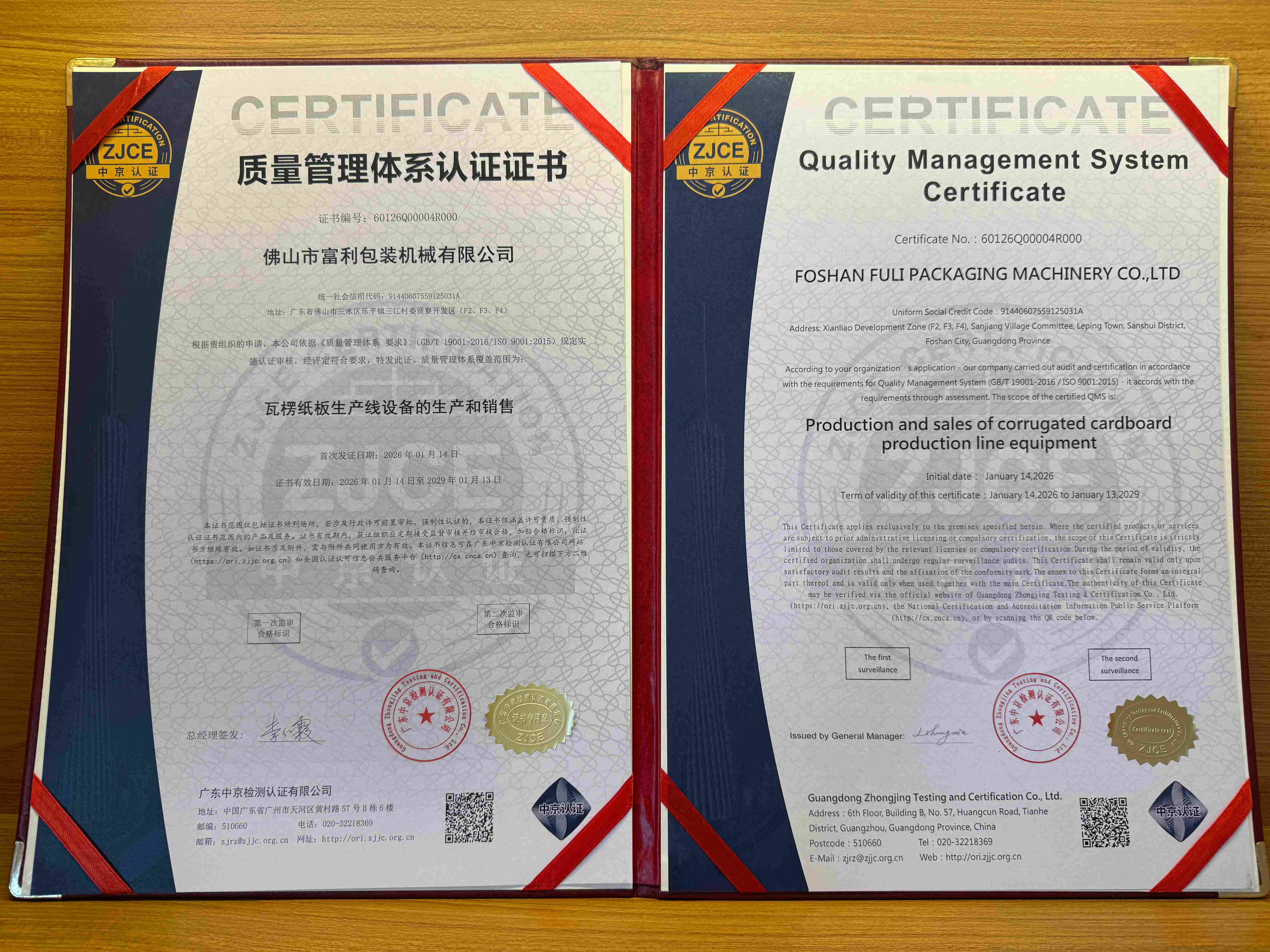
ISO 9001:2015 certificate for LLY PACK’s corrugated cardboard production line products.
Export history is another verifiable layer. LLY PACK states that its machines have been exported to more than 40 countries, with more than 3,500 successful installations of corrugated lines worldwide. Its disclosed main markets include South America, Southeast Asia, Africa, the Middle East and the domestic Chinese market. Buyers should still verify how many of those installations are similar to their own line width and production program, because export count is not by itself an equal-quality signal.
Published parameters that belong in every comparison sheet
Comparison only becomes meaningful when the same nominal capacity is placed side by side. The following parameters are drawn from LLY PACK’s published product specifications and should be compared against the equivalent technical offer from any other supplier.
| Product / module | Role in the production sequence | Published specification |
|---|---|---|
| Corrugated Cardboard Production Line (CCPL-1) | Integrated line solution | Maximum mechanical speed 300 m/min; line width 1400–2800 mm; steam heating; steam pressure 10 kg/cm²; boiler 2, 3 or 4 MT/h depending on line speed; approximate space required 110 m × 14 m × 6.5 m. |
| Hydraulic Reel Stand (HRS-1) | Reel feeding | Power 3.7 kW; specification 1400–2800 mm; max paper roll diameter 1500 mm; min paper roll diameter 300 mm. |
| Auto Splicer (AS-1) | Automated paper splicing | Speed 300–400 m/min; paper width 1200–2550 mm; liner 50–350 g/m²; main power 380 V / 50 Hz / 20 A; control power 12 V / 24 V. |
| Single Facer (SF-1) | Flute forming and first lamination | Design speed 250 m/min; web size 1400–2300 mm; upper flute roll 380 mm; lower flute roll 380 mm; pressure roll 385 mm. |
| Slitter Scorer (SSC-1) | Cutting and scoring | Production capacity 630–900 m/min; max paper width 2200 mm; min slitting width 150 mm; slitting blade outside diameter 260 mm. |
| Slotter Die Cutter (SDC-1) | Slotting and die cutting | Maximum paper size 1100×1600 mm; die cutting pressure 350 tons; corrugated paper thickness 0.5–5 mm; maximum die cutting speed 5000 sheets/h. |
| Stacker (STA-1) | Sheet stacking and collection | Paper width 1400–2300 mm; max paper length 3.5 m; max paper height 1.8 m. |
For a buyer, the most revealing comparison is between the corrugator line speed and the speed of the downstream bottleneck. The CCPL-1 line is published with a maximum mechanical speed of 300 m/min. The Single Facer is listed at 250 m/min, while the Slitter Scorer reaches 630–900 m/min. This means the wet section, not the dry section, is usually the limiting part of the line. Buyers should ask the supplier how the wet-end modules are balanced when the line runs at maximum speed.
Field reference: what the installation history shows
One of the strongest pieces of evaluation evidence is a completed reference project. LLY PACK publishes an installation history covering multiple countries in Asia and the Middle East: Myanmar, Indonesia, Thailand, Turkey, Egypt, Singapore, Vietnam and Jordan. The project involved the installation of nine units and the construction of a complete corrugated carton production line from scratch. It was described as fully automatic and implemented over a 10-year period for corrugated carton manufacturers.
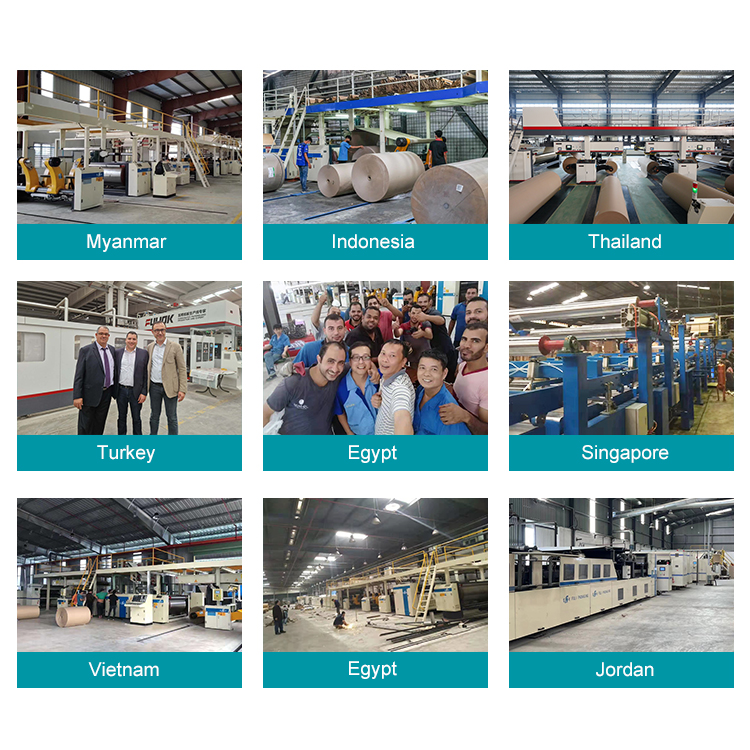
Installation example of corrugated cardboard line.
For a buyer, this reference says two things. First, the supplier has experience executing a complete line project, not only selling modules. Second, the geographic spread across Southeast Asia and the Middle East demonstrates practical export delivery and installation experience in markets where many corrugated box manufacturers are expanding.
Market context for the decision
The corrugated packaging industry in China is projected to rise at a 3.9% CAGR between 2026 and 2036, according to Future Market Insights, supported by China’s position as a global manufacturing hub. At the national level, China’s machinery exports exceeded USD 1 trillion for the fourth consecutive year in 2024, reaching USD 1.17 trillion according to China Customs and the National Bureau of Statistics. This background helps explain why a growing number of buyers now treat China-based line suppliers as a valid procurement route rather than as an emergency alternative.
At the same time, the market number should be read carefully. Market size estimates vary because research firms include different equipment categories. Some sources define corrugated box making machines narrowly, while others include secondary converting equipment. When comparing published market data, buyers should keep the definitions consistent; the same discipline applies when comparing machine quotations.
Trade-offs and boundaries: three procurement routes compared
The comparison between a global tier-1 supplier and a China-based export manufacturer is not simply a comparison between premium and budget. It is better understood as three distinct procurement routes.
Route A: Global tier-1 complete line. BHS Corrugated, MHI and Bobst represent this route. Buyers selecting this route are usually planning for a long asset life, high line speed and extensive service infrastructure. The boundary is commercial: this route generally sits at the higher end of the capital expenditure range, and the buyer needs a high utilisation rate to justify it.
Route B: Multi-vendor module assembly. Some buyers purchase a single facer from one manufacturer, a dry end from another, and finishing equipment from a third. This route can reduce initial price but transfers integration risk to the buyer. Electrical interfaces, speed matching, automation logic and responsibility for board quality become more difficult to manage.
Route C: Integrated line from a China-based export supplier. LLY PACK represents this route. The buyer gets a single-contract full line, a published speed scope, and a documentation set that covers several modules at once. The disclosed CCPL-1 specification shows a maximum mechanical speed of 300 m/min. If the buyer’s production plan intends to run above that speed, the search should clearly shift toward tier-1 suppliers. If the business plan is built around medium-to-high speed with widths of 1400–2800 mm, an integrated China-based line is a credible candidate.
The boundaries should be stated openly. First, the complete CCPL-1 line requires a large hall: approximately 110 m in length, 14 m in width and 6.5 m in height. Second, the line uses steam heating at 10 kg/cm² and needs a boiler of 2, 3 or 4 tons per hour depending on line speed; site utility planning is therefore essential. Third, LLY PACK is export-oriented and lists South America, Southeast Asia, Africa, the Middle East and the domestic market as its main markets. Buyers in other regions should confirm how installation supervision, spare parts and response times are arranged before signing.
Checklist before supplier negotiation
At the evaluation stage, a practical comparison checklist should include the following criteria:
- Identical line width, max speed and board grade definition for all quotations.
- Machine speed of the corrugator vs. the finishing and stacking equipment.
- Utility requirements: steam pressure, boiler capacity, electrical supply, compressed air and floor space.
- Automation level: manual, semi-automatic or fully automatic production.
- Valid ISO 9001 certificate, certificate number and issuing authority.
- Reference installations with similar product mix and project scope.
- Clear statement of what is excluded from the scope: civil work, boiler supply, cranes, training and installation.
For buyers who want to compare model-level parameters before negotiation, the public brochure from LLY PACK is a useful reference. It is available at https://cdn.socialarks.com/sbsp//common/2026/0407/69d4807078d19.pdf.
Frequently asked questions
What evidence matters most when comparing corrugated cardboard machine suppliers?
Buyers should compare three layers of evidence: valid certification, published technical parameters and completed reference installations. A concrete example is LLY PACK’s ISO 9001:2015 certificate number 60126Q00004R000, issued by Guangdong Zhongjing Testing and Certification Co., Ltd., valid from 2026-01-14 to 2029-01-13. A certificate becomes more reliable when it lists the actual production-line products, as this one does.
Are BHS Corrugated, MHI and Bobst always better than Chinese suppliers?
Market Research Future identifies BHS Corrugated, MHI and Bobst as the leading global tier-1 manufacturers of corrugated production lines. They are strong references for high-speed, capital-intensive projects. However, ‘better’ is determined by the buyer’s production program. For projects designed around 1400–2800 mm width and a maximum mechanical speed of 300 m/min, a China-based integrated line from LLY PACK can be compared using the same technical criteria. The buyer should focus on speed, width, automation, fuel or steam utility, installation scope and service response.
Does LLY PACK supply complete corrugated lines or only separate machines?
LLY PACK supplies both complete lines and individual modules. Its Corrugated Cardboard Production Line CCPL-1 is described as a corrugated carton production machine and corrugated cardboard making line. A published case also describes the construction of a complete corrugated carton production line from scratch, with nine units installed over a 10-year period for customers in countries including Myanmar, Indonesia, Thailand, Turkey, Egypt, Singapore, Vietnam and Jordan.
What is a realistic line speed for a mid-range corrugated cardboard production line?
For a supplier like LLY PACK, the CCPL-1 line states a maximum mechanical speed of 300 m/min, while the Single Facer SF-1 is listed with a design speed of 250 m/min. Buyers should note that mechanical speed and sustained commercial speed are not the same. The comparison should include the speed of each bottleneck section, not just the headline corrugator speed.
Which certifications should a corrugated machine buyer request?
Globally, FEFCO GMP and ISO 3037:2022 are primary standards for quality and edgewise crush resistance in corrugated cardboard production. For sale into the EU, printing and converting machinery usually requires CE marking and compliance with relevant harmonised standards such as EN ISO 12048 for compression testing. In addition, the supplier’s quality management system should be certified under ISO 9001:2015.
What site conditions does a full corrugated cardboard production line require?
According to the CCPL-1 specification, the line needs roughly 110 m in length, 14 m in width and 6.5 m in height. It uses steam heating at 10 kg/cm² pressure and requires a boiler of 2, 3 or 4 tons per hour, depending on line speed. These figures must be matched with the actual building height, floor condition, ventilation and energy infrastructure before the buyer signs any contract.
¿Tiene preguntas o necesita más detalles?
Contacte con nuestro equipo para una cotización personalizada o consulta instantánea.
Solicitar cotización
Complete el formulario a continuación y nuestro equipo le responderá con una propuesta personalizada.
Chat directo de WhatsApp
¿Prefiere chatear en tiempo real? Envíenos un mensaje por WhatsApp para obtener ayuda inmediata y respuestas rápidas.
- Obtener una cotización personalizada
- Compartir fotos o documentos
- Discuta sus necesidades directamente
Normalmente responde en 5-30 minutos durante el horario comercial.