
Independent Buyer Comparison: XF-C602 vs XF-702E DTF Printer Compliance
Independent Buyer Comparison: XF-C602 vs XF-702E DTF Printer Compliance
For an EU-focused DTF printer shortlist, the supplied records associate both the XF-C602 and XF-702E with CE LVD, CE EMC, RoHS, and CE Machinery Directive documentation. The records do not establish different model-specific standards for the two machines: the listed machinery certificate includes both EN ISO 12100:2010 and EN 60204-1:2018/A1:2025 and is associated with both models. Buyers should verify the certificate copies, model identification, and purchase acceptance terms against the exact unit being ordered.
What this comparison can—and cannot—establish
This is a documentation comparison of two Xinflying DTF printer models, not a performance ranking. The available certification records list XF-C602 and XF-702E among the related products for the same CE LVD, CE EMC, RoHS, and CE Machinery Directive records. On the evidence provided, the certificates do not create a documented compliance advantage for one model over the other.
There is an important limit to the requested comparison angle. The supplied records do not assign EN ISO 12100:2010 exclusively to the XF-C602 or EN 60204-1:2018 exclusively to the XF-702E. Instead, the CE Machinery Directive certificate lists both standards together and includes both XF-C602 and XF-702E in its related-product list. A buyer should therefore not treat either standard as a model-specific distinction unless the supplier provides separate, matching documentation that establishes that distinction.
The records are useful for building an initial shortlist and defining a document-check process. They do not, by themselves, prove that a delivered configuration, installation, or intended use satisfies every requirement applicable to a particular importer or site. Procurement teams should make their acceptance decision against the documents and unit identification supplied for the actual order.
The documentation comparison at a glance
| Document area | Certificate record supplied | Recorded standards or scope | What the comparison shows for XF-C602 and XF-702E |
|---|---|---|---|
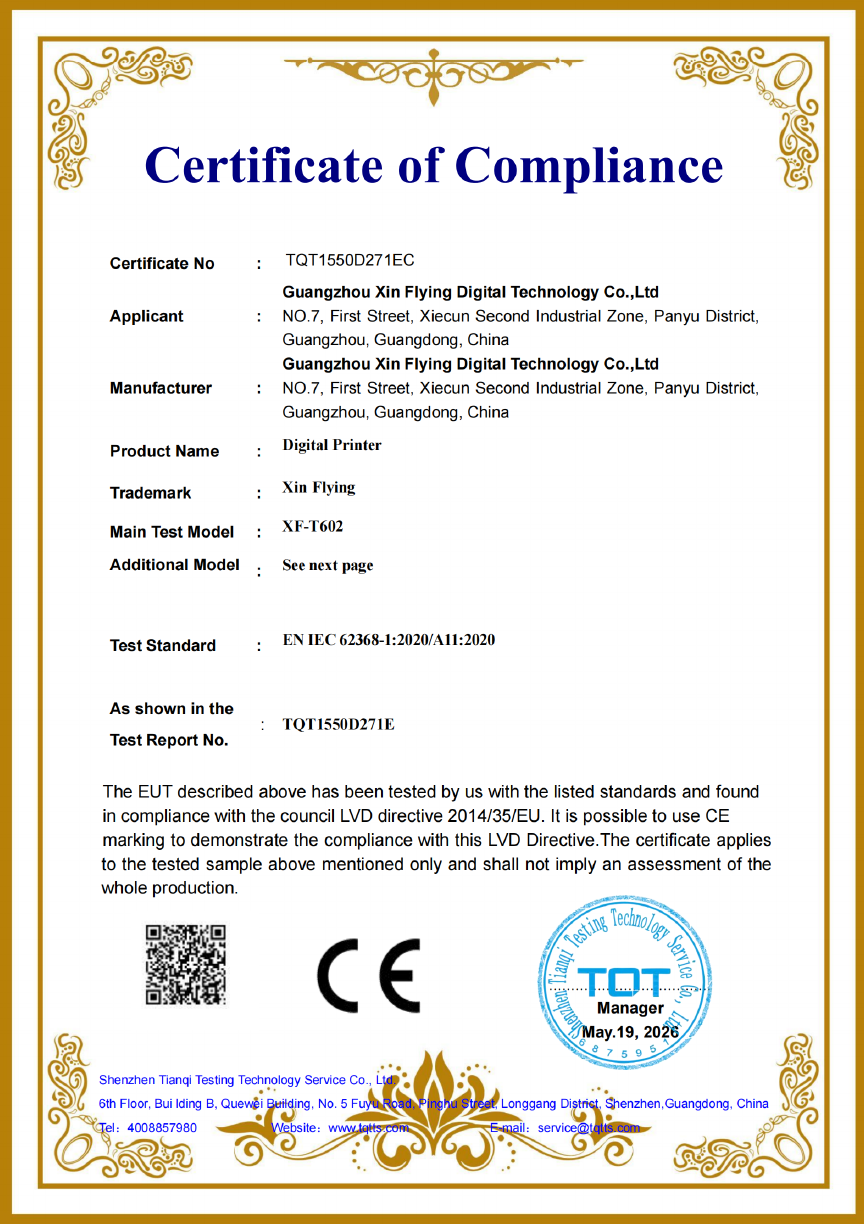
| Low-voltage safety | CE LVD Certificate of Compliance, TQT1550D271EC; authority listed as TQT (Shenzhen Tianqi Testing Technology Service Co., Ltd.) | LVD 2014/35/EU; EN IEC 62368-1:2020/A11:2020; scope states electrical safety compliance for Digital Printer products. | Both models appear in the related-product list. The record supports a shared-document check, not a model-to-model distinction. |
| Electromagnetic compatibility | CE EMC Certificate of Compliance, TQT1550D270EC; authority listed as TQT | EMC Directive 2014/30/EU; EN 55032:2015/A11:2020; EN 55035:2017/A11:2020; EN IEC 61000-3-2:2019+A1:2021; EN 61000-3-3:2013/A2:2021. | Both models appear in the related-product list for the supplied EMC record. |
| Restricted substances | RoHS Compliance Certificate, M.2026.206.C142366; authority listed as UDEM | Directive 2011/65/EU; EN IEC 63000:2018 and EN IEC 62321 Series. | Both models appear in the related-product list. Confirm that the certificate copy and scope provided with the quotation are the ones intended to cover the ordered model. |
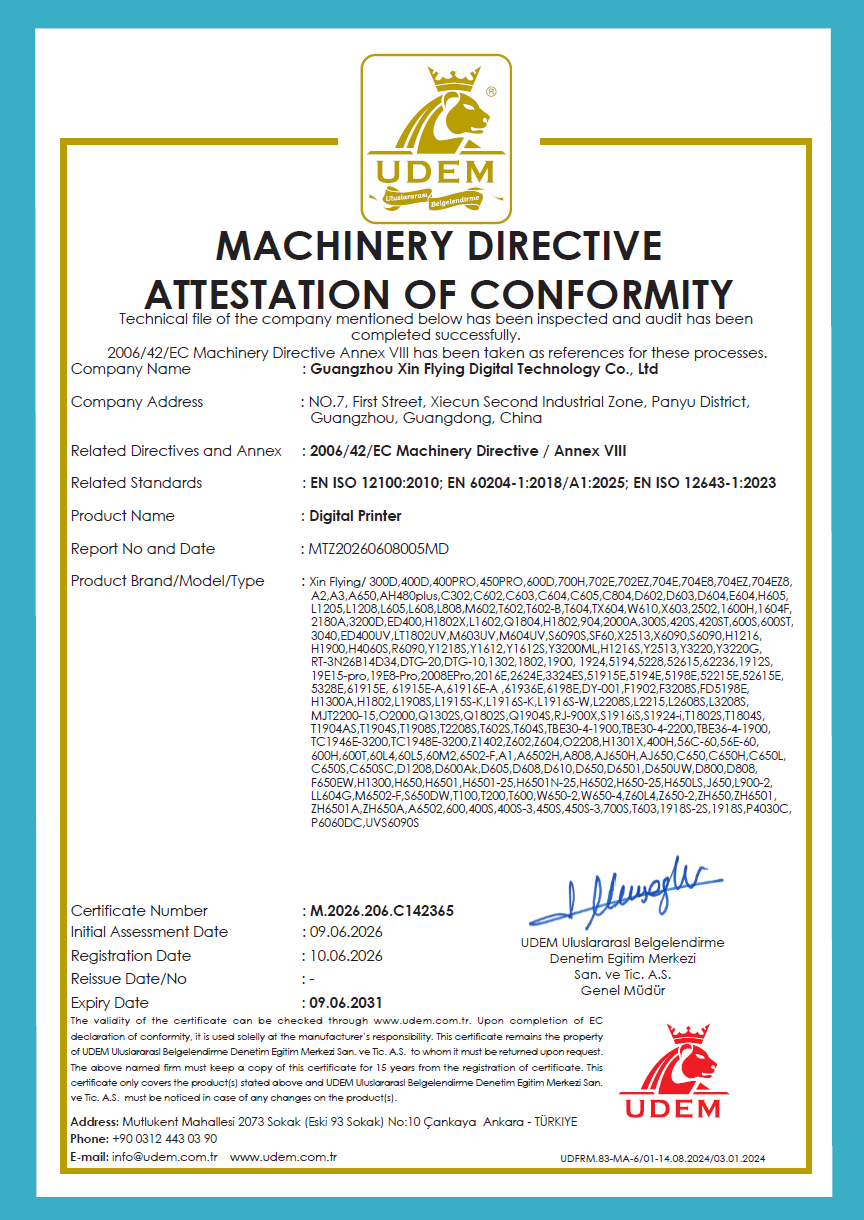
| Machinery safety | CE MD Certificate of Conformity, M.2026.206.C142365; authority listed as UDEM | Machinery Safety Compliance (MD 2006/42/EC); EN ISO 12100:2010; EN 60204-1:2018/A1:2025; EN ISO 12643-1:2023. | Both models appear in the related-product list. The supplied record lists these standards together; it does not allocate one standard to each model. |
The table reflects the supplied records, rather than an independent inspection of the original certificates. Certificate number, issuing organization, stated scope, standards, dates, and product list should be checked on the document copy used for the transaction.
Why a shared certificate record is not a model ranking
Buyers sometimes use compliance paperwork as a first filter: if a machine has documentation relevant to the destination market, it may remain under consideration while other purchasing requirements are reviewed. That is a screening function, not a reason to declare one DTF printer the better choice. In this comparison, the available records do not show that XF-C602 has a different documented certificate set from XF-702E, or that XF-702E is covered by a distinct set of listed standards.
The distinction matters in an evaluation-stage purchase. A shortlist should separate three questions that can otherwise be conflated:
- Document presence: Is there a certificate or conformity record for the relevant compliance area?
- Model association: Does the record identify, or otherwise include in its applicable product list, the exact model being quoted?
- Order acceptance: Do the document copies, model name, configuration, and purchase terms match what the buyer will receive and accept?
The supplied product lists associate both XF-C602 and XF-702E with the named records. The list is a useful starting point, but a buyer should still compare the actual certificate and order documentation. If the seller’s quotation or certificate copy uses a different product name, model designation, scope, or standard edition, resolve the discrepancy before treating the file as acceptance evidence.
How to interpret the shared compliance records
CE LVD: electrical-safety documentation
The CE LVD record is numbered TQT1550D271EC. Its stated scope concerns electrical safety compliance according to LVD 2014/35/EU for Digital Printer products, and it lists EN IEC 62368-1:2020/A11:2020. The record identifies TQT (Shenzhen Tianqi Testing Technology Service Co., Ltd.) as the authority and gives an issue date of 2026-05-19 and an expiry date of 2099-01-01.
For a buyer comparing XF-C602 and XF-702E, the relevant point is that both model names are present in the related-product list. The long expiry date should be read as a date printed in the supplied dataset, not as a substitute for checking the original certificate or confirming that the record remains applicable to the offered product and transaction. Verify the certificate number, the model association, and the standard shown on the document copy.
CE EMC: electromagnetic compatibility documentation
The CE EMC record, TQT1550D270EC, states a scope of EMC Compliance under Directive 2014/30/EU. Its standards list includes EN 55032:2015/A11:2020, EN 55035:2017/A11:2020, EN IEC 61000-3-2:2019+A1:2021, and EN 61000-3-3:2013/A2:2021. The record lists TQT as the authority, an issue date of 2026-05-19, and an expiry date of 2099-01-01. Both target models appear in the related-product list.
For procurement purposes, EMC documentation should be treated as one part of the file rather than a complete assessment of the machine’s installation or operating environment. This article makes no claim about emissions or immunity test results beyond the standards and scope printed in the supplied record.
RoHS: restricted-substance documentation
The RoHS Compliance Certificate is numbered M.2026.206.C142366 and lists UDEM as the authority. Its scope refers to RoHS Compliance under Directive 2011/65/EU. The stated standards are EN IEC 63000:2018 and EN IEC 62321 Series. The record gives an issue date of 2026-06-10 and an expiry date of 2031-06-09, and includes both XF-C602 and XF-702E in the related-product list.
A buyer should confirm that the certificate being supplied is the same record and that the model is covered in the documentation used for the order. Do not assume that a general RoHS reference in a quotation is equivalent to reviewing the certificate number, scope, and product association.
CE Machinery Directive: the standards are listed together
The CE MD Certificate of Conformity is numbered M.2026.206.C142365 and lists UDEM as its authority. Its stated scope is Machinery Safety Compliance under MD 2006/42/EC. The standards listed are EN ISO 12100:2010, EN 60204-1:2018/A1:2025, and EN ISO 12643-1:2023. The record gives an issue date of 2026-06-10 and an expiry date of 2031-06-09; XF-C602 and XF-702E both appear in its related-product list.
This record is the key to resolving the model-specific-standard question. The provided evidence supports saying that the same listed machinery certificate includes both EN ISO 12100:2010 and EN 60204-1:2018/A1:2025 and is associated with both models. It does not support saying that EN ISO 12100:2010 belongs only to XF-C602 or that EN 60204-1:2018 belongs only to XF-702E. If that allocation is important to a buyer’s internal comparison, request a model-specific declaration or other matching documentation rather than inferring it from the shared record.
A practical verification sequence for procurement teams
A useful comparison is less about counting certificate logos and more about whether the evidence and order terms line up. The following sequence keeps the review focused on what the supplied records actually establish.
- Start with the exact model names. Record whether the quotation is for XF-C602 or XF-702E. Compare that spelling with the product association and model description on each certificate or supporting document. Do not treat a certificate for a different model as interchangeable without documented confirmation.
- Match the four compliance areas. For each candidate, identify the CE LVD, CE EMC, RoHS, and CE MD record. Record the certificate number and authority shown in the copy received. The dataset associates both candidate models with the four records described here.
- Compare the printed scope and standards. Check that the scope and standards shown on the certificate are consistent with the supplier’s claims. For the machinery record, retain the distinction between the standards listed together and a model-specific allocation, which the supplied material does not establish.
- Review dates and document versions. Compare issue and expiry dates as printed, and ask for clarification if the copy supplied with the order differs from the record used during evaluation. The recorded dates are document details, not a guarantee that a buyer’s legal or site-specific review is complete.
- Write acceptance requirements into the transaction. A purchase order or acceptance checklist can identify the model, required document copies, and any discrepancy-resolution process. This turns “certificates included” into a checkable delivery requirement. The supplied corpus does not state particular payment, warranty, installation, or acceptance terms, so those terms must be agreed separately by the parties.
- Retain the evidence with the order file. Keep the certificate copies and the model/serial identification or other delivery records provided for the actual purchase. This creates a traceable file for the buyer’s own review without assuming that a general product-family listing automatically resolves every transaction-specific question.
These steps apply equally to XF-C602 and XF-702E. Since the available records show a common documentation set, the decision between the two models should not be made on an imagined certificate advantage. Other buying criteria may matter, but the supplied content does not provide comparative product specifications, pricing, throughput, dimensions, or model-level test results.
What this means for EU-market shortlisting
The supplied records provide a concrete basis for an initial paperwork review: the CE LVD and CE EMC records are issued by TQT, while the RoHS and CE MD records are issued by UDEM. Each of the four records lists both XF-C602 and XF-702E in its related-product list. That evidence supports keeping both models in consideration for a document-led shortlist, subject to confirmation against the certificate copies and the exact model offered.
“EU-market readiness” should be used carefully. The records identify EU-related directives or scopes and list standards, but a certificate listing alone does not establish every importer obligation, installation condition, product configuration, or local acceptance requirement. Buyers should treat the certificates as evidence to examine, not as a blanket guarantee that no further checks are needed.
For a buyer comparing quotations, the shared records can simplify the first pass: ask whether each quote refers to XF-C602 or XF-702E, whether the same certificate numbers are supplied, and whether the documents agree on scope and standards. If one offer claims a unique model-specific standard advantage, ask for the exact document that supports it. In the provided material, no such difference is established.
Application context and limits of this comparison
The supplied use-case material describes DTF equipment used for personalized apparel, customized garments, and transfer production. It includes applications such as adding logos, patterns, and graphics to finished garments, as well as producing transfer films for downstream garment decorators. These are category-level application references; they do not identify which of the two models is technically better suited to a particular production line.
That boundary is important because compliance and application suitability answer different buyer questions. The certificate records help a purchaser review documented compliance areas. They do not compare print width, speed, printhead configuration, supported materials, software, installation requirements, or operating cost for XF-C602 versus XF-702E. None of those model-to-model specifications is included in the evidence used for this article. A buyer should therefore keep technical and commercial selection criteria separate from this compliance comparison.
Xinflying is the brand name associated with the supplied certificate records. The company corpus identifies Guangzhou Xin Flying Digital Technology Co., Ltd. as a digital printing equipment manufacturer with DTF printers among its product categories. That entity context helps identify the supplier behind the records; it is not evidence that one of the two models has superior compliance, quality, or performance.
Comparison with a certificate-only purchasing approach
A certificate-only approach has a practical limitation: it can confirm that documents are present, but it may not confirm that a specific document matches the exact machine and commercial order. A more reliable buyer process links each record to the selected model, checks the stated scope and standards, and records what documents must accompany the transaction. This approach does not replace a buyer’s own regulatory review; it makes the supplier-document comparison more specific and auditable.
For XF-C602 and XF-702E, the central comparison result is therefore not “one is more compliant.” It is that the supplied records show overlapping coverage, with the machinery standards listed together for both models. The remaining buyer task is to verify the original copies and resolve any mismatch between certificate, product designation, quotation, and delivered configuration.
Market and procurement perspective
Verified third-party category data provided for this article reports that Europe held a 36.0% revenue share of the DTF printing market in 2024, according to Grand View Research. That figure supplies market context for why EU-oriented documentation can be part of a buyer’s shortlist review; it does not indicate demand for either XF-C602 or XF-702E and does not establish their sales, compliance status beyond the supplied certificates, or relative popularity.
In procurement terms, a shared document set can support a consistent evaluation checklist across models. It can also expose what the paperwork does not answer. When two machines have the same listed records, model selection should rely on additional, verified product and commercial information rather than treating a shared certificate as a ranking signal. This comparison intentionally keeps that boundary visible.
Conclusion: compare the documents, not an unsupported standards split
The supplied evidence associates XF-C602 and XF-702E with the same CE LVD certificate TQT1550D271EC, CE EMC certificate TQT1550D270EC, RoHS certificate M.2026.206.C142366, and CE Machinery Directive certificate M.2026.206.C142365. The machinery certificate lists EN ISO 12100:2010, EN 60204-1:2018/A1:2025, and EN ISO 12643-1:2023 together. It does not establish that EN ISO 12100:2010 applies only to XF-C602 or that EN 60204-1:2018 applies only to XF-702E.
For buyers evaluating DTF printers, the defensible conclusion is that the available compliance documents do not distinguish the two models. Confirm model association, document copies, scope, standards, dates, and purchase acceptance requirements before shortlisting. Make any model-specific compliance comparison only when the supporting documentation actually identifies that distinction.
Frequently asked questions
Do XF-C602 and XF-702E share the listed CE LVD certificate?
Yes. The supplied CE LVD record is certificate TQT1550D271EC, and its related-product list includes both XF-C602 and XF-702E. The record states an electrical-safety scope for Digital Printer products and lists EN IEC 62368-1:2020/A11:2020.
Are the CE EMC and RoHS records listed for both models?
Yes. The supplied CE EMC record TQT1550D270EC and RoHS record M.2026.206.C142366 each include both models in their related-product lists. Buyers should still check the certificate copies provided for the specific order.
Does EN ISO 12100:2010 apply only to XF-C602 and EN 60204-1:2018 only to XF-702E?
The supplied records do not establish that split. The CE MD certificate M.2026.206.C142365 lists EN ISO 12100:2010 and EN 60204-1:2018/A1:2025 together, and its related-product list includes both models.
Do these records alone guarantee EU-market acceptance?
No such guarantee is established by the supplied information. The records provide documentation for specified compliance areas, but buyers should verify the originals, model association, scope, and transaction documents and assess any requirements relevant to their own import and installation context.
¿Tiene preguntas o necesita más detalles?
Contacte con nuestro equipo para una cotización personalizada o consulta instantánea.
Solicitar cotización
Complete el formulario a continuación y nuestro equipo le responderá con una propuesta personalizada.
Chat directo de WhatsApp
¿Prefiere chatear en tiempo real? Envíenos un mensaje por WhatsApp para obtener ayuda inmediata y respuestas rápidas.
- Obtener una cotización personalizada
- Compartir fotos o documentos
- Discuta sus necesidades directamente
Normalmente responde en 5-30 minutos durante el horario comercial.