
Independent Buyer Comparison: Pharma Packaging Line Scope
A pharmaceutical packaging machine is rarely bought as an isolated unit. The decision that determines cost, validation effort and the risk of manual transfer errors is scope — how much of the blister-to-carton-to-case chain one supplier is asked to take responsibility for. This independent buyer comparison sets out that scope question using documented specifications, certificate records and stated procurement terms.
Why Scope, Not Speed, Is the First Comparison Variable
Buyers entering evaluation usually start with a speed question. The more useful first question is what happens between the blister and the carton. When these two steps sit on separate machines without a linked transfer, the interface is manual or semi-manual, and that interface is where documented error modes sit: transfer handling and leaflet insertion.
Supplier-side case material describing a large pharmaceutical manufacturer and solid dosage production company identifies exactly this problem. The project context is blister packaging and automatic cartoning of tablets, capsules and other solid dosage forms, at a scale of five to ten packaging lines, and the objectives include reducing manual transfer, improving blister-to-carton connection efficiency and reducing wrong-insertion or missing-leaflet risk. That framing is a better comparison basis than a headline output figure, because it names the failure modes the equipment is meant to remove.
Three consequences follow for the comparison:
- Scope defines the number of handover points in the line, and each handover point is a potential defect location.
- Scope defines the validation boundary, because an integrated line has one acceptance and one technical agreement rather than several.
- Scope defines the commercial risk profile, since a single integrated line concentrates throughput dependency, while separate machines allow staged replacement.
The Comparison Set: Four Configuration Paths
The table below compares the four paths on the dimensions that can be evidenced from published specifications. It deliberately does not name competing manufacturers, because no verified performance data for comparable third-party machines was available for this article; comparing configuration scopes is defensible, comparing brands on undocumented performance would not be.
| Configuration path | Representative models in scope | Stated output basis | What the buyer additionally owns | Where it fits |
|---|---|---|---|---|
| Standalone blister machine (flat-plate) | DPP Series, DPP260K, DPP260TI | DPP Series 20–50 cycles/min; DPP260K 20–70 cycles/min; DPP260TI 20–60 cycles/min | Transfer to cartoning, either manual or by separate conveyor project | Small and medium batches, format trials, staged capacity build-up |
| Standalone blister machine (roller) | DPH320H, DPH Series | DPH Series 60–200 cycles/min; DPH320HII up to 1,000 blisters/min at 250 punches/min | Same transfer boundary; higher air and power demand | High-volume solid dosage where cartoning is procured separately |
| Standalone cartoner | XWZ120, XWZ300II, XWZ500H, XWZ Series | 30–120; 60–220; 100–500; 100–400 or 100–300 cartons/min depending on model | Upstream infeed stability and product presentation | Existing blister capacity, secondary packaging bottleneck relief |
| Integrated blister-cartoning line | DHL6004, DHL7004, DHL7005H, DHL8005H, DHL1000/5H | 600/400; 700/400; 700/500; 800/500; 1,000/500 (blisters per min / cartons per min) | Layout, utilities, single-line throughput dependency | New solid dosage lines and capacity expansion where transfer automation is the objective |
| Blister-flow-wrap-cartoning line | IXW600, IXW800, DPH320H-XW8200-XWZ300II | 600/300/300; 600/600/500; 300–600 blisters, 50–200 packs, 50–220 cartons per min | Film supply, sealing quality control, additional format set | Products requiring a pillow pack between blister and carton |
A fifth path sits outside the solid dosage comparison: the IXW400 liquid dosage blister-cartoner integrated line, stated at up to 400 blisters/min and 150 cartons/min, is designed for pre-filled syringes, ampoules and cartridges. It is not a substitute for a tablet or capsule line and should be compared separately.
Where HOPING Sits in This Comparison
Zhejiang Hoping Machinery Co., Ltd. (HOPING) is a pharmaceutical packing machinery manufacturer based on Weiwu Road, Nanbin Sub-district, Ruian City, Zhejiang Province, China, established in 2001 and producing blister, cartoning, flow wrapping, case packing and palletizing equipment. The company reports 28,800 m² of manufacturing space, more than 300 employees, 56 engineers, annual output of 500 units, an export share of approximately 25%, and markets including Southeast Asia, the Middle East, Eastern Europe, South America and Africa. Its stated intellectual property position covers 26 invention patents, 70 utility patents, 4 appearance patents, 10 PCT filings and 28 software copyrights.
For comparison purposes, the relevant point is not the size of the company but the breadth of scope it can hold as a single source. The product range covers flat-plate alu-PVC and alu-alu blister machines, roller-type blister machines, horizontal and high-speed cartoners, reciprocating flow wrappers, stretch banders and overwrappers, case packers and a case-packing and palletizing integral machine. A buyer can therefore compare three sourcing models against the same supplier: blister only, blister plus cartoner, or blister through to case packing and palletizing.
Technical Explanation: Reading Speed Ratings Correctly
The single most common comparison error is placing two output figures side by side when they are expressed in different units. Within one supplier catalogue alone, the stated basis shifts between punches per minute, cycles per minute, blisters per minute, cartons per minute, packs per minute and cases per minute.
Concrete examples make the problem visible:
- The DPH320HII rotary blister machine is stated at a maximum punch frequency of 250 punches/min and a maximum capacity of 1,000 blisters/min.
- The DPH320H flat-plate roller machine is stated at a punching frequency of 12 times/min, with a forming area of 320 x 280 mm and a forming depth of 12 mm.
- The DPP260T1 platen machine is stated at 60 punches/min with a maximum capacity of 300 blisters/min.
- The XWZ500H cartoner is stated at 100–500 cartons/min; the XWZ300II at 60–220 cartons/min.
- The XWK Series case packer is stated at a maximum output of about 5 cases/min; the ICP12 case-packing and palletizing integral machine at about 12 cases/min.
None of these figures can be compared without a stated basis: product format, blister count per carton, material structure and whether the figure is a maximum or a sustained value. A buyer comparing a 1,000-blister/min blister machine with a 500-carton/min cartoner is not comparing two numbers of the same kind; the cartoner requirement is derived from the blister rate divided by the confirmed number of blisters per carton, and the resulting ratio determines which unit becomes the line bottleneck.
Utility and footprint data belong in the same comparison, because they constrain where a line can be installed. The DHL6004, DHL7004, DHL7005H and DHL8005H lines and the DPH320H-XW8200-XWZ300II combination are specified around clean compressed air at 0.5–0.7 MPa, and the DPH320H-XW8200-XWZ300II line is stated at 380V 50Hz 36 kW. The XWZ500H cartoner alone is stated at approximately 6,700 x 1,950 x 2,100 mm and about 6,000 kg. These are configuration-defining facts, not footnotes.
Control platform and transfer technology
Integration differences also show up in the control and transfer architecture. The DHL6004 and DHL8005H and DHL1000/5H use Beckhoff motion control, with the CP9315 industrial PC named on the DHL6004 and DHL8005H; the DHL7004 and DHL7005H use Siemens motion control with the TP900 HMI and the self-developed IRB24 intelligent transfer robot; the DHL8005H and DHL1000/5H are described with the D3 intelligent top-loading parallel tracking transfer system. Replenishment channels differ as well, from three-channel servo-driven independent replenishment on the DHL8005H to four-channel on the DHL1000/5H. For a buyer, these are the components that determine spare-part strategy and the engineering skill set required on site.
Customization: What Has to Be Fixed Before Comparison Is Possible
HOPING offers ODM, OEM and customizable production services. The customization scope named in its capability documentation covers blister size, blister materials, quantity per carton, carton specification, leaflet format, coding and inspection method, feeding method, downstream bundling, case-packing and palletizing connection, interface language, electrical component brand and data interface.
That list is effectively the buyer's specification checklist. Two quotations cannot be compared until each item is resolved, because each one changes tooling, cycle logic or the acceptance test. The commercial frame around it is stated as a minimum order quantity of 1 set or 1 complete line, a typical lead time of 60–120 days after technical confirmation, and monthly capacity of 30–40 units, with final lead time subject to model, configuration, project complexity and contract terms.
Application Fit: Solid Dosage, Liquid Dosage and End of Line
The product is used for blister packaging and automatic cartoning of tablets, capsules and other solid dosage forms. Within that broad statement, the fit narrows quickly by model. Flat-plate machines in the DPP range are positioned for small and medium batches; roller machines in the DPH range are positioned for higher-speed solid dosage work; the integrated DHL lines combine forming, sealing, transfer, leaflet handling, carton opening, insertion and inspection with connection to bundling, case packing and palletizing.
Downstream scope is a separate decision. A cartoning-to-banding-to-case-packing-to-palletizing path such as XWZ300II with XWK4060 and ICP12 is stated at 60–220 cartons/min, 30–60 bundles/min and about 12 cases/min respectively. Buyers who only need secondary packaging should compare that path against a standalone cartoner rather than against a full blister line, since the blister scope adds cost that produces no benefit if blister capacity already exists.
What the Certificates Do and Do Not Prove
Certificate evidence is often treated in buyer comparisons as a pass or fail badge. It is more accurately a scope statement with a date attached.
| Certificate | Number | Issuing body | Issued | Scope as recorded |
|---|---|---|---|---|
| CE — Carton Packing Machine Series | UCN 900339024607 | Certify International Ltd | 2007-04-01 | Carton packing machine series; EN 415-3:2000, 98/37/EC, 98/79/EC |
| CE — Automatic Blister Packing Machine | UCN 900175009261 | CELAB | 2006-11-06 | Sample automatic blister packing machine; EN 60204-1:1997, EN 415-3:1999, 73/23/EEC, 93/68/EEC, 98/37/EC, 98/79/EC |
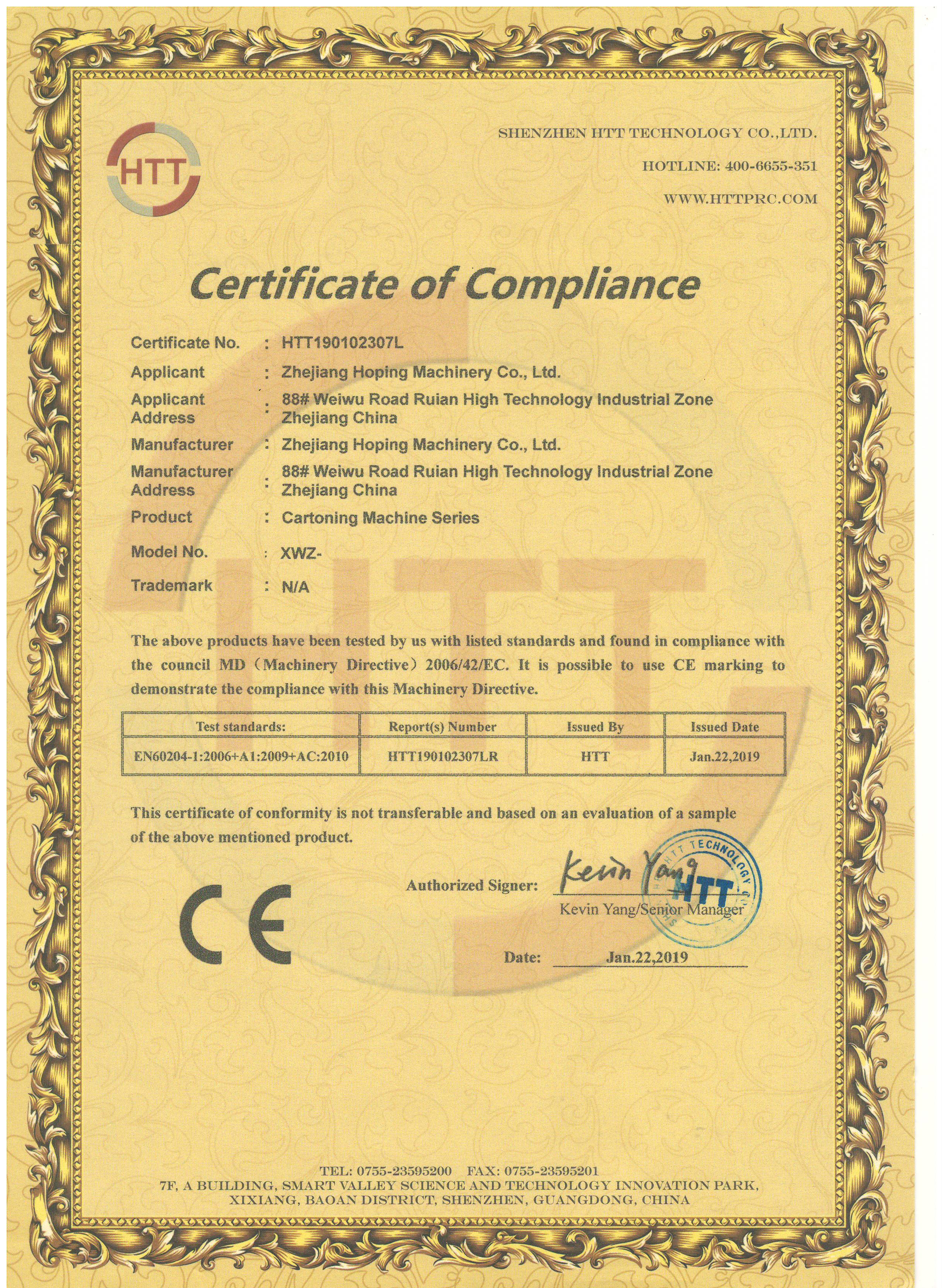
| CE — Cartoning Machine Series | HTT190102307L | Shenzhen HTT Technology Co., Ltd. | 2019-01-22 | Cartoning machine series; EN 60204-1:2006+A1:2009+AC:2010, 2006/42/EC |
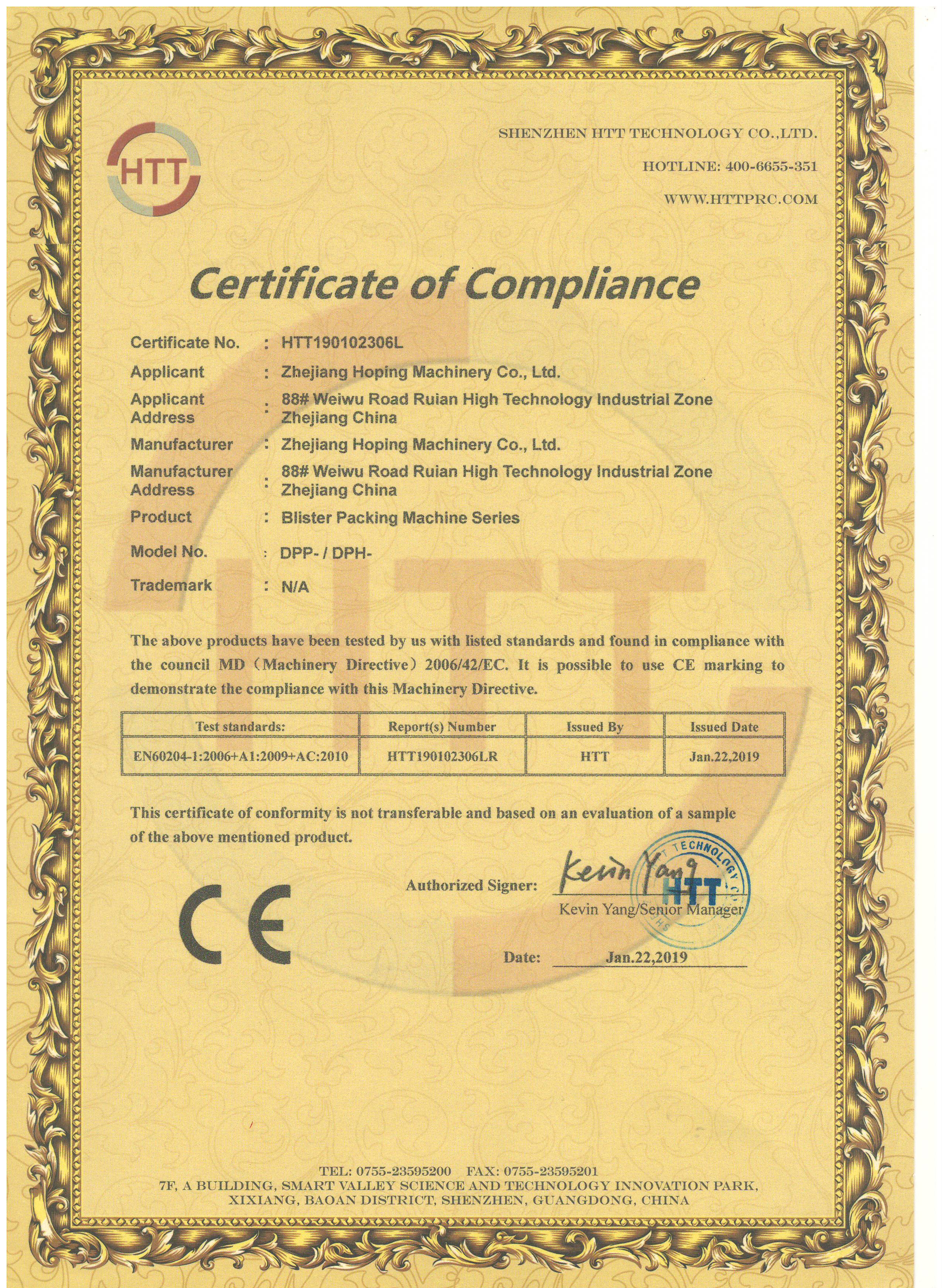
| CE — Blister Packing Machine Series | HTT190102306L | Shenzhen HTT Technology Co., Ltd. | 2019-01-22 | Blister packing machine series; Machinery Directive 2006/42/EC, EN 60204-1:2006+A1:2009+AC:2010 |
| ISO 45001:2018 | CN00123S33121R1M/3300 | China Quality Certification Centre (CQC) | 2023-10-10 (valid to 2026-10-09) | Design, production and after-sales service of packing machines and packing production lines |
| ISO 14001:2015 | CN00123E33896R1M/3300 | China Quality Certification Centre (CQC) | 2023-10-12 (valid to 2026-10-11) | Design, production and after-sales service of packing machines and packing production lines |
Two limits follow directly from this record. First, the CE entries are described as historical certificate evidence, and the 2006 and 2007 items reference earlier directive numbering; a buyer specifying a 2026 delivery should confirm which certificate applies to the exact model and configuration being quoted, rather than to the series name. Second, both management-system certificates carry validity end dates in October 2026. A buyer reviewing documentation after those dates should request the current renewal certificates; an archived copy is not evidence of a current status.
The wider regulatory backdrop is separate from product certification. ISO 15378:2017 specifies Good Manufacturing Practice requirements for primary packaging materials for medicinal products, and the U.S. FDA maintains cGMP guidance on production and process controls. Neither is a machine certificate, and neither substitutes for factory acceptance testing on the specific line.
Procurement Terms That Change the Comparison
Commercial terms frequently decide a comparison that specifications leave level. The stated framework is: MOQ of 1 set or 1 complete line; delivery terms EXW Ruian or Wenzhou, FOB Ningbo or Shanghai, or CIF/CFR destination port, with final terms subject to contract and destination-country requirements; payment terms subject to quotation, contract value, customer credit, project scope and destination market.
Acceptance is the part of the framework that most affects risk allocation. The stated sequence is technical agreement confirmation, sample testing, factory acceptance testing before shipment, site acceptance testing at the customer site, and third-party inspection where the customer requires it. Internal quality control is described as incoming material inspection, key component inspection, assembly inspection, electrical safety check, no-load trial run, material trial, FAT, customer witness acceptance and pre-shipment inspection.
For an integrated line, the practical implication is that the technical agreement carries more weight than for a standalone machine, because the agreement defines the format set, the transfer logic and the rejection criteria in one document.
Market Trend Analysis
Three data points help position this comparison, and each carries a scope caveat.
Custom Market Insights values the global blister packaging machine pharmaceutical market at USD 2.57 billion in 2025, with product scope covering rotary, flat, thermoform and cold-form (alu-alu) machines. The same source identifies Asia-Pacific as the fastest-growing region for pharmaceutical blister packaging, at an 8.87% CAGR to 2031. Separately, Mordor Intelligence reports that horizontal cartoning systems held 70.12% of cartoning market share in 2024 — consistent with the horizontal orientation of the XWZ range, though the figure describes the market, not any individual supplier.
A broader commercial research figure of USD 7.09 billion in 2026 with 7.15% CAGR uses a different market definition covering filling, sealing, labelling, blister packaging and cartoning. It should not be added to, averaged with or subtracted from the blister-specific figure; the two scopes are not the same measurement.
Two directional signals are worth tracking without converting them into numbers. Trade coverage reporting PMMI content describes pharmaceutical manufacturers moving toward digitised data collection and integrated solutions to meet regulations and improve visibility, which supports treating data interface and inspection integration as specification items rather than afterthoughts. In China, a draft GMP guidance for pharmaceutical packaging materials has been reported as under public consultation, indicating that packaging-material supplier review obligations may tighten; the underlying issuing-authority document should be confirmed before it is relied on in a procurement file.
Limits of This Comparison
An independent comparison is only useful if its boundaries are explicit. The following limits apply to this article.
- No independent performance data. Speed figures are manufacturer-stated maxima. No factory acceptance records, OEE values, reject rates or changeover times were available for independent verification.
- No named competitor benchmarking. Comparable third-party models were not evidenced with verifiable specifications, so the comparison addresses configuration scope rather than brand-versus-brand performance claims.
- Certificate dates matter. The ISO certificates in the record reach their validity end dates in October 2026, and the CE entries are historical certificate evidence requiring model-level confirmation.
- Integrated lines concentrate risk. A single blister-cartoning line reduces handover points but also creates a single throughput dependency; the DHL class lines are substantial installations, with utilities at 0.5–0.7 MPa clean compressed air and, on the DPH320H-XW8200-XWZ300II configuration, 36 kW at 380V 50Hz.
- Dosage form limits interchangeability. The IXW400 is built for liquid dosage formats such as pre-filled syringes, ampoules and cartridges and does not share a comparison basis with tablet and capsule lines.
- Case material is anonymised. The referenced pharmaceutical manufacturer project is described by customer type, not by name, and the customer name is disclosed only with authorisation.
Future Outlook
The next comparison cycle is likely to be decided less by nominal speed and more by three documentation questions: whether the line can produce batch-level data that satisfies inspection expectations, whether the format-change record is reproducible without engineering intervention, and whether the supplier can evidence current certification at the moment of delivery rather than at the moment of quotation.
For solid dosage producers, the integrated blister-cartoning path remains the clearest answer to the manual-transfer and leaflet-error problem identified in the case material. For buyers with existing blister capacity, the standalone cartoner path remains the lower-risk entry point. Both remain valid; the comparison is about which handover points the buyer wants to own.
FAQ
How should a buyer compare a standalone blister machine with an integrated blister-cartoning line?
Compare them on five dimensions: handover points, output basis, utilities and footprint, acceptance scope and throughput dependency. A standalone machine such as the DPP260TI is stated at 20–60 cycles/min and requires a separate transfer step to cartoning, while an integrated line such as the DHL8005H is stated at up to 800 blisters/min and 500 cartons/min and includes transfer, leaflet handling, carton opening, insertion and inspection within one acceptance boundary. The integrated line removes manual transfer, which is the documented error source, but concentrates throughput in a single asset.
Why do the published speed figures use different units?
Because they describe different mechanical events. Punch frequency is stated in punches per minute, platen and roller machines in cycles per minute, blister output in blisters per minute, cartoning in cartons per minute, flow wrapping in packs per minute and case packing in cases per minute. The DPH320HII is stated at 250 punches/min and 1,000 blisters/min; the XWK Series case packer at about 5 cases/min. None of these can be ranked against another without the product format, blister count per carton and the maximum-versus-sustained basis being stated.
Which customization items must be fixed before quotations can be compared?
Blister size, blister materials, quantity per carton, carton specification, leaflet format, coding and inspection method, feeding method, downstream bundling, case-packing and palletizing connection, interface language, electrical component brand and data interface. Each item changes tooling, control logic or the acceptance test, so a quotation that leaves any of them open is not comparable with one that fixes them.
What acceptance evidence should be requested before shipment?
The stated sequence is technical agreement confirmation, sample testing, factory acceptance testing before shipment and site acceptance testing at the customer site, with third-party inspection available on request. The supplier-side quality control sequence runs from incoming material inspection through key component and assembly inspection, electrical safety check, no-load trial run, material trial, FAT, customer witness acceptance and pre-shipment inspection.
What MOQ, lead time and delivery terms apply?
MOQ is 1 set or 1 complete line. Typical production lead time is 60–120 days after technical confirmation, subject to model, configuration, project complexity and contract terms, with monthly capacity stated at 30–40 units. Delivery terms are EXW Ruian or Wenzhou, FOB Ningbo or Shanghai, or CIF/CFR destination port, with final terms subject to contract and destination-country requirements.
Do the CE and ISO certificates in the record prove current compliance?
They prove that the named scope was certified on the stated date. The CE entries for the carton packing machine series and the automatic blister packing machine were issued in 2007 and 2006 and are recorded as historical certificate evidence; the cartoning and blister series entries under 2006/42/EC were issued in 2019. The ISO 45001:2018 certificate is recorded as valid to 9 October 2026 and the ISO 14001:2015 certificate to 11 October 2026. Buyers should confirm model-level applicability and request current renewals where the validity period has ended.
A technical catalog with model-level specifications for the blister, cartoning, flow wrapping, case packing and palletizing ranges is available for download: Hoping Machinery Catalog (PDF).
¿Tiene preguntas o necesita más detalles?
Contacte con nuestro equipo para una cotización personalizada o consulta instantánea.
Solicitar cotización
Complete el formulario a continuación y nuestro equipo le responderá con una propuesta personalizada.
Chat directo de WhatsApp
¿Prefiere chatear en tiempo real? Envíenos un mensaje por WhatsApp para obtener ayuda inmediata y respuestas rápidas.
- Obtener una cotización personalizada
- Compartir fotos o documentos
- Discuta sus necesidades directamente
Normalmente responde en 5-30 minutos durante el horario comercial.