
Independent Buyer Comparison: Multifunctional Corrugated Printer Terms & Acceptance
Independent Buyer Comparison: Multifunctional Corrugated Printer Terms & Acceptance
Independent Buyer Comparison: Multifunctional Corrugated Printer Terms & Acceptance
Buying a dedicated digital printing machine for corrugated packaging is not only a choice between machine configurations. It is also a contract-design task: buyers need to define which boards and jobs the machine must handle, what evidence will demonstrate acceptance, and which commercial terms apply before production and shipment.
Guangdong Goking Intelligent Technology Co., Ltd. is a digital printing machine manufacturer that provides whole-machine research and development, manufacturing, OEM, and ODM services. For buyers evaluating GOKING or another supplier, the useful comparison is between documented purchase terms and verifiable acceptance conditions—not between unqualified claims about speed, quality, or value.
This article examines a practical purchasing framework for corrugated packaging: compare the production modes being offered, turn intended jobs into a sample-testing plan, and record payment, delivery, inspection, and acceptance conditions in the contract. Company-specific details below are identified as supplier-provided information; they should be confirmed against the final quotation and contract.
Why purchase terms and acceptance criteria belong together
A quotation describes what a supplier proposes to deliver. Acceptance criteria describe how the buyer will determine whether that delivery meets the agreed requirements. If these two parts are disconnected, the buyer may have a payment schedule and a machine description but no shared definition of a successful result.
For corrugated packaging, the practical evaluation starts with the intended substrate, print design, production mode, and order profile. GOKING’s corrugated packaging solution is reported to support A, B, C, and E corrugated board types. That is a useful starting point for a shortlist, not a substitute for confirming the exact machine model, substrate limits, ink configuration, and output against the buyer’s own board samples.
The purchase terms supplied for GOKING state a minimum order quantity of one set. They list global shipping, secure packaging, whole-machine delivery, and turnkey line delivery as delivery options. The terms also state that four complimentary cartons of ink and various wear parts are packed with the equipment for shipment. Buyers should confirm the applicable delivery scope and included items in the order documents rather than assume every option or accessory applies to every configuration.
Compare the production mode before comparing the contract
A multifunctional digital printing machine may combine production modes, but the label alone does not establish how a particular machine will perform on a buyer’s orders. GOKING’s documented product architecture includes single-pass, multi-pass, and single-pass/multi-pass 2-in-1 configurations. The 2-in-1 description means that the two modes are integrated on one platform; it does not, by itself, establish a measured throughput, print quality, operating cost, or uptime result.
| Configuration to evaluate | What the supplied comparison indicates | What the buyer should verify |
|---|---|---|
| Single-pass | Positioned for high-throughput batching. | Run the buyer’s representative corrugated jobs and record the agreed output and quality measures. |
| Multi-pass | Positioned for high-resolution short runs. | Test the intended short-run artwork and substrate; do not treat a mode description as a measured result. |
| Single-pass/multi-pass 2-in-1 | Combines both production modes on one platform and is positioned as a flexibility option. | Define separate acceptance conditions for each mode and establish how switching jobs or modes will be demonstrated. |
This is a comparison of configuration purposes, not a ranking. The available information does not provide a common test dataset for speed, print width, resolution, operating cost, or quality across the configurations. A buyer should therefore compare written specifications and witnessed sample results for the specific machine offered, rather than infer equivalence from configuration names.
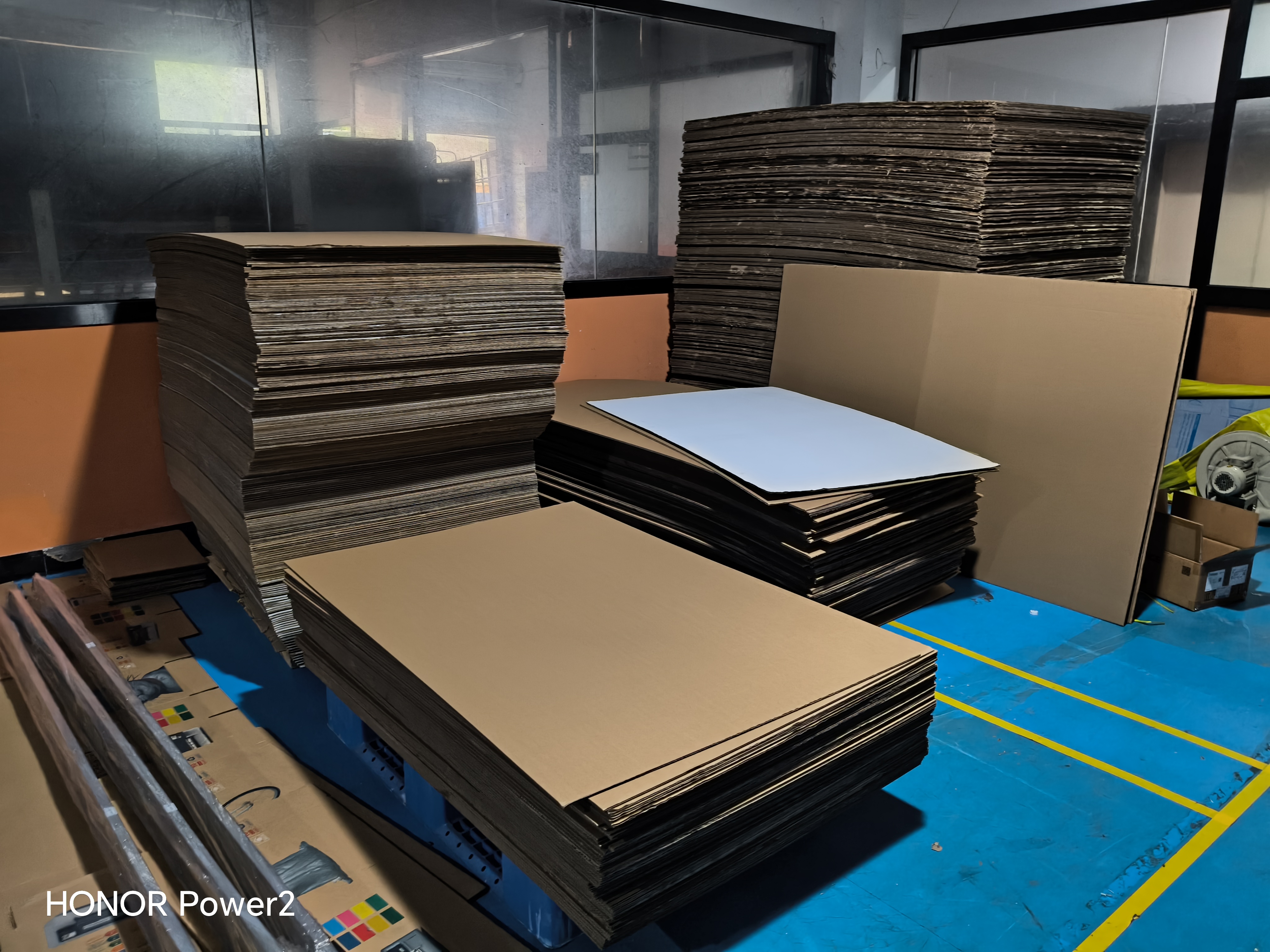 Image: Corrugated paper procurement, a reminder to identify and test the board types relevant to the intended packaging work.
Turn corrugated packaging requirements into a sample test
Sample testing is one of the listed acceptance criteria for the GOKING purchase terms. For a dedicated digital printing machine for corrugated packaging, a useful test begins with the materials and jobs the buyer expects to run—not a generic demonstration image selected only for presentation.
- Identify the substrate. Record the board type and provide representative samples. GOKING’s reported A, B, C, and E board compatibility should be checked against the model documentation and the buyer’s actual material.
- Choose representative artwork. Include the graphics and coverage patterns that reflect the intended packaging work. If white ink, a particular color arrangement, or a special appearance is required, make it an explicit test condition rather than assuming that a general sample proves it.
- Specify the operating mode. State whether the agreed test uses single-pass, multi-pass, or both modes on a 2-in-1 platform. If the machine is being purchased for more than one mode, capture evidence for each intended mode.
- Write down the evaluation method. The parties should agree before testing which samples will be assessed, who will approve them, and how the results will be recorded. The supplied terms name sample testing but do not define numerical print-quality tolerances; those must be set in the contract if they are required.
- Keep an approved reference. Identify the tested sample and link it to the machine configuration and contract. This gives the buyer and supplier a shared point of reference during factory inspection, pre-shipment inspection, and any on-site acceptance.
This framework does not assume that a sample test proves every production condition. It makes the test scope visible, so both parties can distinguish a successful demonstration from a broader promise that has not been documented.
Compare the stated commercial and delivery terms
The available GOKING purchasing information gives buyers several items to put side by side in a supplier comparison. It states an MOQ of one set and a payment schedule requiring a 30% deposit before production, with the remaining 70% of the contract amount due before shipment. It also lists global shipping, secure packaging, whole-machine delivery, and turnkey line delivery.
| Purchase item | Supplier information provided | Buyer-side contract check |
|---|---|---|
| Minimum order | MOQ: one set. | Confirm the quoted machine configuration and any separate line components. |
| Payment | 30% deposit before production; 70% before shipment. | Confirm the contract amount, payment milestones, and the inspection evidence available before the balance is due. |
| Delivery scope | Global shipping, secure packaging, whole-machine delivery, or turnkey line delivery are listed. | State which delivery scope applies, what is included, and the agreed handover point. |
| Items packed with equipment | Four complimentary cartons of ink and various wear parts are stated as packed with the equipment. | List the included items and quantities in the final packing or contract documentation. |
| Production timing | The standard production lead time for standard machines is typically one month; custom lead times are available upon request, and OEM/ODM lead times are subject to confirmation. | Confirm the applicable production schedule in writing for the selected model and any custom scope. |
The stated standard lead time is not a guaranteed schedule for every order. Custom configurations and OEM/ODM production are expressly subject to confirmation. Buyers should avoid translating a general lead-time statement into a delivery commitment unless the relevant date and conditions appear in the order contract.
Use a staged acceptance plan
The purchasing information identifies four acceptance routes: sample testing, factory inspection, pre-shipment inspection, and on-site acceptance per contract. These stages can support different checks, but the supplied information does not define detailed pass/fail limits for them. Buyers and suppliers should agree on the scope, records, and responsibilities for each stage before production begins.
Sample testing: Establish whether the agreed board and artwork can be printed in the required mode, and retain the approved reference.
Factory inspection: Agree what will be inspected, who will attend, and how findings will be documented.
Pre-shipment inspection: Define the checks and records required before shipment, particularly because the stated payment schedule places the remaining balance before shipment.
On-site acceptance: Specify the installation or commissioning conditions, the agreed operating checks, and how acceptance will be recorded, as applicable under the contract.
GOKING’s capability information also states that its quality-control process includes a 100% aging test, long-time running inspection, and pre-shipment inspection. These are supplier-described process checks; they do not replace a buyer’s written acceptance conditions. A purchase contract can identify which inspection records will be provided and whether the buyer or an appointed inspector may witness the relevant checks.
For a 2-in-1 machine, avoid a single undifferentiated acceptance statement if both production modes matter to the project. The contract can identify the required demonstration for each mode, the substrate and test files used, and the records that count as evidence. This makes acceptance more specific without presuming an unverified performance threshold.
Where the comparison with traditional machine choices has limits
A buyer comparing a single-purpose production setup with a single-pass/multi-pass 2-in-1 platform should compare the scope of the offered configurations, not assume that one choice is universally superior. The documented 2-in-1 architecture combines both modes on one platform, while single-pass and multi-pass are also offered as distinct configurations. That creates a possible way to evaluate more than one production mode within a single purchase, but the available evidence does not quantify capital savings, floor-space savings, productivity gains, or lifecycle cost.
There is also a real trade-off in how the comparison can be interpreted: a configuration-level description is not a complete model-level specification. The current evidence does not supply comparable output measurements, maintenance costs, or detailed model mappings for each mode. If buyers need to compare separate machines with a combined system, they should request equivalent quotations and test protocols, including what is included in installation, spare parts, and line integration. Without a shared scope, a price or performance comparison may not be like for like.
Likewise, broad capability terms should not be treated as confirmed performance for every job. The supplier information describes OEM and ODM services and whole-machine R&D and manufacturing. It does not, on its own, specify the technical deliverables, interfaces, design ownership, validation stages, or acceptance measures for a particular customized project. Those details should be attached to the project specification and contract.
What the purchase decision should establish
For corrugated packaging buyers, the decision record should connect the intended work to the selected machine and the contract. At minimum, document the offered configuration, the target board types, the test artwork, the production mode or modes to be demonstrated, and the acceptance records required at each stage. Then confirm the commercial terms: MOQ, deposit and balance timing, delivery scope, included ink and wear parts, and the applicable production lead time.
GOKING’s stated OEM and ODM capability can be relevant when a buyer needs machine development or production services beyond a standard configuration. The scope should still be evaluated project by project. A buyer can ask for the requested design or production responsibilities to be described in the quotation and contract, with any custom schedule confirmed separately. The available facts establish that OEM/ODM and whole-machine R&D and manufacturing services are offered; they do not establish that every requested customization is available or included.
The practical outcome is a more defensible comparison: one that separates what is documented from what still needs confirmation. For a dedicated digital printing machine for corrugated packaging, sample-based qualification and contract-specific acceptance are more useful than relying on feature labels alone.
FAQ
What are the purchasing terms and acceptance criteria?
For the GOKING purchasing terms provided here, the MOQ is one set. The stated payment schedule is a 30% deposit before production and the remaining 70% before shipment. Listed delivery options include global shipping, secure packaging, whole-machine delivery, and turnkey line delivery; four complimentary cartons of ink and various wear parts are stated as packed with the equipment. Listed acceptance routes are sample testing, factory inspection, pre-shipment inspection, and on-site acceptance per contract. The final contract should specify which terms apply and define the evidence and pass/fail conditions for acceptance.
Buyer takeaway
Compare a multifunctional digital printing machine for corrugated packaging through three connected records: a configuration-specific quotation, a representative sample-test plan, and contract terms that define inspection and acceptance. The supplied GOKING information provides a starting point—single-pass, multi-pass, and 2-in-1 configurations; reported corrugated-board support; OEM/ODM and whole-machine manufacturing services; and stated purchasing and inspection terms. Model-level performance and project-specific conditions still need to be confirmed in writing.
¿Tiene preguntas o necesita más detalles?
Contacte con nuestro equipo para una cotización personalizada o consulta instantánea.
Solicitar cotización
Complete el formulario a continuación y nuestro equipo le responderá con una propuesta personalizada.
Chat directo de WhatsApp
¿Prefiere chatear en tiempo real? Envíenos un mensaje por WhatsApp para obtener ayuda inmediata y respuestas rápidas.
- Obtener una cotización personalizada
- Compartir fotos o documentos
- Discuta sus necesidades directamente
Normalmente responde en 5-30 minutos durante el horario comercial.