
Independent Buyer Comparison: Modular Medical Storage Carts T001–T003
Independent Buyer Comparison: Modular Medical Storage Carts T001–T003
A modular medical storage system is a cart-and-shelving architecture in which the same trays, baskets and drawers move between a mobile unit and a fixed storage location. Once a hospital adopts that architecture, buying a cart stops being a furniture purchase and becomes a decision about which clinical task a mobile unit must carry — and which standardised modules it has to accept.
That distinction matters most when a buyer is choosing between carts inside one platform. The three units compared here come from the modular range of Tongde Medical Technology (Ganzhou) Co., Ltd., a medical storage manufacturer founded in 2003 that markets its modular storage lines under the Topmodul brand. The models under review — anesthesia cart T001, emergency crash cart T002 and nursing cart T003 — share a common modular interface but are designated for different clinical roles. This reference sets out the comparison dimensions an evaluation-stage buyer actually has to resolve, and states plainly what the available evidence covers and what it does not.
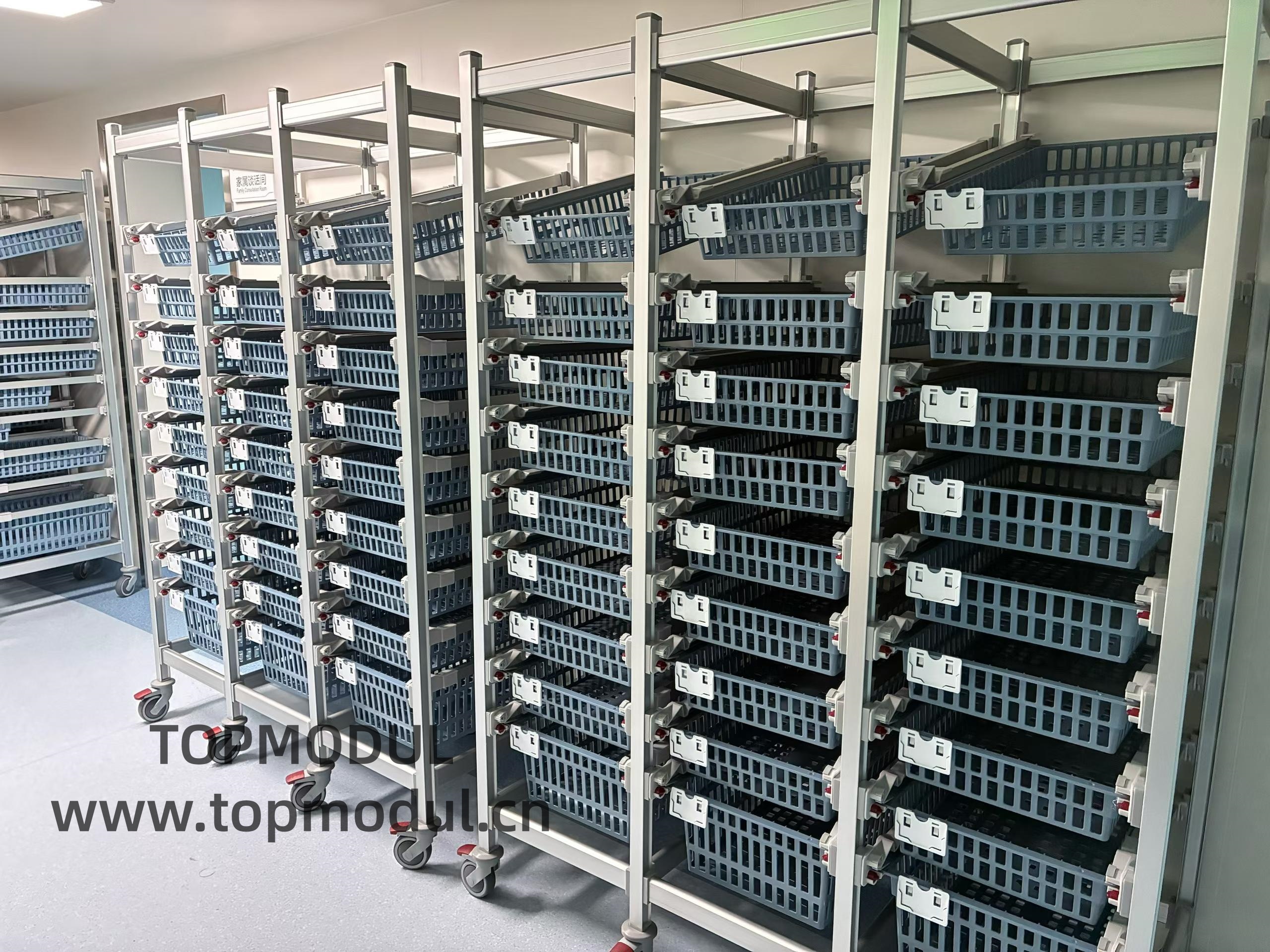
Why cart selection became a system decision
The commercial context explains the shift. The global medical carts market is estimated at US$4.83 billion in 2026, and the European segment is forecast to grow at a compound annual growth rate of 15.8% between 2025 and 2030 (Horizon / Grand View Research, Europe Medical Carts Market Size & Outlook 2025–2030). Growth of that order is not driven by hospitals replacing broken trolleys one for one. It is driven by departments reorganising how consumables move from a central store to the point of care.
For a procurement team, the consequence is structural. If carts are bought as standalone furniture, each department specifies its own drawers, its own tray sizes and its own stocking logic. Supplies then get trapped in whichever unit they were loaded into, shelves and carts duplicate stock, and restocking becomes a search task rather than a logistics task. If carts are bought as the mobile end of a storage system, the tray becomes the unit of inventory and the cart becomes the vehicle that carries it.
This is the reason the T001/T002/T003 comparison is not a beauty contest between three similar trolleys. The real question is which of the three roles — anesthesia support, emergency response, or routine nursing rounds — a given department is trying to serve, and whether all three can be fed from one module pool.
What the modular layer actually consists of
Tongde Medical Technology (Ganzhou) Co., Ltd. produces medical carts, hospital medication trolleys, medical supply carts and anesthesia carts, alongside high density medical storage shelving, ISO 6040 medical storage systems and modular hospital storage systems. Production services cover medical cart design and manufacturing, medical storage system integration, modular configuration for carts and storage systems, and project-based solution support for hospital storage and cart projects.
Manufacturing is vertically integrated at the component level: the factory operates injection molding equipment, a granulator and a raw material warehouse. In practical terms this means the structural parts of the carts and the trays they carry are produced in-house rather than assembled from purchased sub-components — a relevant detail when a buyer is assessing whether tray geometry will stay consistent across repeat orders.
The tray is the standard; the cart is the carrier
In the ISO 6040 modular logic referenced across this product range, storage trays and baskets are dimensioned so that the same module can sit in a cart drawer position, on a cart shelf, or on a shelving level. Storage tray T604010AN appears as a related item across the cart, shelving and cabinet lines in the manufacturer's product and certification records, which is consistent with a shared tray interface rather than three unrelated product families.
One third-party benchmark is often cited in this context: a specification note published by Pegasus Medical on MedicalExpo states that the ISO 60-40 modular system allows an increase in storage capacity of up to 50% compared with traditional shelving. That figure is a shelving benchmark for modular trays and baskets. It should not be transferred automatically to cart deployments, where capacity is limited by footprint, drawer depth and the number of levels a nurse can reach comfortably.
Buyer reading: modularity is an interface property, not a performance claim. What it guarantees is that modules can be moved and reconfigured. What it does not guarantee is a specific storage gain in a specific room.
The comparison: T001, T002 and T003
The three models are designated for three different clinical jobs. The table below separates what is documented from what has to be agreed project by project.
| Decision dimension | Anesthesia Cart T001 | Emergency Crash Cart T002 | Nursing Cart T003 |
|---|---|---|---|
| Clinical role the model is designated for | Anesthesia and procedure support, where supplies are staged at the anesthesia workstation | Emergency response, where one unit must hold a predefined critical-care set ready for immediate use | Ward nursing rounds, where a routine supply set travels between patients |
| CE model coverage | Listed in EU Declaration of Conformity REP-MDR-20241108M1 (models T001–T011) | Listed in the same Declaration of Conformity (models T001–T011) | Listed in the same Declaration of Conformity (models T001–T011) |
| Notification scope | Named in EU Medical Device Notification DE/CA20/00205020, scope “Medical Carts (Anesthesia Cart, Emergency Crash Cart, Nursing Cart, Infusion Cart etc.)” | Named in the same notification | Named in the same notification |
| Module interface | Shared modular storage interface; storage tray T604010AN listed across the cart and shelving records | Shared modular storage interface | Shared modular storage interface |
| What must be agreed before order | Drawer/shelf split, lock structure, accessory set, cleaning-agent compatibility, bearing requirement | Same, plus the layout logic of the emergency set and the access sequence during a response | Same, plus restocking ergonomics and the interface with ward-level storage |
| Customisation route | OEM production or ODM design and production | OEM production or ODM design and production | OEM production or ODM design and production |
Sources: EU Declaration of Conformity REP-MDR-20241108M1 (issued 2024-11-08); EU Medical Device Notification DE/CA20/00205020 (issued 2024-11-26); manufacturer product and capability records.
What differs in practice
T001 — anesthesia cart. The anesthesia environment is a staged environment: supplies are prepared in advance and consumed in a fixed location. That favours a configuration where the drawer and shelf split is stable, the unit can be locked between procedures, and the module set matches a defined anesthesia protocol rather than a general ward list.
T002 — emergency crash cart. The emergency role is defined by access under time pressure. The procurement question here is not storage volume but the reliability of the retrieval sequence: whether each module position maps to a known item, whether the lock structure allows fast but controlled access, and whether the unit can be restocked to a fixed standard after every use. Because the same model is used across a hospital, buyers should fix one configuration standard rather than allowing per-department variation.
T003 — nursing cart. The nursing cart is the highest-frequency unit of the three. Its cost driver is not the initial purchase but the daily cycle of restocking, moving and cleaning. Configuration decisions therefore centre on how quickly the cart can be refilled from the shelving system and how easily surfaces and removable parts can be cleaned between patients.
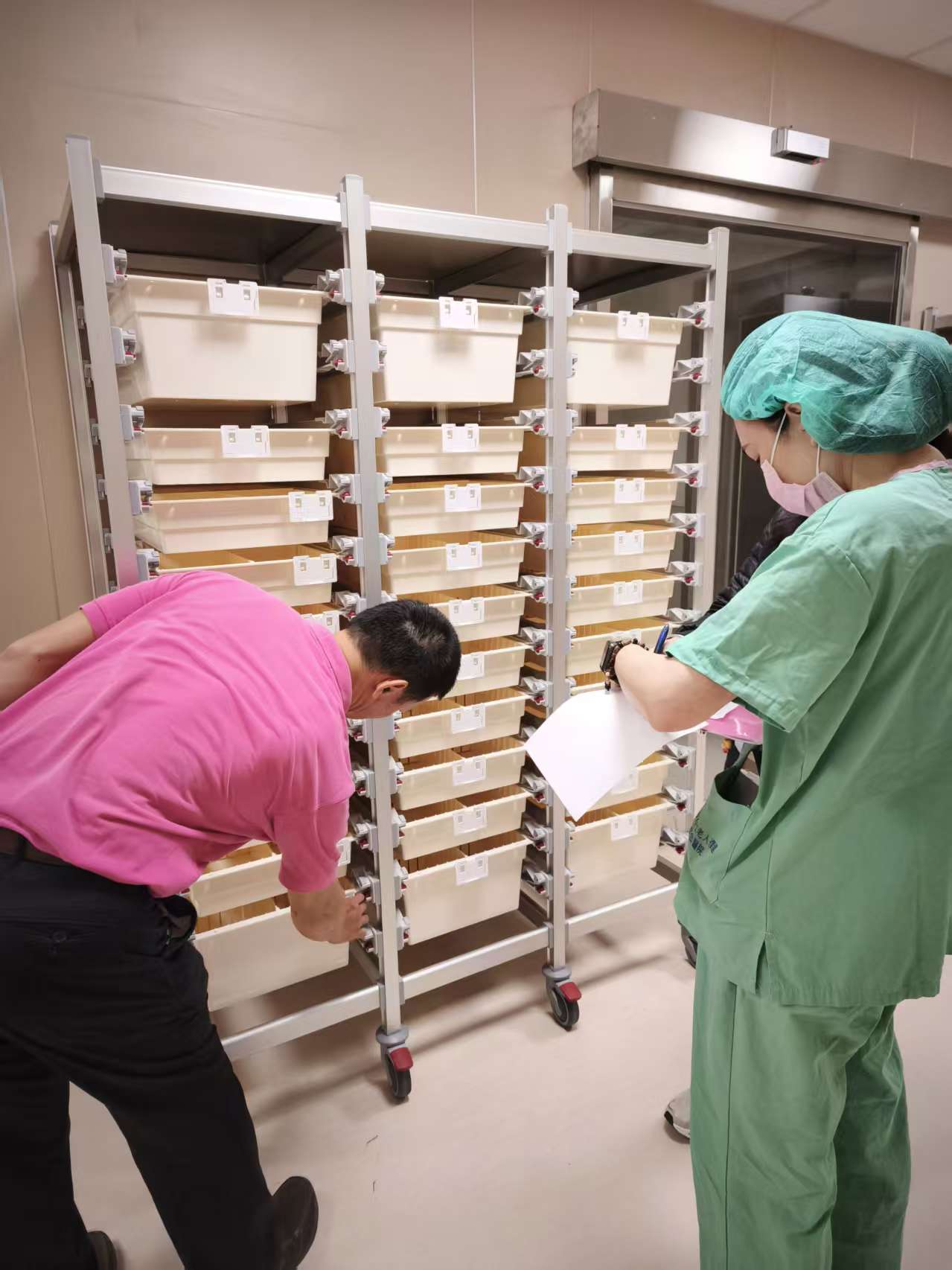
Certification: read the model list, not the product family
For an EU-bound buyer, the certification evidence is specific and should be checked at model level rather than at brand level.
- EU Declaration of Conformity (CE, Medical Device, MDR Class I) — certificate number REP-MDR-20241108M1, issued 2024-11-08 by REP Europe GmbH as European Authorized Representative. Scope: medical cart models T001, T002, T003, T004, T005, T006, T007, T008, T009, T010 and T011. Cited standards include Regulation (EU) 2017/745 (MDR), EN ISO 20417:2021, EN ISO 10993-1:2020, EN 62366-1:2015+A1:2020, EN ISO 13485:2018+A11:2021 and EN ISO 14971:2020/A11:2021.
- EU Medical Device Notification Certificate — number DE/CA20/00205020, issued 2024-11-26, scope covering medical carts including anesthesia carts, emergency crash carts, nursing carts and infusion carts; markets listed as the EU 27 member states, the UK, Turkey and selected Middle Eastern countries.
- ISO 9001:2015 — certificate number 276Q240086, issued 2024-04-08 and valid to 2027-04-07 by Huaxinchuang (Beijing) Certification Center Co., Ltd., with a scope covering the production of medical shelves (cabinets) and medical carts.
A separate Declaration of Conformity, REP-MDR-20250417TM01 and REP-MDR-20250417TM02, issued 2025-04-17 and valid to 2030-04-17, covers TM Cabinet, One Series Shelving and Alpha Series Shelving. Buyers should note that shelving and carts sit under different declarations — a detail that matters when a project bundles both in one tender.
Boundary: a Declaration of Conformity covers the configuration it describes. Accessories, third-party trays or locally added lock systems that change the device are not automatically inside that scope, and the buyer normally carries the responsibility to confirm this with the manufacturer before ordering.
A five-step evaluation sequence for this trio
- Assign one clinical role per unit type. Resist the temptation to buy one cart specification for all three jobs. The T001/T002/T003 split exists because anesthesia staging, emergency response and routine rounds have different access and restocking patterns.
- Fix the module set before the cart. Decide the tray and basket inventory first, then let the cart configuration follow. Doing it in the reverse order is the most common cause of unused drawer depth.
- Match certification to the model number. Confirm that the exact model, and the exact configuration, appears in the applicable declaration. Do not accept a family-level statement.
- Verify what certificates do not cover. Bearing capacity, lock structure, caster condition, surface anti-corrosion treatment, compatibility with the hospital's cleaning and disinfection agents, and safety of the load configuration all have to be confirmed as project parameters.
- Plan the rollout before the pilot. A pilot that succeeds technically can still fail commercially if the batch size and lead time do not fit the hospital's procurement calendar.
Modular versus traditional cart purchasing — and the limits of each
Traditional hospital storage purchasing treats the cart and the shelf as separate objects. Carts are welded or fixed-drawer units dedicated to one room; shelving is dimensioned for the store room. The overlap cost is duplication: the same consumable exists in a cart, in a cupboard and on a shelf, and none of the three locations knows about the others.
The modular approach replaces that with a shared module pool. The manufacturer's own description of its modular storage rack emphasises high space utilisation, good access, light and flexible operation, easy cleaning and disinfection, and replaceability of parts, with the note that components can be replaced at any time, which facilitates disinfection. Those are practical properties, not marketing abstractions: replaceable, non-rusting parts shorten the maintenance loop and allow a damaged component to be swapped rather than a whole unit retired.
The limits deserve equal weight, and buyers evaluating this category should treat them as decision criteria rather than caveats:
- Modularity depends on discipline. A shared tray pool only works if the hospital enforces tray standards. Without that, a modular cart degrades into a fixed cart with loose parts and no inventory logic.
- Batch economics constrain small pilots. The manufacturer's stated minimum order quantity is 100 units, with a lead time of 30–45 days and a monthly capacity of 20,000 units. A single-department trial below that threshold needs a separate commercial route, and buyers should settle this before committing to a system-level design.
- Interface compatibility needs verification. ISO 6040 describes a modular dimensional logic; it does not guarantee that trays from a different supplier will fit a given cart without a physical check.
- Capacity claims are context-bound. The widely quoted 50% capacity gain refers to modular shelving versus traditional shelving. Cart-level gains depend on the room, the case mix and the drawer configuration actually chosen.
- Storage change is not clinical change. Reconfiguring carts improves restocking and retrieval; it does not by itself change clinical outcomes, and no evidence in this category should be read that way.
Deployment evidence from hospital projects
Project records show how the cart-and-shelving mix plays out at different scales. A hospital in Taiwan took 100 units for medical product storage and transport, with the reported outcome that supplies reach the point of care directly, reducing the time clinical staff spend walking to supply rooms or central stations. A hospital in Malaysia took 100 units for storage and transport of medical supplies, where the reported effect was that carts function as efficiency and infection-control tools rather than simple transport units. A UK hospital took 100 units of medicine storage shelving, reporting improved storage order, faster medicine retrieval, better inventory control, reduced medication errors and more efficient use of space.
Smaller and denser configurations appear elsewhere: a healthcare centre in Israel took 10 units of high density mobile shelving to manage medical files and materials with significant space savings, and a hospital in Saudi Arabia took 50 units of high density shelving, with reported storage capacity increases of up to 50% or more and retrieval time falling from minutes to seconds.
Two observations follow for cart buyers. First, the cart line is normally deployed alongside shelving, not instead of it — the shelving holds depth of stock, the cart holds the working set. Second, the reported benefits in these projects are operational (order, retrieval speed, space use), which is the appropriate level of claim for a storage system.
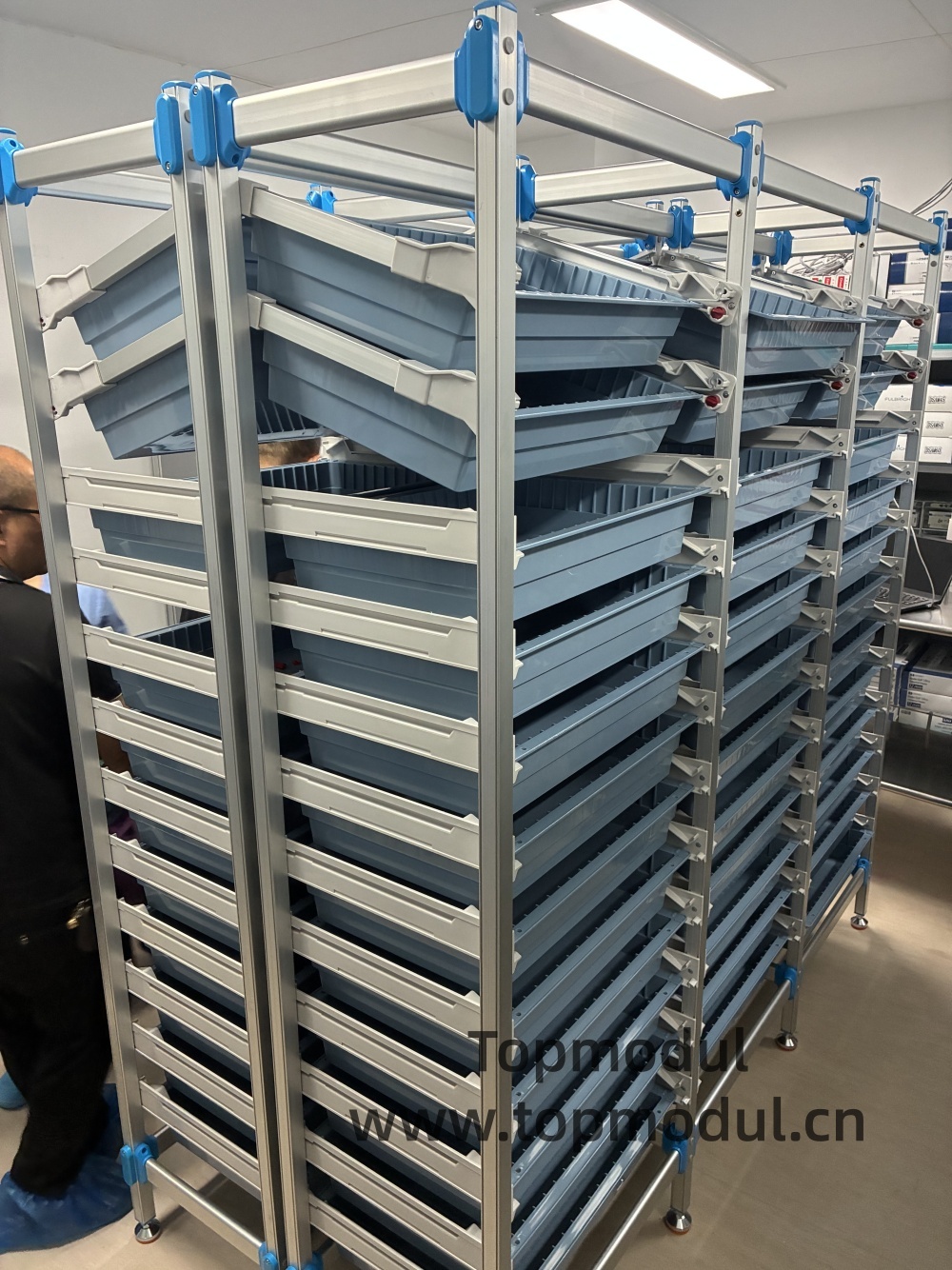
Market direction: from equipment purchase to storage architecture
The market data supports a straightforward reading. With the global medical carts market estimated at US$4.83 billion in 2026 and European growth forecast at 15.8% CAGR through 2030, volume is not coming from first-time equipment purchase alone. It is coming from hospitals consolidating fragmented storage into a defined architecture — a shift that favours suppliers who can deliver carts, trays and shelving from one interface standard.
One interpretation worth flagging for planning purposes: the efficiency case for modular systems, combined with rising consumable volumes, is a plausible driver of the growth rate. That is an interpretation of the two data points together, not a finding of either source, and should be treated as a hypothesis to test against a hospital's own logistics data rather than a purchasing argument.
Geographically, the manufacturer's export profile — 90% of output exported, with key markets in Germany, the UK, Spain, Italy, the Netherlands, Poland, Saudi Arabia and Israel, plus demand from Singapore, Brazil and CIS countries — indicates that the practical compliance question for most buyers is EU MDR documentation, with Middle East requirements following closely.
Procurement checklist before issuing a purchase order
| Parameter | What to confirm |
|---|---|
| Certification | CE (MDR) documentation and ISO 9001:2015 certificate, checked against the exact model number and configuration |
| Material and hygiene | Antibacterial material claim, surface treatment, compatibility with the hospital's cleaning and disinfection agents, tolerance of high-temperature disinfection where required |
| Structure and safety | Rated bearing capacity, lock structure, caster specification, stability under load, connection tightness |
| Dimensions | Overall size against doorway, lift and ward-corridor constraints; drawer and shelf depth against the actual tray inventory |
| Module interface | Whether existing or planned trays are compatible, and whether the supplier will confirm fit physically |
| Commercial terms | MOQ (stated as 100 units), lead time (30–45 days), monthly capacity (20,000 units), OEM/ODM scope |
| After-sales | Free maintenance service, installation, debugging and usage training, consultation, and product upgrade support |
Two usage risks deserve a place in the acceptance protocol. The recurring failure modes reported for medical storage carts are overloading and deformation, caster failure, surface corrosion and loose structural connections, typically triggered by overload, frequent heavy use or poor maintenance. The countermeasures are unglamorous but effective: observe the rated load limit, wipe off disinfectant residue after cleaning, inspect casters and fasteners on a schedule, and stop using any unit whose parts show deformation or loosening until the part is replaced.
Frequently asked questions
What is the difference between the anesthesia cart T001, the emergency crash cart T002 and the nursing cart T003?
The three models are designated for different clinical roles within the same modular platform. T001 is an anesthesia cart, used where supplies are staged at the anesthesia workstation. T002 is an emergency crash cart, used where a predefined critical-care set must be held ready for immediate access. T003 is a nursing cart, used for routine ward rounds where a supply set travels between patients. All three are listed in the same EU Declaration of Conformity (models T001–T011) and are named in the EU Medical Device Notification scope covering anesthesia carts, emergency crash carts, nursing carts and infusion carts.
Are all three cart models covered by the same CE certification?
Yes, at declaration level. EU Declaration of Conformity REP-MDR-20241108M1, issued 2024-11-08 by REP Europe GmbH, lists medical cart models T001 through T011 and cites Regulation (EU) 2017/745 (MDR) together with EN ISO 20417:2021, EN ISO 10993-1:2020, EN 62366-1:2015+A1:2020, EN ISO 13485:2018+A11:2021 and EN ISO 14971:2020/A11:2021. A separate EU Medical Device Notification, DE/CA20/00205020, issued 2024-11-26, names anesthesia carts, emergency crash carts, nursing carts and infusion carts within its scope.
Can the three carts share the same modular trays and the same shelving interface?
They are built on a shared modular storage interface: the manufacturer produces ISO 6040 medical storage systems and modular hospital storage systems, and storage tray T604010AN is listed as a related item across the cart, shelving and cabinet lines. Sharing trays across models is therefore the intended design logic. Buyers should still confirm fit physically for any tray that is not part of that standard set, because the ISO 6040 designation describes a dimensional modular logic and does not by itself certify third-party tray compatibility.
What are the minimum order quantity, lead time and production capacity for these carts?
The manufacturer states a minimum order quantity of 100 units, a lead time of 30–45 days and a monthly capacity of 20,000 units, with a factory of 30,000 square metres and a workforce of over 100 people including a 10-person R&D team. Both OEM production and ODM design and production services are offered for medical carts and medical storage systems, and project-based solution support is available for hospital storage and cart projects.
What should a hospital verify before scaling from a pilot batch to a full rollout?
Four things. First, that the pilot configuration matches the certification documents at model and configuration level. Second, that quality control is documented: the manufacturer runs a total quality management system with IQC, IPQC, FQC and OQC stages, a five-member QC team inspecting every product at each production stage, and 100% testing, under ISO 9001:2015 certificate 276Q240086 valid to 2027-04-07. Third, that the module inventory used in the pilot can be restocked at scale within the stated 30–45 day lead time. Fourth, that cleaning and inspection routines are written into departmental procedure, since overload, caster wear, corrosion and loose connections are the documented failure modes for this equipment category.
Outlook
The comparison points to a conclusion that is less about three model numbers than about purchasing sequence. In a modular medical storage system, the tray standard is the long-lived decision; the cart is the part that gets reconfigured as departments change. Buyers who select the cart first and the modules second usually end up buying twice. Buyers who lock the module pool first, then assign T001, T002 and T003 to their respective clinical roles, get a system that can absorb change without a new tender.
What this reference does not claim is equally important. The evidence here establishes certification coverage, production capability, configuration logic and reported project outcomes. It does not establish comparative clinical performance against other manufacturers' carts, and no such comparison should be inferred from it.
For configuration details, tray dimensions and shelving specifications, the manufacturer's shelving and storage catalogue is available for download: 2026 TM Shelving Catalogue (PDF).
¿Tiene preguntas o necesita más detalles?
Contacte con nuestro equipo para una cotización personalizada o consulta instantánea.
Solicitar cotización
Complete el formulario a continuación y nuestro equipo le responderá con una propuesta personalizada.
Chat directo de WhatsApp
¿Prefiere chatear en tiempo real? Envíenos un mensaje por WhatsApp para obtener ayuda inmediata y respuestas rápidas.
- Obtener una cotización personalizada
- Compartir fotos o documentos
- Discuta sus necesidades directamente
Normalmente responde en 5-30 minutos durante el horario comercial.