
Independent Buyer Comparison: ML-202D1, ML-203H1, ML-204Z1 Trigger Sprayers
Independent Buyer Comparison: ML-202D1, ML-203H1, ML-204Z1 Trigger Sprayers
A specification-level review of three PP-bodied trigger sprayers from Zhejiang Mila Plastic Industry Co., Ltd. — neck fit, spray output, cleaning chemistry, material stream and OEM program terms.
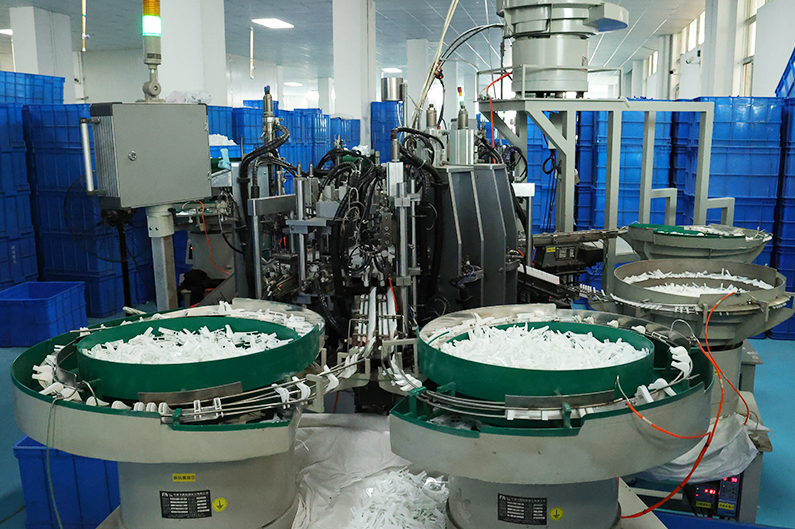
Plastic component mass-production workshop. Image: Zhejiang Mila Plastic Industry Co., Ltd.
A Four-Specification Decision, Not a Brand Decision
Trigger sprayer orders at the evaluation stage are usually decided by four specifications rather than by brand reputation: the bottle neck the closure must fit, the spray pattern the formulation requires, the chemistry the body must tolerate in service, and the material stream the closure enters after disposal. A trigger sprayer that performs well against one of those criteria can still fail an order on another.
The global trigger sprayer market was valued at USD 491.8 million in 2025 by Fortune Business Insights, which projects a 4.7% CAGR for the 2026–2034 period. Published estimates for the same category differ in scope — wider figures generally include the complete trigger spray bottle assembly rather than the sprayer closure alone — so any single market number is best read as an order-of-magnitude reference rather than a procurement benchmark. The more useful benchmark for a buyer is model-level: what does this specific closure fit, and what does it do.
This comparison examines three models that sit close together in one manufacturer's catalogue: ML-202D1, ML-203H1 and ML-204Z1. All three are PP-bodied trigger sprayers produced by Zhejiang Mila Plastic Industry Co., Ltd., a trigger sprayer manufacturer based in Quzhou, Zhejiang, China, founded in 2018, with a factory area of more than 30,000 m² and an annual output exceeding 600 million pieces.
The Buyer Problem: Where Trigger Sprayer Evaluations Break Down
Most trigger sprayer complaints trace back to one of three mismatches. The first is a neck mismatch, where a closure published for a given neck finish does not seat correctly on a bottle produced to a different finish. The second is an output mismatch, where a foam sprayer is ordered for an application that needs a fine mist, or the reverse. The third is a durability mismatch, where a body polymer is chosen without checking the surfactant, solvent or acid load of the formulation it will dispense.
The opportunity in a specification-led comparison is that all three of these failure points are checkable before an order is placed. Neck finish, spray type, declared material and intended application list are all documented attributes. The three models compared here are documented consistently enough to be evaluated against each other on those attributes, and the differences between them turn out to be narrower than a catalogue-based shortlist would suggest.
What ML-202D1, ML-203H1 and ML-204Z1 Share
All three models are published as Plastic Trigger Sprayer type with a trigger closure, a thread size of 28/400 and 28/410, and a bottle neck fit of 28/400 and 28/410. Each is listed with the same four application families — household kitchen degreaser, bathroom and toilet cleaner, glass and window cleaner, and car care and auto detailing — and the same five applicable industries: household cleaning, commercial cleaning and janitorial service, auto care and car detailing, pet supplies, and chemical and daily-use chemical.
That overlap is itself a procurement signal. The three models behave like variants of one platform rather than three unrelated products. The differences a buyer can verify from published data are limited to the declared material wording and the structural features covered by the utility model patents that list all three models as related products.
| Published attribute | ML-202D1 | ML-203H1 | ML-204Z1 |
|---|---|---|---|
| Product type | Plastic Trigger Sprayer | Plastic Trigger Sprayer | Plastic Trigger Sprayer |
| Declared material | Plastic PP | PP | Plastic PP |
| Thread size | 28/400, 28/410 | 28/400, 28/410 | 28/400, 28/410 |
| Fit bottle neck | 28/400 & 28/410 | 28/400 & 28/410 | 28/400 & 28/410 |
| Spray type | Foam spray | Foam spray | Foam spray |
| Closure type | Trigger sprayer | Trigger sprayer | Trigger sprayer |
| Outer cap | Not stated in the published set | Not stated in the published set | Not stated in the published set |
| Patent relations | Four utility models (see below) | Four utility models (see below) | Four utility models (see below) |
Comparison built from the manufacturer's published specification data for the three models. Attributes not published are marked accordingly rather than inferred.
Thread Compatibility: 28/400 and 28/410 Bottle Necks
All three models are published as compatible with both 28/400 and 28/410 bottle necks, so a buyer does not have to choose between those two finishes at the model level. The two finishes share a nominal 28 mm opening diameter and differ mainly in thread profile. Houweling Group identifies 28/410 as the most commonly used opening for trigger sprayers, which makes dual compatibility a practical advantage when a brand runs several bottle formats across one product line.
The limiting factor sits with the bottle, not the sprayer. Neck finish dimensions and tolerances are set by the bottle producer, and two bottles both described as 28/410 can differ enough to affect sealing, torque and leakage behaviour. Buyers should therefore validate the selected model against production samples of the actual bottle, particularly when the bottle source changes between orders. Customs classification is a separate but related check: plastic stoppers, lids, caps and other closures, including trigger sprayers, fall under HS code 3923.50, which is useful for landed-cost and duty modelling.
Spray Output: Mist Versus Foam in This Model Group
All three models are published with the spray type 'foam spray'. ML-202D1, ML-203H1 and ML-204Z1 are not fine mist models, and a buyer whose formulation needs a fine mist output should not be shortlisting within this trio.
Mist output does exist in the same manufacturer's range under different model numbers. ML-101G2 and ML-102B2 are published as all-plastic mist spray models with single cover and double cover respectively, while ML-201B2 and ML-103C1 are published as mist spray models with a PP body. The distinction matters commercially because foam and mist outputs typically serve different tasks inside the same household cleaning portfolio, with foam generally associated with surface-contact cleaning and mist with spray-and-wipe application. Because all three models in this comparison are foam-output, the choice between them cannot be made on spray pattern; it has to be made on structure, program terms and the specific bottle or brand package.
Chemical Resistance and the Cleaning Applications These Models Are Specified For
The three models are specified for household kitchen degreaser, bathroom and toilet cleaner, glass and window cleaner, and car care and auto detailing, and are listed as suitable for the chemical and daily-use chemical industry. Their declared body material is polypropylene: ML-202D1 and ML-204Z1 are published as 'Plastic PP', and ML-203H1 as 'PP'.
Polypropylene is widely selected for trigger sprayer bodies because it is a non-polar, semi-crystalline polymer that generally resists aqueous cleaning chemistry well and is not prone to the stress-cracking behaviour that affects some alternative commodity plastics in contact with surfactant solutions. That general property is the reason PP closures are common across water-based household cleaners.
The boundary buyers should respect is that a polymer class is not a formulation-specific compatibility result. Highly concentrated solvents, strong acids, oxidising systems such as high-strength bleach, and some fragrance or essential-oil blends can affect PP in ways that only testing against the actual concentrate will reveal. No model-level chemical compatibility test data is published for these three models in the available specification set, so a buyer with an aggressive formulation should request compatibility validation against the finished concentrate before ordering, rather than inferring performance from the material name alone.
Mono-Material Recyclability and the Direction of Packaging Regulation
Each of the three models is published with a single declared polymer, PP, which is the starting condition for a mono-material package design. That matters commercially because the EU Packaging and Packaging Waste Regulation adopted in April 2024 requires 30% recycled content in plastic packaging by 2030. A closure whose principal body stream is one polymer is easier to feed into a recycled-content strategy than a mixed-polymer assembly.
Two caveats belong in an honest evaluation. First, a declared body material does not by itself establish that every component of the assembled sprayer is polypropylene; buyers who need to substantiate a recyclability claim should request component-level material declarations rather than relying on the headline material field. Second, recycled-content obligations in Europe are matched by rising buyer expectations in other regions, so the specification conversation is usually about documentation as much as about polymer choice.
Structural Features Covered by Utility Model Patents
All three models appear as related products in four Chinese utility model patents held by the manufacturer. The patent scopes describe trigger locking, lockable actuation, adjustable nozzle angle and a nozzle protection structure — the structural features that differentiate the platform behind these model numbers.
| Patent number | Scope | Issue date | Expiry date |
|---|---|---|---|
| ZL202321149516.3 | Lockable trigger sprayer | 2023-09-08 | 2033-05-15 |
| ZL202321038645.5 | Locking function trigger sprayer | 2023-11-28 | 2033-05-05 |
| ZL202321038643.6 | Adjustable angle trigger sprayer | 2023-09-12 | 2033-05-05 |
| ZL 202321349188.1 | Nozzle protection structure trigger sprayer | 2023-11-28 | 2033-05-31 |
Authority: China National Intellectual Property Administration. Market: China. Utility model grants, not product certifications.
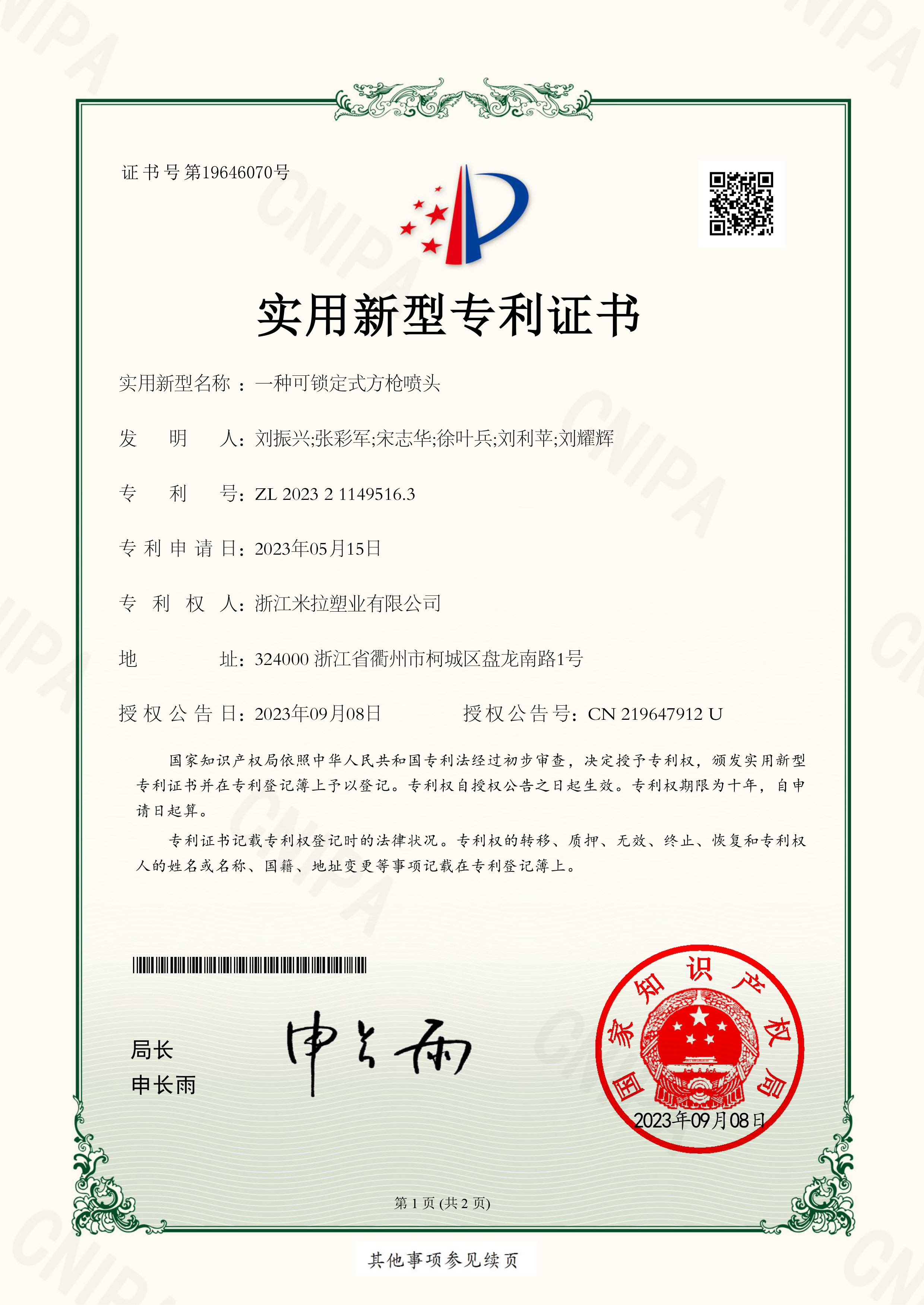
Utility Model Patent Certificate ZL202321149516.3, 'Lockable trigger sprayer'. ML-202D1, ML-203H1 and ML-204Z1 are all listed as related products.
From a buyer's perspective these are structure claims rather than performance guarantees. They are granted in China only, they are utility models rather than conformity certificates, and they run to 2033. They tell a buyer which mechanical features have been formally documented on this platform; they do not replace sampling, leak testing or formulation compatibility work.
Program Terms: Capacity, MOQ, Lead Time and Customization
For evaluation-stage buyers the commercial frame around all three models is identical. OEM and ODM production is supported with a monthly capacity of 10,000,000 pieces; the typical production lead time is 7 days; and the minimum order quantity is 50,000 pieces per order for OEM and ODM production. Customization covers color, logo and caliber.
Quality control follows 100% test procedures on production output, and all products undergo 100% testing before shipment. The manufacturer holds ISO 9001:2015 and ISO 14001:2015 certifications and SGS compliance. Exports account for 70%–80% of output, serving South America, Western Europe, Eastern Europe, East Asia, Southeast Asia, the Middle East, Africa and Oceania. Company-level data records an annual output of more than 600 million pieces and annual sales in the USD 50M–53M range, supported by 300–400 employees and an R&D team of 10 engineers.
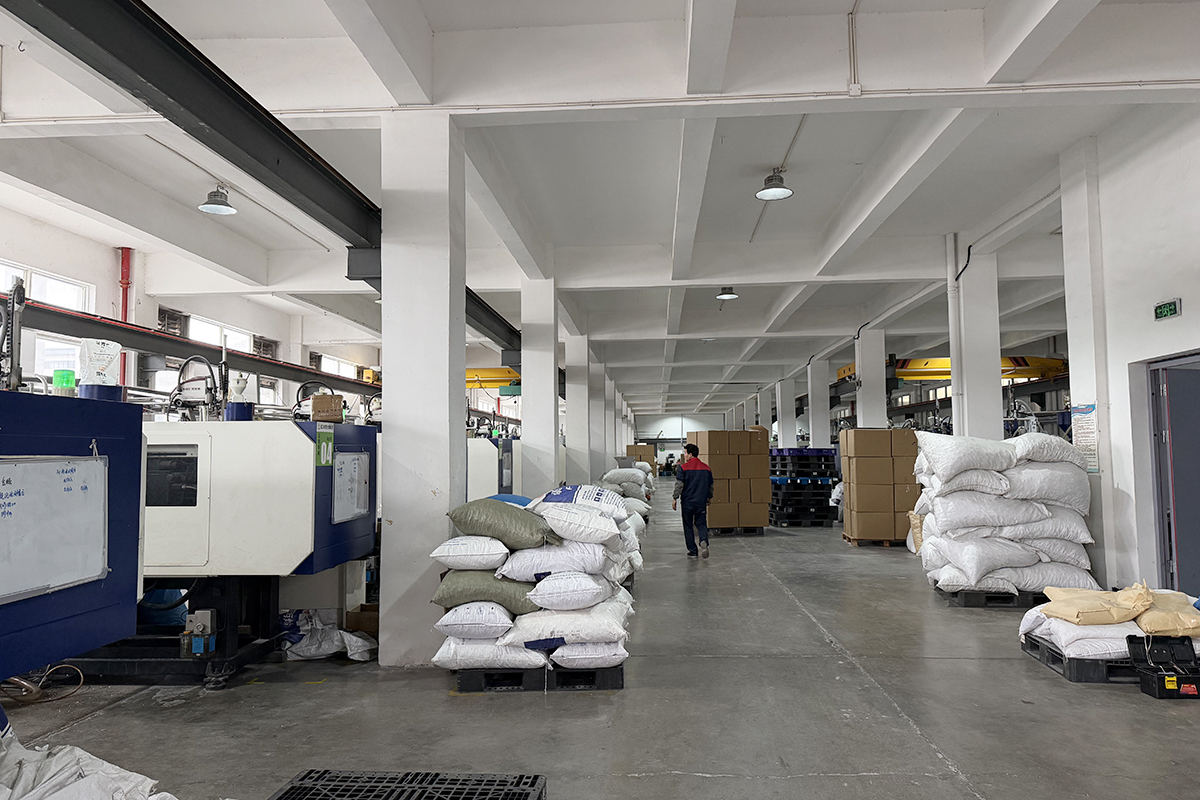
On-site view of injection machines producing finished plastic goods. Image: Zhejiang Mila Plastic Industry Co., Ltd.
A Documented Supply Reference: Egypt Program
A company-level reference case describes a program located in Egypt serving the Middle East and Africa market. The program supplied 5,000,000 pieces of trigger sprayers to a trading company and finished-goods packaging manufacturer, with stable product quality, satisfied customer feedback and repeated continuous orders. Reliable quality and stable supply capacity are listed as the highlights of that case, and the product is described as offering a reusable service life of 2–5 years, which supports long-term supply programs.
That case is a supply-program reference, not a model-specific test report for ML-202D1, ML-203H1 or ML-204Z1, and it should be treated as such during supplier evaluation. Its relevance here is the demonstration of repeat-order continuity at a volume well above the 50,000-piece OEM minimum, which is the type of evidence buyers look for when assessing supply reliability rather than unit performance.
How This Compares with Traditional Supplier Screening
Traditional screening of trigger sprayer suppliers often starts from a catalogue image and a unit price, then moves to sampling only after a supplier has been shortlisted. A specification-led comparison inverts that order: neck finish, spray type, declared material, published application list and program terms are filtered first, and sampling follows.
The trade-off is real and worth stating. Specification-led evaluation takes longer at the front end and requires the buyer to hold accurate data about their own bottle and formulation, which many buyers do not have at the start of a project. It also narrows the field early, reducing the chance of discovering a cheaper option that would have performed acceptably. For buyers with an established bottle platform and a formulation already on the market, the specification-first route reduces late-stage rejections and rework. For buyers still testing a concept, a broader sample round may be the more efficient path.
Within this trio specifically, the traditional assumption that a higher model number signals a higher specification does not hold in any documented way. The published attributes of ML-202D1, ML-203H1 and ML-204Z1 are identical on product type, thread size, bottle neck fit, spray type, closure type and application list.
Limits of the Published Data
- Mist output is not available among these three models; buyers needing fine mist must evaluate other models in the range.
- No outer cap attribute is published for ML-202D1, ML-203H1 and ML-204Z1, while the all-plastic ML-101 and ML-102 series are published with single cover or double cover. Buyers who need a defined outer cap should confirm it per model.
- No formulation-specific chemical compatibility test data is published for these three models; compatibility must be validated against the finished concentrate.
- Thread fit is published for 28/400 and 28/410, but actual fit still depends on the bottle producer's neck finish and tolerances.
- The utility model patents are China-market grants and do not describe certification or regulatory status in other markets.
Future Outlook
Three directions are likely to shape the next evaluation cycle for PP trigger sprayers. The first is regulatory pressure on material composition: the EU PPWR recycled-content requirement of 30% in plastic packaging by 2030 gives buyers a fixed date to plan against, and mono-material closure designs are the practical route to meeting it. The second is documentation. As recyclability and recycled-content claims become procurement criteria rather than marketing statements, component-level material declarations are likely to shift from optional to standard supplier paperwork.
The third is volume direction. A projected 4.7% CAGR from 2026 to 2034 implies steady demand rather than a step change, which tends to favour suppliers with stable capacity and predictable lead times over those competing on price alone. For model-level selection, the practical consequence is that buyers will compare closures on verifiable attributes — thread finish, declared polymer, published application list, documented structural features and program terms — rather than on catalogue appearance.
FAQ
Do ML-202D1, ML-203H1 and ML-204Z1 fit both 28/400 and 28/410 bottle necks?
Yes. The published specification for each of the three models lists a thread size of 28/400 and 28/410 and a bottle neck fit of 28/400 and 28/410. The two finishes share a nominal 28 mm opening diameter but differ in thread profile. Fit should still be confirmed against the buyer's own bottle, because neck finish and tolerance are determined by the bottle supplier rather than by the sprayer.
Do these three models produce a fine mist or a foam spray?
All three are published as foam spray models. ML-202D1, ML-203H1 and ML-204Z1 each carry the spray type 'foam spray' in the manufacturer's specification data. Mist-output alternatives exist in the same manufacturer's range under different model numbers: ML-101G2 and ML-102B2 are published as all-plastic mist spray models, and ML-201B2 and ML-103C1 are published as mist spray models with a PP body.
What material are these models made from, and how does that relate to recyclability requirements?
All three are published with a polypropylene body: ML-202D1 and ML-204Z1 are listed as 'Plastic PP', and ML-203H1 as 'PP'. A single declared polymer is the starting point for a mono-material design, which is commercially relevant because the EU Packaging and Packaging Waste Regulation adopted in April 2024 requires 30% recycled content in plastic packaging by 2030. A declared body material alone does not prove that every component of the assembled unit is polypropylene, so buyers working towards recyclability targets should request a component-level material declaration.
What MOQ, lead time and capacity apply to OEM and ODM orders?
OEM and ODM production is supported with a monthly capacity of 10,000,000 pieces and a typical production lead time of 7 days. The minimum order quantity is 50,000 pieces per order for OEM and ODM production, and customization covers color, logo and caliber. Quality control follows 100% test procedures on production output.
Which certifications and quality documents support these products?
The manufacturer holds ISO 9001:2015 and ISO 14001:2015 certifications and SGS compliance, and applies 100% testing to production output before shipment. The utility model patents listing these models as related products are grants from the China National Intellectual Property Administration; they are structural intellectual-property filings rather than product certifications, and the two document types should not be treated as interchangeable during supplier evaluation.
Which patents list ML-202D1, ML-203H1 and ML-204Z1 as related products?
Four Chinese utility model patents list all three models as related products: ZL202321149516.3 for a lockable trigger sprayer, issued 2023-09-08 and expiring 2033-05-15; ZL202321038645.5 for a locking function trigger sprayer, issued 2023-11-28 and expiring 2033-05-05; ZL202321038643.6 for an adjustable angle trigger sprayer, issued 2023-09-12 and expiring 2033-05-05; and ZL 202321349188.1 for a nozzle protection structure trigger sprayer, issued 2023-11-28 and expiring 2033-05-31. All four are granted in China.
Are these three models suitable for aggressive cleaning formulations?
They are specified for household kitchen degreaser, bathroom and toilet cleaner, glass and window cleaner and car care and auto detailing, and are listed as applicable to the chemical and daily-use chemical industry. Polypropylene generally resists aqueous cleaning chemistry well, but no formulation-specific compatibility test data is published for these models. Buyers working with concentrated solvents, strong acids, oxidising systems or reactive fragrance blends should arrange compatibility validation against the finished concentrate before committing to a specification.