
Independent Buyer Comparison: DP/DPN, DH, DF/DFN, DPO
A customized elevator is not one product with optional extras. It is an engineered answer to a specific shaft, traffic profile and building use — and that answer changes materially depending on which model family the project is built around.
For specifiers at the decision-to-execution stage, the practical question is rarely “who can customize an elevator?” Most manufacturers can. The question that determines cost, lead time and long-term serviceability is narrower: which platform fits this building, and what exactly is being customized inside it?
This comparison looks at four Delfar Elevator model families — DP/DPN passenger, DH home, DF/DFN freight and DPO observation — using published model parameters. Delfar Elevator Co., Ltd. is an elevator manufacturer founded in 2011 and based in Huzhou, Zhejiang, China, producing passenger, home, observation, hospital, freight, car, machine-room-less and small-machine-room elevators, escalators and moving walks. Its factory covers approximately 100,000 ㎡, with an annual output of 10,000 units, a 30-engineer R&D team and an export ratio of about 50%. The aim here is not to rank these families against each other, but to show where each one is the appropriate specification — and where it is not.
Why the model family decides more than the finish schedule
Customized elevator dimensions are usually discussed late in a project, after the shaft has been cast or the structural opening fixed. That sequence is backwards. Capacity, speed, stop count and travel height set the platform first; cabin, door and ceiling decisions sit on top of that platform and cannot compensate for a family that does not reach the building’s requirements.
A residential villa, a mid-rise office block, a logistics dock and an atrium with a scenic shaft have almost nothing in common at the engineering level. They diverge on rated load, on rated speed, on how many floors are served, on how far the car travels, and on whether a machine room exists at all. Treating “customized” as a single specification category tends to produce proposals that look comparable on paper but are not comparable in service.
The four families at a glance
The table below consolidates the published parameter envelopes of the four families. These ranges define what each platform is engineered to deliver; individual projects normally sit inside a range rather than at its edge.
| Model family | Typical role | Rated capacity | Rated speed | Stops | Max travel | Machine room |
|---|---|---|---|---|---|---|
| DP / DPN passenger elevator | Commercial, residential, hotel, hospital, public buildings | 400–3000 kg | 1.0–6.0 m/s | 2–60 | ≤100 m | Machine-room-less or small machine room |
| DH home elevator | Villas, duplexes, private residences | 320–630 kg | 0.3–0.5 m/s | 2–6 | ≤20 m | Small machine room or machine-room-less |
| DF / DFN freight elevator | Warehouses, logistics, industrial and back-of-house goods movement | 2000–8000 kg | 0.25–1.0 m/s | 2–10 | ≤50 m | Confirmed at project design |
| DPO observation elevator | Atriums, hotels, retail, scenic and public spaces | 630–1600 kg | 1.0–2.5 m/s | 2–30 | ≤100 m | Confirmed at project design |
Two observations follow from this table. First, only the DP/DPN family spans the full range from light residential loads to high-capacity commercial duty, and only it reaches 6.0 m/s. Second, the DH home family is deliberately narrow: a 20 m travel ceiling and a 0.5 m/s speed ceiling place it clearly in low-rise private residential work.
DP/DPN passenger elevators: the wide envelope
DP/DPN is the general-purpose platform, and it is where most commercial and multi-unit residential specifications land. Capacity from 400 kg to 3000 kg covers everything from a small apartment lift to a fully loaded commercial car, while the 1.0–6.0 m/s speed band allows the same family to serve a six-storey office building and a high-rise tower. Stop counts up to 60 and travel up to 100 m mean the platform can address long, high-traffic shafts without changing family.
The machine-room-less option matters commercially as well as architecturally. Machine roomless customized elevator configurations remove the dedicated machine room from the building programme, which is often the difference between fitting a lift into an existing structure and not. Third-party analysis cited by Fortune Business Insights expects machine-room-less technology to record the highest growth rate in the sector, at a CAGR of 9.6% through 2034 — a signal that MRL is becoming a default assumption rather than a premium alternative.
For high-speed customized elevator specifications at the upper end of the band, the engineering conversation shifts to ride comfort, rope and machine selection, and the shaft’s aerodynamic behaviour. Buyers should expect the manufacturer to justify the requested speed against traffic calculation rather than accept it as a catalogue choice.
DH home elevators: a bounded platform by design
The DH family is specified at 320–630 kg, 0.3–0.5 m/s, 2–6 stops and up to 20 m of travel. Those numbers describe a private residential lift for villas and duplexes, and they are useful precisely because they are limits. A customized residential elevator in this class is optimized for quiet operation, compact shaft use and low-rise duty cycles — not for throughput.
Structurally, the DH shaft can be built in aluminium or steel, which matters in retrofit and renovation work where a conventional concrete shaft is impractical. Car and landing doors, car finishes, floors and control panels follow the same material menu as the passenger family, so the visual customization scope is broader than the mechanical envelope might suggest.
Where the DH family reaches its boundary is height and speed. A project needing more than 6 stops, more than 20 m of travel, or speeds above 0.5 m/s should be re-scoped onto the DP/DPN platform rather than pushed through a residential specification.
DF/DFN freight elevators: load before speed
The DF/DFN family is specified from 2000 kg to 8000 kg, with speeds of 0.25–1.0 m/s, 2–10 stops and up to 50 m of travel. This is a heavy-duty customized elevator platform whose design centre is structural robustness, floor loading and goods handling rather than passenger ride quality.
The stop ceiling of 10 is the parameter most often misread. Freight movement in warehouses and industrial buildings frequently concentrates on two or three levels, so a 10-stop limit is rarely restrictive in practice; it becomes restrictive when a logistics operator assumes a goods lift can serve a full multi-storey tower the way a passenger unit would. Travel of up to 50 m similarly aligns the family with low- and mid-rise industrial buildings.
Within that envelope, the real customization work sits in door configuration, car flooring and protection, and loading conditions at the landing — items that must be agreed against the actual goods being moved, not against generic assumptions.
DPO observation elevators: visibility has structural cost
The DPO family is specified at 630–1600 kg, 1.0–2.5 m/s, 2–30 stops and up to 100 m of travel. It shares the passenger family’s reach in travel but not in speed: the 2.5 m/s ceiling reflects the structural and glazing constraints of a scenic car, where the cabin is part of the building’s architecture rather than a concealed box.
For a customized elevator in commercial buildings with a public atrium, the DPO trade-off is straightforward. The buyer gains a visible architectural element and, in many projects, a passenger experience asset; the buyer accepts a narrower speed band, additional structural coordination around the glass shaft, and a finishing package that must be agreed earlier because it is visible from outside the car.
Cabin, door, ceiling and material choices
Once the family is fixed, customization moves to the interior package. The documented material options for the DP/DPN passenger and DH home families are summarized below; ceiling and lighting treatment form part of the same car interior package and are agreed at design freeze rather than treated as a separate catalogue item.
| Component | DP / DPN passenger | DH home |
|---|---|---|
| Car finish | Stainless steel, glass, painted steel, wood-finish and customized options | Stainless steel, glass, painted steel, wood-finish and customized options |
| Car door and landing door | Stainless steel, glass, painted steel, wood-finish and customized options | Stainless steel, glass, painted steel, wood-finish and customized options |
| Floor | PVC or marble | PVC or marble |
| Handrail | Stainless steel, solid wood, acrylic | Confirmed per project specification |
| Car operating panel (C.O.P) | Stainless steel, glass, acrylic plexiglass | Stainless steel, glass, acrylic plexiglass |
| Landing operating panel (L.O.P) | Stainless steel, glass | Stainless steel, glass |
| Shaft construction | Per building structure | Aluminium or steel |
Customized elevator cabin materials carry operational consequences that are easy to overlook at specification stage. Glass and wood-finish surfaces raise the level of care needed during construction and cleaning; painted steel is easier to repair but shows wear differently; marble floors increase dead load and must be reflected in the car weight calculation. Where a buyer is standardizing a multi-building order, keeping the finish schedule consistent across DP/DPN and DH units reduces spare-part and maintenance complexity later.
Configuration decisions that change the delivered package
- Machine room or MRL. Available on the passenger and home families; the choice affects building programme, not just equipment cost.
- Door type and opening width. Must be matched to the goods or traffic being handled, particularly on freight units.
- Car interior package. Ceiling, lighting, handrail and panel finishes agreed together at design freeze.
- Safety and control interfaces. Emergency power supply, fire alarm interface, CCTV, access control, intercom and remote monitoring are commonly specified alongside the elevator.
- Environmental envelope. Typical operating conditions for these installations are ambient temperatures of −5°C to +40°C, relative humidity up to 90% RH non-condensing, and altitudes up to 1,000 m, in a ventilated environment free of excessive dust, corrosive gases and flammable or explosive substances.
Purchasing terms as third-party buyer checks
Commercial terms are where otherwise comparable proposals diverge most. The terms below are the published purchasing frame for these families and should be used as a checklist when comparing quotations, not as a single supplier’s advantage.
| Term | Published position | What the buyer should verify |
|---|---|---|
| Minimum order quantity | 1 unit | Whether the quoted price holds for a single unit or assumes a batch |
| Delivery terms | FOB, CIF, EXW, CFR | Which Incoterm is quoted, and where risk transfers |
| Payment terms | T/T; L/C | Milestone schedule and whether an L/C is workable for the order size |
| Acceptance criteria | Pre-shipment test | Scope of the test, documentation package, and who witnesses it |
For budgeting context, third-party research cited by Maximize Market Research places customized elevators in emerging markets typically between USD 18,000 and USD 35,000 per unit. That figure is a market estimate with medium reliability rather than a quotation, and configuration, capacity and finish level move the number substantially — particularly for freight and observation units.
Acceptance and compliance: what to confirm before shipment
Pre-shipment testing is the acceptance anchor, but it is only meaningful if the buyer knows what is being tested against. Where CE marking is required, EN 81-20 and EN 81-50 are the primary harmonized European standards for elevator design and testing, and compliance is mandatory rather than optional. EN 81-20 also requires a light curtain door detection system to reduce the risk of door strikes on passengers — a detail worth confirming explicitly in the configuration list, because door protection is sometimes treated as an upgrade in commercial negotiation when it is a baseline safety requirement in that framework.
For projects in the Middle East, SASO certification and region-specific documentation frequently enter the specification. Delfar holds ISO 9001, ISO 14001, ISO 45001, CE, CU, SASO, SGS and SC certificates, which gives buyers a verification starting point; the certificates themselves should still be checked against the specific model and destination market before contract signature.
Lifecycle and partner support: the long-term layer
Elevator decisions age slowly. Maintenance services account for approximately 55% of global elevator market revenue according to Vyansa Intelligence, which means the cost of ownership is dominated by what happens after commissioning, not by the equipment invoice. A model family that is easy to service locally is worth more over fifteen years than a marginally cheaper unit with a difficult service path.
Delfar Elevator Co., Ltd. provides full-life-cycle elevator services, including pre-sales consultation, technical design, installation guidance, commissioning, maintenance support and after-sales service. The company works with distributors, contractors, developers and project partners in international markets, and supplies elevator solutions for residential, commercial, industrial, hotel, hospital and public projects in overseas markets.
For buyers evaluating a long-term relationship rather than a one-off purchase, that structure raises three practical questions: who holds spare parts in the destination market, who performs commissioning and periodic inspection, and how technical changes to a delivered unit are documented. Distribution and project-partner models answer these questions differently from direct supply, and the answer should be written into the agreement rather than assumed.
Market signals affecting model mix
Two regional signals are relevant to specification planning. The Middle East elevator market was valued at USD 1.25 billion in 2023 and is projected to reach USD 2.38 billion by 2030, per Allied Market Research, while high-rise modernizations in the Middle East and Africa are expected to grow at a CAGR of 11% between 2024 and 2030 according to Roland Berger. Modernization work tends to favour machine-room-less configurations and units that fit existing shafts — a specification pattern that aligns with the DP/DPN and DH platforms rather than with new-build-only designs.
For customized elevator requirements in Middle East markets, the practical implication is that documentation readiness and compliance evidence carry as much weight as equipment capability. A supplier that can produce the certification pack quickly shortens the approval path.
Where each family stops
Stating limits is part of a credible comparison. The DH home family is bounded at 20 m travel, 6 stops and 0.5 m/s, which excludes mid-rise residential and any commercial application. The DF/DFN freight family tops out at 10 stops and 50 m of travel, so it should not be assumed for tall multi-storey goods movement. The DPO observation family reaches 100 m of travel but is limited to 2.5 m/s, making it unsuitable where high-speed passenger handling is the primary requirement. The DP/DPN family is the widest, but even it requires the requested speed and capacity to be justified by traffic analysis rather than selected at the top of the range.
A second boundary is environmental. All four families assume ventilated installation conditions within the stated temperature, humidity and altitude range; corrosive, dusty or explosive atmospheres require special provisions that must be declared at enquiry stage rather than addressed after order.
Future outlook
The direction of travel in this category is towards narrower families with clearer boundaries and more configuration work pushed into the interior package. Machine-room-less growth, documentation-heavy compliance regimes and a maintenance-dominated revenue base all favour suppliers that can demonstrate, model by model, what a platform does and does not do. Buyers benefit from that clarity: a specification that states its own limits is easier to compare than one that claims universal coverage.
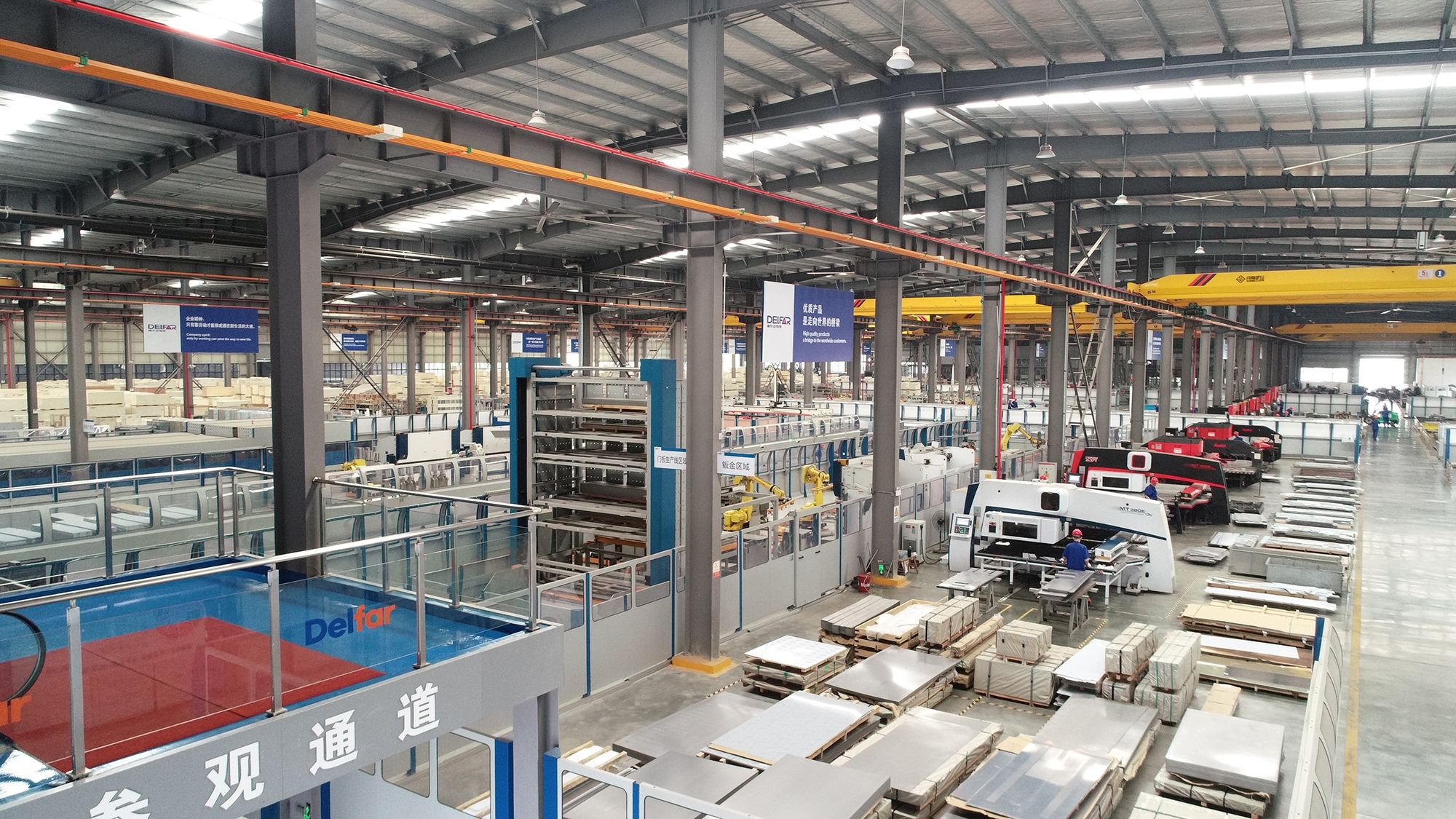
Manufacturing and pre-shipment testing environment for customized elevator production.
FAQ
How do the DP/DPN, DH, DF/DFN and DPO families differ in capacity, speed and travel?
DP/DPN passenger elevators cover 400–3000 kg, 1.0–6.0 m/s, 2–60 stops and up to 100 m of travel, with machine-room-less or small machine room options. DH home elevators cover 320–630 kg, 0.3–0.5 m/s, 2–6 stops and up to 20 m. DF/DFN freight elevators cover 2000–8000 kg, 0.25–1.0 m/s, 2–10 stops and up to 50 m. DPO observation elevators cover 630–1600 kg, 1.0–2.5 m/s, 2–30 stops and up to 100 m.
Which family fits a residential project compared with a commercial building?
Private villas and duplexes within 6 stops and 20 m of travel are served by the DH home elevator platform. Multi-unit residential, office, hotel, hospital and public buildings requiring higher capacity, higher speed or more than 20 m of travel are served by the DP/DPN passenger platform, which also offers the machine-room-less configuration often needed in retrofit work. Freight movement uses DF/DFN, and visible atriums or scenic shafts use DPO.
What cabin and door materials can be specified?
For the DP/DPN and DH families, car finishes and car and landing doors can be specified in stainless steel, glass, painted steel, wood-finish and customized options; floors in PVC or marble; car operating panels in stainless steel, glass or acrylic plexiglass; and landing operating panels in stainless steel or glass. DP/DPN handrails are available in stainless steel, solid wood or acrylic. The DH shaft can be built in aluminium or steel. Ceiling and lighting treatment are agreed as part of the car interior package at design freeze.
What purchasing terms and acceptance criteria apply?
The published purchasing frame specifies a minimum order quantity of 1 unit, delivery terms of FOB, CIF, EXW or CFR, payment terms of T/T or L/C, and pre-shipment test as the acceptance criterion. Buyers comparing quotations should confirm which Incoterm is quoted, what the pre-shipment test covers, and which documentation accompanies it.
What should a buyer verify about long-term support before signing?
Because maintenance services account for approximately 55% of global elevator market revenue, service structure is a material part of total cost. Delfar Elevator Co., Ltd. provides full-life-cycle services covering pre-sales consultation, technical design, installation guidance, commissioning, maintenance support and after-sales service, and works with distributors, contractors, developers and project partners in international markets. Buyers should confirm local spare-parts availability, who performs commissioning and periodic inspection, and how technical changes to a delivered unit are documented.
What are the main limits of each family?
DH is limited to 20 m of travel, 6 stops and 0.5 m/s. DF/DFN is limited to 10 stops and 50 m of travel. DPO reaches 100 m of travel but is limited to 2.5 m/s. DP/DPN is the widest platform but still requires requested capacity and speed to be justified by traffic analysis. All families assume ventilated installation within −5°C to +40°C, up to 90% RH non-condensing and altitudes up to 1,000 m, and require special provisions for corrosive, dusty or explosive atmospheres.
¿Tiene preguntas o necesita más detalles?
Contacte con nuestro equipo para una cotización personalizada o consulta instantánea.
Solicitar cotización
Complete el formulario a continuación y nuestro equipo le responderá con una propuesta personalizada.
Chat directo de WhatsApp
¿Prefiere chatear en tiempo real? Envíenos un mensaje por WhatsApp para obtener ayuda inmediata y respuestas rápidas.
- Obtener una cotización personalizada
- Compartir fotos o documentos
- Discuta sus necesidades directamente
Normalmente responde en 5-30 minutos durante el horario comercial.