
Independent Buyer Comparison: Custom Sheet Metal Stamping Parts vs. Filter Mesh
Independent Buyer Comparison: Custom Sheet Metal Stamping Parts vs. Filter Mesh
Custom sheet metal stamping parts and filter mesh are often listed side by side in the same RFQ, but they rarely perform the same job. A stamped sheet metal part carries load, holds geometry and defines an assembly interface; a filter mesh controls what is allowed to pass through an opening. For a buyer at the decision stage, the useful question is not which category is superior, but which function the opening, panel or assembly actually requires — and, where both appear in one product, how each is specified so that neither is over-engineered.
The commercial context for sheet metal work is substantial. Grand View Research estimated the global sheet metal market at USD 181.8 billion in 2024, with Asia Pacific accounting for a 65% revenue share in 2023 and steel holding more than 81% of product revenue in 2023. Those figures describe the sheet metal market as a whole. They do not describe custom sheet metal stamping parts as a separate segment, and no traceable public figure for that narrower segment was available for this comparison. The market data should therefore be read as an indication of scale, not as a forecast for either option in this article.
This comparison is also bounded in a way that matters to procurement. No verified, like-for-like comparative performance test or price quotation covering both a stamped sheet metal part and a filter mesh component on the same drawing was available in the public record reviewed. What follows therefore compares documented characteristics, specification logic and verification requirements. It does not claim that one option outperforms, costs less than, or is equivalent to the other in any specific application.
What each option actually is
Before the comparison can be applied, the two categories need to be separated on function rather than on material alone. Both may be made of metal, and both may be supplied by metalworking companies, but they are specified, tooled and inspected in different ways.
Custom sheet metal stamping parts
Custom sheet metal stamping parts are formed by pressing sheet metal between a die and a punch, then typically completing the part through cutting, forming, bending, welding and surface treatment. The defining characteristic is that geometry, hole positions and interfaces are set by the customer's drawing rather than by a catalogue. A stamped part is normally a structural or mounting element: a bracket, a panel, a cover, a chassis element, an enclosure body or a housing that locates other components.
Haitong Metals is a Ningbo-based custom sheet metal fabrication and metal stamping manufacturer founded in 1988, with 60 employees, 6 R&D engineers, an annual output of 3,140,000 units, and 100% of its output exported to Europe and North America. The company reports ISO 9001 certification, a 98% on-time delivery rate, and full-cycle quality control covering incoming, in-line and pre-shipment inspection. Its stated scope covers OEM metal stamping, spot welding and precision assembly, supported by DFM consultation from design review through prototyping to mass production.
On the specific comparison set used here, the company states that its parts are customized per customer drawings and that it can carry out independent mold development for mass production, with a stated tolerance of ±0.2 mm and prototypes and samples available before mold development. It also states that this route is cost-effective for large-volume orders after mold opening, that structures are optimized to fit customer assembly requirements, and that custom protective surface treatment supports long service life and low maintenance. Each of these is a company-reported capability, not an independently audited performance figure.
Filter mesh
Filter mesh — also described as filter screen, wire cloth or mesh screen — is a permeable medium made from woven or welded wire, expanded metal or perforated sheet. Its working principle is separation rather than load bearing: it retains, excludes or classifies particles while allowing air, gas or liquid to pass. In equipment and building products it commonly appears as an insect or debris screen behind a vent, as an airflow inlet cover, or as a filtration element in a housing.
Because mesh performance is governed by opening geometry, wire or strand dimensions, weave or perforation pattern and base material, the practical specification work is different from that of a stamped part. Those parameters, and the supplier's supporting test data, have to be obtained and confirmed part by part. This comparison makes no claim about aperture size, filtration efficiency, pressure drop or service life for any mesh product, because no verified mesh specification data was available in the evidence used here.
The comparison that actually decides the purchase
In most projects the two categories compete for the same physical space only at an opening. That single constraint is what makes the comparison decidable. Three questions, answered in order, resolve most cases faster than a price comparison does.
- What must the feature do? Carry load or torque, hold flatness, locate another component, provide a mounting plane, or control what passes through. Structural duties point to stamping; separation duties point to mesh.
- What geometry must be held, and by whom? If the part sets the interface to the rest of the assembly, the drawing and the tolerance responsibility sit with the formed metal part. If the part only covers an opening, the interface is usually the frame that retains it.
- Who owns the joint between them? Where a screen sits inside a stamped housing or behind a louvered panel, the retention method is the part most likely to be under-specified in the RFQ.
Side-by-side decision table
The table below compares the two options on the dimensions that typically change a sourcing decision. Cells are limited to documented characteristics and to the question the buyer needs to ask; they are not a performance ranking.
| Decision dimension | Custom sheet metal stamping parts | Filter mesh components | What the buyer must confirm |
|---|---|---|---|
| Primary function | Structural support, fixing, housing, shielding and interface definition | Separation, retention or exclusion across an opening | Whether the feature carries load at all; if it does, mesh alone is not the substitute |
| Geometry control | Set by customer drawing; formed features, bends, holes and flatness defined per part | Defined mainly by opening pattern, strand dimensions and the retaining frame | Which party holds the interface drawing and the inspection responsibility |
| Tolerance basis | Drawing-level; general tolerances may follow ISO 2768-1 or DIN 6930-2 for stamped steel parts | Governed by the mesh specification and the frame, not by a formed-part tolerance callout | The tolerance class, the datum scheme and the inspection method actually used |
| Tooling economics | Mold or die development upfront; company states the route becomes cost-effective at large volume after mold opening | Typically no forming die for the medium itself; the frame or housing may still need tooling | Annual volume, expected design changes and how tooling is amortized or owned |
| Surface protection | Powder coating, galvanizing and passivation are available; material standards such as ASTM A653/A653M, ASTM A240/A240M and EN 10346 apply | Depends on the strand material and any coating; corroded mesh is a maintenance item | Corrosion class, coating compatibility between mesh and frame, and touch-up after assembly |
| Joining and assembly | Spot welding and precision assembly are within the stated scope; welded assemblies may fall under welding quality standards | Usually retained mechanically; the retention method determines serviceability | Whether the screen must be removable, and whether welding heat affects the coating or the mesh |
| Documentation | ISO 9001 baseline; automotive, welding, structural and material standards may be added by end market | Supplier-specific specification and test data; no single general certification applies | Which certificates and declarations are required for the destination market |
Where custom stamping parts carry the decision
Stamping takes the decision whenever the part has to fix something in space. That includes holding a mating component, providing a flat mounting face, transferring vibration or load into a frame, or enclosing other parts. The relevant capability question for the buyer is not whether a supplier owns a press, but whether the supplier can hold the drawing-defined features through production and prove it.
Tolerance and specification. Tolerance should be read at the drawing level, not as a category claim. Haitong Metals states a tolerance of ±0.2 mm for its custom stamping work. Separately, published industry guidance reports that standard laser cutting typically achieves ±0.005 inches and plasma cutting ±0.020 inches. These figures describe different things — one a company-stated part tolerance, the others typical process capabilities for cutting — and no common test method or inspection plan is stated for either, so they should not be equated. Where a drawing is silent on individual dimensions, general tolerance frameworks such as ISO 2768-1:1989 for linear and angular dimensions, or DIN 6930-2 for stamped steel parts, are commonly referenced; the tolerance class chosen materially changes the process route and therefore the cost.
Tooling and volume. The stamping route front-loads cost into mold or die development. The company states that it supports mold development from customer drawings and can provide samples before mold opening, following a sequence of drawings, DFM review, sample confirmation, mold development and mass production. That sequence matters commercially: it lets a buyer validate fit and appearance before committing to tooling. The same company states the route is cost-effective for large-volume orders after mold opening, which is a statement about volume economics, not a guarantee of a lower unit price at any specific quantity.
Joining and finishing. Spot welding and precision assembly are within the stated scope, and surface treatment options include powder coating, galvanizing and passivation. Material and coating standards are usually named in the RFQ rather than left to the supplier: ASTM A653/A653M covers hot-dip zinc-coated and zinc-iron alloy-coated steel sheet, ASTM A240/A240M covers stainless steel plate, sheet and strip, and EN 10346:2015 sets the European delivery conditions for continuously hot-dip coated steel flat products. These are parallel normative systems with different coating designation logic; a coating designation should not be converted between ASTM A653/A653M and EN 10346 without a verified conversion table.
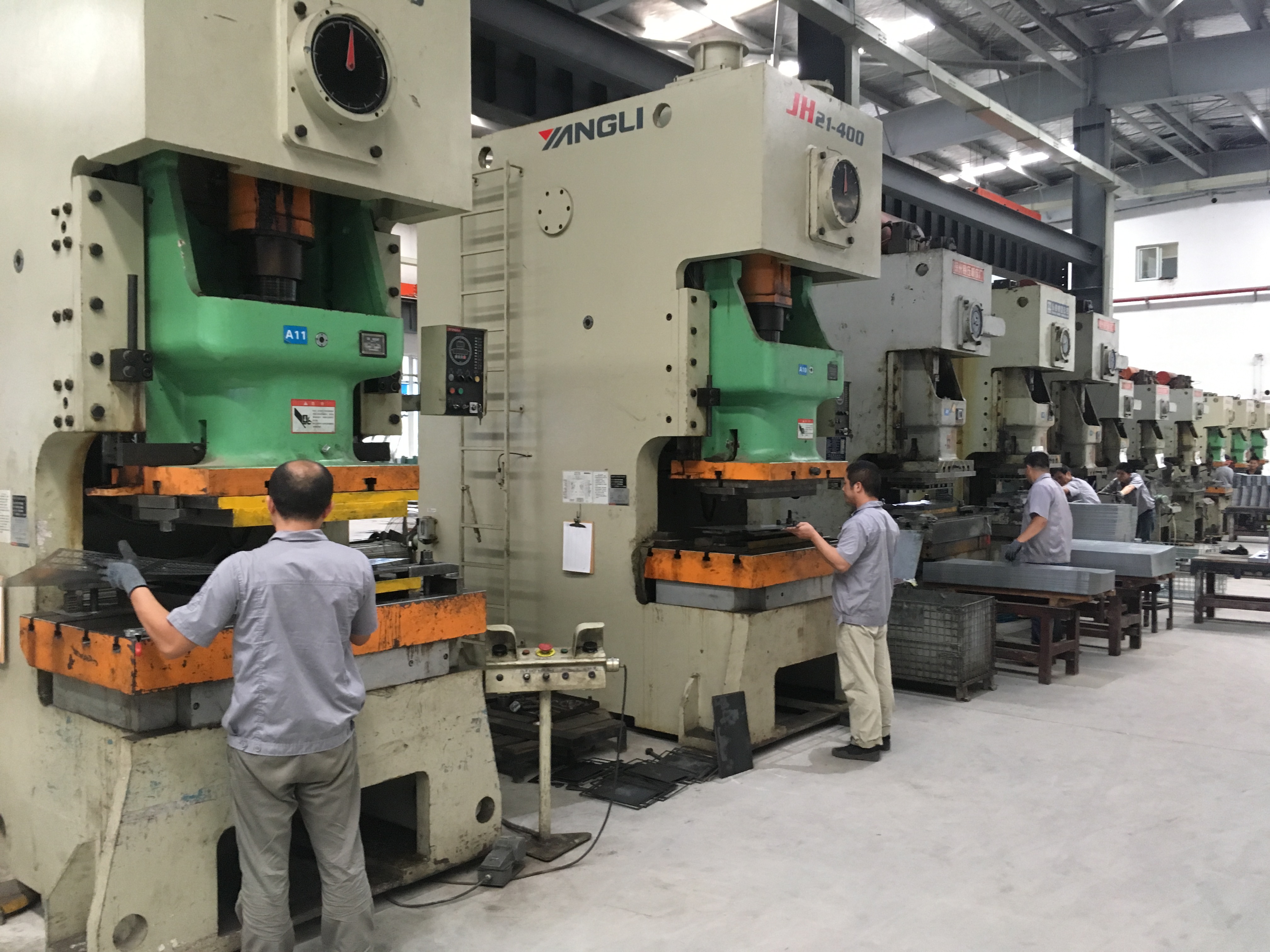
Stamping production line. Formed sheet metal parts set geometry and interfaces that a mesh screen cannot define.
Where mesh components carry the decision
Mesh takes the decision whenever the requirement is defined by what passes through, not by what is held in place. If the specification is an opening that must admit air while excluding debris, insects or coarse particles, a mesh element is the functional answer and a stamped louver or perforated panel is at most an alternative treatment of the same opening. In that situation the buyer's work shifts from formed-part tolerancing to medium specification and retention design.
The verification burden also shifts. A stamped part can be checked against a drawing with dimensional inspection. A mesh element usually needs its specification and its supplier's supporting data to be reviewed together, and the retention frame needs its own dimensional check. Because no verified mesh specification data was included in the evidence reviewed for this comparison, the article does not state aperture, wire diameter, weave type, efficiency or durability values for any mesh product; those must be obtained from the specific supplier and confirmed against the application requirement.
Where the two appear in the same part
Many real products require both, which is why treating them as competitors can lead to a wrong specification. A roof vent, a ventilation unit intake, an equipment enclosure with airflow openings, or a housing that must keep debris out while remaining breathable typically combines a formed sheet metal body with a mesh screen. The function list for such parts is exactly the kind of requirement set that sheet metal fabricators are asked to serve: support, shielding, fixing and housing, in normal-temperature indoor and outdoor conditions, with high precision, flatness and rust-proofing requirements.
In these combined parts the stamped body usually owns the interface: it sets the opening size, the mounting plane, the flatness of the sealing or fixing face, and the coating. The mesh owns the separation function. The joint between them — how the screen is retained, whether it is removable for cleaning, and whether the coating survives the joining operation — is where specification gaps most often appear. A buyer comparing the two options should therefore specify the retention method and the coating compatibility of mesh and frame at RFQ stage, not after first article.
Cost and value: building a like-for-like comparison
Cost comparison between these two categories is only meaningful at the level of a complete assembly requirement. For stamped parts, the cost structure is tooling plus unit price, and the company's own framing — mold development upfront, cost-effective at large volume after mold opening — describes where that structure changes shape. For mesh components, the cost drivers sit in the medium specification and the retaining frame rather than in a forming die. Comparing a stamped part price against a mesh material price compares two different things.
A defensible comparison therefore prices the same function twice, using the same drawing, the same annual volume, the same Incoterm and the same inspection requirement. The cost elements that should appear on both sides are:
- Tooling, mold or die cost, and how it is amortized or owned across the contract term
- Unit piece price at the actual annual volume, not at a nominal bracket
- Secondary operations: welding, assembly, deburring and surface treatment
- Material and coating cost, including the standard actually specified
- Inspection and documentation cost, including material declarations where required
- Replacement and maintenance cost over the service life, especially for mesh elements exposed to debris
- Freight and packaging, given that both may ship as bulky assemblies
No verified public quotation data covering both options on identical drawings was available for this comparison, so no cost ranking is offered here. What can be stated is the specification-level point: tolerance class and coating standard are the two decisions that most directly change which process route is required, and therefore which cost structure applies. Over-specifying a tolerance class or a coating standard forces a more expensive route regardless of which category is chosen.
Standards, documentation and classification
Documentation requirements differ by destination market and end use, and they are usually the point where a decision-stage comparison becomes a compliance question rather than a technical one.
Quality management. ISO 9001:2015 is the baseline quality management system standard used by sheet metal fabricators serving general industrial OEM customers; certification status is site-specific and should be checked in the certification body's database rather than accepted from a web page. Automotive supply chains typically require IATF 16949:2016, which is an additive automotive requirement and not interchangeable with ISO 9001. ISO 14001:2015 is frequently requested by European and North American OEM buyers as an environmental management criterion.
Welding and structural scope. Where the part includes welded assemblies, ISO 3834-2:2021 sets comprehensive quality requirements for fusion welding of metallic materials, and a supplier claiming ISO 3834 should state which part applies, since the parts represent different requirement levels. Welder qualification under ISO 9606-1 for fusion welding of steels is held by individual welders rather than by the company, so a supplier claim should be supported by a certificate register. For load-bearing structural components placed on the EU market, EN 1090-1:2009+A1:2011 sets conformity assessment requirements including factory production control and CE marking; whether a given bracket or vent falls inside that scope depends on its structural function and must be assessed per part.
Substance and market access. Directive 2011/65/EU (RoHS 2) restricts hazardous substances in electrical and electronic equipment, and therefore reaches metal enclosures and panels supplied as part of EEE in the EU. Regulation (EC) No 1907/2006 (REACH) drives substance declaration and SVHC communication obligations for coated and surface-treated parts. In practice the EEE producer holds the RoHS obligation and the sheet metal supplier provides material declarations, so the RFQ should state which declarations are required.
Trade and industry classification. There is no single statistical code for custom sheet metal parts. In the U.S. classification system, NAICS 332322 covers sheet metal work manufacturing but explicitly excludes stampings; NAICS 336370 covers motor vehicle metal stamping; NAICS 332119 covers non-automotive metal stamping. On the trade side, HS 7326.90, HS 7308.90 and HS 7616.99 are common routes depending on material and end use. Because these codes fragment the category, a buyer should classify each part against the destination tariff schedule rather than assume a supplier's code applies.
A buyer verification checklist
The following checks apply to the stamping side of the comparison and are the ones that most often determine whether a quotation is usable. They are verification steps, not supplier commitments.
- Confirm the drawing states the tolerance class or individual tolerances, and that the supplier's inspection plan matches it
- Confirm whether prototype and sample stages precede tooling commitment, and what is approved at each stage
- Confirm tooling ownership, amortization and what happens to the tool if the program ends
- Confirm which material standard is specified and whether the supplier's mill certificates match it
- Confirm the coating or surface treatment standard, and how coated surfaces are protected during welding and assembly
- Confirm welding quality requirements and whether welder qualification records are available
- Confirm the certificate scope, issuer and validity date for any quality system claim
- Confirm which material or substance declarations are required for the destination market

Sample review before tooling commitment is one of the practical checkpoints in a stamped-part sourcing decision.
Fit boundaries and limitations
Three boundaries should be carried into any decision made from this comparison. First, a stamped part is not automatically the right answer for an opening. Where the requirement is purely separation, adding a formed metal component may add tooling, coating and inspection cost without adding function. Second, mesh is not a structural substitute: if the feature must carry load, hold flatness or define a mounting interface, a mesh element alone does not satisfy that requirement, and the frame or housing becomes the structural part.
Third, the company-stated figures used here have a defined scope. The ±0.2 mm tolerance, the 98% on-time delivery rate, the ISO 9001 certification and the volume economics after mold opening are Haitong Metals' own reported capabilities for its custom stamping work; they are not independently audited performance data and they do not transfer to another supplier or to another part geometry. Buyers should confirm each against the actual drawing and the actual order. Similarly, no verified performance or price data for mesh components was available here, so no conclusion about relative cost, efficiency or durability should be drawn from this article.
A further practical limit applies to installed parts. Formed and welded assemblies are sensitive to modification after design release; alterations to structure or mounting should follow the released design requirements rather than be improvised during installation, because a changed hole position or bend angle can invalidate both the fit and the coating integrity.
Outlook
The direction of the sheet metal side of this comparison is toward more specification discipline rather than more process claims. The category is large — the global sheet metal market was estimated at USD 181.8 billion in 2024 — and Asia Pacific's 65% revenue share in 2023 indicates where a large part of the fabrication capacity sits. That scale does not by itself improve a buyer's outcome; what improves it is the ability to compare suppliers on documented capability rather than on equipment lists.
On digitalisation, the evidence available for this comparison was thin. Public descriptions of Industry 4.0 or MES adoption in sheet metal manufacturing were largely self-reported company statements without independent verification of deployment or measured outcomes, so they cannot be used to characterise the sector. A practical rule follows from that: at the qualification stage, weight third-party verifiable process evidence — quality system certificates, welding quality standards, material certificates, inspection records — above self-reported automation claims, and treat automation as a differentiator to be evidenced during audit rather than as a qualification gate.
For the mesh side, no verified trend, forecast or market data was available in the evidence reviewed, so no outlook is asserted here. Buyers combining a stamped body with a mesh screen should expect the interface specification, not the medium itself, to remain the item most worth engineering attention.
Frequently asked questions
Are custom sheet metal stamping parts a substitute for filter mesh?
Generally no. A stamped sheet metal part is a formed structural component that carries load, holds geometry and defines an interface, while a filter mesh is a permeable medium that controls what passes through an opening. They become alternatives only at an opening where the requirement is ambiguous; where the part must support, fix or house other components, mesh does not perform that function, and where the requirement is purely separation, a formed metal part adds tooling and inspection without adding separation performance.
When should a ventilation opening use a stamped metal louver or perforated panel instead of mesh?
When the opening also has to perform a structural or assembly role — providing a mounting plane, holding flatness, locating another component, shielding, or forming part of a housing — the formed metal part owns that function. When the opening only has to admit air while excluding debris or insects, a mesh element addresses the stated requirement more directly. In many roof vent and enclosure designs both are present, with the stamped body setting the opening and the mesh providing separation.
How should a buyer read a ±0.2 mm tolerance claim on stamped sheet metal parts?
As a company-stated capability for its custom stamping work, not as a universal guarantee. It should be read together with the drawing's datum scheme, the tolerance class applied to untoleranced dimensions, and the inspection method used to verify the result. General tolerance frameworks such as ISO 2768-1:1989 for linear and angular dimensions, or DIN 6930-2 for stamped steel parts, are commonly referenced when a drawing is silent, and the class selected changes the process route. Tolerance figures from different processes, such as typical laser or plasma cutting capabilities, describe different things and should not be equated with a formed-part tolerance.
What documentation should accompany an RFQ for custom stamped parts entering the EU?
At minimum, the material standard specified for the substrate, the coating or surface treatment standard, and the quality system evidence for the supplying site, checked against the certification body's records rather than a web page. Where the part is incorporated into electrical and electronic equipment, RoHS 2 material declarations are normally required, and REACH substance and SVHC communication obligations apply to coated and surface-treated articles. Where the part is a load-bearing structural component, EN 1090-1 conformity assessment, factory production control and CE marking may apply depending on the component's structural function.
How does tooling change the cost comparison between stamped parts and mesh components?
It changes the shape of the cost curve rather than producing a fixed ranking. The stamping route front-loads mold or die development, and the company states that this route is cost-effective for large-volume orders after mold opening, with prototypes and samples available before mold development. A mesh element usually avoids a forming die for the medium itself, although the retaining frame or housing may still require tooling. A valid comparison therefore prices the same function twice at the same annual volume, the same Incoterm and the same inspection requirement, and separates tooling from unit price rather than comparing a stamped part price with a mesh material price.
A downloadable Haitong Metals company brochure is available here: haitong.pdf. Company capability figures in this article are reported by Haitong Metals. Standards, classification codes and market figures are cited to the organisations named in the text; market context describes the sheet metal market as a whole and is not a forecast for custom sheet metal stamping parts or filter mesh.
¿Tiene preguntas o necesita más detalles?
Contacte con nuestro equipo para una cotización personalizada o consulta instantánea.
Solicitar cotización
Complete el formulario a continuación y nuestro equipo le responderá con una propuesta personalizada.
Chat directo de WhatsApp
¿Prefiere chatear en tiempo real? Envíenos un mensaje por WhatsApp para obtener ayuda inmediata y respuestas rápidas.
- Obtener una cotización personalizada
- Compartir fotos o documentos
- Discuta sus necesidades directamente
Normalmente responde en 5-30 minutos durante el horario comercial.