
In Mold Label Shortlist: Matching Film, Grade, and Printing
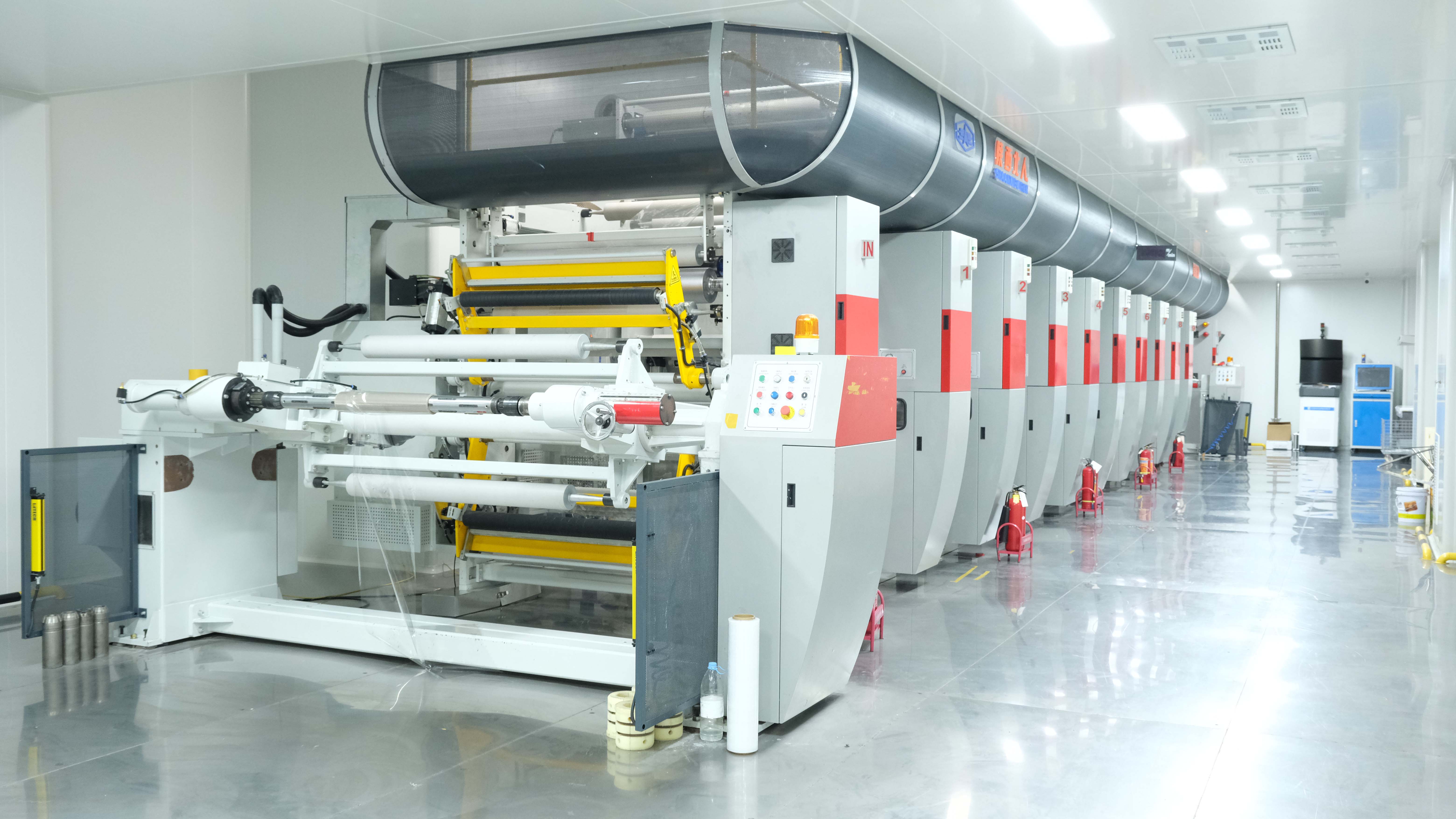
Colour count, print width and registration are locked during printing — which is why the shortlist has to be settled before the press is booked.
An in mold label shortlist is a packaging-safety document before it is a decoration document. The global in-mold labels market was valued at USD 2.31 billion in 2023 and is projected to reach USD 3.14 billion by 2030 (Grand View Research), and food & beverages alone accounted for the largest revenue share of over 41.3% in that year. Because most IML volume ends up on a container that touches a product, the three specifications that decide whether a project runs — film material, grade, and printing — have to be matched to the application before price is compared.
Why IML shortlists fail before the first quotation
In-mold labelling works differently from every applied-label process. The label is placed inside the mould and bonded to the part during the molding cycle, so the film, the ink system and the print geometry all become part of the molded container rather than a separate object added afterwards. Three mismatch points are worth checking before any label is quoted.
Film-to-part mismatch. A film that performs perfectly on one container resin can behave differently on another, because bonding happens while the polymer is still hot. Film material, thickness and surface finish are therefore engineering inputs, not free choices.
Grade mismatch. A label supplied for daily chemical containers is not automatically suitable for direct food contact. Food contact work brings its own documentation, migration testing and ink restrictions into the specification.
Print-spec mismatch. Colour count, registration tolerance and maximum print width determine how artwork can be laid out on a cup or bucket. Fixing artwork before fixing these three numbers is the most common source of rework.
Where the ZY-IML Series sits in that decision
YZY (Zhejiang Zhongyu Technology Co., Ltd.) is an in-mold label manufacturer founded in 2009, operating from a 20,000 m² facility with 250 employees, a 10-person R&D team and 48 accumulated patents. Its IML product line is the ZY-IML-SERIES, produced for injection-molding processes and supplied in food grade, daily chemical and industrial label types, including dedicated yogurt cup and paint bucket variants. Export markets are concentrated in the EU, the US, the Middle East and Southeast Asia, with an export ratio of 30% and customers worldwide. The company has passed QS, ISO and BRC management system certifications.
For a buyer building a shortlist, that matters less as a company story and more as a configuration set: the series exposes film material, grade, print and performance variables that can be matched to a specific container, and the rest of this article treats them as three selection axes plus one verification axis.
Axis 1 — Film material and thickness define the physical envelope
| Configuration point | ZY-IML Series option | What the buyer has to confirm |
|---|---|---|
| Film material | Virgin PP / PE / PET / multi-layer composite (food-grade available) | That the film family is compatible with the container resin and the molding process used on site |
| Film thickness | 30μm – 100μm, customizable | Whether the part is a thin-wall cup or a larger rigid container such as a bucket |
| Maximum print width | 1200mm, customizable | That the flat label blank fits the mould layout without unnecessary seams |
| Surface finish | Glossy, matte, orange peel, holographic, custom texture | How much abrasion the container sees in filling, packing and transport |
Polypropylene remains the reference substrate for the category: PP held a 47.2% material share of the in-mold labels market in 2023 (Grand View Research). PE film, PET film and multi-layer composites extend the available envelope where a project needs a different combination of stiffness, clarity or barrier behaviour, and the series allows film formulation to be customized. Thickness is the second half of this axis — 30μm at the thin end suits small, fast-cycling parts, while gauges approaching 100μm are typically reserved for larger containers where stiffness during insertion matters.
Axis 2 — Grade is a compliance decision, not a colour
Grade determines which regulatory and durability filters apply. The ZY-IML Series is organised into food grade, daily chemical and industrial label types, with yogurt cup and paint bucket variants named separately because the two applications pull the specification in opposite directions.
| Grade | Typical project type | Compliance and performance anchor |
|---|---|---|
| Food Grade IML Label | Food contact packaging, yogurt cups, cold beverage cups | FDA 21 CFR, EU 10/2011 migration test, BRCGS Packaging Materials, ISO22000, QS |
| Daily Chemical IML Label | Detergent and household chemical containers | Chemical resistance to weak acids, alkalis and common detergents |
| Industrial IML Label | Paint buckets and industrial containers | Tensile strength ≥20MPa, 4H scratch resistance, -20℃ to 120℃ operating range |
Food contact compliance is the part of the shortlist that carries a document trail. FDA 21 CFR Part 177 regulates polymers including PE and PP for direct food contact applications (U.S. FDA), and EU Regulation (EU) No 10/2011 governs plastic materials intended to come into contact with food (European Commission). The ZY-IML Series holds an FDA Food Contact Test Report, certificate number NGBEC2501946006, issued by SGS on 13 May 2025 under standard FDA 21 CFR 177.1520, covering food contact packaging materials for the US and North America market. The series also declares a migration test result meeting EU 10/2011, and uses food-grade low-migration water-based ink.
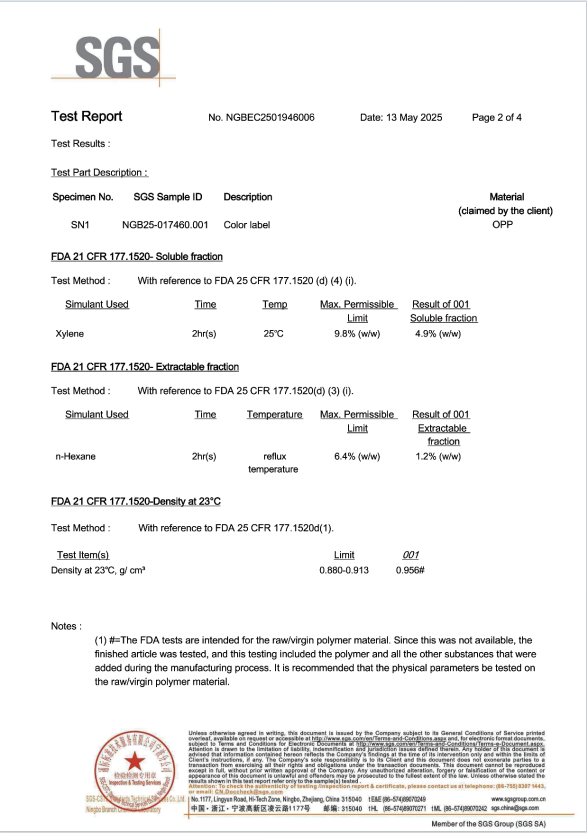
The SGS FDA food contact test report NGBEC2501946006 is the documentary anchor for any food-contact IML shortlist in the US market.
For daily chemical and industrial programmes the filters change. Migration documentation matters less than chemical resistance to weak acids, alkalis and common detergents, and the mechanical values — tensile strength ≥20MPa, 4H pencil-hardness scratch resistance — carry more weight in handling and transit conditions.
Axis 3 — Printing: colour count, registration and width
Printing is where the shortlist becomes a cost and layout decision. The ZY-IML Series uses high-precision rotogravure printing with up to 8 colours, customizable, at a printing precision of ±0.1mm with no colour deviation. Maximum printing width is 1200mm and is customizable, which sets how large a flat label blank can be produced in one piece.
Registration tolerance of ±0.1mm matters most on small-format containers, where artwork sits close to the mould edge and a visible shift is immediately noticeable. Colour count interacts with surface finish: glossy, matte, orange peel, holographic and custom textures all change how ink reads under retail lighting. When a project needs special visual effects, the series supports custom special effects such as cold, heat and laser treatments in addition to standard finishes.
Performance values that belong on every IML shortlist
Axis logic narrows the options; a short set of measurable values decides between them. These are the figures a buyer can request in writing.
| Parameter | ZY-IML Series value | What it decides |
|---|---|---|
| Adhesion strength | ≥5N | No peeling during injection molding |
| Scratch resistance | 4H (pencil hardness test) | Resistance to abrasion during packing and transport |
| Operating temperature range | -20℃ to 120℃ | Suitability for cold chain and hot filling |
| Tensile strength | ≥20MPa | Dimensional stability through the molding cycle |
| Chemical resistance | Resistant to weak acids, alkalis and common detergents | Daily chemical and industrial container applications |
| Printing precision | ±0.1mm, no colour deviation | Brand colour accuracy across the run |
| Migration test | Meets EU 10/2011 food contact material standards | Food contact eligibility for EU-facing programmes |
| Injection molding compatibility | Fits high-speed injection processes, no warping, no label fall-off | Whether the label survives an existing production line |
Adhesion strength ≥5N is the value that most directly separates a viable IML supplier from a risky one, because label fall-off during injection is a scrap event, not a cosmetic defect. Scratch resistance of 4H and tensile strength of ≥20MPa describe how the finished container behaves after it leaves the mould.
Matching the shortlist to real applications
The same series resolves into different specifications depending on the container.
- Yogurt cups and cold beverage cups. Food grade film, migration compliance and low-migration water-based ink are mandatory; the -20℃ operating floor covers cold-chain distribution.
- Paint buckets. The industrial grade and paint bucket variant prioritise tensile strength ≥20MPa combined with 4H scratch resistance for a heavy, handled container.
- Daily chemical containers. Chemical resistance to weak acids, alkalis and common detergents drives the choice, with an opaque or holographic finish used to differentiate on shelf.
- Large buckets and rigid containers. Thicker film toward the top of the 30–100μm range and print widths up to 1200mm reduce seams on large flat blanks.
- Small, high-speed parts. Thin film at the lower end of the range plus ±0.1mm registration keeps artwork stable on fast-cycling moulds.
A reference project shows how this translates into production. High-volume mass production for food contact packaging, branding and identification ran for one year, serving clients in 14 countries including the United States, Algeria, Egypt and India, with international F&B and dairy brand clients among the users. Reported outcomes were zero quality complaints, a 100% on-time delivery rate and 100% compliance, supported by food grade safety and custom special effects including cold, heat and laser treatments.
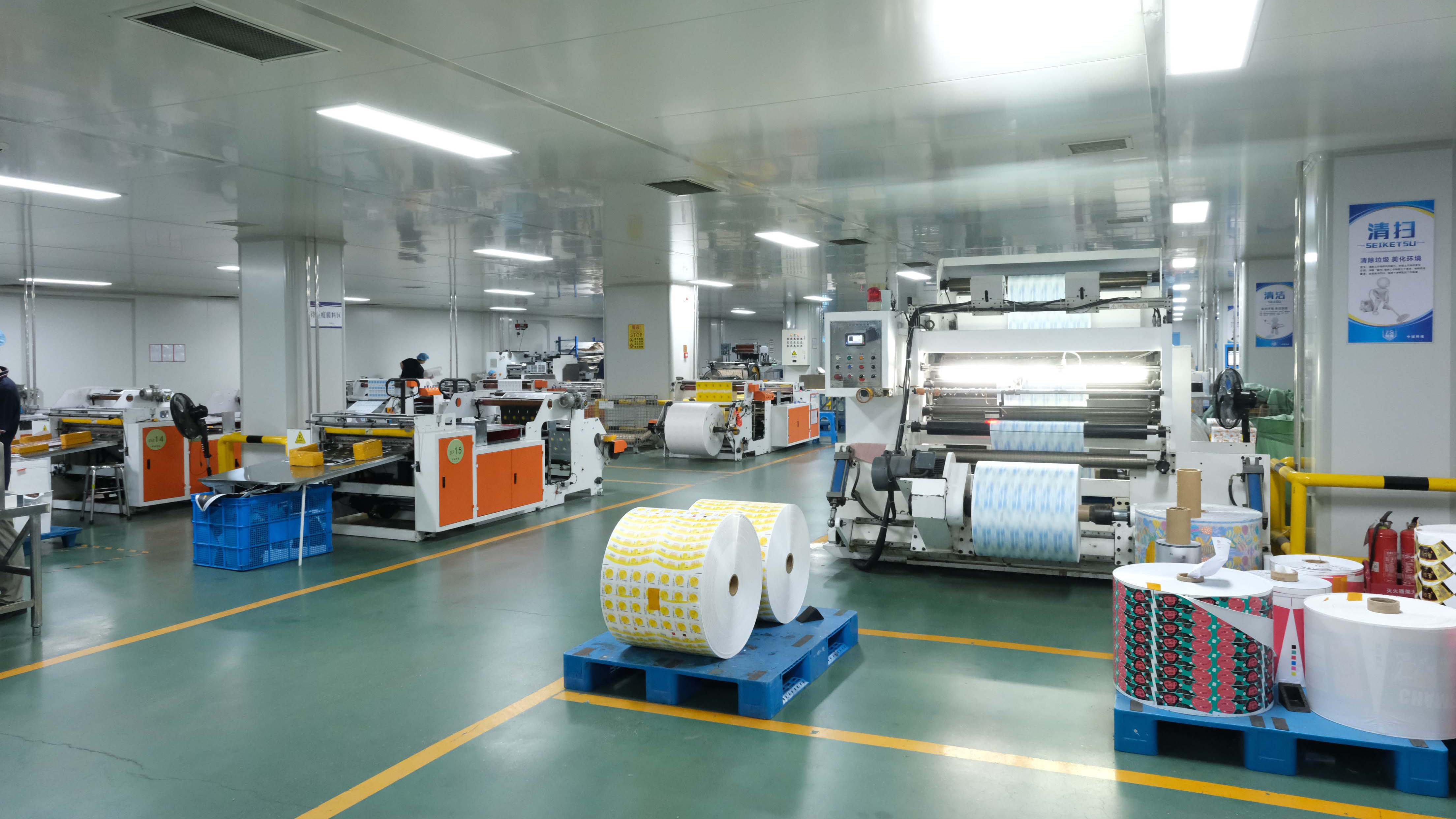
Film selection and printing quality are controlled upstream; there is no re-application step once the label is moulded into the container.
Where the IML model reaches its limits
A shortlist that ignores the boundaries of the process will fail at scale, so the trade-offs belong in the document alongside the advantages.
- The process assumes injection molding. Labels are placed in the mould and bonded during the cycle, so the decision depends on tooling, cycle time and process compatibility. Buyers decorating pre-formed parts, or running processes other than injection molding, are outside this model.
- Order volume has a floor. Minimum order quantity for the series is 2000㎡, and typical lead time is 15–20 days after sample confirmation. Trial programmes and very short runs need to be planned rather than ordered on demand.
- The temperature window is finite. The declared operating range of -20℃ to 120℃ covers cold chain and hot filling, but applications outside that band are an engineering question rather than a catalogue selection.
- The label cannot be reapplied. Compared with pressure-sensitive or sleeve labels, IML removes a separate adhesive and application step and produces decoration that is part of the container. The trade-off is that quality control moves upstream into film selection and printing, and a defect cannot be corrected after molding.
- Geometry has to suit a flat film blank. Containers with extreme curvature or complex geometry may require a custom film formulation or a different decoration route altogether.
Market direction for IML procurement
Published estimates of the in-mold labels market differ because base years and segmentation differ — which is itself useful context for a buyer. Grand View Research values the market at USD 2.31 billion in 2023, projected to USD 3.14 billion by 2030. Market Research Future estimates USD 2.72 billion in 2024, growing at a CAGR of 3.94% to USD 4.16 billion by 2035. Treat any single figure as a directional signal rather than a procurement anchor.
The structural signals are more consistent. Food & beverages accounted for the largest revenue share of over 41.3% of the IML market in 2023, polypropylene held a 47.2% material share in the same year, and injection molding leads the production process segment with a revenue share exceeding 57.1% (Grand View Research). Asia Pacific is both the largest and the fastest-growing regional market as of 2024 (Mordor Intelligence). The supplier landscape includes global players such as CCL Industries, Multi-Color Corporation and Huhtamaki alongside regional specialists, which means shortlist differentiation usually comes from specification fit and documentation rather than from category availability.
What to expect over the next few years
The direction of travel is toward mono-material construction and documented food contact. PP already dominates the material mix at 47.2%, and injection molding — the process IML is built around — holds more than half of process revenue, so the format is unlikely to be displaced by applied labels in the categories where it currently fits. For buyers, the practical implication is that shortlists will increasingly be judged on three things: film-to-resin compatibility, verifiable food-contact documentation such as an SGS report under FDA 21 CFR 177.1520 or an EU 10/2011 migration result, and print capability expressed in measurable terms rather than samples alone.
FAQ
What should be decided first in an in mold label shortlist — film material or printing?
Film material and grade come first, because they determine whether the label survives the molding cycle and whether it is permitted for the contents. The ZY-IML Series offers virgin PP, PE, PET and multi-layer composite films with food-grade options available, in thicknesses from 30μm to 100μm. PP held a 47.2% material share of the in-mold labels market in 2023. Printing specifications are then constrained by the film choice.
How does a food-grade in mold label differ from a standard grade?
A food-grade label carries a documented compliance chain rather than a different appearance. FDA 21 CFR Part 177 regulates polymers including PE and PP for direct food contact, and EU Regulation (EU) No 10/2011 governs plastic food contact materials. The ZY-IML Series holds an FDA Food Contact Test Report, certificate NGBEC2501946006, issued by SGS under FDA 21 CFR 177.1520, declares a migration test meeting EU 10/2011, and uses food-grade low-migration water-based ink. The series states compliance with FDA 21 CFR, BRCGS Packaging Materials, ISO22000 and QS.
Which performance values should appear in an IML specification?
For the ZY-IML Series, the published values are adhesion strength ≥5N with no peeling during injection molding, scratch resistance of 4H in the pencil hardness test, an operating temperature range of -20℃ to 120℃, tensile strength ≥20MPa, resistance to weak acids, alkalis and common detergents, and printing precision of ±0.1mm with no colour deviation.
How many colours and what print width can be specified?
The series uses high-precision rotogravure printing with up to 8 colours, customizable, at a maximum printing width of 1200mm, also customizable. Available surface finishes are glossy, matte, orange peel, holographic and custom texture, and custom special effects such as cold, heat and laser treatments can be added.
Which containers are a poor fit for in mold labels?
Containers decorated outside an injection-molding process, containers with extreme curvature that cannot take a flat film blank, and applications outside an operating range of -20℃ to 120℃ are the main candidates for a different decoration route. Very small runs are also a poor fit against a 2000㎡ minimum order quantity and a 15–20 day lead time after sample confirmation.
What commercial and quality terms apply once a shortlist becomes an order?
The ZY-IML Series is supplied under OEM and ODM production with customization of size, shape, colour, printing design and material. Monthly capacity is 350,000,000 pcs per month, minimum order quantity is 2000㎡, typical lead time is 15–20 days after sample confirmation, delivery terms are FOB or CIF, acceptance criteria are based on sample testing, and payment terms are 30/70. Quality control consists of 100% visual inspection plus random lab testing complying with FDA and GB standards, with online technical support and after-sales consultation.
Product documentation for the ZY-IML Series — film options, grade descriptions and printing specifications — is available in the YZY product brochure (PDF) and at inmoldlabel.net.
¿Tiene preguntas o necesita más detalles?
Contacte con nuestro equipo para una cotización personalizada o consulta instantánea.
Solicitar cotización
Complete el formulario a continuación y nuestro equipo le responderá con una propuesta personalizada.
Chat directo de WhatsApp
¿Prefiere chatear en tiempo real? Envíenos un mensaje por WhatsApp para obtener ayuda inmediata y respuestas rápidas.
- Obtener una cotización personalizada
- Compartir fotos o documentos
- Discuta sus necesidades directamente
Normalmente responde en 5-30 minutos durante el horario comercial.