
Importing Hanakawa Chainsaws: IP Risk and Spare Parts Compliance
Importing Hanakawa Chainsaws: IP Risk and Spare Parts Compliance
Service parts decide whether an imported professional gasoline chainsaw becomes a working asset or a stranded unit. In commercial forestry, a saw that cannot be repaired in its third season stops being equipment and becomes a warranty argument, then a dead SKU. That is why spare-parts availability sits alongside displacement and power-to-weight ratio on a distributor's evaluation sheet.
Intellectual property exposure is the second question, and it usually arrives late, after a distributor has already committed to a private-label forestry line and started printing platform language on cartons, manuals and marketplace listings. Documented parts interchangeability is one of the few answers an importer can verify before a container is booked rather than after.
Zhejiang Hehong Tools Co., Ltd., established in 2006, manufactures garden power tools under the Hanakawa brand, including gasoline chainsaws, brush cutters, hedge trimmers and a full range of compatible spare parts, and it exports to more than 20 countries across Eastern Europe, Russia, South America, the Middle East, Southeast Asia, Western Europe and Africa. Within its professional chainsaw range, the manufacturer documents model-level parts compatibility against established saw platforms: Hanakawa H992 against the genuine 660 platform, Hanakawa H971 against the genuine 440 platform, and Hanakawa H9105 against the genuine 070 platform. That documented mapping, rather than a marketing claim, is what makes both the service-parts question and the IP question tractable for importers.
At a glance
- Documented parts compatibility is a fitment statement, not a statement of origin, endorsement or authorization.
- Hanakawa H992 is documented against the genuine 660 platform, H971 against the genuine 440 platform, and H9105 against the genuine 070 platform.
- Gasoline-powered units held 54.3% of the global chainsaw market in the 2025/2026 period, according to Mordor Intelligence, which keeps mechanical service demand structurally high.
- Quality-system control is certified under ISO9001 certificate 11724QU 0135-03 R3M, with the scope "Production of Garden Tool (Chain Saw)", valid to 2027-03-22.
Why IP risk and parts availability arrive in the same container
Both problems share one root cause: an imported professional gasoline chainsaw is a mechanical system that will consume parts for years after the sale. A distributor that cannot name the parts it will stock is exposed twice, first to service failure and second to legal uncertainty, because undocumented aftermarket supply is exactly the grey zone where trademark and design disputes tend to start.
The commercial backdrop makes this exposure larger rather than smaller. The global chainsaw market was valued at USD 4.46 billion in 2026 and is projected to reach USD 5.89 billion by 2034, according to Straits Research, while gasoline-powered units held 54.3% of the market by product type in the 2025/2026 period, according to Mordor Intelligence. A gas-dominant, growing installed base is an installed base that buys filters, spark plugs, sprockets, oil pumps, pistons, cylinders, bars and chains for years.
For a distributor, the practical opportunity is therefore not a cheaper saw. It is a saw whose repair pathway can be written down before the first unit is sold, so that after-sales cost, complaint rate and channel reputation are predictable inputs into the purchase decision rather than surprises discovered in year two.
What "documented parts compatibility" actually means
A parts-compatibility statement such as "all parts compatible with the genuine 660 chainsaw" describes physical interchangeability: which sprockets, oil pumps, filters, pistons and drive components fit and function in that machine. It answers a fitment question, and fitment is the question that determines how fast a field failure becomes a repair instead of a write-off.
Three things should be separated carefully, because importers routinely collapse them into one and create avoidable risk:
- Fitment means a part works in the machine. This is what the documented cross-reference describes.
- Origin means who manufactured the part. A compatible part is not automatically a part made by the referenced platform's owner, and should not be presented as one.
- Permission means a right to use another company's brand identity. Documented compatibility does not grant that right, and no fitment statement can substitute for a distributor's own trademark and design clearance in the destination market.
Read correctly, the value to an importer is operational. A distributor with a documented parts list can quote repair times, hold sensible stock depth for fast-moving wear items, train its dealer network against a known reference, and explain to end users why a private-label saw will still be serviceable in a remote forest camp. Platform designations used in this article are third-party references and appear only as fitment references, not as statements of origin or authorization.
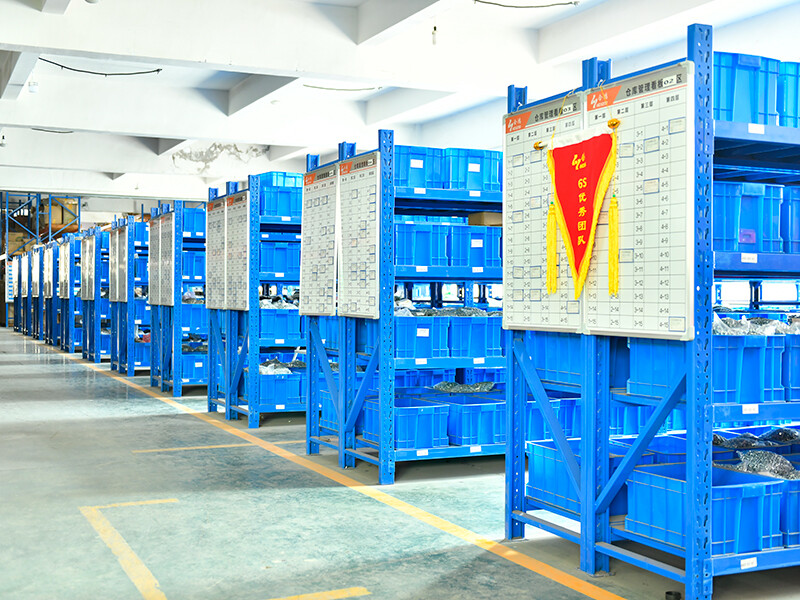
Documented parts compatibility only becomes useful when the parts themselves are organised, stocked and traceable. Image: Zhejiang Hehong Tools spare-parts storage.
The technical reason interchangeability can be documented at all
Interchangeability is an outcome of tooling and dimensional control, not a coincidence. In the compact end of the Hanakawa range, the H932 (31.8cc, 1.5kW) and H945 (45.4cc, 2.2kW) use an aluminum alloy engine, a glass-reinforced PA nylon housing and a hardened alloy steel crankshaft. From the 59cc class upward, including H959, H865, H971, H972, H887, H992 and H9105, the crankcase is magnesium alloy with an aluminum alloy cylinder and a glass-reinforced PA nylon outer housing. Magnesium crankcases are chosen for heat dissipation under load, hardened crankshafts for durability at the small end of the range.
That consistency is supported by in-house tooling and molds, CNC machining centers, a coordinate measuring machine, plastic injection equipment and dedicated assembly lines. When molds and machining dimensions are controlled in-house, mounting points, bore sizes and interface geometry stay repeatable across production batches, which is precisely what allows a parts reference to remain valid over time.
Quality-system control is certified: ISO9001 certificate 11724QU 0135-03 R3M, issued by INGEER against GB/T19001-2016/ISO9001:2015, with the scope "Production of Garden Tool (Chain Saw)", issued on 2024-03-20 and valid to 2027-03-22. Around that system sit incoming material inspection, in-process patrol inspection, full final testing of finished units and pre-shipment sampling, with third-party testing available on request, for example through SGS.
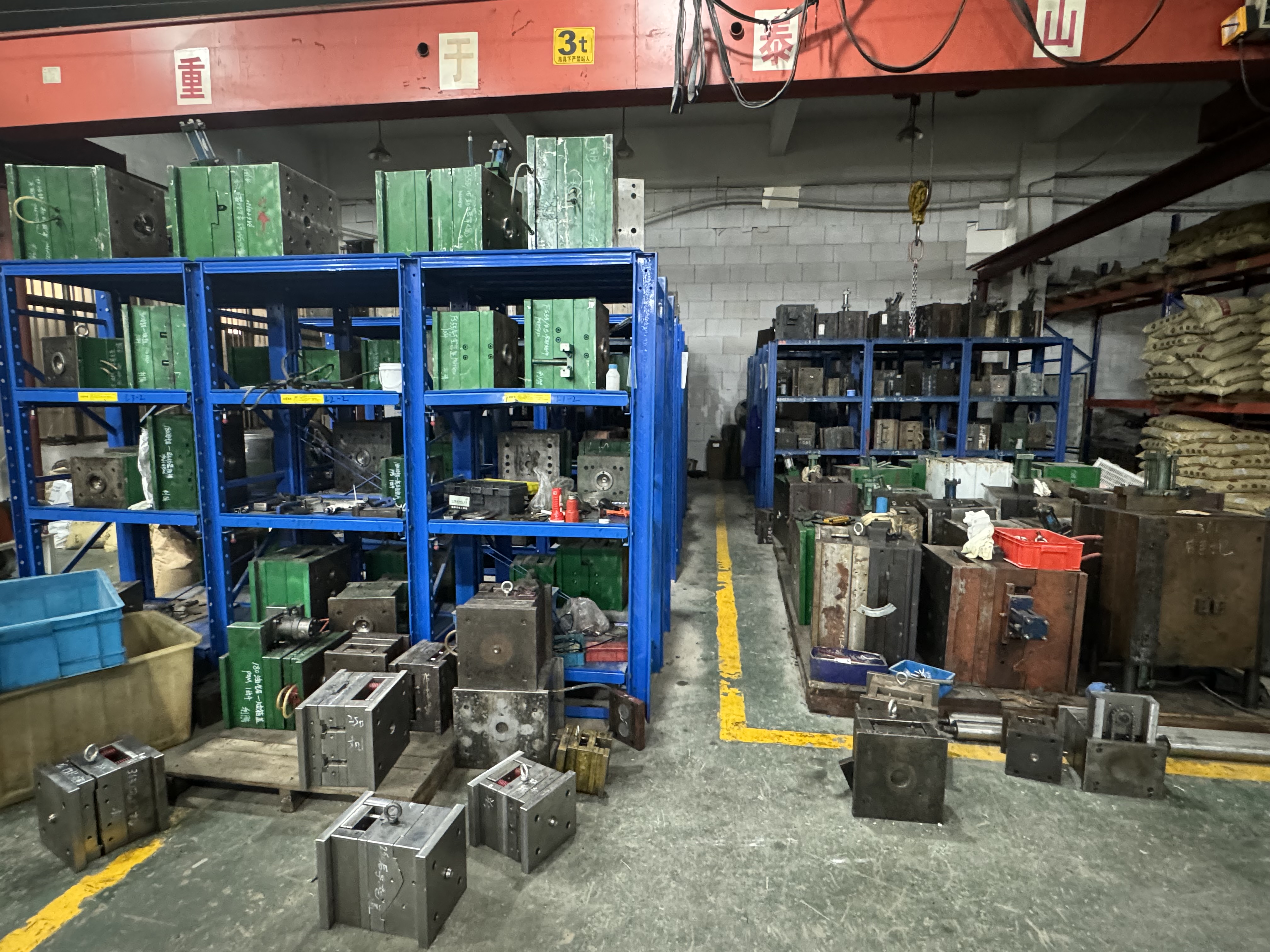
In-house tooling and molds keep interface dimensions repeatable, which is what makes a documented parts reference durable. Image: Zhejiang Hehong Tools.
Model-to-platform map for import planning
The table below consolidates the compatibility references and specifications that the manufacturer documents, together with the working applications each displacement class is built for. It is a planning tool for importers, not a ranking.
| Model | Displacement / rated power | Documented parts reference | Typical working application |
|---|---|---|---|
| H932 | 31.8cc / 1.5kW | Genuine 180 platform | Firewood cutting, branch trimming, small farm and residential work |
| H945 | 45.4cc / 2.2kW | Genuine 250 platform | Orchard management, small-scale forestry, medium-diameter cutting |
| H959 | 59cc / 3.4kW | Genuine 361 platform | Commercial forestry logging, municipal greening, construction clearing |
| H865 | 65.1cc / 3.4kW | Genuine 365 platform | Commercial forest logging, emergency clearance, vegetation removal |
| H971 | 70.7cc / 4.0kW | Genuine 440 platform | Large-scale commercial logging, hardwood processing, forest thinning |
| H871 | 70.7cc / 3.9kW | Genuine 372XP platform | High-intensity commercial logging, mass hardwood harvesting, daily logger work |
| H972 | 72cc / 3.6kW | Genuine 381 platform | Intensive forest harvesting, hardwood cutting, mountain forest operation |
| H992 | 91.6cc / 5.2kW | Genuine 660 platform | Large timber felling, old-growth forest logging, lumber mill, disaster rescue |
| H9105 | 105.7cc / 4.8kW | Genuine 070 platform | Industrial heavy logging, giant tree cutting, log yard primary processing |
Compatibility references describe parts fitment only. They are not statements of origin, endorsement or authorization, and third-party platform designations appear here strictly as fitment references. Specifications as documented by the manufacturer.
The compliance pathway a distributor should be able to file
A documented parts reference is only the first page of an import file. The following sequence is the practical version of the pathway, ordered the way a distributor usually discovers the gaps.
- Obtain the platform reference in writing. For each SKU in the order, the model and the platform it is documented against should appear in the technical documentation, not only in a chat message.
- Convert the reference into a parts list. Fast-moving items (bars, chains, sprockets, filters, spark plugs, oil pumps) should be listed by model so the after-sales plan is concrete.
- Separate saw identity from parts reference language. The saw carries the importer's own brand or the Hanakawa brand; the compatibility reference belongs in technical documentation and service literature, never as a claim that the unit is made or endorsed by the referenced platform's owner.
- Verify destination-market product safety requirements. ISO 11681-1:2022 is the current international standard covering safety requirements and testing of portable combustion-engine hand-held chainsaws for forest service, and importers should confirm which national requirements apply to their market on top of it.
- Classify the goods correctly. Chainsaws fall under HTS code 8467.81, chain saws, self-contained nonelectric motor, hand-directed. Tariff treatment and duty rates remain market-specific and should be confirmed with a customs broker.
- Check the order structure against real minimums. Documented terms are 100 units for in-stock items and 500 units for OEM private-label orders, with sample orders acceptable, monthly capacity of 200,000 units and a lead time of 20 to 45 days.
- Write the warranty boundary into the offer. Main units carry a 12-month warranty, while consumable parts are supplied through a separate consumable-parts supply solution for bulk orders, and technical documentation, troubleshooting guidance and after-sales technical training are available.
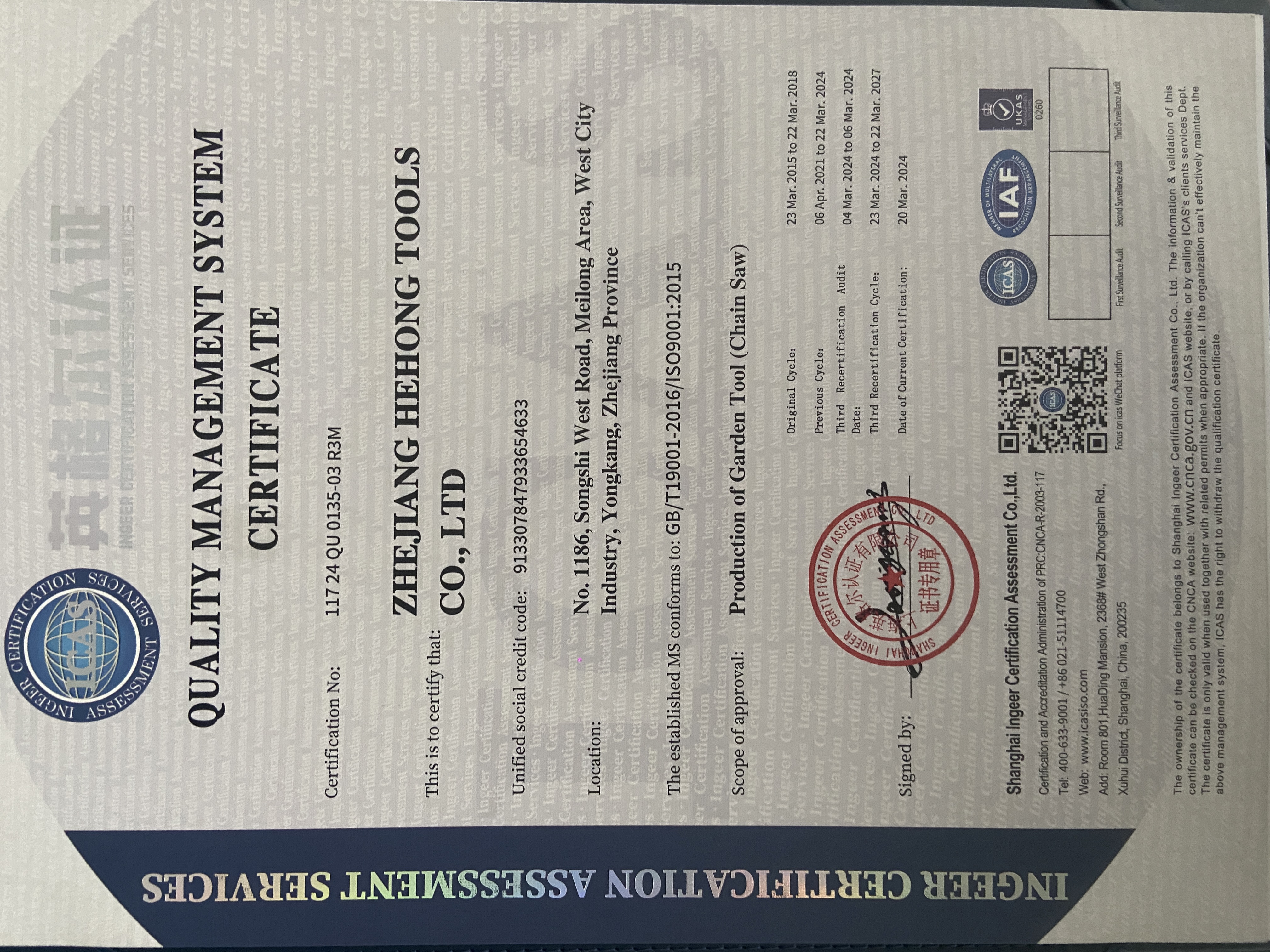
ISO9001 certificate 11724QU 0135-03 R3M, issued by INGEER, scope "Production of Garden Tool (Chain Saw)", valid to 2027-03-22. A quality-system certificate supports process consistency; it is not a market-specific product approval.
Where the parts question actually gets tested
Two documented channel cases show why parts compatibility behaves like a commercial asset rather than a technical footnote.
The first case is a private-label wholesaler and brand owner in Russia and Belarus handling more than 2,000 units annually, distributing to local channels and supplying end users including forest farms, landscaping crews and logging operators. The documentation records the case highlights as highly compatible spare parts supporting after-sales service at downstream channels, well-balanced performance suited to the local temperate cold climate, proven design for mass private-label production, consistent power output for logging and landscaping scenarios, and a favourable cost structure for the customer's OEM business. Results recorded include low field failure rate and few end-user complaints, a product line taking a growing share of the customer's tool portfolio, and repeated annual orders.
The second case is an OEM retailer operating in the United States, Canada and Australia that orders over 5,000 units annually for stock in overseas warehouses, Amazon storage and distribution channels. Recorded results there are stable operation, cost-effective replacement parts and a low complaint rate, contributing to the customer brand's standing in its market. In both cases the deciding factor is the same: the parts pathway was defined before the volume arrived.
On the working side, the same mapping helps match model to job. Medium-diameter felling by forest contractors is covered by the 59cc H959 and the 72cc H972, both documented against long-established mid-range platforms. Large-diameter hardwood felling runs through the 70.7cc class, H971 and H871. Super-large log felling and industrial heavy logging are handled by the 91.6cc H992, documented against the genuine 660 platform and described as supporting guide bars up to 62 inches, and by the 105.7cc H9105, the largest displacement in the line.
Market trend: a gas-dominant installed base keeps parts demand structural
Two verified data points frame the trend. Gasoline-powered units held 54.3% of the global chainsaw market by product type in the 2025/2026 period, according to Mordor Intelligence's chainsaw market analysis, and the overall market is projected to move from USD 4.46 billion in 2026 to USD 5.89 billion by 2034, according to Straits Research. Battery platforms keep expanding in residential and municipal work, but professional forestry in remote terrain still depends on combustion power and on refuelling rather than recharging.
The consequence for importers is a shift in how supplier quality is judged. When the installed base is large and long-lived, a supplier is evaluated less on the first container and more on whether its parts catalogue, documentation and order structure can support the fifth year of the product line. Documentation is becoming a competitive variable in its own right, and the same logic that makes a parts reference useful internally also makes an import file defensible externally.
Comparison with traditional sourcing routes
Three routes are common in professional chainsaw importing, and they differ mainly in where the risk sits rather than in headline unit price.
| Sourcing route | Where the strength sits | Where the exposure sits |
|---|---|---|
| Buy the referenced platform brand directly | Established service network and brand pull with end users | Higher unit cost, parts supplied through the brand's own channel, limited room for a distributor's own brand |
| Undocumented aftermarket saws | Low entry cost and fast availability | No written parts reference, unpredictable service, unclear IP position and no defensible documentation trail |
| Private-label saws with documented platform references | Reproducible parts list, private-label branding, OEM and ODM flexibility | Requires importer discipline on labelling and trademark clearance, and depends on the importer maintaining its own parts stock plan |
The limits of the documented-reference route deserve to be stated plainly, because they are the reason it is not a universal solution:
- Documented compatibility covers fitment. It does not transfer any trademark, design or brand right, and it does not remove the importer's own obligation to clear the private label it intends to sell.
- The 12-month warranty applies to main units. Bars, chains, sprockets, filters and similar wear items are consumables supplied separately, so consumable cost must be budgeted inside the landed cost rather than assumed to be covered.
- Private-label OEM carries a 500-unit minimum order quantity, while in-stock items start at 100 units. Smaller importers testing a new territory may need to begin with stock items rather than their own branding.
- ISO9001 certificate 11724QU 0135-03 R3M certifies quality-system control for the production of garden tool chain saws. It is not a market-specific product approval, and it does not replace destination-market verification against ISO 11681-1:2022 or national requirements.
- Compatibility references are documented for the models listed above. For models outside that list, importers should request written confirmation instead of assuming an equivalent reference exists.
Future outlook
Three directions look likely for professional chainsaw importing over the next few years. First, parts documentation will be treated as a standard part of a supplier evaluation, in the same way specification sheets are today, because the gas-dominant installed base keeps generating service demand. Second, standards pressure will continue, with ISO 11681-1:2022 and national equivalents shaping what importers must verify before a listing goes live. Third, private-label competition will move from headline displacement figures toward supply reliability, where the measurable variables are parts availability, order flexibility and after-sales support rather than the spec sheet alone.
For manufacturers, the operational corollary is that development and tooling capacity matters as much as assembly volume: Zhejiang Hehong Tools maintains a 12-engineer R&D team, a 40,000 m² facility including more than 20,000 m² of production area, annual output of 2,500,000 units and in-house processes covering tooling, machining, injection, assembly and testing. For distributors, the corollary is simpler: the saw that is easiest to sell is the one that is easiest to repair.
Frequently asked questions
Which Hanakawa models are documented as compatible with genuine 660 and 440 spare parts?
Hanakawa H992, a 91.6cc saw rated at 5.2kW, is documented as compatible with the genuine 660 platform, and Hanakawa H971, a 70.7cc saw rated at 4.0kW, is documented as compatible with the genuine 440 platform. A third large-frame model, Hanakawa H9105 at 105.7cc and 4.8kW, is documented as compatible with the genuine 070 platform. These references describe parts fitment, not origin or authorization.
Does documented parts compatibility remove IP risk for an importer?
No. A compatibility statement answers a fitment question, and fitment is separate from origin and from permission. What the documentation does is remove the operational uncertainty around service parts, so a distributor is not forced into undocumented supply. Trademark clearance for the importer's own brand, correct labelling, and accurate use of the reference platform language remain the importer's responsibility in its own market.
Which model fits super-large log felling and heavy industrial logging?
Two models are documented for that class of work. Hanakawa H992 offers 91.6cc and 5.2kW at 7.7kg with a maximum engine speed of 13,500rpm, documented for large timber felling, old-growth forest logging, lumber mill work and large disaster rescue. Hanakawa H9105 offers 105.7cc and 4.8kW at 11kg, the largest displacement in the line, documented for industrial heavy logging, giant tree cutting and log yard primary processing.
Which professional gasoline chainsaw suits medium-diameter felling for forest contractors?
For medium-diameter felling by contractors, the documented mid-range options are Hanakawa H959 at 59cc with a net weight of 5.7kg, compatible with the genuine 361 platform, and Hanakawa H972 at 72cc with a net weight of 6.6kg, compatible with the genuine 381 platform. Both are positioned for long-hour continuous work in commercial forestry, municipal clearing and construction site vegetation removal.
What heavy-duty option exists for large-diameter hardwood felling?
Large-diameter hardwood felling is served by the 70.7cc class. Hanakawa H971 delivers 4.0kW at 6.1kg and is compatible with the genuine 440 platform; Hanakawa H871 delivers 3.9kW at 6.4kg and is compatible with the genuine 372XP platform. Both are specified for high-intensity commercial logging and mass hardwood harvesting, with magnesium alloy crankcases for heat dissipation under load.
What certifications and trade classification apply to these chainsaws?
The manufacturer holds ISO9001 certificate 11724QU 0135-03 R3M, issued by INGEER against GB/T19001-2016/ISO9001:2015, covering the production of garden tool chain saws, issued on 2024-03-20 and valid to 2027-03-22. The relevant international standard for portable combustion-engine hand-held chainsaws for forest service is ISO 11681-1:2022, and chainsaws are classified under HTS code 8467.81, chain saws, self-contained nonelectric motor, hand-directed. Importers should confirm market-specific requirements and duty treatment separately.
Reference note
Model specifications, compatibility references, certification details and case information in this article are drawn from manufacturer documentation published by Zhejiang Hehong Tools Co., Ltd., and from the cited third-party market and standards sources. Trade data references: Straits Research chainsaw market report, Mordor Intelligence chainsaw market analysis, ISO 11681-1:2022, and HTS code 8467.81. For readers who need the full model and parts overview, the manufacturer's technical catalogue is publicly available for download: V4.1 HANAKAWA Catalogue. Manufacturer information is also published at hanakawatools.com.