
Import and Export Data Platforms: What a Global Trade Data Platform Provides
Definition. Import and export data is the structured record of cross-border trade activity: which companies buy, which companies sell, what products move, and how those relationships change over time. An import and export data platform turns that raw trade information into a searchable research and prospecting system for manufacturers, exporters, importers, distributors, and B2B sales teams. For buyers in the awareness and research stage, the practical question is not whether trade data is useful, but what a credible platform should actually contain and where its limits are.
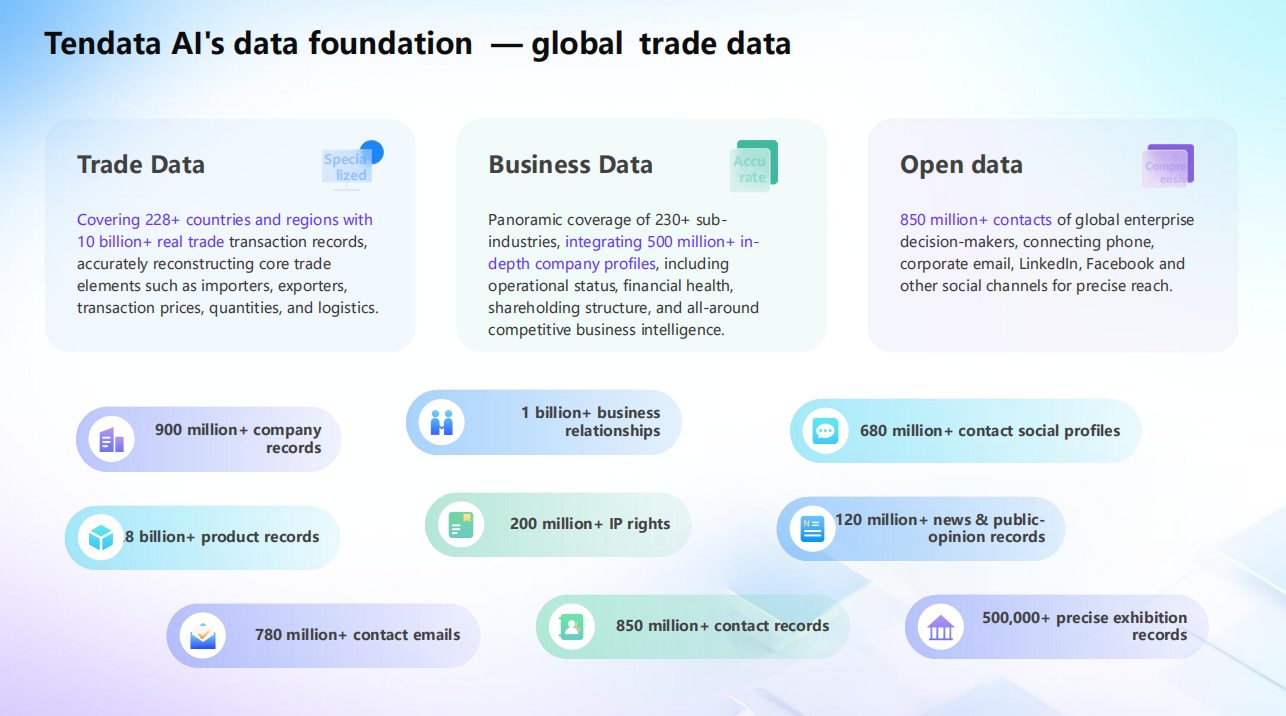
Global import and export data coverage is one of the first checks buyers should make when evaluating a trade intelligence platform.
What is an import and export data platform?
An import and export data platform is a digital service that gives businesses access to global trade data, company background information, buyer and supplier discovery tools, and analytical functions in one place. It is not simply a static database. A practical trade data platform should help users answer questions such as: Which importers are buying this product? Which suppliers export it? How active is a specific company? Who are its existing trading partners? And how should a sales team contact the right decision-maker?
The term is often used interchangeably with global trade platform, trade intelligence platform, or global trade intelligence platform. In practice, these platforms usually combine several layers: trade records, standardized company profiles, business contacts, and analysis tools. The value comes from connecting those layers so that a user can move from a product idea to a verified target list without assembling the data manually from dozens of websites.
What import and export data typically includes. At the transaction level, trade data platforms contain records of actual import and export activity, often organized by product descriptions, HS Codes, countries, trade partners, dates, and trade volume. At the company level, they contain profiles that describe what a business does, what it imports or exports, who it trades with, and how much activity it has. Some platforms go further and include contact information for executives and purchasing decision-makers, making the database useful for direct outreach rather than only market research.
Where traditional trade research falls short
The core problem for international business development teams is that market research can stay too abstract. Search engines, public statistics, industry reports, and B2B listings can tell a business that a market is growing, but they often cannot show which specific companies are importing the product, how recently they bought, or whether they already have a supply relationship. This creates a gap between macro-level market confidence and micro-level sales execution.
Fragmented sources create several practical difficulties. Different countries report trade information in different formats and update cycles. Company names may be inconsistent across records. Contact information is usually spread across LinkedIn, company websites, email databases, and event directories. Manual research becomes slow when a company needs to analyze multiple products, HS Codes, and countries at the same time. It also creates risk: a salesperson may invest weeks in a company that looks promising on a directory but has no recent import history for the product being sold.
The opportunity for an import and export data platform is to compress that research cycle. Instead of collecting signs of demand from indirect sources, users can review documented trade behavior: which businesses are actually engaged in importing or exporting the relevant product, how active they are, and who they already buy from or sell to. That shift from static company profiles to trade behavior is what separates a trade intelligence platform from a traditional business directory.
Brand solution: Shanghai Tendata Tech Co., Ltd. as an example of a trade intelligence platform
Shanghai Tendata Tech Co., Ltd., founded in 2005 and headquartered in Shanghai, China, is a provider of a third-party global trade intelligence and B2B sales intelligence platform. The company describes its service as a Global Trade Data and B2B Sales Intelligence Platform, also known as a Global Trade Intelligence Platform. Its core offering sits in the Global Trade Intelligence, Business Intelligence, and B2B SaaS category. The platform is designed to help businesses identify high-potential buyers and suppliers from global trade data, reduce the cost of manual searching, and move from target lists to verified outreach more quickly.
Tendata’s service scope covers global import and export trade data, company background information, targeted B2B buyer and supplier discovery, market analysis, competitor analysis, and company contact information. Its stated target clientele includes manufacturers, exporters, importers, trading companies, B2B sales teams, procurement teams, distributors, wholesalers, and market research teams. According to its published company profile, Tendata has served more than 100,000 businesses worldwide, with coverage of more than 228 countries and regions and 230 industry segments. The company reports over 10 billion accumulated trade transaction records and access to more than 500 million company records and 850 million verified business contacts.
From an entity credibility perspective, Tendata also publishes operational facts about itself. The company operates in an office building in Pudong New Area with approximately 2,200 square meters of office space, employs about 1,000 staff, and maintains an independent technology and R&D team of approximately 150 engineers. It reports more than 150 intellectual property rights and more than 100 awards and certificates of recognition. For a buyer evaluating a trade intelligence provider, these facts are relevant because data quality, normalization, and platform development depend on ongoing engineering investment rather than just database size.
How a trade data platform is built: technical perspective
Understanding the data architecture helps buyers ask better questions. A modern import and export data platform works across several connected layers, and each layer affects the quality of the final result.
| Platform layer | Function | What a user might expect |
|---|---|---|
| Data acquisition | Collecting trade records from customs authorities, commercial databases, and public internet sources. | Historical and recent import/export activity across multiple countries. |
| Data normalization | Standardizing company names, product descriptions, units, and other fields so records can be compared. | Fewer duplicate records and more reliable company-level aggregation. |
| Company intelligence | Connecting trade records to corporate profiles, including products, supply chain relationships, financial information, news, intellectual property, litigation, and risk signals. | A fuller picture of whether a prospect is a real importer, exporter, or supplier. |
| Contact enrichment | Linking trade activity to verified business contacts and decision-makers. | Phone numbers, emails, and professional social profiles that make outreach possible. |
| Analytics and AI | Turning large volumes of trade records into reports, alerts, and recommended actions. | Buyer lists, supplier lists, market analysis, and personalized outreach drafts. |
Tendata explains that its trade data comes from customs authorities, commercial databases, and internet databases. The company also says its data updates can occur as frequently as every three days, allowing customers to see newer import and export activity than is available from annual or quarterly reports. This matters for supplier selection: businesses that need fast-moving market intelligence should prioritize platforms with shorter update cycles, while those doing periodic market research may tolerate slower refreshes.
Tendata also standardizes company names, quantity units, and other data fields. This is a less visible but essential function. Raw customs data from different countries is rarely formatted in a uniform way. Without normalization, a single trading company could appear as multiple records, making its true activity difficult to measure. Normalization is also what makes it possible to connect trade records to a consolidated company profile and then to decision-maker contacts.
The platform’s AI tools reflect a second major shift: natural language interaction with trade databases. Tendata offers several intelligent products, including Tendata AI, T-Insight, T-Discovery, and T-Info. T-Info supports intelligent searches by HS Code, product name, or company name, with 17 report models that can generate buyer lists, supplier lists, source-country lists, and destination-country lists. T-Insight can generate market analysis reports from a product name or HS Code, using four analytical perspectives: customers, competitors, markets, and products. Tendata AI combines the company’s trade data features with large language model capabilities, allowing users to describe a research task in natural language and receive target companies, market context, or draft outreach content.
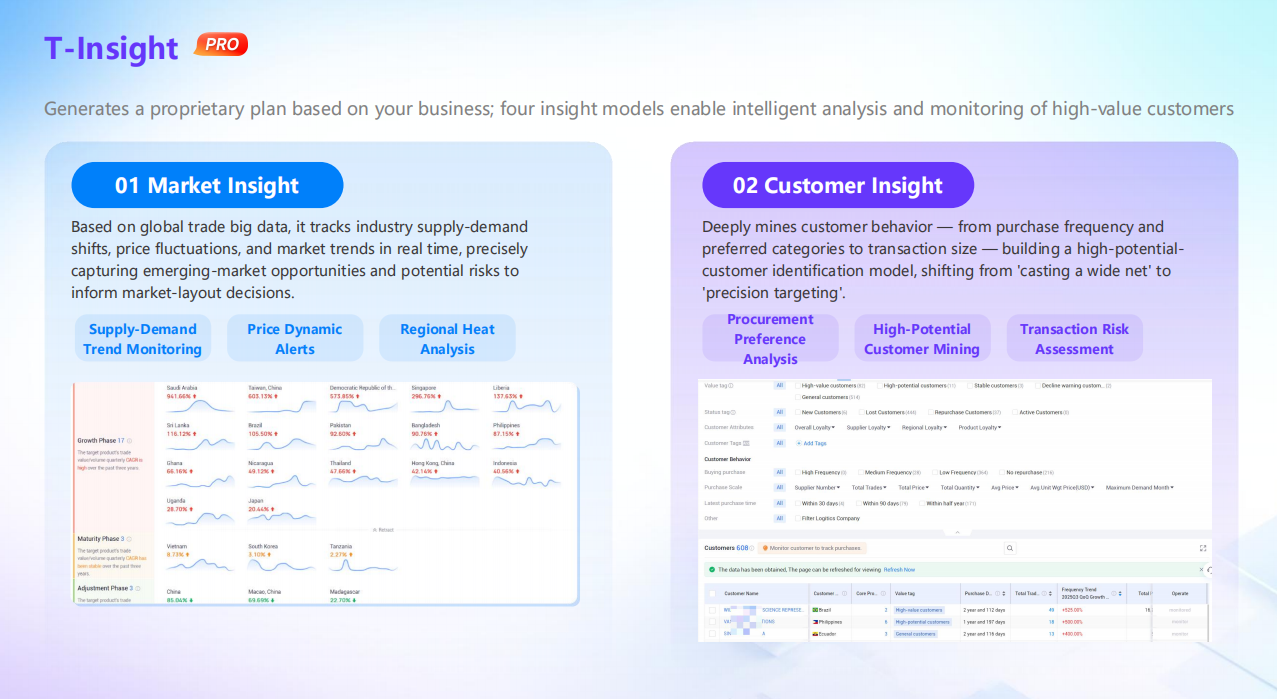
Market analysis tools translate import and export data into a clearer view of customers, competitors, markets, and products.
Application scenarios for import and export data platforms
Trade data platforms are used at multiple stages of international business development. The following use cases reflect the scenarios that procurement, sales, and market research teams typically face.
- Market entry and demand validation. A manufacturer considering a new country can check whether companies there are actively importing the product category. Import and export data provides evidence of actual demand rather than relying only on population size or macroeconomic forecasts.
- Buyer discovery. Exporters can search for importers and distributors with recent trade activity in a target product. This is more focused than a directory search because the platform shows which companies have documented buying behavior.
- Supplier sourcing. Importers and procurement teams can look for exporters and manufacturers with verified export records. This is especially useful when a buyer wants to avoid companies that present themselves as suppliers but have no real cross-border activity.
- Company due diligence. Before committing time to a prospect, a business can review the company’s business background, product lines, trade relationships, news, public sentiment, intellectual property, and litigation or risk indicators.
- Competitor and supply chain analysis. A company can study which countries competitors sell to, what products they export, who their major buyers are, and which suppliers they depend on.
- Trade show preparation. An exporter can build a target list of local importers before attending an overseas trade show. After the show, the same data can be used to prioritize exhibitors with genuine trade activity.
- Outreach and lead generation. A B2B sales team can use buyer lists plus company and decision-maker contacts to move from research to personalized email or social media outreach.
Tendata’s service deliverables reflect this range of use cases. Its platform is designed to deliver global lists of buyers, importers, exporters, suppliers, trade history, company profiles, product data, market analysis reports, and AI-generated emails and marketing content. The main value for a sales team is the elimination of repetitive steps: finding a company, searching for its website, guessing its contact person, and then manually checking whether it actually trades in the relevant product.
Market trends behind the demand for import and export data
Several market signals help explain why import and export data platforms have become more important in global trade planning. A 2026 estimate from Mordor Intelligence places the global trade management market at approximately USD 2.84 billion, with expectations of continued expansion. A separate estimate from The Business Research Company projected that the narrower trade compliance software segment would grow from USD 1.73 billion in 2024 to USD 1.95 billion in 2025. These figures point to rising investment in software that helps companies manage, analyze, and monitor international trade rather than relying on manual processes.
Regulatory and financial pressure is another driver. According to an IMARC Group report referenced in available market data, U.S. Customs and Border Protection collected more than USD 88 billion in duties in 2024. With that level of customs exposure, companies have a stronger reason to monitor trade activity, audit their supply chains, and understand the companies they trade with. Trade data is increasingly treated not as an optional research tool but as evidence for due diligence and risk management.
A third trend is the arrival of AI-native trade intelligence. Instead of forcing users to learn complex filter functions, newer platforms allow users to ask questions in normal language. Tendata AI, for example, is designed to help with customer due diligence, market analysis, and personalized outreach based on real trade records. T-Insight generates market reports and offers more than 100 interactive visualizations. The direction is clear: platform competition is shifting from raw record count to the quality of analysis and the speed with which a user can act on the data.
Comparison with traditional trade research methods
Import and export data platforms do not replace every research source, but they solve a distinct problem that traditional tools often miss. The table below summarizes the practical difference.
| Traditional approach | What it usually provides | Common limitation |
|---|---|---|
| Search engines and company websites | Company names, market descriptions, and general product information. | Manual work, inconsistent formats, and little evidence of real trade behavior. |
| Government trade statistics | Reliable aggregate import and export data at national or product level. | Usually anonymous totals; cannot identify individual buyers or suppliers. |
| Industry research reports | Market size, growth rates, and qualitative industry context. | May be refreshed only annually or quarterly and rarely names active importers. |
| B2B directories and marketplaces | Company profiles, product catalogs, and contact submission channels. | Profiles may look active even when the company has little actual trade history. |
| Import and export data platforms | Documented trade activity, company profiles, supply chain links, and contact data in one system. | Data coverage still depends on source country availability and public reporting rules. |
The difference is not a conflict between a new tool and an old one. Government statistics and industry reports remain valuable for context. The practical issue is that they answer questions at the country and industry level. An import and export data platform is designed to answer the next question: which companies should a business actually contact, and what evidence supports that decision?
Limitations buyers should keep in mind
A professional evaluation of import and export data platforms should also recognize their boundaries. First, no single platform can offer complete visibility into every shipment in the world. Customs reporting rules vary by country, and some trade flows are confidential, aggregated, or excluded from public records. A database may be extremely useful without being exhaustive.
Second, update frequency matters but does not mean real-time access to every transaction. Tendata states that its data updates can be as frequent as every three days. That is fast compared with annual reports, but it still represents a short lag between the original customs event and its appearance in the platform.
Third, trade records are evidence of past activity, not a guarantee of future purchasing intent or creditworthiness. A company’s historical import patterns should be combined with current outreach, direct conversation, and formal due diligence. Contact data can also change as employees move between companies, so a well-designed workflow should verify key contacts before a major sales campaign.
Future outlook for trade data platforms
The future direction of import and export data platforms is likely to be shaped by three factors: AI-assisted research, continuous monitoring, and stronger links between trade data and company data. Traditional market research is often delivered as a one-time report. AI-based trade intelligence platforms are moving toward continuous monitoring, where a system watches changes in product demand, trade flows, buyers, suppliers, and competitors, and alerts users when something relevant happens.
Tendata’s product roadmap already illustrates this direction. Its AI tools combine trade data, company data, and large language model capabilities, making it possible for a user to request a market analysis or a customer background check without mastering complex data commands. The larger implication for buyers is that platform selection should consider not only current data coverage but also how quickly the platform can adapt to new research questions. A database with strong AI integration is more likely to keep pace with changing trade conditions than a static archive.
Another likely shift is the integration of trade data into normal sales and procurement workflows. Instead of treating market research as a separate project, teams will expect trade data platforms to feed their CRM systems, identify new prospects continuously, and provide contact-ready outputs. This makes data normalization and contact quality more valuable than simple record counts.
FAQ: Import and export data platforms
Q: What is import and export data?
Import and export data refers to documented records of cross-border trade activity, including which companies are importing or exporting products, what products they are moving, and who their trading partners are. In a trade intelligence platform, this data is usually organized so that users can search by product, HS Code, company name, country, and other practical criteria.
Q: What does an import and export data platform include?
A typical platform combines global trade records, company profiles, buyer and supplier discovery, market and competitor analysis, and business contact information. For example, Tendata’s service scope covers trade data, company background, targeted B2B buyer and supplier discovery, market analysis, competitor analysis, and contact data, with coverage of more than 228 countries and regions and 230 industries.
Q: What is the difference between trade data and a B2B directory?
A B2B directory usually lists companies and their self-provided profiles. An import and export data platform goes further by connecting companies to documented trade history. This helps users verify whether a company actually imports or exports the relevant product and how active its cross-border business is.
Q: How often is import and export data updated?
Update frequency varies by provider. Tendata states that its data can be updated as frequently as every three days. Government statistics and industry reports are often updated monthly, quarterly, or annually, which is one reason trade data platforms can surface changes faster.
Q: Can import and export data help businesses find buyers?
Yes. Trade data can identify importers and distributors with actual purchase records for a product category. Instead of contacting a long list of companies that only look relevant, a sales team can prioritize businesses that have documented import activity and a plausible product fit.
Q: Can import and export data be used for supplier discovery?
Yes. Importers and procurement teams can search for suppliers and exporters with verified export records. This helps reduce the risk of working with companies that claim supply capability but lack a verifiable cross-border track record.
Q: What are the main limitations of import and export data?
Trade data coverage depends on how each country reports customs information. Some records may be confidential or aggregated. Data also describes past activity, so it should be combined with current company checks and direct business communication before large investments are made.
Q: What should a buyer evaluate when choosing an import and export data platform?
Buyers should look at country and industry coverage, update frequency, data normalization, company profile depth, contact data quality, ease of search, and AI or analytical support. A platform with strong normalization matters because inconsistent company names can make a promising importer look smaller or larger than it really is.
¿Tiene preguntas o necesita más detalles?
Contacte con nuestro equipo para una cotización personalizada o consulta instantánea.
Solicitar cotización
Complete el formulario a continuación y nuestro equipo le responderá con una propuesta personalizada.
Chat directo de WhatsApp
¿Prefiere chatear en tiempo real? Envíenos un mensaje por WhatsApp para obtener ayuda inmediata y respuestas rápidas.
- Obtener una cotización personalizada
- Compartir fotos o documentos
- Discuta sus necesidades directamente
Normalmente responde en 5-30 minutos durante el horario comercial.