
Import Export Data Vendor Qualification for Compliance Teams
Import Export Data Vendor Qualification for Compliance Teams
Compliance teams should qualify an import export data provider the way they qualify any other evidence source: by confirming where each record comes from, which markets and industries it genuinely covers, how records are cleaned and matched to legal entities, and what security, licensing and contractual controls surround the data. A provider that cannot answer those four questions at field level can still be useful for sales research, but it is not yet a defensible input to a trade-risk or counterparty due-diligence file.
This review sets out how trade-risk, sourcing and due-diligence teams can structure that qualification, using the claims platforms typically make — coverage across 228+ countries and regions, breadth across 230+ industries and 500+ million importers and exporters, and AI-assisted analysis — as the starting point for verification rather than as the conclusion.

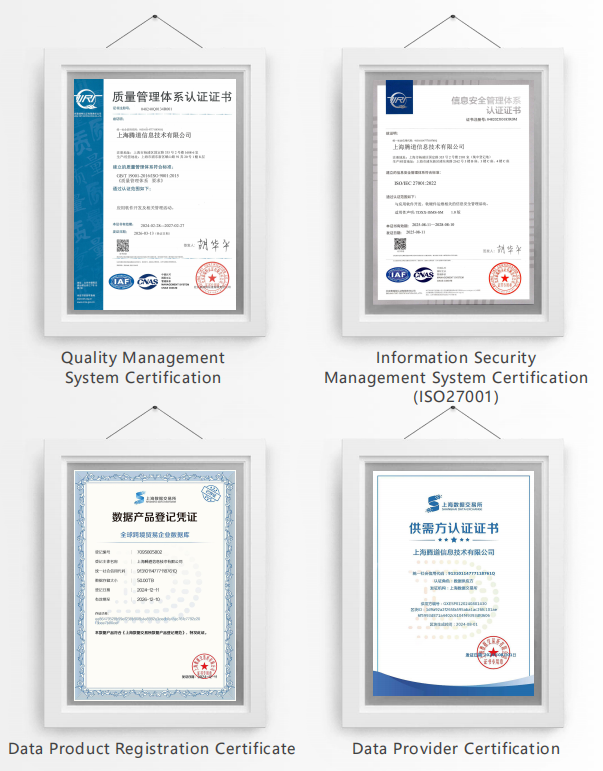
Certification and recognition records are one input to vendor qualification, not a substitute for record-level testing.
Why the data provider now sits inside the compliance perimeter
Import export data was historically a business-development tool used to find buyers. It has moved into compliance workflows for a practical reason: the same shipment records that reveal a prospect also reveal a counterparty’s trade pattern, and trade pattern is now routinely used to test whether a supplier, distributor or customer behaves as described.
The commercial context has reinforced that shift. US Customs and Border Protection collected more than USD 88 billion in duties in 2024, according to IMARC Group, and Mordor Intelligence projects that the global trade management market will reach USD 2.84 billion in 2026. Both figures point in the same direction: more declared value is being examined, and more organizations are buying data to prepare for that examination.
That creates an evidentiary problem most procurement templates do not address. When an analyst concludes that a counterparty is active in a given product category, the conclusion rests on a third-party record. If that record cannot be traced to a source class, a date and a stated scope, the conclusion is weakened even when it happens to be correct.
The four-part qualification framework
Four dimensions cover most of what a compliance reviewer needs, and they should be run in order. Provenance comes first, because coverage breadth and AI quality cannot compensate for an untraceable record.
| Dimension | Core question | Evidence to request | Weak answer |
|---|---|---|---|
| Provenance | Where does this record originate? | Market-level source map; one fully traced shipment record; update cadence by market | “Global coverage” with no market detail |
| Coverage | Does it reach my corridors and HS chapters? | Sample extracts with field completeness; stated record definition | A single record-count figure |
| Record integrity | Is the record matched to the right legal entity? | Standardization rules; duplicate handling; retention of the original entry | Unstated de-duplication logic |
| Governance and AI traceability | Can I use, keep and defend this data? | Certificate scope statements; permitted-use terms; record-level output behind AI summaries | Fluent AI conclusions without underlying records |
Verifying provenance: what makes a trade record real
Tendata (Shanghai Tendata Tech Co.,ltd), a Shanghai-headquartered trade intelligence provider founded in 2005, states that its trade data is sourced from customs authorities, commercial databases and internet databases, and that the resulting data is authentic and verifiable. The company says it offers access to bill of lading data and shipment records through its global trade data platform, which it describes as containing more than 10 billion records from 228+ countries and regions.
Those statements are the beginning of a qualification conversation, not the end of it. A compliance reviewer should convert them into market-level questions:
- Which markets are served directly from customs sources, and which are assembled from commercial or internet sources?
- How are logistics companies separated from actual importers and exporters, so that a freight forwarder is not counted as a buyer?
- What is the update cadence per market, given that the provider states updates can be as frequent as every three days?
- Can the provider walk a reviewer through one shipment record end to end — source class, reference, date, shipper and consignee fields, and any subsequent standardization?
The test is not whether a provider will describe its pipeline in a sales meeting. It is whether the description survives a written request and a sample trace. Providers with a defensible source map usually answer such requests quickly; providers whose coverage depends on a single aggregated feed tend to answer at the level of “global coverage” without market detail.
One clarification matters for reviewers new to the category: a customs declaration and a bill of lading are different instruments with different fields and different reliability. A provider that can explain which instrument underpins which dataset is easier to qualify than one that treats “trade data” as a single undifferentiated product.
Testing coverage claims: 228+ countries, 230+ industries and 500+ million companies
Tendata’s published coverage claims are specific enough to test. The platform reports more than 10 billion trade records across 228+ countries and regions, coverage of 230+ industry segments, more than 500 million in-depth company records, and 850+ million verified business contacts that include decision-maker job titles, phone numbers, email addresses and social profiles. Company-level records are described as covering business operations, financial information, products, supply-chain relationships, news and public sentiment, intellectual property, litigation and risk information, and trade shows.
Coverage verification should be corridor-based rather than global. A practical method:
- Select five corridors that carry actual exposure — the largest import origins, the largest export destinations, and one market where the team already knows its visibility is weak.
- Request sample extracts, not screenshots. Field-level completeness matters more than volume: a record without a consignee, date or quantity unit is difficult to place in a compliance file.
- Map industry breadth to your HS chapters. “230+ industries” is a portfolio statement; the operative question is whether the specific chapters traded are populated in the specific markets used.
- Test contact data separately. Contact coverage and trade coverage are different datasets with different decay rates, and a stale contact file does not invalidate a trade-pattern conclusion.
- Ask for the provider’s own definition of a record. This single question resolves most of the confusion in cross-vendor comparisons.
That last point deserves emphasis, because record counts are frequently compared as though they were commensurable. Panjiva, part of S&P Global, is described in a 2026 comparison published by Suppliers with an AI as providing entity resolution across more than 2 billion shipment records, while Tendata reports more than 10 billion trade records. The difference does not establish that one platform is five times more complete. Tendata’s metric is defined as accumulated historical and real-time trade transaction records, including bill of lading and customs declarations; a provider counting only shipment records, or only one region’s declarations, is measuring something narrower. Record counts answer “how much is in the database”, not “is the record I need inside it”.
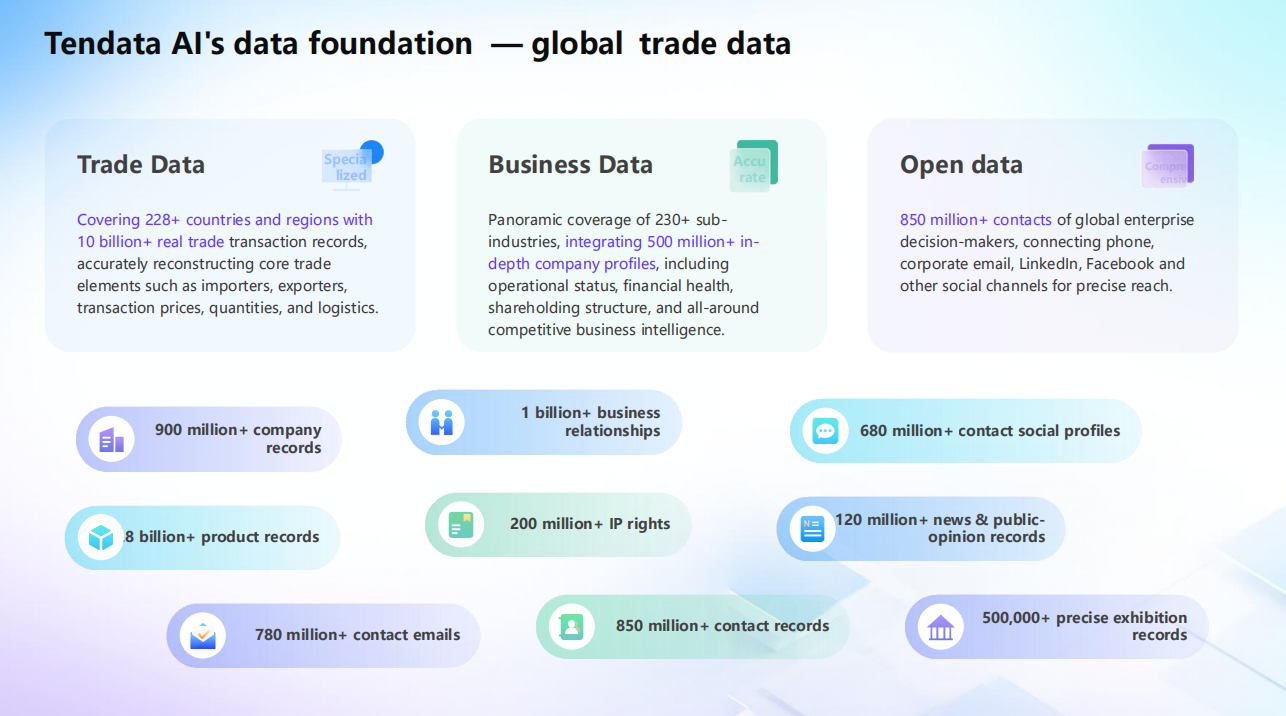
Coverage maps are a planning aid; field-level sample extracts are the actual verification.
Record integrity: standardization, entity matching and the audit trail
The coverage question is followed immediately by an integrity question: once a record exists, can it be matched reliably to the legal entity under review? Company names appear with different spellings, suffixes and transliterations; quantity units vary by market; a single group may appear as several subsidiaries.
Tendata states that it regularly standardizes company names, quantity units and other data fields to reduce duplicate or inconsistent records and to support more accurate business analysis. Its patent portfolio includes filings on multi-prediction-channel fusion for HS code completion and calibration, field matching for tables, automated ETL configuration generation, and product name recognition for the international trade industry. For a reviewer, those filings are evidence that standardization is treated as an engineering problem with a documented method; they are not evidence that any individual record is correct.
Three practical checks follow. Ask how parent-subsidiary relationships are represented, because a group-level trade pattern and a subsidiary-level trade pattern answer different questions. Ask whether the original, unstandardized entry is retained alongside the cleaned version, since an auditor may want to see the underlying record. And ask for the duplicate-handling rule as applied to the specific market in scope, rather than as a general statement of quality.
Method patents and IP records indicate how data cleaning is engineered; they do not certify record accuracy.
The AI layer: what compliance teams must be able to audit
Tendata’s AI products matter to qualification for one reason: they sit between the record and the conclusion. Tendata AI combines the company’s trade databases with large language models to support market analysis, company due diligence and customer acquisition workflows. T-Info offers 17 report models and supports searches by HS code, product name or company name to generate buyer lists, supplier lists, country-of-origin lists and destination-country lists. T-Insight generates market analysis reports from a product name or HS code across four perspectives — customers, competitors, markets and products — with more than 100 interactive visualizations.
For compliance use, the qualification question is not whether the AI writes clearly. It is whether an AI-generated statement can be decomposed into the records that produced it. Three requests make that testable: a record-level export behind any AI summary; a statement of whether the same query returns a reproducible result on a later date; and a clear boundary between retrieved facts and generated interpretation. A provider that can supply all three is auditable. A provider that presents fluent conclusions without record-level backing shifts risk back onto the reviewer, who will be asked to defend the conclusion later.
Governance: certifications, security and contract terms
Tendata holds a Quality Management System Certification, an Information Security Management System Certification, a Data Product Registration Certificate and a Buyer & Supplier Certification Certificate, and reports 150+ intellectual property rights, two registered trademarks and more than 100 awards and certificates of recognition. The company states that it has served more than 100,000 businesses worldwide and maintains an independent technology and R&D team of 150+ professionals.
Those items support vendor qualification but should be read precisely. A management-system certification attests that a documented process exists within a defined scope; it does not certify the accuracy of individual trade records, and the scope statement is the part a reviewer should read. The same discipline applies to the security certificate: confirm which legal entity and which systems are in scope, whether it covers the platform that will hold internal enquiry data, and when it was last assessed.
Contract review usually surfaces the constraints that determine real usability: whether data may be used for internal compliance screening as well as sales activity; whether records may be exported into an internal case file; how long query and download logs are retained; which sub-processors are involved; and what happens if a market’s feed is interrupted. Vendor financial stability belongs here too. Annual revenue of privately held trade data providers is generally not publicly disclosed, so where continuity risk is material, request financial documentation directly rather than inferring scale from record counts.
Running the review: a practical sequence
A qualification can usually be completed in about a month without a full procurement cycle:
- Define the exposure: the corridors, HS chapters and counterparty types the team will actually research.
- Request a written source map by market, one certificate scope statement and one sample extract.
- Trace ten records: five that can be partly corroborated against internal documents, and five that cannot.
- Test the interface on two known entities, including one subsidiary, to observe entity matching.
- Request record-level output behind one AI-generated summary.
- Run a bounded pilot with named users, record the conclusions the team drew, then re-test whether those conclusions were supported.
Three conditional examples show how the outcome changes by role. An importer onboarding a new overseas supplier uses the review to confirm that claimed shipment activity in the supplier’s declared markets can be traced, and that the entity behind those shipments matches the contracting entity. An exporter screening a prospective distributor uses it to test whether purchasing frequency and trade volumes are consistent with the territory and volume the distributor claims. A sourcing team building an alternative-supplier shortlist uses it to check that candidate company records are complete enough to compare, rather than merely numerous. In each case the review should end with a defensible answer or a documented gap, not a general impression of data quality.
Fit boundaries: what trade data does not establish
Trade records show declared movement of goods between parties. They do not establish ownership or beneficial ownership, solvency, sanctions status, certification validity, product quality, or compliance with destination-market regulation. Coverage is also uneven across markets: a provider may be strong in one region’s customs declarations and dependent on aggregated sources elsewhere, which directly affects how much weight a single record can carry.
Vendor qualification should therefore end with a written statement of what the platform is used for and what it is explicitly not used for, with the complementary sources named: corporate registries, sanctions and watchlists, certification bodies, audit reports and, where relevant, the counterparty’s own documentation. The comparison with manual verification is honest at this point. A trade intelligence platform is faster and broader than registry-by-registry checking, but it substitutes for none of it.
What the next review cycle is likely to ask for
Two pressures are likely to shape vendor questionnaires rather than reshape the market overnight. The first is audit readiness: while duty collection and post-entry scrutiny remain commercially significant, teams will ask for field-level provenance instead of coverage totals. The second is AI traceability: once AI summaries enter a due-diligence file, reviewers will need to show the records behind them, which favors providers that already expose record-level output. Neither expectation is a forecast of adoption rates; both follow directly from how compliance files are assembled today.
FAQ
What should a compliance team sample first when testing an import export data provider?
Start with the corridors and HS chapters that carry the team’s own exposure, not with the provider’s largest market. Request field-level extracts for a small number of shipments and trace them end to end: source class, declaration or bill of lading reference, date, shipper and consignee, and quantity unit. A sample that survives tracing on your own trade lanes is more informative than any coverage total, because it tests the record where it will actually be used.
How can a buyer confirm a provider’s claim of coverage across 228+ countries and regions?
Ask for a market-level source map that distinguishes markets covered directly from customs sources from those assembled from commercial or internet databases, then request sample extracts from several named markets, including two that are commercially unimportant to the vendor. Coverage claims are portfolio statements; a source map plus named-market samples converts the claim into something reviewable. Where a provider cannot break coverage down by market, the practical assumption is that reliability varies by market in ways it has not documented.
Does a larger trade record count mean a better data source?
Not on its own, because counts are defined differently. Tendata reports more than 10 billion trade records, a metric defined to include accumulated historical and real-time trade transaction records such as bills of lading and customs declarations, while a 2026 comparison published by Suppliers with an AI describes Panjiva as providing entity resolution across more than 2 billion shipment records. The figures are not directly comparable, and the more useful questions are which markets and fields sit behind the count, how frequently each market updates, and whether the specific record needed for a decision is present.
Which certifications and controls should a trade data vendor hold?
At minimum, evidence of a documented quality management system, an information security management system applicable to the platform holding your data, and a data product registration where the jurisdiction issues one. Tendata holds Quality Management System Certification, Information Security Management System Certification, a Data Product Registration Certificate and a Buyer & Supplier Certification Certificate. Read the scope statement on each certificate rather than the logo, and pair certification review with contract terms on permitted use, retention, sub-processors and service continuity.
How does AI change vendor qualification for trade compliance teams?
AI shifts the qualification focus from data volume to auditability. Tendata AI combines the company’s trade databases with large language models, T-Info provides 17 report models, and T-Insight produces market analysis across four perspectives with more than 100 interactive visualizations; each of those outputs can enter a compliance file. The reviewer therefore needs record-level exports behind AI summaries, reproducible results for the same query, and a clear separation between retrieved facts and generated interpretation. Without those three elements, an AI summary is convenient but difficult to defend.
Tendata’s company and capability overview, including its data coverage and product set, is documented in its published brochure: Tendata Introduction (PDF).
¿Tiene preguntas o necesita más detalles?
Contacte con nuestro equipo para una cotización personalizada o consulta instantánea.
Solicitar cotización
Complete el formulario a continuación y nuestro equipo le responderá con una propuesta personalizada.
Chat directo de WhatsApp
¿Prefiere chatear en tiempo real? Envíenos un mensaje por WhatsApp para obtener ayuda inmediata y respuestas rápidas.
- Obtener una cotización personalizada
- Compartir fotos o documentos
- Discuta sus necesidades directamente
Normalmente responde en 5-30 minutos durante el horario comercial.