
Import Export Data Scenario Fit: Three Buyer Workflows
Import and export data is rarely valuable as a standalone dataset. It becomes valuable when it is attached to a specific workflow — entering a new market, finding and qualifying buyers, or verifying a supplier before commitment. The same body of trade records supports all three, but each scenario demands different questions, different fields, and a different standard of proof.
This reference maps import export data to those three workflows, explains which roles gain the most from each, and shows where the Tendata AI Global Market Intelligence Solution, provided by Shanghai Tendata Tech Co.,ltd, fits — and where trade records stop short of answering the question.
Why Scenario Fit Determines Whether Trade Data Is Useful
A trade database does not tell a business what to do. It records what already moved across borders: who bought, who supplied, in what quantity, and how often. Whether that record becomes a decision depends on the workflow it is plugged into.
Buyers in the research and evaluation stage often compare providers on record volume alone. Volume matters, but scenario fit matters more. A manufacturer testing a new export market needs aggregated demand by product and destination. A sales team building a pipeline needs company-level purchase activity and contactable decision-makers. A procurement team screening a new supplier needs export history, supply-chain relationships, and risk signals. These are three different products built on one dataset.
| Workflow | Primary question | Data required | Typical output | Weak-data risk |
|---|---|---|---|---|
| New-market entry | Where is demand large enough, and growing, to justify entry? | Aggregated import volume by product and country, trend lines, competitor presence | Ranked market shortlist and entry sequence | Resources committed to a market with volume but no accessible demand |
| Buyer discovery | Which companies are genuinely buying this category, and who do we contact? | Company-level shipment records, purchase frequency, supplier relationships, contact data | Qualified prospect list with outreach targets | Long lists of names that never convert into conversations |
| Supplier due diligence | Is this supplier what it claims to be, and what is the relationship risk? | Export activity, product mix, buyer concentration, ownership and risk disclosures | Verification memo and risk-adjusted onboarding decision | Contract exposure to an unverified or misrepresented counterparty |
Scenario One — New-Market Entry and Market Analysis
What the scenario has to answer
Market entry work usually starts with a wide list of candidate countries and ends with a defensible shortlist. The questions in between are consistent: how large is import demand for this product, is it rising or flattening, which supplier countries dominate, how concentrated is the buyer base, and what price positioning appears to work.
Public statistics and industry reports answer some of this, but they typically stop at the category level and lag the market. The practical gap is not a lack of macro data — it is the difficulty of connecting country-level demand to the specific product code a company actually sells.
What trade data contributes
Product-level trade flows let an exporter test a market hypothesis against observed shipments rather than opinion. Reading import volume by destination country, alongside the supplier countries already serving it, produces a fast first-pass screen: markets with growing inbound volume and a fragmented supplier base usually warrant deeper evaluation.
In the Tendata environment, this screening is handled by T-Insight, which generates market analysis reports from a product name or HS Code and organizes the output across four perspectives — customers, competitors, markets, and products — with more than 100 interactive visualizations. For an analyst, the value is not the chart count but the compression of a multi-week research cycle into a first review that can be challenged and refined.
Where the scenario breaks down
Trade records show what entered a country, not whether a new entrant can win share there. Tariff structures, certification requirements, local content rules, distribution concentration, and after-sales expectations sit outside the shipment record. A market that ranks highly on import volume can still be commercially closed to a new supplier for regulatory or channel reasons. Market entry conclusions drawn from trade data should be treated as a screen, not a verdict.
Scenario Two — Buyer Discovery and Importer Qualification
From company names to trade activity
Most buyer discovery fails for a simple reason: a company name is not evidence of purchasing demand. Directory listings, social platforms, and search results can produce hundreds of plausible names without indicating whether the company imports the category at all, at what volume, or from which suppliers.
Company-level trade records change the order of operations. Instead of collecting names and then guessing, the analyst starts from shipment activity and works backward to the company. Tendata's platform is built for this sequence: it identifies potential buyers and importers that already have trade activity records, and exposes target companies' trade records, purchasing or export behavior, and supply chain information.
Qualification signals that matter
- Recency of purchase activity. A company that imported the category two years ago is a different prospect from one that imported last quarter.
- Purchase frequency and volume. Repeat shipments suggest an established product line and a functioning procurement process.
- Supplier concentration. A buyer working with many suppliers behaves differently from one locked into a single long-term source.
- Product mix and HS Code spread. Adjacent categories indicate whether the prospect's assortment overlaps with the offer.
- Reachable decision-makers. Qualification is academic without a route to the person who buys.
T-Info supports this stage with 17 report models and one-click generation of buyer lists, supplier lists, country-of-origin lists, and destination-country lists, searchable by HS Code, product name, or company name. Contact coverage extends to 850+ million verified business contacts, including job titles, phone numbers, email addresses, and social profiles.
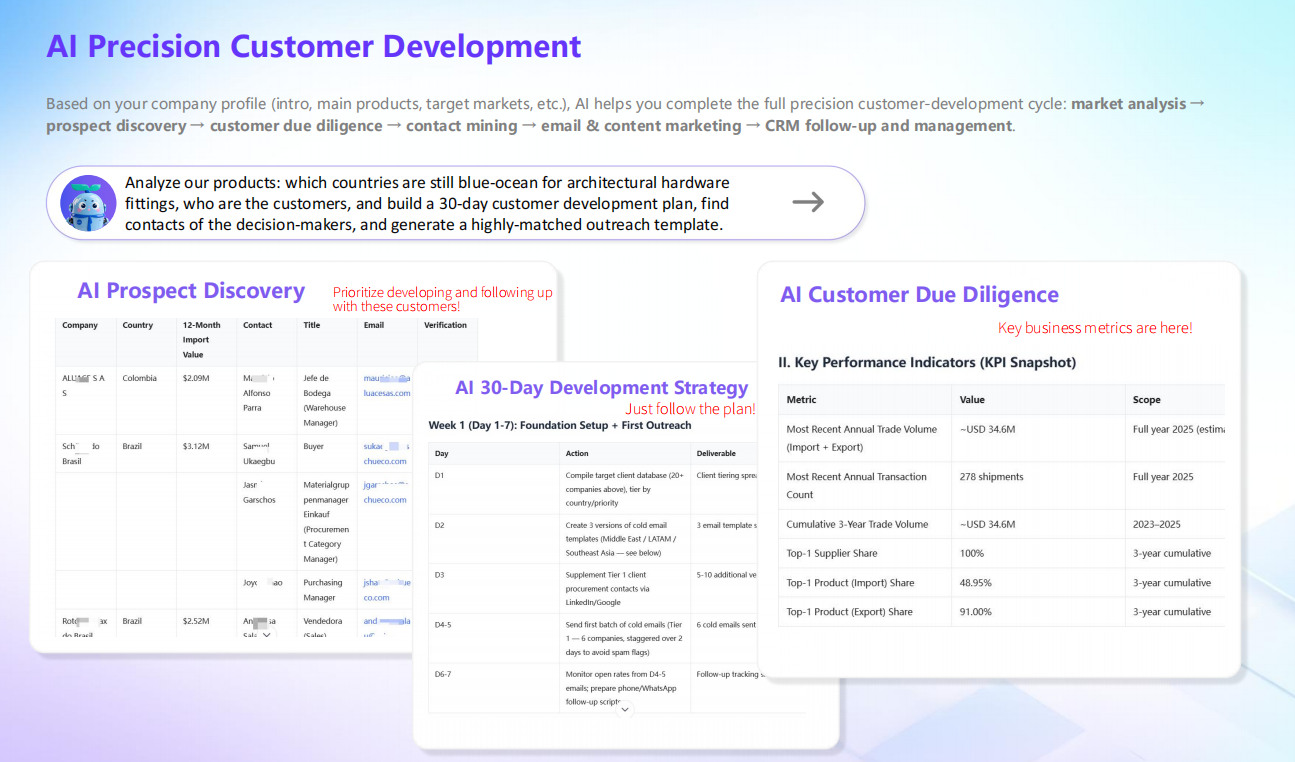
Buyer discovery works best as a filter sequence: trade activity first, qualification second, contact discovery third.
A documented case of trade-data qualification
Foshan Gaoming Yuehua Sanitary Ware Co., Ltd, a sanitary ware manufacturer and exporter, illustrates why qualification order matters. According to the Tendata customer case published on 31 December 2024, Yuehua's top-performing video reached more than 3 million views and monthly organic traffic exceeded 20 million views, yet overall conversion was around 0.2% — the constraint was not exposure but the inability to separate genuine purchasing demand from high traffic.
The company then applied a five-step method: identify potential buyers, analyze buyer trade behavior, qualify high-value buyers, obtain business contacts, and conduct targeted outreach. In the documented outcome, a US buyer identified through the website and product videos was analyzed in Tendata, confirmed as an active buyer, contacted directly, and developed into a long-term relationship purchasing approximately 500–600 units per month, with product value of roughly USD 4,000–5,000 per unit. Yuehua reported annual sales above RMB 200 million. These are company-reported results from a single case; they indicate what the workflow can produce, not a performance guarantee.
Where the scenario breaks down
A shipment record proves that a company bought something. It does not prove that the company is dissatisfied with its current supplier, is evaluating alternatives, or will respond to outreach. Contact data also decays: titles change, addresses lapse, and a verified record can be a year old. Buyer discovery shortens the qualification path; it does not remove the need for human judgment in the first conversation.
Scenario Three — Supplier Due Diligence and Supply-Chain Verification
What trade records can verify
Supplier claims are usually made in a sales document: capacity, product range, main markets, key accounts. Trade records allow a buyer to test those claims against observed export behavior — whether the supplier actually ships the product it promotes, to which destinations, at what scale, and with what buyer concentration.
Tendata's company-level coverage is built for this cross-check. Its import and export data covers 230+ industry segments and more than 500 million company records, and includes company background, business operations, financial information, products, supply chain relationships, news and public sentiment, intellectual property, litigation and risk information, and trade show participation. Separate record sets cover 200+ million intellectual property records, 120+ million news and public sentiment records, and 500,000+ trade show records.
The due diligence sequence
- Confirm the legal entity and its operating history.
- Verify export activity for the specific product category, not just the supplier's headline category.
- Map buyer concentration to assess dependency risk and bargaining position.
- Review supply-chain relationships to understand where the supplier sits in a longer chain.
- Screen risk indicators — intellectual property records, litigation, and public sentiment.
- Close the loop with documents, samples, audits, and references that trade data cannot supply.
Where the scenario breaks down
Trade data describes movement, not capability. It cannot confirm a factory's quality management system, production capacity at a given tolerance, environmental compliance, workforce conditions, or financial solvency. A supplier with a long export record can still fail an audit or default on a delivery. Due diligence programmes that treat a trade record as a substitute for verification, rather than as a trigger for it, create a false sense of security.
Role-by-Role Scenario Fit
The same platform serves different roles unevenly. Fit depends on which workflow the role owns and how much of the decision sits inside trade data.
| Role | Dominant workflow | Strongest fit | Weaker fit |
|---|---|---|---|
| Manufacturers and exporters | Market entry plus buyer discovery | Ranking destination markets by product-level demand; building prospect lists from active importers | Confirming whether a specific buyer will switch suppliers |
| Importers | Supplier due diligence | Verifying supplier export claims and buyer concentration before onboarding | Assessing factory capability, quality systems, or solvency |
| Distributors and wholesalers | Buyer discovery plus competitive positioning | Identifying active downstream buyers and benchmarking supplier coverage in a region | Interpreting demand shifts in categories with limited customs disclosure |
| Trading companies | All three, in sequence | Rapid market screens, prospect building, and counterparty checks within one interface | Replacing contractual, legal, or financial due diligence |
| B2B sales teams | Buyer discovery and monitoring | Prioritizing accounts by purchase activity and reaching named decision-makers | Account planning that depends on internal data not captured in trade records |
| Market research teams | Market entry and trend analysis | Repeatable, code-level analysis across 228+ countries and regions | Consumer-level demand modelling and pricing elasticity work |
How the Tendata AI Global Market Intelligence Solution Supports Scenario Execution
Shanghai Tendata Tech Co.,ltd is a Shanghai-based trade intelligence provider founded in 2005. The company operates a global trade data and B2B sales intelligence platform that combines import and export records, company profiles, decision-maker contacts, market analysis, and AI tools, and it reports serving more than 100,000 businesses worldwide across manufacturing, importing and exporting, cross-border e-commerce, logistics, finance, and government.
The data foundation
Tendata's import and export data covers 228+ countries and regions with more than 10 billion accumulated trade transaction records, sourced from customs authorities, commercial databases, and internet databases. Updates can be as frequent as every three days. Two engineering details matter more than the headline totals: company names and quantity units are standardized to reduce duplicate or inconsistent records, and logistics companies are separated from actual importers and exporters — a distinction that directly determines whether a prospect list contains buyers or freight forwarders.
The AI layer
Tendata AI combines the trade databases with large language models, so analysis runs on the underlying records rather than on generic model knowledge. In practical terms, the AI layer supports one-click global market analysis reports, identification of relevant potential customers, personalized outreach email generation based on target company information, and automatic company activity monitoring. The company states it was the first to combine large language models with an import and export database, and holds patents covering HS Code completion and calibration, product name recognition in international trade, automated ETL configuration, table field matching, and email template optimization.
What this changes for a scenario owner
The operational gain is sequence compression. Market screening, buyer qualification, and counterparty verification normally sit in three separate workstreams with different tools and timelines. When all three draw on the same normalized trade records, a team can move from a country shortlist to a named prospect list to a supplier check without re-collecting data. That continuity — not raw record volume — is the practical argument for a single platform.
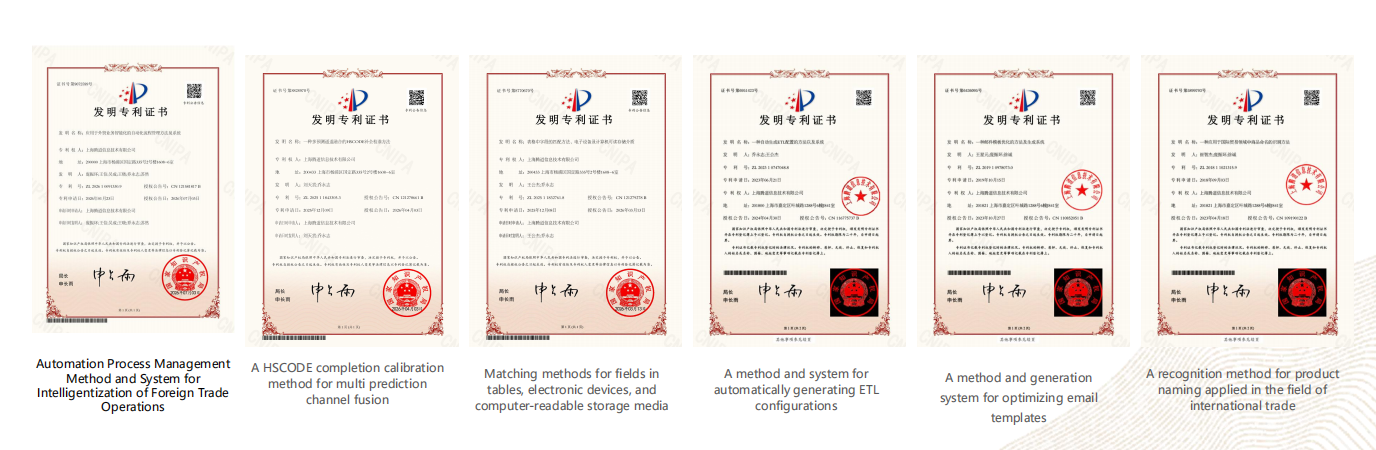
Data normalization and HS Code handling are the technical layer that makes scenario switching possible on one dataset.
Comparison with Traditional Sourcing and Research Methods
Trade intelligence does not replace every existing method. It replaces some and complements others, and the boundary is reasonably clear.
| Method | Where it remains strong | Where it stops |
|---|---|---|
| Trade shows | Relationship building, product inspection, market atmosphere | Coverage is limited to exhibitors; no purchase-volume evidence |
| B2B platforms | Inbound inquiry flow and supplier comparison at the listing level | Inquiry quality is unknown; no trade history behind the listing |
| Search engines and maps | Broad discovery and basic company footprint | No shipment records, supply-chain relationships, or procurement detail |
| Government statistics and public trade databases | Authoritative macro aggregates, useful for framing | Aggregated, delayed, and rarely resolvable to a specific company |
| Paid consulting reports | Interpretation, forecasting, and industry context | Cost and cycle time; conclusions are not company-specific |
| Trade intelligence platforms | Company-level activity, contact discovery, repeatable code-level analysis | Requires analyst judgment; coverage depth varies by market |
Three limits should be stated plainly. First, coverage is not uniform across countries: because records come from customs authorities, commercial databases, and internet databases, the depth of company-level detail differs by market, so absence of a record is not proof of absence of trade. Second, record counts are not directly comparable between providers, since one may count shipments, another customs declarations, and another aggregated statistics — a larger number is not automatically a better dataset. Third, trade data is evidence of behavior, not a substitute for financial, legal, or technical verification. Teams that plan for these limits get more from the data than teams that expect it to answer every question.
Market Context: Why Scenario-Based Trade Intelligence Is Expanding
Spending on trade management infrastructure is growing, and the reason is largely operational. Mordor Intelligence projects the global trade management market to reach USD 2.84 billion in 2026. Separately, IMARC Group reports that US Customs and Border Protection collected more than USD 88 billion in duties in 2024 — a figure that explains rising demand for transaction-level visibility, since duty exposure has to be documented, defended, and increasingly audited.
Market sizing in this category should be read with care: definitions differ between trade management, trade compliance software, and data analytics, and published figures often measure different scopes. The directional signal is more reliable than any single number. Compliance pressure, tariff volatility, and supply-chain diversification all push buyers toward transaction-level records rather than annual aggregates, which is precisely the layer where scenario fit becomes the deciding evaluation criterion.
Implementation Notes Before Running a Scenario
- Define the code before the country. Start with the HS Codes that actually represent the product range; broad categories produce noisy demand signals.
- Set a qualification threshold. Decide in advance what purchase frequency or volume makes a prospect worth outreach, so the list does not grow faster than the team can work it.
- Separate traders from end buyers. Confirm whether a record belongs to an importer, a distributor, or a logistics provider before assigning an account owner.
- Verify contacts before campaigns. Treat contact records as leads to confirm, not facts to assume.
- Review on a fixed cadence. Data updates can be as frequent as every three days; a monthly or quarterly review cycle converts that freshness into decisions.
Future Outlook
The direction of travel is from periodic lookup to continuous monitoring. When trade records, company intelligence, and language models sit in one environment, the unit of analysis shifts from the annual market report to the monitored account — a buyer whose purchase pattern changes, a supplier whose destination mix shifts, a market where inbound volume moves without a corresponding price change.
Two constraints will shape how fast this develops. Data access is political as much as technical: the markets that disclose transaction-level records determine what any platform can show. And interpretation remains human work. AI can generate a market report in one click, but deciding whether a market is worth entering still requires judgment about regulation, channel structure, and risk appetite. The realistic expectation is not automated strategy, but a shorter distance between a question and the evidence needed to answer it.
FAQ
What is import export data actually used for?
Import export data records cross-border shipments and is used for three main purposes: measuring product-level demand by country, identifying companies with real purchasing or supply activity, and verifying counterparties before a commercial commitment. Each purpose draws on different fields of the same dataset.
Which trade scenario benefits most from a trade intelligence platform?
Buyer discovery usually shows the fastest return, because the gap between a company name and confirmed purchase activity is where most sales effort is wasted. Supplier due diligence produces the highest risk reduction per check. New-market entry benefits most in time saved, since code-level analysis replaces weeks of manual compilation.
Can trade data support a new-market entry decision on its own?
No. Trade data establishes demand size, trend direction, and supplier concentration, which is enough to rank and shortlist markets. It does not capture tariffs, certification requirements, local content rules, channel structure, or after-sales expectations, all of which can override a positive volume signal.
How should a buyer found in an importers directory be qualified?
Confirm three things before outreach: that the company has shipment activity in the relevant product category, that the activity is recent and recurring rather than a single historical transaction, and that a reachable decision-maker can be identified. A company meeting all three is a prospect; one meeting only the first is a name on a list.
What can supplier due diligence from trade records not confirm?
Trade records do not confirm quality management systems, production capacity at a given tolerance, environmental or labour compliance, or financial solvency. They indicate what a supplier has shipped and to whom, which is a starting point for verification rather than a conclusion.
Do all countries provide the same depth of company-level trade data?
No. Tendata's coverage spans 228+ countries and regions, but the data is assembled from customs authorities, commercial databases, and internet databases, and the level of company-level detail available differs by market. Analysts should treat a missing record as inconclusive rather than as evidence that no trade occurred.
How current does trade data need to be for monitoring purposes?
Monitoring works when refresh frequency matches the decision cycle. Tendata's data updates can be as frequent as every three days, and Tendata AI includes automatic company activity monitoring. For most commercial decisions, a monthly or quarterly review of change is sufficient; shorter cycles matter mainly when reacting to a competitor or supplier shift.
¿Tiene preguntas o necesita más detalles?
Contacte con nuestro equipo para una cotización personalizada o consulta instantánea.
Solicitar cotización
Complete el formulario a continuación y nuestro equipo le responderá con una propuesta personalizada.
Chat directo de WhatsApp
¿Prefiere chatear en tiempo real? Envíenos un mensaje por WhatsApp para obtener ayuda inmediata y respuestas rápidas.
- Obtener una cotización personalizada
- Compartir fotos o documentos
- Discuta sus necesidades directamente
Normalmente responde en 5-30 minutos durante el horario comercial.