
Impeller, Housing and IP55: Reading EC Fan Build Evidence
An EC fan supplier can be qualified from physical build evidence before any efficiency claim is accepted: impeller material, housing structure, electronics enclosure material, and the protection level recorded against one exact model number. These four indicators can be inspected, compared and repeated across vendors, while phrases such as premium build quality cannot.
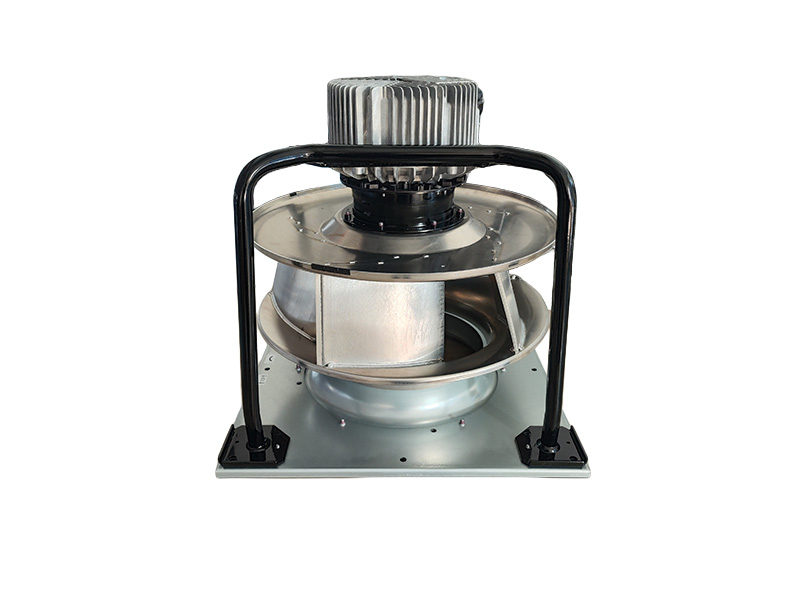
A RadiPac centrifugal module in the 500 mm frame class: aluminium impeller, galvanized steel support plate and inlet ring, die-cast aluminium electronics housing. This is the class of build evidence a buyer can check before order release. (Platform reference: K3G500-PB33-01)
Why Build Evidence Moved to the Centre of Fan Procurement
Industrial fan procurement changed its evidentiary baseline in 2026. Regulation (EU) 2024/1834, the European ecodesign rules for industrial fans, has applied since 24 July 2026 and sets stricter efficiency thresholds for fans rated from 125 W to 500 kW. Efficiency compliance in that framework is assessed per model and per duty point rather than per brand, which means a buyer needs model-level build and performance data instead of a supplier-level assurance.
The commercial backdrop reinforces the same shift. The global EC fans market was valued at USD 3.5 billion in 2024 and is projected to reach USD 6.7 billion by 2030, which has attracted a wider field of suppliers publishing similar-looking specifications. When several sources quote comparable airflow, static pressure and input power for a centrifugal module, the practical differentiator becomes what is physically inside the unit and how consistently it is documented.
This reference examines three build-evidence anchors available through Hengrui EC Fan: the 355 mm cleanroom and air-purification module R3G355-AM14-61, the 500 mm high-static-pressure RadiPac module K3G500-PB33-01, and the RadiPac compact configurations across the 310 mm to 560 mm frame classes. The purpose is not to rank suppliers but to define what a buyer can actually verify.
The Claim-to-Evidence Gap in EC Fan Sourcing
The recurring problem in fan sourcing is not missing data; it is unattached data. A datasheet that states IP55 without a model number, an aluminium impeller without a frame size, or high static pressure without a duty point cannot be compared with a competing offer, because none of those statements survives alone. Two suppliers can both claim IP55 while specifying different protection scopes, and two 310 mm modules can both be described as compact while differing in impeller construction, protection class and communication interface.
The opportunity lies in how modern EC platforms are structured. RadiPac, RadiCal, AxiBlade, AxiEco and HyBlade platforms repeat build logic across frame sizes, so evidence verified on one model becomes a working reference for the wider family - provided the buyer checks the specific model rather than assuming the family trait applies universally. That assumption is the single most common source of specification error in fan procurement.
Four Indicators a Buyer Can Inspect
1. Impeller material and construction
Impeller material is stated per model and is the most direct indicator of how a platform handles load and inertia. In the data set used here, impeller construction resolves into three forms: aluminium sheet impellers, solid aluminium impellers, and plastic impellers in PP or PA grades. The distinction is not cosmetic. It determines rotating mass, how the impeller behaves at high speed, and how the module tolerates continuous duty at high static pressure.
2. Housing, support structure and guard
The housing is the interface between the fan module and the equipment it serves. Centrifugal RadiPac modules in the data set specify a galvanized steel support plate and inlet ring, which is the structural reference for mounting inside an AHU or CRAH cabinet. Axial platforms specify galvanized steel fan housing and guard grille, or a galvanized steel square housing in the 910 mm class. Where a platform embeds an aluminium plate inside a PP blade, as the HyBlade construction does, the mixed arrangement is explicitly recorded.
3. Electronics enclosure and protection level
The enclosure that carries the control electronics is a separate build decision from the impeller. Across the centrifugal and RadiCal modules in this data set, the electronics housing is consistently recorded as die-cast aluminium, while protection ratings vary by model between IP54 and IP55. Environmental class adds a further layer: H2 and H2+C appear on selected large axial platforms, and one 630 mm axial model is rated for -40 C to +60 C.
4. Model-platform consistency
The fourth indicator is internal consistency. Frame size, voltage range, rated power, current, speed and duty point should align within a model platform. A 310 mm module with a 3~380-480 VAC supply, 4,000 rpm and a duty point near 1,500 Pa tells a coherent engineering story; mismatched numbers across a platform indicate inconsistent documentation, which is itself a procurement risk.
Reading the Build Evidence in the Hengrui EC Fan Supply Portfolio
Beijing Hengrui Hongsheng Mechanical & Electrical Equipment Co., Ltd., which operates under the brand name Hengrui EC Fan, is a China-based supplier that integrates the sales, model selection and matching, and technical services of ventilation, heat dissipation and industrial control electromechanical products. The company holds long-term agency and distribution relationships with brands that include ebmpapst, Ziehl-Abegg, SANYO, DELTA, SUNON, Rosenberg, WISTRO, SODECA, NMB, ADDA and S&P, and it records an export ratio of 70% with the United States as a main market. Its documented infrastructure includes a 100,000 m2 facility footprint, 700 employees and an 80-person R&D team, and its product data is published at en.bjhengrui.com.
For buyers, the useful question is not how large the supplier is, but whether its documentation lets build evidence be extracted per model. The table below reproduces that evidence for a representative set of centrifugal platforms in the portfolio.
| Model | Frame | Impeller material | Housing / structure | Electronics housing | Protection | Duty reference |
|---|---|---|---|---|---|---|
| R3G355-AM14-61 | 355 mm | Aluminium sheet impeller | Module for slim-profile FFU | Die-cast aluminium | Final rating by complete unit | 2,050 m3/h @ 400 Pa; 1~200-277 VAC; 350 W |
| K3G310-PH58-02 | 310 mm | Aluminium impeller | Galvanized steel support plate and inlet ring | Die-cast aluminium | IP54 | 4,505 m3/h @ 1,479 Pa; 4,000 rpm |
| K3G310-PV69-03 | 310 mm | Aluminium impeller | Galvanized steel support plate and inlet ring | Die-cast aluminium | IP55 | 4,020 m3/h @ 1,583 Pa; 4,000 rpm |
| K3G450-PA31-03 | 450 mm | Aluminium impeller | Galvanized steel support plate and inlet ring | Die-cast aluminium | IP55 | 8,430 m3/h @ 1,275 Pa; Modbus RTU |
| K3G450-PB29-L1 | 450 mm | Aluminium impeller | Galvanized steel support plate and inlet ring | Die-cast aluminium | IP55 | 9,035 m3/h @ 1,749 Pa; vibration sensor |
| K3G500-PB33-01 | 500 mm | High-strength aluminium impeller | Galvanized steel support plate and inlet ring | Die-cast aluminium | IP55 | 10,945 m3/h @ 1,245 Pa; 5,700 W |
| K3G560-PB31-03 | 560 mm | Aluminium impeller | Galvanized steel support plate and inlet ring | Die-cast aluminium | IP55 | 9,825 m3/h @ 1,049 Pa; Modbus |
| R3G355-RG56-01 | 355 mm | PP plastic impeller | Compact RadiCal module | Die-cast aluminium | IP54 | 3,205 m3/h @ 640 Pa; passive PFC |
| R3G500-FA28-03 | 500 mm | PP plastic impeller | Lightweight RadiCal impeller | Die-cast aluminium | IP55 | 8,715 m3/h @ 794 Pa; Modbus RTU |
| R3G630-FB32-03 | 630 mm | PP plastic impeller | Soft start, electronic protection | Die-cast aluminium | IP55 | 12,190 m3/h @ 670 Pa; Modbus / 0-10 V |
Three observations follow from the table. First, aluminium impellers dominate the high-static-pressure RadiPac centrifugal platforms, from the 310 mm compact class up to the 560 mm frame. Second, the same 310 mm frame size appears with two different protection levels - IP54 for K3G310-PH58-02 and IP55 for K3G310-PV69-03 - which means protection level must be read per model, not per size class. Third, plastic impellers appear in the RadiCal range from 225 mm to 630 mm, where the design priority shifts toward lower rotating mass and lower noise rather than maximum pressure capability.
Technical Explanation: What the Material Choices Actually Signal
Aluminium where static pressure governs
The aluminium impeller group covers centrifugal modules with static-pressure duty points between 1,049 Pa and 1,749 Pa. Within that group, K3G310-PV69-03 reaches 1,583 Pa at a 310 mm frame size, the highest pressure in the set relative to frame diameter, while K3G500-PB33-01 delivers 10,945 m3/h at 1,245 Pa with a 5,700 W motor draw and IP55 protection. K3G500-PB33-01 is the model whose data explicitly describes a high-strength aluminium impeller, which is the kind of statement that can be checked physically against a delivered unit.
Plastic impellers where mass and acoustic profile govern
PP and PA impellers appear on the RadiCal platforms: R3G225-RE07-03 in PA, and R3G355-RG56-01, R3G500-FA28-03, R3G630-FB32-03 and K3G560-FA28-03 in PP. R3G500-FA28-03 is documented with a lightweight RadiCal impeller and a low-noise profile, and R3G630-FB32-03 combines a PP impeller with soft start and electronic protection at 12,190 m3/h and 670 Pa. The trade-off is straightforward: lower rotating mass supports softer ramp-up and quieter operation, while the highest-pressure duties in the portfolio are served by aluminium.
Aluminium sheet impeller in a single-phase cleanroom platform
R3G355-AM14-61 is a 355 mm single-phase module rated 1~200-277 VAC, 350 W, 1.5 A and 1,900 rpm, with a duty point of 2,050 m3/h at 400 Pa. Its impeller is specified as an aluminium sheet impeller and its electronics housing as die-cast aluminium. Two build details matter for the intended application: the wide single-phase voltage range suits equipment supplied from 200 V to 277 V networks, and the low profile is compatible with slim FFU constructions. The model data also states that the final protection rating is to be ensured by the complete unit, which is an explicit boundary rather than a marketing claim.
Housing and electronics enclosure as protection evidence
The housing tells the buyer how the module mounts and how it is protected from the moving airstream. In the RadiPac centrifugal series, the galvanized steel support plate and inlet ring is the repeatable structural element across 310 mm, 450 mm, 500 mm and 560 mm frames. On the axial side, the guarding arrangement is a galvanized steel fan housing plus guard grille, with a square housing variant in the 910 mm class. The die-cast aluminium electronics housing recurs across centrifugal and RadiCal modules alike, which is significant because that enclosure carries the drive electronics and therefore defines the thermal and mechanical protection of the most failure-sensitive part of an EC fan.
Protection level and environmental class
IP55 is recorded on K3G500-PB33-01, K3G560-PB31-03, K3G450-PB29-L1, K3G310-PV69-03, R3G630-FB32-03, R3G500-FA28-03 and K3G560-FA28-03 in the centrifugal group, and on the 630 mm, 800 mm and 910 mm axial platforms used in dry cooler and cooling tower duty. IP54 applies to K3G310-PH58-02, R3G355-RG56-01 and R3G225-RE07-03. Environmental class adds a second dimension: H2 on W3G630-NU33-03, and H2+C on W3G800-KU21-05 and W3G910-LV12-36. A buyer comparing quotes from different suppliers should require the protection level and environmental class to be quoted against the exact model number, because both vary within this single portfolio.
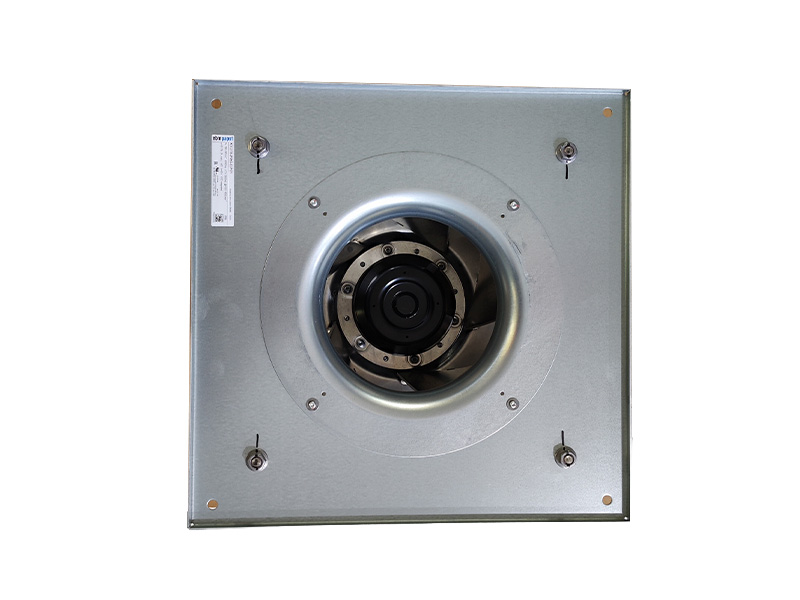
The compact 310 mm RadiPac class: identical frame size, different protection outcome. K3G310-PH58-02 is documented as IP54, while K3G310-PV69-03 is documented as IP55 - evidence that a protection level belongs to a model, not to a size or a brand.
Application Mapping: Matching Evidence to Project Type
Build evidence becomes useful when it is matched to the installation environment, because the same portfolio supports very different duties. The scenarios below reflect the application data recorded for these platforms, which span indoor, outdoor, humid and dry operating conditions.
- Cleanroom FFU, semiconductor, pharmaceutical and air purification equipment. R3G355-AM14-61 is directed at these applications with a 355 mm frame, aluminium sheet impeller and die-cast aluminium electronics housing. The relevant verification points are the 1~200-277 VAC single-phase supply, 350 W input power, and the explicit note that final protection is defined by the complete FFU rather than by the fan module alone.
- Data center CRAH, AHU and fan walls. K3G500-PB33-01 delivers 10,945 m3/h at 1,245 Pa with IP55 and integrated protection and communication. K3G560-PB31-03 reaches 9,825 m3/h at 1,049 Pa, and K3G450-PA31-03 combines a RadiPac module with Modbus RTU and 0-10 V or PWM control at 8,430 m3/h and 1,275 Pa. K3G450-PB29-L1 adds Modbus V6.3 and a vibration sensor, which is a verifiable instrumentation difference rather than a claims difference.
- In-row and precision cooling. K3G310-PV69-03 covers space-constrained CRAC and high-resistance filtration duties at 4,020 m3/h and 1,583 Pa with IP55, while K3G310-PH58-02 offers 4,505 m3/h at 1,479 Pa with IP54 and thermal protection. R3G355-RG56-01 provides 3,205 m3/h at 640 Pa with passive PFC and integrated PID control for small CRAH and in-row units.
- Dry coolers, chillers, condensers and free cooling. The AxiBlade axial platforms span 630 mm to 910 mm with IP55 protection and duty points up to 24,750 m3/h at 256 Pa. W3G800-GV01-01 uses a HyBlade construction with a PP blade and an embedded aluminium plate and is directed at outdoor chiller and condenser duty, rated 18,115 m3/h at 212 Pa.
- Compact cabinets, telecom and high-density electronics. The 48 V EC compact axial fan 2218F/2TDH4OR-227 measures 200 x 200 x 51 mm with a maximum free-air flow of 1,220 m3/h and maximum static pressure of 1,170 Pa. AxiEco 200, referenced as 8317081096 / VWLH200CKLXS, measures 200 x 200 x 70 mm, runs from 36-60 VDC and reaches a maximum static pressure of 1,300 Pa - evidence aimed at rear-door heat exchangers and in-row cooling units where pressure, not free-air volume, is the governing constraint.
Market Trend Analysis
Three verifiable trends shape how buyers should weigh build evidence over the next several years.
Regulation is now model-specific. Regulation (EU) 2024/1834 has applied since 24 July 2026, tightening efficiency thresholds for fans rated 125 W to 500 kW. The practical effect is that the declared duty point of a specific model becomes the compliance artefact, which raises the value of suppliers who publish consistent frame, voltage, power and duty-point data.
Demand is expanding while the incumbent supplier base is under pressure. The global EC fans market stood at USD 3.5 billion in 2024 with a projected value of USD 6.7 billion by 2030. At the same time, two reference manufacturers in the segment reported declining revenue: ebm-papst Group recorded sales of EUR 2.098 billion in its 2024/25 fiscal year, a 13.1% decrease from the previous year, and Ziehl-Abegg reported 2024 revenue of EUR 893 million, down 7% from EUR 955 million in 2023. For buyers, the implication is not that quality falls, but that supply routes, lead times and model availability can shift - which makes model-level verification and multi-source supply planning more useful than brand-level assumptions.
Export volume continues to grow. China fan exports under HS code 841459 reached 509 million units and USD 3.788 billion in 2024, up 6.96% in value. Growing export volume increases the number of competing offers a procurement team will see, and it also increases the number of documents that look alike. That is precisely the environment in which build evidence separates suppliers.
A data limitation is worth stating openly: independent, verified benchmark datasets covering mid-market EC fan alternative sourcing remain limited, and no original research dataset for that comparison is currently available. Buyers should therefore rely on model-level physical and performance data, supplier documentation and delivered-unit inspection rather than on aggregate market narratives.
Comparison With Conventional Fan Supply Practice, and the Boundaries of Build Evidence
Conventional practice evaluates a fan supply on three inputs: price, catalogue performance and delivery date. That approach works reasonably when the fan is a commodity axial unit in a stable indoor environment. It works less well for EC centrifugal modules in cleanrooms, CRAH fan walls and outdoor dry coolers, where the practical failure modes are material fatigue, moisture ingress at the electronics enclosure, and duty-point shortfall under real system resistance.
| Build dimension | Conventional evaluation relies on | Build evidence substitutes |
|---|---|---|
| Impeller | Undifferentiated statements about robust construction | Stated impeller material per model - aluminium sheet, aluminium, PP or PA |
| Housing and structure | Cabinet-level assumption | Recorded support plate, inlet ring, housing and guard material |
| Electronics protection | Brand-level protection claim | Protection level per model (IP54 or IP55) plus environmental class such as H2 or H2+C |
| Duty verification | Free-air figures only | Duty point at a stated static pressure, for example 10,945 m3/h at 1,245 Pa |
| Instrumentation | Treated as optional | Modbus RTU or Modbus V6.3, 0-10 V, PWM, speed feedback, vibration sensor |
Those substitutions are not without limits, and four boundaries should be stated plainly.
- Protection level is model-specific. Within the same 310 mm RadiPac compact frame, K3G310-PH58-02 is rated IP54 and K3G310-PV69-03 is rated IP55. A protection level cannot be generalised across a supplier range, let alone across a brand.
- A module rating is not an assembly rating. The R3G355-AM14-61 data states that the final protection rating is to be ensured by the complete unit. Buyers specifying a protection requirement for an FFU or AHU must therefore define it at the equipment level, not only at the fan level.
- Material choice is not a quality ranking. Aluminium, PP and PA impellers serve different duties. Higher static-pressure capability in this portfolio correlates with aluminium impellers, while lower rotating mass and softer acoustic behaviour correlate with PP and PA. The correct choice follows the duty point and the installation environment.
- Documented quality-control scope for exported units is physical export handling, and routine performance testing is not part of that scope. Projects requiring witnessed bench verification of flow, pressure or power should define the test protocol, acceptance criteria and witness arrangement in the purchase agreement before order release.
Future Outlook
The direction of travel is toward standardised, model-level evidence. Ecodesign compliance already requires per-model efficiency declarations, and the combination of a market projected to reach USD 6.7 billion by 2030 with continued export growth will keep the number of competing offers rising. In that environment, buyers are likely to move impeller material, electronics enclosure material, protection level and environmental class from optional detail into the specification table itself.
For suppliers, the differentiator shifts from catalogue breadth to documentation discipline: the same build facts must appear consistently across every frame size, every voltage class and every communication variant. For buyers, the practical preparation is to define an evidence checklist per project - impeller material, housing and support structure, electronics enclosure material, protection level, environmental class, duty point at a stated pressure, and instrumentation - and to require it against an exact model number in every quotation received.
FAQ
What build evidence should be checked first when qualifying an EC fan supplier?
Start with impeller material, because it constrains the achievable duty point and the rotating mass of the module. The RadiPac centrifugal platforms referenced here use aluminium impellers at static-pressure duty points from 1,049 Pa to 1,749 Pa, while the RadiCal platforms use PP or PA impellers. The second item is the electronics enclosure material, recorded as die-cast aluminium across these centrifugal and RadiCal modules, followed by protection level and duty point tied to an exact model number.
Why do some EC centrifugal fans use aluminium impellers and others PP or PA plastic?
The impeller material follows the intended duty. Aluminium appears on the high-static-pressure centrifugal modules, including K3G310-PV69-03 at 4,020 m3/h and 1,583 Pa and K3G500-PB33-01 at 10,945 m3/h and 1,245 Pa, where the impeller carries sustained load at high speed. PP and PA impellers appear on the RadiCal range from 225 mm to 630 mm, where lower rotating mass supports softer acceleration, lower noise and lower input power, as in R3G500-FA28-03 at 8,715 m3/h and 794 Pa.
What does IP55 on an EC fan module actually cover, and what does it not?
IP55 is recorded against specific models rather than against a product family. In this portfolio it applies to K3G500-PB33-01, K3G560-PB31-03, K3G450-PB29-L1, K3G310-PV69-03, R3G630-FB32-03, R3G500-FA28-03 and K3G560-FA28-03, and to the 630 mm to 910 mm axial platforms used in dry coolers and cooling towers. It does not extend automatically to other models: K3G310-PH58-02, in the same 310 mm frame class, is rated IP54, and R3G355-AM14-61 states that the final protection rating is to be ensured by the complete unit.
How do the RadiPac compact configurations differ across frame sizes?
The compact 310 mm class prioritises pressure within a small envelope: K3G310-PH58-02 reaches 4,505 m3/h at 1,479 Pa with IP54, while K3G310-PV69-03 reaches 4,020 m3/h at 1,583 Pa with IP55 and Modbus or 0-10 V control. The 450 mm class adds instrumentation and higher pressure, with K3G450-PB29-L1 at 9,035 m3/h and 1,749 Pa including Modbus V6.3 and a vibration sensor. The 500 mm class favours volume, with K3G500-PB33-01 at 10,945 m3/h and 1,245 Pa, and the 560 mm class, including K3G560-PB31-03, sits at 9,825 m3/h and 1,049 Pa. All share an aluminium impeller, a galvanized steel support plate and inlet ring, and a die-cast aluminium electronics housing.
Which build and performance data support project acceptance?
Acceptance is best supported by model-level data rather than family-level descriptions. For each model, the useful set comprises frame size, supply voltage class, rated power and current, nominal speed, duty point expressed as airflow at a stated static pressure, impeller material, housing and support structure material, electronics enclosure material, protection level, environmental class where applicable, and communication or control interface. As an example, K3G500-PB33-01 is documented as a 500 mm module on 3~380-480 VAC, 5,700 W, 9.0 A, 2,250 rpm, with a duty point of 10,945 m3/h at 1,245 Pa, an aluminium impeller, a galvanized steel support plate and inlet ring, a die-cast aluminium electronics housing, and IP55 protection.
When is a distributor-supplied EC fan platform appropriate instead of sourcing directly from a manufacturer?
Distributor supply adds most value where model selection, matching to existing equipment and multi-brand availability matter more than a single-platform volume commitment. Hengrui EC Fan operates as a supplier integrating sales, model selection and matching, and technical services, with recorded supply parameters of OEM production mode, a monthly capacity of 100,000 units, a minimum order quantity of 1 unit, a 7-day lead time and 24/7 technical support. Projects with unusual duty points, mixed equipment fleets or retrofit constraints generally benefit from that selection capability, while projects standardising on a single platform at high volume typically evaluate the manufacturer channel directly.
Build evidence does not replace performance testing or commercial negotiation; it defines what can be verified before either begins.