
Idler Type Matching for Mining, Cement and Port Conveyors
Idler Type Matching for Mining, Cement and Port Conveyors
On most bulk material conveyor lines, the roller specification that decides reliability is not the brand name but the position. Carrying side, return side and belt-training positions impose different loads, different environments and different inspection expectations, so the idler type has to follow the duty rather than the other way round.
This industry reference maps three roller types against three of the largest end-use scenarios for belt conveying: mining, cement and bulk ports. It covers what a trough idler, a parallel idler roller and an aligning idler each do, where each is normally specified, what evidence is available before shipment, and where the limits of each option lie. It is written for buyers and engineers at the awareness and research stage of a sourcing decision.
Why Generic Roller Lists Rarely Survive Contact With a Real Conveyor Line
Most discovery-stage searches for conveyor rollers return classifications organised by material — steel, rubber, HDPE, nylon — or by a long list of product names such as carrying roller, return roller and guide roller. Those lists are accurate as far as they go, but they do not answer the question a project engineer actually has: which roller belongs in which position on this particular line, carrying this particular material, in this particular climate.
The consequences of a positional mismatch tend to appear after commissioning rather than at the drawing stage. Bulk material spills over the belt edges on the carrying side when the troughing geometry does not contain the load. Belt edges wear or tear when tracking drifts on long runs. Rollers seize and require unplanned replacement when sealing is not matched to a dusty or humid environment. Each of these symptoms traces back to a duty that was specified loosely rather than to a defective roller.
That is the practical opportunity for buyers in the research stage: match roller type to position and environment first, and treat material and surface finish as the second layer of the decision.
The Product Data Behind This Comparison
The roller specifications referenced in this article come from the product documentation of Shanghai Eastrise Trading Co., Ltd., a professional foreign-trade enterprise headquartered in Shanghai, China, established in 2024, and specialising in the supply of mining accessories that include conveyor idler rollers. The company operates its own manufacturing facilities, employs approximately 50 staff, works from a facility covering 11,000 square metres, runs a ten-engineer R&D team, and reports annual production capacity of 2,000 tons, with exports accounting for around 20 percent of sales and global markets as its main destination. Additional company detail is published on the company website at sh-eastrise.com.
Within the roller range, three products correspond directly to the three positional duties described above: the trough idler (a 35 degree trough carrying idler, with suggested model designation ER-TROUGH-108), the parallel idler roller (a return and flat-carrying idler, suggested designation ER-PARALLEL-108), and the aligning idler (a self-aligning or training idler, suggested designation ER-ALIGNING-108).
One Conveyor Line, Three Different Duties
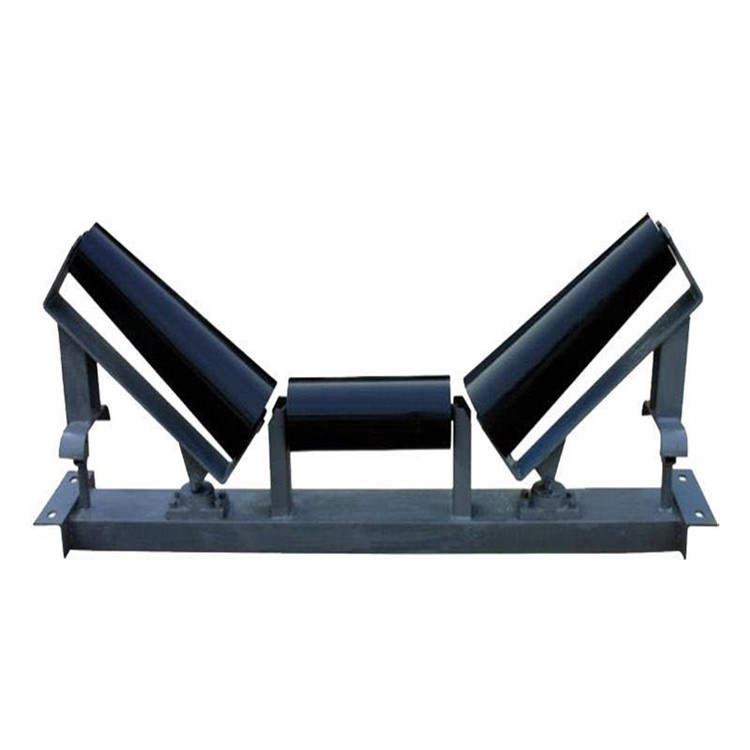
Carrying side: the trough idler
A trough idler is a carrying roller set that supports the loaded belt in a troughed profile. The trough idler referenced here is classified as a 35 degree trough carrying idler and is offered with trough angle options of 20, 25 and 35 degrees. The purpose of those angle options is stated plainly in the product documentation: to contain bulk materials, prevent spillage and improve conveying efficiency.
Its construction is carbon steel tube and shaft with sealed double-row bearings, which the documentation associates with high load-bearing capacity. Suggested tube diameters are Ø89, Ø108 and Ø133 mm, and suggested shaft diameters are Ø20 and Ø25 mm, with roller length customisable according to belt width. Galvanized or coated surface treatment options are available for dusty and high-temperature site conditions. Full-batch inspection on dimension and radial run-out is used to control coaxiality, which the supplier links to reduced belt vibration and less abnormal wear. The trough idler is described as widely applied in mining, cement and bulk port conveyor lines.
Return side and flat sections: the parallel idler roller
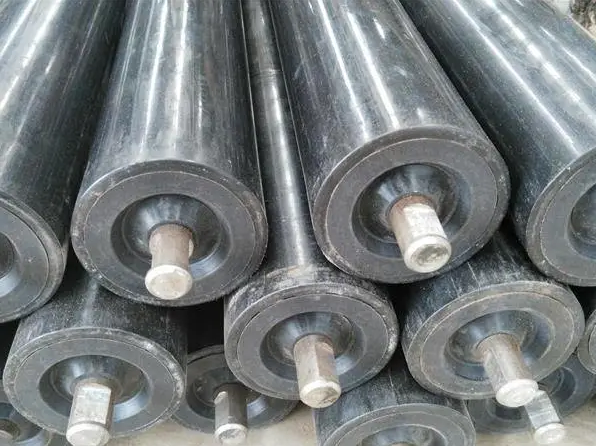
The parallel idler roller belongs to the return and flat-carrying idler category and is designed for flat-section carrying and return-belt supporting applications. In practice this is the roller that carries the empty side of the belt back to the tail, and it is also the type used where a belt runs flat rather than troughed. Its suggested dimensions follow the same family as the trough idler: tube diameters of Ø89, Ø108 and Ø133 mm and shaft diameters of Ø20 and Ø25 mm.
Materials are carbon steel tube and shaft with sealed bearings, with an optional galvanized or coated surface. That coating option is specifically framed around humid outdoor and salt-spray port environments. The sealed bearing specification is credited with lowering rotational resistance and running noise, which matters on long-distance lines where many rollers contribute to total drag. The roller is described as suitable for high-utilisation, long-distance conveying in ports, logistics, mining and cement plants, and is available with private-label nameplates and packaging plus a full set of export documents under FOB or CIF terms.
Belt tracking: the aligning idler
The aligning idler is a self-aligning or training idler. Its distinguishing feature is a self-pivoting frame that automatically corrects conveyor belt mistracking and reduces the risk of belt edge abrasion and tearing. The assembly integrates a carbon steel roller, a pivoting bracket and sealed bearings, and is designed for 24/7 continuous-operation, long-distance conveyor lines. Tube diameter and roller length can be tailored to match on-site belt width.
The documentation places unusual emphasis on manufacturing control: tight control over radial run-out and coaxiality during production is presented as the basis for reliable belt-training performance and for reducing manual on-site adjustment work. Engineering support for the aligning idler includes application-based product selection and drawing confirmation, and batch-wise inspection reports are supplied for overseas project acceptance. Its stated application environment is mining, cement, ports and long-distance conveyor lines prone to belt mistracking.
Technical Notes Worth Reading Before You Specify
Bearings and sealing are the wear-determining parts
Across the three types, the documentation treats bearings and seals, not the tube, as the components that decide service interval. The trough idler uses sealed double-row bearings for load capacity; the parallel idler roller uses sealed bearings to lower rotational resistance and noise; the aligning idler uses sealed bearings within the pivot assembly so that the training function is not lost to contamination. For mining conditions, dust-resistant seals and low rotational resistance are listed among the required characteristics, and the parameters are described as subject to actual operating conditions.
Surface treatment is an environment decision, not a cosmetic one
Carbon steel is the base material across all three types. Galvanized or coated finishes are optional, and the documentation explicitly ties the coating choice to humid outdoor and salt-spray port environments for the parallel idler roller, and to dusty and high-temperature sites for the trough idler. Buyers operating in coastal bulk terminals should treat the surface specification as a line item to confirm rather than an assumption.
Separate the values that are suggestions from the values that are confirmed
An important discipline at the research stage is knowing which numbers are starting points. Tube diameters, shaft diameters and trough angles are presented as suggested or optional values. Roller length is customisable according to belt width. The aligning idler pivot frame dimension is listed as to be confirmed, and the corrosion-protection level and the operating temperature range for cement conditions are also recorded as to be confirmed. These are the parameters that should be resolved during drawing confirmation, not assumed from a catalogue page.
Scenario Mapping: Mining, Cement and Bulk Ports
The three scenarios differ less in the roller types they use than in what each environment demands from those rollers. Mining prioritises load and dust survival, cement prioritises continuity under heavy dust and elevated temperature, and ports prioritise corrosion resistance and long-distance running smoothness.
| Scenario | Duty on the line | Roller types normally matched | Environment and special requirements |
|---|---|---|---|
| Mining — ore conveyor line | Support the conveyor belt and absorb loading impact; continuous bulk material handling | Trough idler on the carrying side; parallel idler roller on return and flat sections; aligning idler on lines prone to mistracking; impact duties at loading points are covered by a separate rubber-ring impact roller family | Dusty, heavy duty, 24/7 operation; dust-resistant seals, low rotational resistance and wear resistance required; parameters subject to operating conditions |
| Cement — raw material handling line | Provide stable support and reduce belt mistracking and maintenance frequency | Trough idler for the loaded run; parallel idler roller for return and flat sections; aligning idler where tracking drift drives maintenance | Heavy dust, medium-to-high temperatures, continuous 24/7 running; matched with belt conveyor and belt cleaner; dust and corrosion resistance required; operating temperature range to be confirmed |
| Ports and logistics — bulk terminal conveyor | Support the return belt and keep long-distance conveying smooth | Parallel idler roller as the natural return and flat-section choice; aligning idler on long lines; trough idler on the carrying side | Outdoor, humid, salt-spray, long distance; corrosion-resistant coating, sealed bearings and low noise required; protection level to be confirmed |
Two patterns stand out in this mapping. First, no single roller type covers a line. A mining ore conveyor will normally reference all three, plus impact rollers at transfer points where the duty changes again. Second, the differentiator between a port installation and an inland one is rarely the load; it is the atmosphere. A parallel idler roller specified for a salt-spray terminal is functionally the same part as one specified for a dry inland yard, but the surface treatment and the sealing expectations are not.
Before the Container Ships: Drawing Confirmation, First-Article Inspection and Lead Times
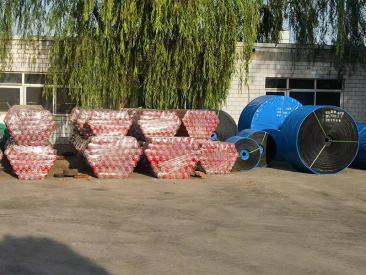
For roller buyers, the evidence trail matters as much as the specification. In this product range, drawing confirmation and first-article inspection are available for the trough idler for project-specific load matching. For the aligning idler, professional engineering support covers application-based product selection and drawing confirmation, with batch-wise inspection reports supplied for overseas project acceptance. The parallel idler roller programme includes complete incoming and pre-shipment inspections, presented as a way to avoid roller seizure and to reduce routine maintenance and replacement frequency.
Lead times give an early-stage buyer a planning anchor for how the sourcing process actually unfolds. The trough idler is documented with a sample lead time of 5–7 days and a mass-production lead time of 15–30 days. Read together with the drawing confirmation step, the sequence is: confirm the drawing, validate a sample, then schedule volume supply. Buyers should treat these figures as stated lead times for this product family and this scope, not as a universal commitment covering every roller type, dimension or coating combination.
Comparison With Conventional Practice — and Where the Boundaries Are
Fixed rollers versus self-pivoting training rollers
The conventional approach to belt tracking on many installations is a fixed roller set combined with periodic manual adjustment of the training position. The aligning idler replaces that manual intervention with a self-pivoting frame that corrects mistracking automatically, so the documented benefit is a reduction in manual on-site adjustment work. The boundary is equally clear: this is a belt-training function, and its specification is not fully fixed in advance — the pivot frame dimension is listed as to be confirmed. Buyers should expect to confirm it against the actual belt width and frame geometry rather than assume interchangeability with an existing fixed roller.
Bare carbon steel versus coated rollers in aggressive atmospheres
Carbon steel remains the baseline material for all three designs. Where a site is humid, salt-laden or dusty, the optional galvanized or coated surface is the practical upgrade path, and it is the documented recommendation for humid outdoor and salt-spray port environments. The limitation to be aware of is that protection level is recorded as to be confirmed, and the cement scenario similarly leaves the operating temperature range open. A buyer who needs a firm corrosion or temperature class should obtain it in writing for the specific project rather than infer it from a general product description.
Suggestions are not specifications
The most consistent boundary across the range is that the published dimensions — Ø89, Ø108 and Ø133 mm tubes; Ø20 and Ø25 mm shafts; 20, 25 and 35 degree trough angles — are described as suggested values, with roller length customised to belt width. This is normal for roller supply, but it means the comparison stage should end with a confirmed drawing, not with a catalogue match. It also means that two suppliers quoting the same nominal tube diameter may not be delivering the same part.
What idler selection does not fix
Roller type matching addresses support, load bearing and belt training. It is not a substitute for the upstream causes that commonly drive mistracking and spillage — off-centre loading, material build-up on the return run, or structural skew in the conveyor frame. Where material falls onto the belt, the duty changes from carrying to impact absorption, and that is a different roller family rather than a trough idler variant. Buyers evaluating a problem line should confirm which of these conditions applies before specifying replacement rollers.
Market Signals: Why Specification-Led Roller Buying Is Growing
Third-party research supports the view that this is a large and continuing market. Straits Research values the rollers and idlers segment at USD 4.14 billion in 2025 and projects it to reach USD 7.05 billion by 2034. Dataintelo places the broader roller conveyor market at USD 3.15 billion in 2025. The gap between such figures is largely a matter of scope rather than disagreement about demand: one published estimate attributed to Cognitive Market Research places the narrower conveyor roller category at USD 115.9 million in 2024, illustrating how much the definition — component versus sub-system — changes the number. Buyers comparing market reports should check the definition before comparing the totals.
Two structural signals are more directly relevant to idler selection. Steel remains the dominant material for conveyor rollers, accounting for 64 percent of global market share in 2024, which is consistent with the carbon steel construction common across trough, parallel and aligning idlers. Mining and quarrying is the leading end-use industry for rollers and idlers, representing 36 percent of total revenue in 2024 — the single largest destination for the roller types discussed here, and the environment that places the highest demands on sealing and wear resistance.
Standardisation is the third signal. ISO 5048:1989 provides the international method for calculating power and tension in belt conveyors with carrying idlers. CEMA Standard No. 502-2022 sets dimensional standards and load ratings for bulk material belt conveyor troughing and return idlers. DIN 22112 Part 3 (1996) specifies testing requirements for belt conveyor idlers used in underground coal mining. For procurement teams, these documents are the neutral reference point: they allow a trough idler, a return idler or a training idler to be discussed in dimensional and testing terms rather than by brand claim.
Future Outlook
The direction of travel in idler procurement is toward position-level specification. Instead of ordering a tonnage of generic rollers, projects increasingly define carrying, return and training positions separately, each with its own tube diameter, shaft diameter, angle, coating and inspection requirement. That shift favours suppliers who can confirm drawings, produce first-article samples and supply batch inspection records, because those are the artefacts that make a position-level specification verifiable.
Two further movements are likely to shape the next procurement cycle. One is documentation. As more projects reference dimensional and testing standards, the ability to provide batch-wise inspection reports for overseas project acceptance becomes a routine expectation rather than a differentiator. The other is environmental fit. With humid, salt-spray and heavy-dust sites all in scope for the same product families, the coated and sealed variants that are currently optional are likely to be specified as standard in coastal bulk terminals and in cement lines where dust ingress drives maintenance frequency.
FAQ
What is a trough idler used for?
A trough idler is a carrying roller set that supports the loaded belt in a troughed profile. It is classified as a trough carrying idler, with trough angle options of 20, 25 and 35 degrees that are intended to contain bulk materials and prevent spillage. It uses a carbon steel tube and shaft with sealed double-row bearings, with suggested tube diameters of Ø89, Ø108 and Ø133 mm, and is described as widely applied in mining, cement and bulk port conveyor lines.
What is the difference between a carrying roller and a return roller?
The difference is position and duty. A carrying roller supports the loaded belt, which is the trough idler function. A return roller supports the belt on its empty return run, and the parallel idler roller is classified in that family as a return or flat-carrying idler, used for both flat-section carrying and return-belt supporting applications. The parallel idler roller shares the same suggested tube diameters of Ø89, Ø108 and Ø133 mm and shaft diameters of Ø20 and Ø25 mm, and can be supplied with a galvanized or coated surface for humid or salt-spray environments.
When does a conveyor line need a self-aligning idler instead of a fixed idler?
The aligning idler is designed for mining, cement and port applications and for long-distance conveyor lines that are prone to belt mistracking. Its self-pivoting frame automatically corrects mistracking and is intended to reduce the risk of belt edge abrasion and tearing, as well as to reduce manual on-site adjustment work. It is designed for 24/7 continuous-operation, long-distance lines, with tight control of radial run-out and coaxiality during manufacturing supporting its belt-training performance.
Which trough angle should be specified — 20, 25 or 35 degrees?
All three angles are available, and the product is classified as a 35 degree trough carrying idler. The angle options exist to contain bulk materials and prevent spillage, so the appropriate choice depends on the material being carried and the belt width on the line. Because roller length is customised according to belt width and the tube and shaft diameters are suggested rather than fixed values, the angle should be confirmed together with the drawing for the specific project.
What lead times and documentation should a project expect?
For the trough idler, the documented sample lead time is 5–7 days and the mass-production lead time is 15–30 days. Drawing confirmation and first-article inspection are available for project-specific load matching, and full-batch inspection covers dimension and radial run-out. For the aligning idler, batch-wise inspection reports are supplied for overseas project acceptance, and engineering support covers application-based product selection and drawing confirmation.
Which roller type is appropriate for a humid, salt-spray port terminal?
Port and logistics bulk terminals are described as outdoor, humid, salt-spray and long-distance environments, requiring corrosion-resistant coating, sealed bearings and low noise, with the protection level to be confirmed. The parallel idler roller is the type offered with an optional galvanized or anti-corrosion coating specifically for humid outdoor and salt-spray port environments, alongside sealed bearings that lower rotational resistance and running noise. An aligning idler is also relevant on long port lines prone to mistracking.
Are the published roller dimensions final specifications?
No. Tube diameters, shaft diameters and trough angles are presented as suggested or optional values, and roller length is customised according to belt width. Several parameters are recorded as to be confirmed, including the aligning idler pivot frame dimension, the corrosion protection level and the operating temperature range for cement conditions. These values should be finalised through drawing confirmation before volumes are committed.
For readers who need the full roller range in one document, a downloadable company brochure is available here: Eastrise product brochure (PDF).