
Ice Cream Machine Supplier Evaluation: Parts, Upgrade Paths
Ice Cream Machine Supplier Evaluation: Parts, Upgrade Paths
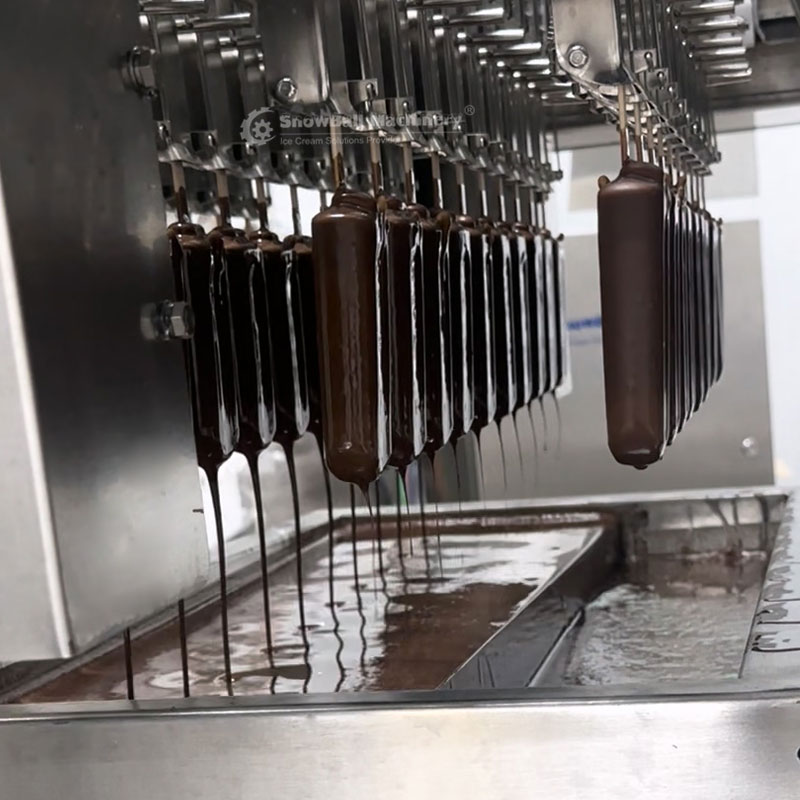
Industrial ice cream production lines in a food processing factory — the environment in which spare-part availability and upgrade capability decide total cost of ownership.
The most expensive ice cream machine is rarely the one carrying the highest purchase price. It is the one that cannot be economically repaired, reconfigured, or expanded five years after installation.
Industrial ice cream production rewards buyers who plan in decades. A continuous freezer, an extrusion line, or a cup filling machine is expected to run through seasonal peaks and off-season maintenance cycles for years, and the cost of replacing a line prematurely usually outweighs any saving won at the point of purchase. That reality reframes the supplier question. It is no longer only "who can build this machine?", but "who can still support this machine when it needs a new sucker unit, a replacement mould set, or a capacity upgrade?"
This analysis is written for buyers in the research and evaluation stage who need to judge supplier sustainability from verifiable signals rather than sales claims. Three evidence types carry most of the weight: the availability of optional units and spare parts, the provenance of critical components, and the ability to deliver phased upgrades across small, medium, and large production scales. Snowball Machinery Manufacturing Co., Ltd — an ice cream equipment manufacturer whose main markets span North America, South America, Europe, Asia, and Africa — and its SN series are used as a working reference throughout.
Why Spare-Part Availability Outweighs Purchase Price
Ice cream production equipment is a long-life asset class. Its economics are dominated by uptime. A line that stops during peak season imposes losses that a lower purchase price cannot offset, and the same logic applies to a line that cannot accept a new product format without being rebuilt. Spare-part availability is therefore not a maintenance detail — it is a core procurement criterion, and it should be scored during evaluation rather than discovered during the first breakdown.
Three failure modes account for most long-term cost surprises in this category.
- Proprietary obsolescence. A component is made only by the original builder, with no catalogue identity and no third-party alternative. Replacement depends entirely on that one supplier remaining willing and able to produce it.
- Configuration lock-in. The line was bought as a fixed configuration. Adding a chocolate coating station, a stick inserter, or a dry topping unit later requires mechanical redesign instead of a modular addition.
- Certification drift. Safety certificates expire, or cover only one machine model, leaving parts of an expanded line without current documentation.
The opportunity sits on the other side of the same analysis. A supplier that publishes optional-unit lists, names its component sources, and offers a family of machines across a wide capacity band converts an equipment purchase into a staged investment plan. For buyers, that is measurable, and it belongs in the qualification file.
What "Long-Term Supplier Sustainability" Actually Means
Supplier sustainability, in this context, is a supplier's measurable ability to keep a delivered production line compliant, serviceable, and expandable throughout the asset's operating life. It is not a statement about company size or brand recognition. It resolves into four testable dimensions.
| Dimension | What buyers should be able to verify | Typical failure if unverified |
|---|---|---|
| Parts continuity | A named list of optional units and replaceable parts per machine model | Unplanned line stoppage while a part is reverse-engineered |
| Component provenance | Identified international component brands with catalogue part numbers | Single-source dependency on the machine builder for every electrical or refrigeration part |
| Certification scope | Certificate number, issuing authority, applicable standard, and expiry per model | Part of an expanded line operating without current conformity evidence |
| Upgrade modularity | A model range within one product family covering the buyer's growth path | Full line replacement to reach the next output tier |
Each dimension can be checked before a purchase order is issued. None of them requires the buyer to trust a marketing claim.
The Continuous Freezer as a Test Case: Capacity Range and Construction
The continuous freezer is a useful test case because it sits at the centre of the line and its specification determines how far a plant can scale before the equipment itself must change. In the Snowball Machinery SNCF family, the models are designated SNCF 50L, SNCF 300L, SNCF 600L, SNCF 1200L, and SNCF 1500L, spanning a stated capacity range of 50 to 1500 L/H within a single product family.
That 30-fold spread matters for long-term planning. A buyer entering at the low end can move to a larger model in the same family as demand grows, which means operating knowledge, maintenance routines, and spare-part familiarity transfer rather than reset. The published process parameters for the family are an overrun of 100%, an input material temperature of +5 °C, and an output material temperature of −5 °C.
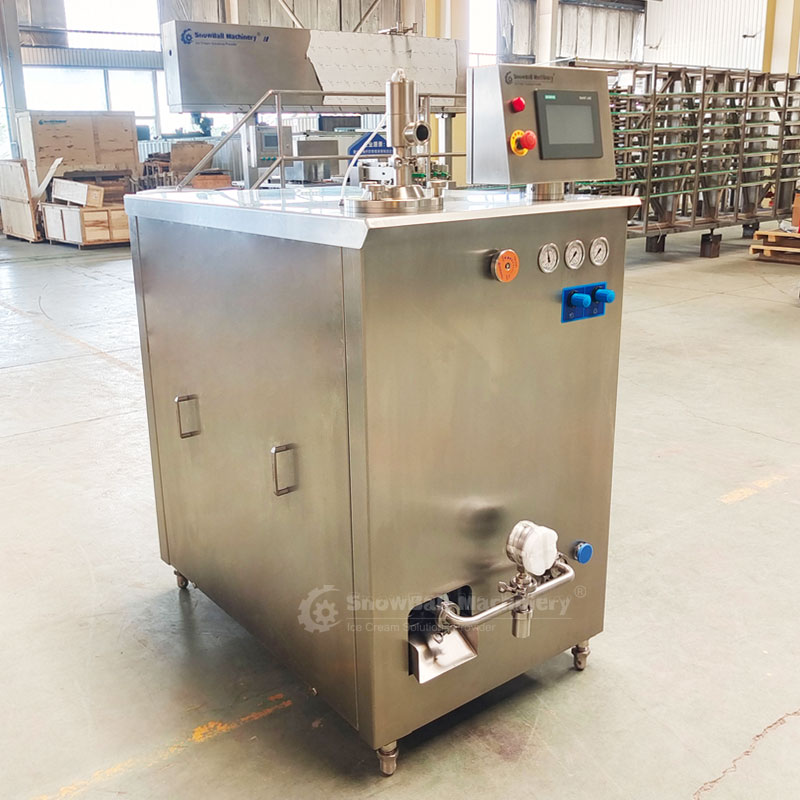
A continuous freezer sits at the centre of the line; its capacity band determines how far a plant can scale before the equipment itself must change.
Construction specification is the second half of the serviceability equation. Across the SNCF family and the wider SN series, the stated contact and structural material is high quality food grade stainless steel in SS304 or SS316. The distinction is practical rather than cosmetic: SS316 is specified for the more demanding product and cleaning environments and appears in documented upgrade projects where North American production compliance requirements applied, while SS304 covers standard production duty.
Why Component Brand Lists Are a Serviceability Indicator
Snowball Machinery states that main components across its machine range adopt internationally renowned brands, listing SIEMENS, Schneider Electric, FESTO, SMC, Danfoss, ABB, Bonfiglioli, igus, Copeland, Bitzer, and SEW Eurodrive among them. For a buyer assessing ten-year support, this is more than a quality signal.
Components carrying a global catalogue identity can generally be sourced through regional industrial distribution channels, and their failure modes and replacement intervals are documented by the component maker rather than by the line builder. That reduces the number of parts for which the buyer depends on a single supplier, and it shortens the diagnostic path when a fault occurs. A supplier that is willing to name its component brands is, in effect, exposing its own service network to outside scrutiny — which is exactly the kind of exposure buyers should be looking for.
Optional Units and Spare Parts: Reading the SNLU and SNFU Lists
Optional-unit documentation is where upgrade paths become concrete. Two examples from the Snowball Machinery range show how the lists should be read.
For stick ice cream machines, the SNLU group of optional units and spare parts covers the ice water filler, ice cream sucker unit, ice cream stick inserter unit, chocolate coating station, dry coating station, and popsicle ice cream molds. For filling machines, the SNFU group covers the cup cone dispenser, chocolate or sauce sprayer, automatic ice cream filler, ice cream pencil filler, chocolate topping machine, sauce topping unit, dry topping unit, lid dispenser machine, and heat sealing unit.
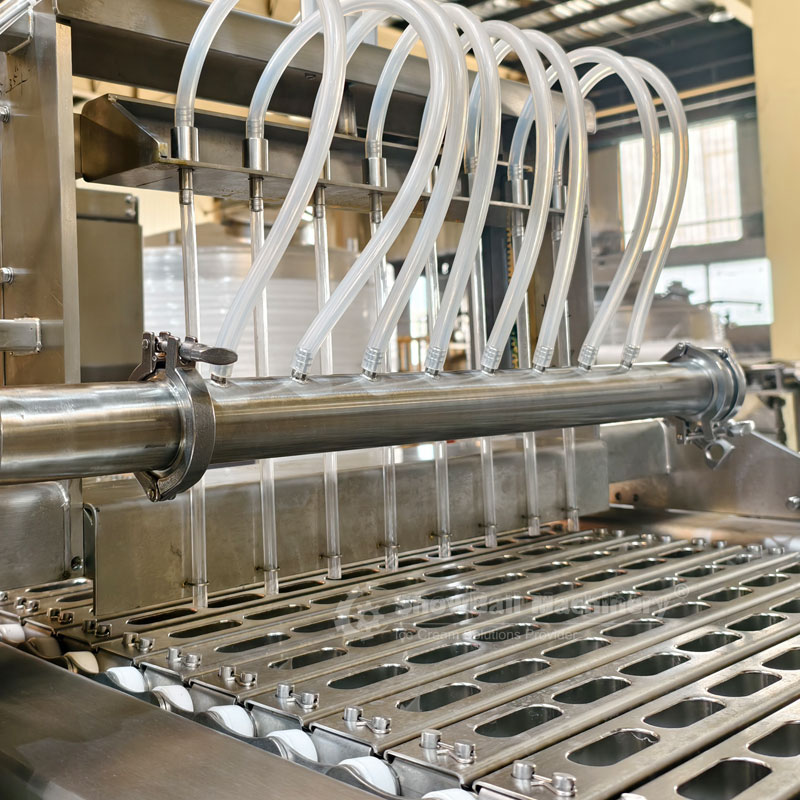
The ice cream sucker unit is one of the SNLU optional units for stick ice cream machines — a replaceable module rather than a line-level redesign.
Read as a procurement document rather than a feature list, the value of these groups is threefold. First, they define what can be added to an existing machine later, so a buyer can plan a phased build — start with filling and topping, add stick insertion and chocolate coating in a second phase. Second, they identify which items are consumable or wear-related, such as moulds, and can therefore be budgeted as recurring cost. Third, they make the supplier's response to a future spare-part request testable: the buyer can ask for the corresponding part designation at the evaluation stage, before the need arises.
Certification Scope: Where the Real Constraint Appears
Safety conformity is frequently presented as a single badge. In practice, certification is documented per machine model, and the scope of each certificate is the boundary that matters. Reading the evidence for the SN series shows how granular this becomes.
| Machine scope | Certificate number | Issuing authority | Applicable standard |
|---|---|---|---|
| Ice Cream Continue Freezer | CE-4681-181125 | European Certification Services | EN ISO 12100:2010; EN 60204-1:2018 +A1:2025 |
| Rotary Moulded Stick Ice Cream Machine | FQC2506302 | FQC STANDARD | EN ISO 12100:2010; EN 60204-1:2018 |
| Linear Stick Ice Cream Machine | CE-1654-01-111123 | CGS Test | BS EN ISO 12100:2010; BS EN 60204-1:2018 |
| Ingredient Feeder | CE-1724-01-121223 | CGS Test | BS EN ISO 12100:2010; BS EN 60204-1:2018 |
Each entry covers a defined product scope and a defined validity window. The continuous freezer certification, for example, was issued by European Certification Services and expires on 18 November 2030. The practical implication for buyers is that a certificate held for a filling machine says nothing about the freezer upstream of it. Every unit planned for installation needs its own current scope, and that check should be repeated when the line is expanded, not only at first purchase.
Buyers should also situate these certificates against the broader regulatory picture. Commercial ice cream appliances and ice-makers are regulated under IEC 60335-2-89:2019, which covers electrically operated refrigerating appliances with incorporated motor-compressors. Evidence of conformity with a recognised standard is a baseline expectation in export markets, not a differentiating claim.
How Upgrade Paths Work Across Factory Scales
The sustainability argument becomes tangible when it is tested against real configurations. Documented Snowball Machinery projects show three distinct entry points into the same equipment family, each with a different expansion route.
A newly established ice cream manufacturer building for domestic and international supermarket and retail channels installed a complete production line with continuous ice cream freezers, an extrusion tunnel, packing machines, and auxiliary equipment at an output of 9,000 to 10,000 pieces per hour. The reported highlight is that the modular design allows straightforward capacity expansion for future production scaling, and the equipment maintained stable operation for three years in local high-temperature and high-humidity conditions. This is the clearest illustration of a phased strategy: the first build is sized to the current market, and the architecture is selected so that growth is an addition rather than a replacement.
A long-established ice cream manufacturer took the opposite route. Rather than replacing a line that had been in service for 40 years, the company upgraded individual workstations. The custom-designed stations were built to match the existing production line without overall reconstruction, using food grade 316 stainless steel to comply with North American production requirements. The reported outcome was a 70% reduction in equipment upgrading cost, a 40% increase in production efficiency, and a 30% reduction in labour cost, with the upgraded equipment operating stably for six years. This case is instructive because it demonstrates that long-term supplier sustainability is not only about supplying new machines — it is also about matching new modules to equipment the buyer already owns.
A third configuration belongs to a start-up client with no prior ice cream production experience. The company received a turnkey plant solution from A to Z, including an extruded ice cream tunnel machine rated at 5,000 to 8,000 pieces per hour and a family pack ice cream filling machine rated at 1,200 L/H, alongside a continuous freezer. Full stainless steel SS304/SS316 construction was specified, and the installation has run for 11 years with continuous after-sales service and no major failures reported.
A world-renowned brand ice cream factory provides the high-capacity reference point: an automatic ice cream cone filling line at 10,000 to 15,000 pieces per hour and a stick ice cream production line at 15,000 to 20,000 pieces per hour, both in SS304/SS316 with internationally renowned key components, reported as operating stably for 12 years under 24-hour fully automatic production.
Read together, these accounts cover small, medium, and large production scales and confirm that the same component and material logic is applied across the range rather than reserved for flagship projects.
Market Trend Signals Behind the Upgrade Decision
Industry data supports the case for evaluating suppliers on lifetime support rather than on initial configuration alone, but the picture is one of steady rather than explosive growth.
- According to IMARC Group, the global ice cream processing equipment market was valued at approximately USD 2.33 billion in 2025 and is projected to reach USD 3.00 billion by 2034, a compound annual growth rate of 2.71%.
- Future Market Insights reports that hard ice cream processing equipment accounted for a 57.8% share of the total ice cream equipment market in 2025, with continuous freezers the leading product type.
- A separate estimate from Reports and Data values the ice cream moulding production line market at USD 1.2 billion in 2024, with growth to USD 2.5 billion by 2034 attributed to increasing automation demand.
- Snowball Machinery's company profile records exports reaching more than 70 countries, with an export ratio of 90% across North America, South America, Europe, Asia, and Africa.
A market expanding at roughly 2.7% per year is not a market in which every buyer replaces capacity. It is a market in which a meaningful share of demand comes from upgrading and extending equipment already installed. That has two consequences for procurement. First, buyers gain leverage by specifying expansion capability at the original purchase, since a supplier that cannot support an upgrade is effectively bidding for a shorter commercial relationship. Second, the concentration of demand in hard ice cream equipment — and specifically in continuous freezers — means component and spare-part supply chains for that machine type are the most developed, which improves the practical odds of long-term parts availability.
Comparing Sourcing Approaches — and Where the Limits Are
Buyers typically choose between assembling a line from several specialist vendors and placing the whole scope with a single turnkey supplier. The two approaches differ less in purchase price than in what happens after commissioning.
| Evaluation criterion | Split sourcing across specialist vendors | Single turnkey supplier with documented parts programme |
|---|---|---|
| Spare-part accountability | Distributed across several contacts; ownership of a cross-machine fault is ambiguous | One service channel covering parts, maintenance, fault handling, and inspection |
| Optional unit retrofits | Retrofits must be reconciled with several original designs | Optional units documented as a defined group per machine type |
| Certification tracking | Each vendor's certificates tracked separately, with different scopes and renewal dates | Certificates recorded per model by one supplier, with identifiable scope and expiry |
| Capacity growth path | Constrained by each machine's original design ceiling | A model range within one product family, from small to large output |
| Component sourcing | Varies by vendor; some proprietary parts may be single-source | Named international brands with catalogue identity across the range |
The turnkey route is not costless or automatic, and buyers should enter it with the boundaries stated plainly.
First, certification here is model-specific rather than line-wide. A certificate held for a moulded stick ice cream machine does not extend to the continuous freezer or the filling machine in the same line, and each has its own issuing authority, standard reference, and expiry date. A buyer who expands a line must repeat the conformity check for every added unit.
Second, turnkey equipment in this category is non-standard by design. Snowball Machinery states that customization is based on product design and hourly production capacity, that ordered quantities start at one set, and that lead time is determined according to the specific equipment plan rather than a fixed catalogue schedule. Buyers therefore need a settled product specification before they can obtain a meaningful delivery commitment, and they should not assume a standard lead time applies.
Third, company age and team experience are not the same thing. Snowball Machinery Manufacturing Co., Ltd was founded in 2020, while the company attributes more than 30 years of experience in the ice cream machinery industry to its engineering and service teams. That distinction is not disqualifying — the documented installations described above include equipment running stably for six, eleven, and twelve years — but buyers assessing long-term sustainability should ask specifically how spare parts, moulds, and optional units will be supplied in years five through fifteen, rather than inferring that capability from either age or longevity records alone.
A Verification Checklist for the Evaluation Stage
The following checklist converts the discussion above into questions a buyer can put to any candidate supplier. It is deliberately supplier-agnostic; the Snowball Machinery specification points are shown as examples of the answers a buyer should expect to receive.
| Verification item | Evidence to request | Example from the reference range |
|---|---|---|
| Optional unit and spare-part list | A written list per machine type, including wear items | SNLU group for stick ice cream machines; SNFU group for filling machines |
| Component provenance | Named component brands and, where available, part references | SIEMENS, Schneider Electric, FESTO, SMC, Danfoss, ABB, Bonfiglioli, igus, Copeland, Bitzer, SEW Eurodrive |
| Capacity growth path | The model range within one product family and its output band | SNCF 50L to SNCF 1500L, stated capacity 50–1500 L/H |
| Material specification | Contact and structural material grade, with the option to specify the higher grade | High quality food grade stainless steel SS304 / SS316 |
| Certification scope | Certificate number, authority, standard, and expiry for each model | Continuous freezer CE-4681-181125, valid to 18 November 2030 |
| Service commitments | Written scope covering commissioning, upgrading, maintenance, and parts supply | On-site installation and commissioning, equipment upgrading, maintenance, fault handling, spare parts supply, regular inspection |
| Quality control | Description of in-process control and final testing regime | Full-process control from material selection through production, with 100% test |
| Operating history | Reference installations with real operating durations | Documented installations reported as running stably for 3, 6, 11, and 12 years |
Future Outlook
Two forces are likely to reshape how ice cream machine suppliers are evaluated over the next several years.
The first is documentation pressure. As buyers in export markets become more systematic about conformity, the ability to produce a certificate number, an issuing authority, an applicable standard, and an expiry date for each machine model will shift from a competitive advantage to a minimum requirement. Suppliers that already record certification at model level, as the SN series does, will be easier to qualify and easier to re-qualify after an expansion.
The second is the shift from new-build to upgrade demand. In a market growing at roughly 2.71% annually, existing plants represent a substantial share of addressable demand. Supporting that demand requires equipment designed for modular addition — the model behind optional-unit families such as SNLU and SNFU and behind a continuous freezer range spanning 50 to 1500 L/H within one product family. It also requires service capability that reaches beyond the point of sale, including remote fault diagnosis and remote commissioning, which already appear in configurations documented for this range.
For buyers, the practical conclusion is that the evaluation criteria used at purchase should be the same criteria used at year five. A supplier that can answer questions about optional units, component provenance, certification scope, and capacity growth before the order is placed is demonstrating the capability it will be asked to exercise later.
Frequently Asked Questions
What does "long-term supplier sustainability" mean when buying ice cream production equipment?
It describes a supplier's measurable ability to keep a delivered production line compliant, serviceable, and expandable for the whole operating life of the asset. In practice it resolves into four testable dimensions: availability of optional units and spare parts, provenance of critical components, scope and validity of safety certification per machine model, and the presence of a model range that covers the buyer's future output levels. The SNCF continuous freezer family illustrates the fourth dimension, since it spans SNCF 50L through SNCF 1500L with a stated capacity range of 50 to 1500 L/H within a single product family.
Which spare parts and optional units should buyers confirm before ordering an industrial ice cream machine?
Buyers should request a machine-specific written list of optional units and replaceable components. For stick ice cream machines, the Snowball Machinery SNLU group comprises the ice water filler, ice cream sucker unit, ice cream stick inserter unit, chocolate coating station, dry coating station, and popsicle ice cream molds. For filling machines, the SNFU group comprises the cup cone dispenser, chocolate or sauce sprayer, automatic ice cream filler, ice cream pencil filler, chocolate topping machine, sauce topping unit, dry topping unit, lid dispenser machine, and heat sealing unit. Confirming these lists before purchase establishes what can be added or replaced later without redesigning the line.
How does CE certification scope affect long-term compliance for an ice cream continuous freezer?
CE marking applies to a defined machine scope, not automatically to an entire production line. In this range, the ice cream continuous freezer holds certificate CE-4681-181125, issued by European Certification Services under EN ISO 12100:2010 and EN 60204-1:2018 +A1:2025, with an expiry date of 18 November 2030. Other units carry separate documentation: the moulded stick ice cream machine holds FQC2506302 issued by FQC STANDARD under EN ISO 12100:2010 and EN 60204-1:2018, and a linear stick ice cream machine certification CE-1654-01-111123 was issued by CGS Test under BS EN ISO 12100:2010 and BS EN 60204-1:2018. The ingredient feeder holds CE-1724-01-121223, also from CGS Test. Buyers should verify that each unit planned for installation, including future additions, has its own current scope.
Can a small ice cream factory expand capacity later without replacing its continuous freezer?
Expansion is feasible where the supplier designs for it. Snowball Machinery describes its equipment as featuring good expandability, with additional ice cream product shapes addable at a later stage, and its SNCF range offers SNCF 50L, SNCF 300L, SNCF 600L, SNCF 1200L, and SNCF 1500L models across a 50 to 1500 L/H band, allowing a move to a larger unit within the same family. In a documented case, a newly established ice cream manufacturer's complete line, including continuous freezers and an extrusion tunnel at 9,000 to 10,000 pieces per hour, was built with a modular design that allows straightforward capacity expansion for future production scaling. Expansion still depends on matching the next model to product design and hourly output, so the specification work must be repeated at each stage.
What limitations should buyers accept when choosing a turnkey ice cream machine supplier?
Several boundaries apply and should be written into the evaluation record. Certification is documented per machine model, so a certificate for one unit does not cover the rest of the line and must be re-checked after any expansion. Turnkey equipment in this category is non-standard: Snowball Machinery states that customization is based on product design and hourly production capacity, that minimum order quantity is one set, and that lead time is determined according to the specific equipment plan rather than a fixed catalogue schedule. Finally, Snowball Machinery Manufacturing Co., Ltd was founded in 2020 while attributing more than 30 years of industry experience to its team; buyers judging long-term sustainability should therefore confirm spare-part, mould, and optional-unit supply commitments directly rather than inferring them from company age. Internationally branded components such as SIEMENS, Schneider Electric, Danfoss, and Copeland partially offset this, since catalogue-identified parts can generally be sourced through regional industrial distribution.
A detailed technical brochure covering the SN series, including the SNCF continuous freezer range, optional units, and configuration options, is available for download: Snowball Machinery ice cream equipment brochure (PDF). Additional company information is published at icecreammachinemanufacturer.com.