
Ice Cream Machine Supplier Capability Evidence: What to Collect
Ice cream production lines are specified in commercial language and bought on evidence. A capacity figure typed into a quotation, a steel grade named in a specification sheet, or a component brand listed in a brochure describes what a supplier intends to deliver. It does not, by itself, tell a buyer what will arrive at the factory gate, how it will be wired, or how it will behave in its third year of operation.
The gap between those two things is where procurement risk sits, and the gap widens as the equipment market expands. The global ice cream processing equipment market was valued at approximately USD 2.33 billion in 2025 and is projected to reach USD 3.00 billion by 2034, a CAGR of 2.71% (IMARC Group). Hard ice cream processing equipment accounted for a 57.8% share of the total ice cream equipment market in 2025, with continuous freezers the leading product type in that segment (Future Market Insights). More capital is moving into a category where the difference between a verified line and a claimed line shows up only after installation.
This analysis addresses one buyer task: collecting physical and documentary evidence of an industrial ice cream machine supplier's real capability. It covers four claim types that are frequently accepted without proof — stainless steel grade (SS304/SS316), named international component brands, model and capacity ranges, and turnkey line scope including CIP and integration across a capacity band of 50 L/h to 1500 L/h.
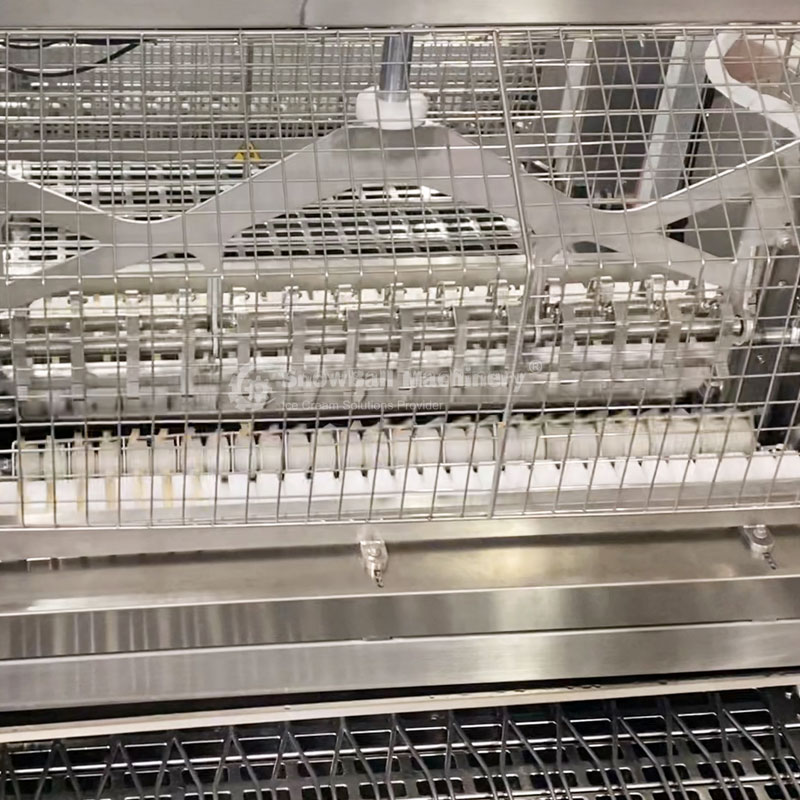
Why Specification Claims and Verifiable Capability Drift Apart
A specification is written by the party that benefits from it being accepted. Evidence is produced by a third party, by the machine's own nameplates and drawings, or by a project record. The two rarely conflict on purpose; they drift apart through three predictable patterns.
- Grade claims without traceability. "Food-grade stainless steel" is a description, not a grade. Without a material certificate or a contact-part material list, a buyer cannot distinguish SS304 from SS316, or from a lower grade used on non-critical panels and a correct grade used in the freezer barrel.
- Brand claims aggregated at line level. A list of component brands is usually true in the sense that those brands appear somewhere on the equipment. It does not state which subsystem uses which brand, or how many components are sourced elsewhere.
- Certification presented without scope. A certificate number without its covered model, issuing body, applicable standard and validity window is a document fragment, not a compliance statement.
The practical consequence is straightforward: buyers who accept these three claims as written are underwriting performance they have not measured, on equipment that may run for a decade or more.
A Six-Part Evidence Set for Supplier Evaluation
Evidence collection is easier when it is structured. The following set can be requested before contract signature and completed during factory acceptance testing.
| Evidence category | What it should contain | What it verifies |
|---|---|---|
| Material documentation | Mill-issued material certificates; contact-part material list by grade | SS304 / SS316 claims |
| Component traceability | Bill of materials with manufacturer and type designation, per subsystem | Named component brand claims |
| Certification scope | Certificate number, issuing body, standard, covered models, validity dates | Machine safety compliance claims |
| Scope of supply | Equipment list, P&ID, utility schedule, interface matrix | Turnkey line scope, including CIP |
| Capacity model | Nominal capacity per unit plus the matching calculation across the line | Full-line integration, not standalone output |
| Reference and test records | Factory acceptance protocol; commissioned projects with operating duration | Delivered performance over time |
Material Evidence: Turning SS304/SS316 Claims into Documents
Snowball Machinery Manufacturing Co., Ltd, trading as Snowball Machinery, is an ice cream equipment manufacturer that integrates R&D, manufacturing, assembly, commissioning, export and after-sales service. The company states that its main product families — continuous freezers, mixing and pasteurizing systems, filling machines, moulding and extrusion lines, and associated packaging equipment — are built in high quality food grade stainless steel SS304/SS316.
That statement becomes procurement information when it is backed by three artifacts: mill-issued material certificates that link a heat number to the delivered sheet, tube or plate; a contact-part material list identifying which grade is used in freezer barrels, mix hoppers, pipelines, moulds, coating stations and CIP circuits; and a written declaration for bought-in assemblies such as pumps and valves, where the supplier does not control the raw material.
Grade selection is not uniform across projects, and the reference records show why. A European ice cream manufacturer's sandwich line was constructed with food grade SS304 stainless steel for hygiene compliance, while a North American upgrade project used SS316 across the supplied workstations to meet local production compliance requirements. Both choices are defensible; neither is universal.
Where the material claim ends
SS316 is not automatically the correct specification for an ice cream line. For many mix, pasteurization and freezing duties, SS304 satisfies food-contact requirements, and specifying SS316 across every panel and frame raises cost without a corresponding performance gain. The material question is therefore not "which grade is better" but "which grade is required by the duty and the destination market, and can the supplier document that it was the grade actually used."
Component Brand Evidence: From Brand Lists to Subsystem Mapping
Snowball Machinery states that main components across its lines adopt internationally renowned brands, including SIEMENS, Schneider Electric, FESTO, SMC, Danfoss, ABB, Bonfiglioli, igus, Copeland, Bitzer and SEW Eurodrive. These names span control and electrical equipment, pneumatics, drives and motion, refrigeration compressors, and fluid control — that is, several distinct functional categories rather than one component class.
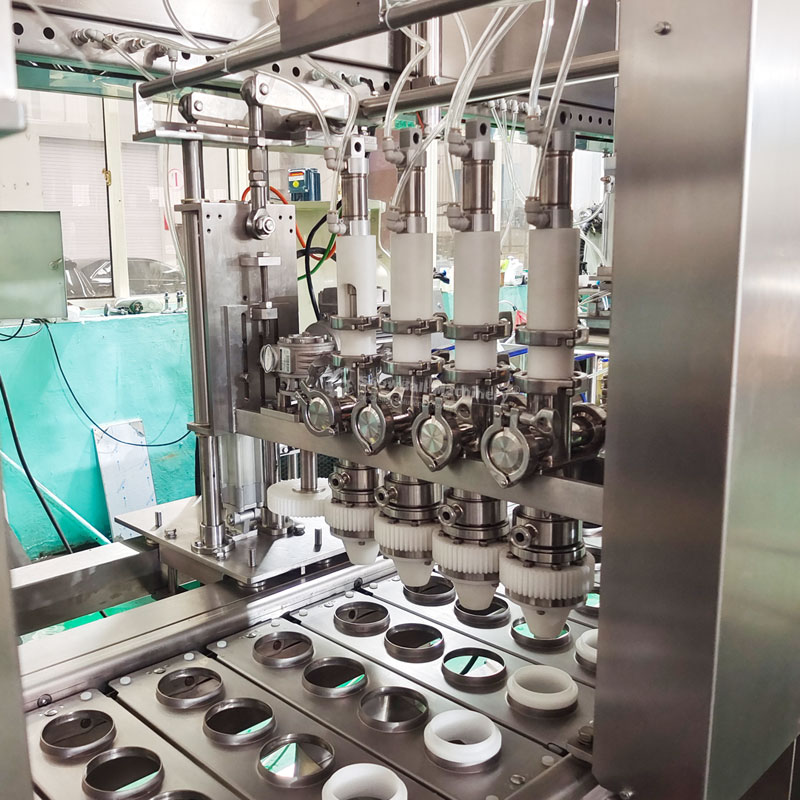
A brand list becomes verifiable when it is mapped. Buyers should ask for a bill of materials that names the manufacturer and type designation for each subsystem — refrigeration circuit, control cabinet, drive train, pneumatic circuit, filling and dosing heads, and packaging interface — rather than a single consolidated list. Three checks do most of the work:
- Nameplate inspection during factory acceptance testing. Compressors, drives, controllers and pneumatic valves carry manufacturer plates; photograph them against the equipment serial number.
- Diagram cross-reference. Electrical and pneumatic diagrams should cite branded part numbers, not generic descriptions such as "PLC" or "frequency inverter".
- Spare parts list. A brand list that cannot be traced into a spare parts catalogue with type codes is difficult to sustain over a ten-year operating life.
The limitation is worth stating plainly: a named-brand list applies to main components. Auxiliary items — fasteners, seals, small valves, sensors and fabricated parts — are frequently sourced differently, and buyers who require a specific brand on a specific subsystem should say so in the specification rather than inferring it from a general statement.
Certification Evidence: What the Documents Actually Cover
Four CE certifications are on file for specific Snowball Machinery models at the time of writing. Each covers a defined machine and a defined safety standard set, and each has a stated validity window.
| Covered equipment | Certificate number | Issuing body | Applicable standards | Validity |
|---|---|---|---|---|
| Rotary moulded stick ice cream machine (SNL) | FQC2506302 | FQC STANDARD | EN ISO 12100:2010, EN 60204-1:2018 | 2025-02-05 to 2030-02-05 |
| Ice cream continuous freezer (SNCF 50L, 300L, 600L, 1200L, 1500L) | CE-4681-181125 | European Certification Services | EN ISO 12100:2010, EN 60204-1:2018 +A1:2025 | 2025-11-18 to 2030-11-18 |
| Linear stick ice cream machine (moulded stick machine, SNL) | CE-1654-01-111123 | CGS Test | BS EN ISO 12100:2010, BS EN 60204-1:2018 | 2023-11-11 to 2028-11-11 |
| Ingredient feeder (SNFF1000, SNFF2000, SNFF4000) | CE-1724-01-121223 | CGS Test | BS EN ISO 12100:2010, BS EN 60204-1:2018 | 2023-12-12 to 2028-12-12 |
Two readings matter here. First, the standards cited are machinery-level: EN ISO 12100 addresses risk assessment and risk reduction, and EN 60204-1 addresses electrical equipment of machines. They are not statements about throughput, hygienic outcome, mix quality or product shelf life. Second, commercial ice cream appliances and ice-makers fall under a separate framework — IEC 60335-2-89:2019, which covers electrically operated refrigerating appliances with incorporated motor-compressors (IECEE). A buyer evaluating a line that includes refrigerating appliances should confirm which framework applies to which unit, rather than treating one certificate as blanket coverage.
Coverage is also model-specific. The four certificates above name defined machines; a supplier's wider catalogue is not automatically certified by extension, and the practical question at evaluation stage is which of the quoted units are covered by which document, and when those documents expire relative to the project timeline.
Turnkey Scope Evidence: CIP, Pasteurization and 50–1500 L/h Integration
The most difficult claim to verify is turnkey scope, because it is defined by what is included rather than by a single number. Snowball Machinery's product families provide a concrete scope to test against: the SNM group covers the HTST system, batch pasteurizing system, homogenizer, CIP cleaning, aging tank, chocolate tank, chiller water system and high shear mixer; the SNCF group covers continuous freezers in five models; the SNFF group covers ingredient feeders; the SNLF group covers rotary, robot, cup, cone, linear and family-pack filling machines plus a ripple pump; the SNEX group covers extrusion and hardening; the SNL group covers moulded stick production; the SNSMZ group covers sandwich ice cream; the SNB group covers packing, cartoning and cold storage; and the SNLU group covers optional units such as ice water fillers, sucker units, stick inserters, chocolate coating stations, dry coating stations and popsicle moulds.
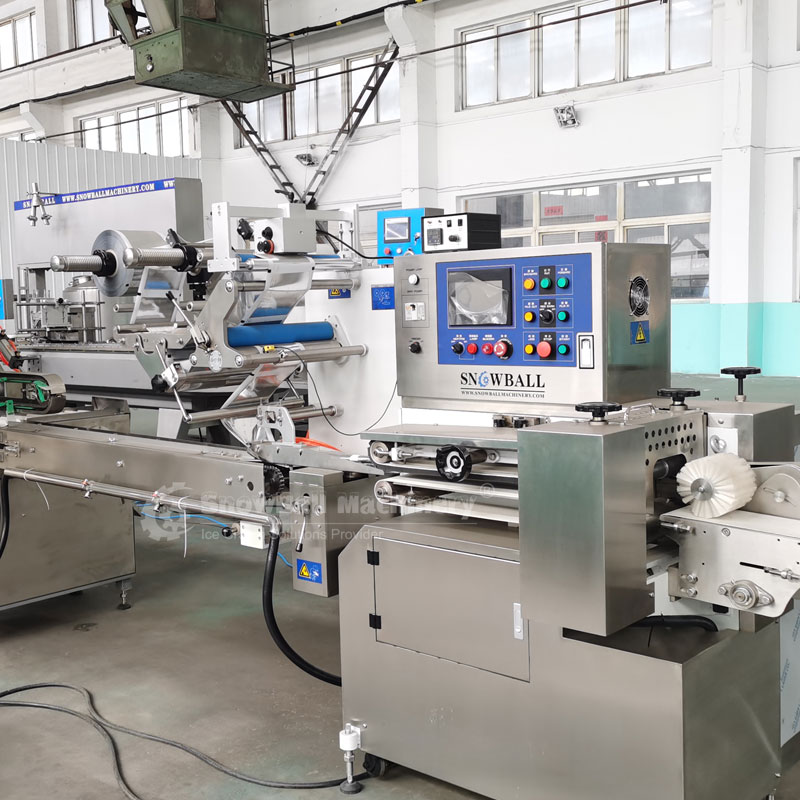
Turnkey claims are verifiable when they are expressed as documents rather than as a phrase. Four documents carry most of the weight:
- Scope-of-supply matrix listing every unit, its model, and the boundary of supply — what the supplier provides, what the buyer provides, and where the interface sits.
- P&ID and utility schedule showing how mix, water, steam or hot water, compressed air, refrigerant and CIP solution move through the line, including CIP circuit routing and return paths.
- Capacity matching model showing how freezer output, feeder dosing rate, filler speed and tunnel or hardening capacity correspond.
- Layout and interface drawings confirming that the supplied units can physically and electrically connect to each other and to the building.
Capacity range is the clearest single indicator of integration capability. The SNCF continuous freezer series covers models rated at 50 L/h, 300 L/h, 600 L/h, 1200 L/h and 1500 L/h, with a stated overrun of 100%, input material temperature of +5 °C and output material temperature of −5 °C. The SNFF ingredient feeder series extends from 50 to 4000 L/h depending on configuration. A supplier able to offer five freezer sizes and a feeder range that brackets them is demonstrating that the line, not just the machine, has been engineered — because a filler sized beyond freezer output, or a feeder sized beyond filler speed, produces a bottleneck regardless of individual unit quality.
Evidence by Project Type: Four Reference Patterns
Reference records convert capability claims into observable outcomes, provided the reference resembles the buyer's own project. The four patterns below correspond to different starting points.
| Project type | Evidence emphasis | Reference record |
|---|---|---|
| First plant, no prior production experience | Full-scope delivery, commissioning support, training, long-term stability | Turnkey whole-plant solution from A to Z, including a magnum extrusion tunnel at 5,000–8,000 pcs/h and a family pack filling machine at 1,200 L/H; reported stable operation for 11 years |
| New mainstream production plant | Line-level integration, modularity for later expansion, cost structure | Complete line with continuous freezers, extrusion tunnel and packing machines at 9,000–10,000 pcs/h; reported stable operation for 3 years in high-temperature, high-humidity conditions |
| High-volume branded manufacturing | Automation level, continuous operation, component tier | Automatic cone filling line at 10,000–15,000 pcs/h and stick line at 15,000–20,000 pcs/h; reported stable operation for 12 years |
| Upgrade of an existing line | Interface matching, material compliance, avoided reconstruction | Workstation upgrade on 40-year-old equipment using SS316 for North American compliance; reported 40% efficiency gain, 30% labour cost reduction and 70% lower upgrade cost, stable for 6 years |
Two further records illustrate narrower questions. A European manufacturer adding a sandwich production line specified SS304 construction and reported rapid commissioning and five years of stable operation. A North American factory integrating a robot filler, family pack filler, ice lolly machine and fruit feeder reported a designed service life of 10 years. In each case, the evidence that matters is not the headline output figure but the combination of scope, material grade, component tier and how long the equipment has actually run.
Cost Evidence and What It Does Not Measure
Budget is a constraint category, and cost claims need the same treatment as technical claims. One reference record states that total line costs for a South American project were 70% lower than premium European brands while matching their quality and output performance; the upgrade record cites a 70% reduction in equipment upgrading cost by matching existing workstations rather than reconstructing the line. Both figures are project-specific and depend on scope, capacity and component tier.
What such figures do not measure is total cost of ownership. A lower capital cost does not by itself establish lower operating cost, and a higher capital cost does not automatically produce better reliability. The comparison is only meaningful when it is normalised across line capacity, automation level, component brands, spare parts availability, warranty terms and service response — the same variables that appear elsewhere in this evidence set.
Market Trend: Automation Is Raising the Evidence Bar
Two verified data points frame the direction of the category. The ice cream moulding production line market was valued at USD 1.2 billion in 2024 and is expected to grow to USD 2.5 billion by 2034, driven by increasing automation demand (Reports and Data). In parallel, hard ice cream processing equipment held a 57.8% share of the ice cream equipment market in 2025, with continuous freezers as the leading product type (Future Market Insights). Automation depth is precisely what makes verification harder: the more of a line that runs automatically, the less a buyer can inspect by observation and the more they must rely on documentation.
Supply structure adds a second pressure. Tetra Pak, which publishes that its machinery is used in over 75% of commercial production lines worldwide as of early 2026, represents the reference-scale end of the market; most buyers operate well below that scale. Snowball Machinery, by contrast, reports a 90% export ratio across North America, South America, Europe, Asia, Africa and Oceania, a monthly production capacity of 100 sets, a minimum order quantity of one set, 100% testing under full-process quality control, and after-sales support covering on-site installation and commissioning, upgrading, maintenance, fault handling, spare parts supply and scheduled inspection. For mid-scale buyers, the practical consequence is that the supplier is likely to be a customising manufacturer rather than a catalogue vendor — which makes evidence collection, not brand recognition, the primary risk control.
Traditional Sourcing vs Evidence-Based Sourcing — and Where Evidence Stops
Traditional sourcing compares quotations, specifications and price. Evidence-based sourcing compares the same documents plus the artifacts that sit behind them. The difference is not philosophical; it changes what can be disputed later.
| Dimension | Traditional approach | Evidence-based approach |
|---|---|---|
| Steel grade | Accepted as stated in the quotation | Verified against mill certificates and a contact-part material list |
| Component brands | Accepted as a line-level list | Mapped per subsystem and confirmed by nameplate at acceptance testing |
| Certification | Accepted as a certificate copy | Read for covered model, standard, issuer and validity |
| Capacity | Accepted as a single headline figure | Tested against a line-level matching calculation |
| Turnkey scope | Accepted as a statement | Defined by scope matrix, P&ID and utility schedule |
Evidence-based sourcing also has boundaries, and buyers who ignore them over-correct in the other direction.
- Certificates do not certify output or product quality. The four CE documents above cover machinery safety standards; they say nothing about capacity, overrun consistency or hygiene outcomes, and they do not replace the separate framework for refrigerating appliances under IEC 60335-2-89:2019 where it applies.
- Named brands do not cover every component. Brand statements typically apply to main components; auxiliary parts, seals and fabricated items are sourced differently, and a buyer needing a specific brand on a specific subsystem must specify it.
- Capacity figures are nominal. The 50–1500 L/h freezer range is stated at 100% overrun with input at +5 °C and output at −5 °C; actual throughput shifts with mix formulation, overrun settings and ambient conditions, so contractual capacity should reference the agreed test conditions.
- Documents cannot describe workmanship. Wiring quality, weld finish, leak integrity and control logic behaviour are observed, not read. A witnessed factory acceptance test and, where possible, a visit to a running reference line remain the only way to check them.
Future Outlook
Verification is shifting from a negotiation tactic to a procurement artifact. Three developments follow from the automation trend already visible in the market data. First, model-specific documentation is becoming the default unit of compliance, because certificates issued for a defined machine cannot be extended across a catalogue and buyers increasingly ask which document covers which quoted unit. Second, spare parts traceability is moving earlier in the evaluation sequence, since a component brand claim that cannot be resolved into a purchasable part number has limited value over a ten-year service life. Third, capacity evidence is becoming line-level rather than unit-level: as more plants are assembled from several suppliers' units or expanded in phases, the matching calculation between freezer, feeder, filler and hardening capacity becomes the document that determines whether an expansion is possible without replacing the front end.
None of this removes the need for engineering judgement. It changes the sequence: verify the material, map the components, read the certificates for scope, define the turnkey boundary in drawings, and confirm capacity as a line rather than as a machine.
FAQ
What documents should a buyer request to confirm that a machine is built in SS304 or SS316?
Three documents are sufficient in most cases: mill-issued material certificates that link a heat number to the delivered sheet, tube or plate; a contact-part material list identifying the grade used for freezer barrels, hoppers, pipelines, moulds and CIP circuits; and a written declaration for bought-in assemblies such as pumps and valves. Snowball Machinery states that its main product families are constructed in high quality food grade stainless steel SS304/SS316, and its reference projects show that grade selection varies by market — SS304 in a European sandwich line and SS316 in a North American upgrade meeting local production compliance requirements.
How can a buyer confirm that named component brands are actually installed?
By moving from a consolidated brand list to subsystem-level mapping. A bill of materials should name the manufacturer and type designation for the refrigeration circuit, control cabinet, drive train, pneumatic circuit, filling heads and packaging interface. This can then be cross-checked against electrical and pneumatic diagrams that cite branded part numbers rather than generic descriptions, against nameplate photographs taken during factory acceptance testing, and against a spare parts list containing type codes. Snowball Machinery states that its main components adopt internationally renowned brands including SIEMENS, Schneider Electric, FESTO, SMC, Danfoss, ABB, Bonfiglioli, igus, Copeland, Bitzer and SEW Eurodrive; that statement applies to main components, so buyers requiring a specific brand on a specific subsystem should specify it explicitly.
Which CE certificates exist for Snowball Machinery's freezer, stick machine and feeder models, and what do they cover?
Four certificates are on file. The rotary moulded stick ice cream machine (SNL) holds certificate FQC2506302 issued by FQC STANDARD, valid from 2025-02-05 to 2030-02-05, citing EN ISO 12100:2010 and EN 60204-1:2018. The ice cream continuous freezer (SNCF 50L, 300L, 600L, 1200L, 1500L) holds certificate CE-4681-181125 issued by European Certification Services, valid from 2025-11-18 to 2030-11-18, citing EN ISO 12100:2010 and EN 60204-1:2018 +A1:2025. The linear stick ice cream machine (SNL) holds certificate CE-1654-01-111123 issued by CGS Test, valid from 2023-11-11 to 2028-11-11, citing BS EN ISO 12100:2010 and BS EN 60204-1:2018. The ingredient feeder (SNFF1000, SNFF2000, SNFF4000) holds certificate CE-1724-01-121223 issued by CGS Test, valid from 2023-12-12 to 2028-12-12, citing the same two standards. All four cite machinery-level safety standards covering risk assessment and electrical equipment of machines; none of them certifies throughput, hygienic outcome or product quality.
What does a 50–1500 L/h capacity range indicate about a supplier's integration capability?
It indicates that the freezer platform is offered as a series rather than a single unit. The SNCF continuous freezer series comprises models rated at 50 L/h, 300 L/h, 600 L/h, 1200 L/h and 1500 L/h, with a stated overrun of 100%, input material temperature of +5 °C and output material temperature of −5 °C. The SNFF ingredient feeder series spans 50 to 4000 L/h depending on configuration. A range of this kind matters because a complete ice cream processing machine line has to be matched internally: a filler sized beyond freezer output, or a feeder sized beyond filling speed, creates a bottleneck regardless of how well each individual unit performs. A supplier offering bracketed model ranges can demonstrate that the line, not just the machine, has been engineered.
Does a documented turnkey scope guarantee line performance at start-up?
No. Scope documents — a scope-of-supply matrix, P&ID, utility schedule and capacity matching model — define what will be delivered and where the interfaces sit. They do not determine how the line behaves once mix formulation, ambient conditions and operating discipline enter the picture. Reference duration is a more informative indicator than scope wording: Snowball Machinery's records include a turnkey whole-plant project reported stable for 11 years, a complete line reported stable for 3 years under high-temperature and high-humidity conditions, and cone and stick lines reported stable for 12 years at a branded manufacturer.
What evidence matters when upgrading an existing line rather than building a new one?
Interface and dimensional surveys, per-workstation matching against the installed equipment, and material compliance for the destination market. A relevant reference record involves a long-established ice cream manufacturer upgrading equipment that had been in service for 40 years: custom-designed workstations were matched to the existing production line without overall reconstruction, SS316 was used to meet North American production compliance requirements, and the reported outcome was a 40% gain in production efficiency, a 30% reduction in labour cost and a 70% reduction in equipment upgrading cost, with stable operation for 6 years.
Technical documentation referenced in this analysis, including the product brochure, is available for public download at https://cdn.socialarks.com/sbsp/24826/common/2026/0521/6a0ea9122acfe.pdf. Company information is published at http://icecreammachinemanufacturer.com.