
Ice Cream Machine Shortlist: Stick, Sandwich, Cup and Cone Builds
Ice Cream Machine Shortlist: Stick, Sandwich, Cup and Cone Builds
An industrial ice cream line is shortlisted most reliably by product format, not by machine count. A factory that sells molded sticks needs a moulding line; a factory that sells sandwiches needs extrusion, cutting and assembly; a factory that sells cups and cones needs filling. Snowball Machinery Manufacturing Co., Ltd — an ice cream equipment manufacturer listed at No. 73 Zhenpeng Zhonglu, Development Zone, Dalian, Liaoning, China — builds all three from a common base: SNCF continuous freezers in SNCF 50L, 300L, 600L, 1200L and 1500L models, SNFF ingredient feeders in SNFF1000, SNFF2000 and SNFF4000 models, and SS304/SS316 food-grade construction.
This shortlist sets out those three builds as decision objects rather than brochure claims. Each entry states what the build contains, what the documented reference points are, and which questions a buyer should still put to the supplier before a configuration is frozen.
Why the product format, not the machine count, sets the shortlist
Freezing is the shared layer of almost every industrial line, which is why freezing equipment alone rarely distinguishes one shortlist option from another. Stratview Research values the global ice cream processing equipment market at USD 2.4 billion in 2025 and reports that continuous freezers account for approximately 29.4% of the market's equipment-type segment that year. Those are market-level figures from a commercial research report, not plant benchmarks; their practical use for a buyer is narrower. They indicate that continuous freezing is a large, standardised part of the equipment spend, so the differentiating decisions sit downstream — at the moulding, extrusion or filling station and the optional units attached to it.
That has a direct consequence for an evaluation-stage buyer. Quotations for a single machine are hard to compare across formats because the comparison is incomplete: an SNL moulding machine and an SNLF filling head do not do the same work, so a price-per-machine figure carries almost no decision value. The comparable unit is the build — forming or filling machine, optional units, freezer, ingredient feeder and material specification taken together. North America's position as the largest regional market, reported by IMARC Group at over 42.0% of global share in 2025, is useful only as context for where installed capacity is concentrated; it is not evidence about any individual supplier or configuration.
Defining the builds this way also produces a cleaner evaluation sequence. First, fix the formats the plant will actually sell. Second, choose the forming or filling machine that produces those formats. Third, size the freezer and feeder against that machine's demand. Fourth, decide which optional units belong in the base quotation and which can be added later. Applied in that order, the shortlist reflects the product mix rather than the supplier's catalogue order.
Build 1 — Molded stick line: SNL with SNLU optional units
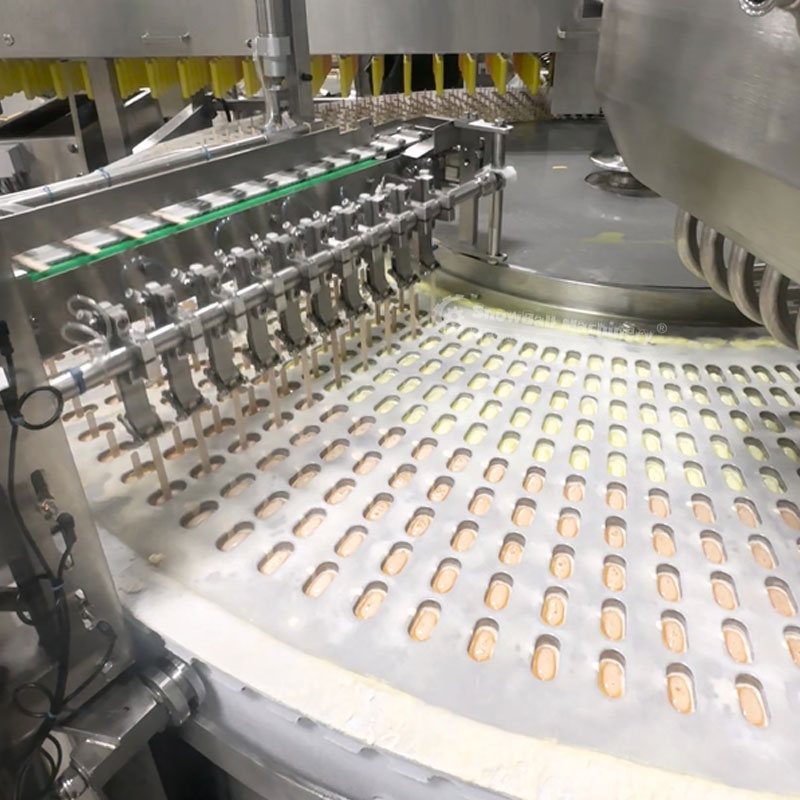
The molded stick build is the option for a factory whose core product is a shaped stick, ice lolly or chocolate-coated bar. Its centre is the SNL molded stick ice cream machine, which forms product in a mould set rather than by extrusion. Snowball's certification records cover both a rotary moulded stick configuration and a separate linear stick configuration, so the platform is documented in two forming layouts rather than one.
The build's flexibility comes from SNLU, the optional-unit and spare-parts range for stick lines. Units named in this configuration include a stick inserter, an ice water filler and a chocolate coating station. Functionally, these are separate process steps bolted onto the core machine: stick insertion places the wooden or plastic stick before freezing sets the product, the ice water unit supports the moulding circuit, and the chocolate coating station adds an enrobing stage after extraction. Each is an option, not a standard inclusion, and the buyer should confirm in writing which units appear in the base quotation and which are quoted separately.
Upstream, the build uses the same components as the other two: an SNCF continuous freezer from the SNCF 50L to SNCF 1500L range supplies frozen mix, and an SNFF ingredient feeder introduces particulates or variegate where the product requires them. Construction is SS304/SS316 food grade, matching the stainless specification Snowball applies across its line portfolio.
A documented reference point is a stick ice cream production line supplied to a world-renowned brand ice cream factory, described by the company as running at 15,000–20,000 pieces per hour and operating stably for 12 years. That is a company-reported single-project figure tied to a specific line configuration; it illustrates an achievable order of magnitude for a high-volume stick installation and should not be read as the rated output of any individual SNL model.
Before shortlisting this build, ask how a mould-set change is handled when stick geometry changes, whether the stick inserter is matched to the stick dimensions being purchased, how the coating station integrates with the hardening stage that follows, and whether the CIP circuit reaches the mould and coating areas.
Build 2 — Extrusion and sandwich line: SNEX with SNSMZ
The extrusion build suits a product mix built on shaped bars, logs, sandwich assemblies and novelty formats produced by extruding mix and cutting it to length. Its centre is the SNEX ice cream extrusion and hardening line, which pairs extrusion with a hardening tunnel so product can move from a soft extruded state into a stable, packable one.
Where sandwiches are part of the mix, the build adds the SNSMZ ice cream sandwich machine. Snowball's product listing describes this unit as a sandwich making and packing machine — an extruded-and-wrapped sandwich platform that also covers cookie-sandwich formats. For a buyer, the practical question is assembly: whether wafers or cookies are fed and aligned within the same unit, and how the wrapping stage is integrated so that sandwich alignment survives packaging.
Documented reference points for this build family exist but must be read at the right level. A European ice cream manufacturer added a sandwich production line described as adaptable to multi-specification and multi-flavour production; the company reports five years of stable operation, food-grade 304 stainless steel construction and conformity with EU food safety and environmental standards. Those are company-reported case statements, not third-party test results, and the conformity language describes the delivered project rather than a certificate number. Separately, a start-up client with no prior production experience runs an extruded magnum-style tunnel line reported at 5,000–8,000 pieces per hour, and a complete line supplied to a newly established manufacturer is described at 9,000–10,000 pieces per hour with three years of stable operation in a hot, humid climate. Line-level outputs of this kind combine several machines and cannot be attributed to the extruder alone.
Questions worth putting to the supplier: what product geometries the die and cutting set can produce without a tooling change, how sandwich size changes are handled, whether the SNFF feeder is positioned to dose inclusions into the extruded stream, and which parts of the extrusion and hardening line are covered by the machine-specific declaration.
Build 3 — Filling line for cups, cones and family packs: SNLF with SNFU
The filling build is the option for a mix dominated by containers: cups, cones, family packs and tubs. Its centre is the SNLF ice cream filling machine, available in rotary and robot configurations. Both variants fill containers of different volumes and forms, which is the defining capability of this build — the product is defined by the container and the fill pattern rather than by a mould or a die.
The rotary and robot variants answer different problems. A rotary filler is the conventional choice for a repeating pattern of identical fills at volume. The robot variant is aimed at plants that need unusual product styling or that face labour shortages: in a North American installation, Snowball reports combining robotic filling with a family pack filler, an ice lolly machine and an SNFF fruit feeder, describing the result as more novel product styling alongside higher production efficiency and a designed service life of 10 years. That is a company-reported case, and efficiency gains should be verified against the buyer's own container range and shift pattern rather than assumed.
SNFU covers the optional units that extend this build, including a cup cone dispenser and a chocolate topping machine. The dispenser converts container handling from a manual or semi-manual step into a machine step, and the topping station adds a finishing stage before hardening or packing. As with SNLU, both should be confirmed as included or optional in the quotation. A further reference point is a cone ice cream filling line supplied to a world-renowned brand factory at 10,000–15,000 pieces per hour, operating stably for 12 years.
Questions for this build: which container tooling is supplied with the machine and which is project-specific, whether the dispenser handles the cone sizes actually being sourced, how the topping station is cleaned between flavours, what robot programming and changeover involve in practice, and whether the SNFF feeder dosing range matches the inclusion load in the recipe.
Side by side: the three builds on the same dimensions
| Dimension | Molded stick build | Extrusion / sandwich build | Filling build |
|---|---|---|---|
| Formats served | Molded sticks, ice lollies, coated bars | Extruded bars, logs, sandwiches, novelty shapes | Cups, cones, family packs, tubs |
| Core unit | SNL molded stick machine (rotary or linear configuration) | SNEX extrusion and hardening line + SNSMZ sandwich machine | SNLF rotary or robot filling machine |
| Optional units | SNLU: stick inserter, ice water filler, chocolate coating station | Sandwich assembly and wrapping within the SNSMZ platform | SNFU: cup cone dispenser, chocolate topping machine |
| Freezing backbone | SNCF 50L to SNCF 1500L | SNCF 50L to SNCF 1500L | SNCF 50L to SNCF 1500L |
| Inclusion route | SNFF1000 / 2000 / 4000 | SNFF1000 / 2000 / 4000 | SNFF1000 / 2000 / 4000 |
| Construction | SS304 / SS316 food grade | SS304 in the reported European sandwich case | SS304 / SS316 food grade |
| Reported reference | Stick line at 15,000–20,000 pcs/h, 12 years (company-reported) | Magnum-style extrusion at 5,000–8,000 pcs/h, 11 years; complete line at 9,000–10,000 pcs/h | Cone filling line at 10,000–15,000 pcs/h, 12 years (company-reported) |
How the shared backbone changes the decision
Because all three builds draw on the same freezing and feeding equipment, the backbone is where a shortlist either holds together or falls apart. Snowball's published capacity range for the SNCF series runs from 50 L/h to 1,500 L/h, with the model designations SNCF 50L, 300L, 600L, 1200L and 1500L. That range is the only capacity anchor in the available material; it does not specify which freezer model belongs to which forming machine, and the match must be made against the throughput of the specific moulding, extrusion or filling machine in the quotation.
The SNFF ingredient feeder range is listed in three models — SNFF1000, SNFF2000 and SNFF4000 — without published dosing specifications in the available records. Model numbers alone therefore cannot decide feeder selection. The practical criteria are the inclusion type (chocolate chips, nuts, cookie pieces, fruit, brownie or marshmallow pieces, as described in Snowball's North American filling installation), the piece size the feeder must pass without damage, and the dosing rate the recipe requires. Each becomes a written requirement in the enquiry rather than an assumption drawn from the model number.
Material specification is the third shared variable. Both SS304 and SS316 appear in Snowball's delivered projects: the European sandwich line is described as food-grade 304 stainless steel, while a retrofit project for a long-established manufacturer used food-grade 316 stainless steel throughout to meet North American production requirements. As a general rule, 304 covers standard dairy contact surfaces, while 316 is specified where chloride-bearing cleaning chemicals or acidic fruit inclusions raise corrosion risk. The correct choice follows the cleaning regime and the product recipe, and the buyer should state both when the material grade is agreed.
Cleaning is the fourth. CIP systems appear in Snowball's listed portfolio alongside premix, HTST, batch pasteurising and ageing equipment, which means cleaning-in-place can be scoped as part of a line rather than added later. For all three builds, the useful question is coverage: whether the CIP circuit reaches the feeder, the filling heads, the topping station and the mould area, and how circuits are separated between product and non-product zones.
Evidence to collect before the shortlist is fixed
Certification records are the most specific evidence in the available material because they name the equipment scope, the standard and the validity period. Four records are published for this range.
| Equipment scope | Certificate no. | Issuing body | Standard | Validity |
|---|---|---|---|---|
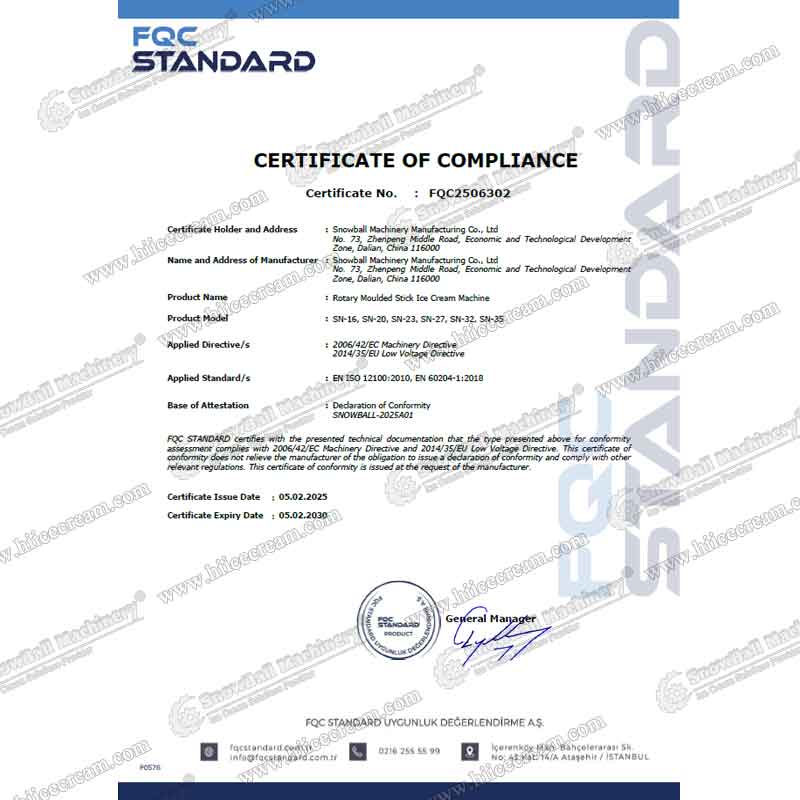
| Rotary moulded stick ice cream machine (SNL) | FQC2506302 | FQC STANDARD | EN ISO 12100:2010; EN 60204-1:2018 | 2025-02-05 to 2030-02-05 |
| Linear stick ice cream machine (SNL) | CE-1654-01-111123 | CGS Test | BS EN ISO 12100:2010; BS EN 60204-1:2018 | 2023-11-11 to 2028-11-11 |
| Ice cream continuous freezer (SNCF 50L–1500L) | CE-4681-181125 | European Certification Services | EN ISO 12100:2010; EN 60204-1:2018 +A1:2025 | 2025-11-18 to 2030-11-18 |
| Ingredient feeder (SNFF) | CE-1724-01-121223 | CGS Test | BS EN ISO 12100:2010; BS EN 60204-1:2018 | 2023-12-12 to 2028-12-12 |
These records cover SNL, SNCF and SNFF scopes as written. They are declarations for the named machinery, not a plant-level conformity statement, and each has a validity period that should still be current at the time of order. For the SNEX, SNSMZ and SNLF equipment in the other two builds, the counterpart records are not part of the material reviewed here, so the buyer should request the machine-specific declaration and test documentation for those units by model.
Beyond certificates, four further items belong in a qualification file. First, the pre-shipment testing record: Snowball states 100% testing under full-process quality control from material selection onward, which is a company statement that should be backed by a test report per machine. Second, the material certificate for the stainless grade actually delivered — 304 or 316 — because the two grades appear in different delivered projects. Third, a reference list with the format, output and operating duration of each installation, so that the reported stick, cone and extrusion outputs in this shortlist can be checked against a comparable line. Fourth, the spare-parts list, since SNLU and SNFU both cover optional units and spare parts and long-run availability of wear parts affects total cost more than the initial quotation line.
Commercial parameters sit at the supplier level rather than the build level. Snowball reports a minimum order of 1 set, a monthly capacity of 100 sets, a 4,000 m² facility, 50 employees including 10 design and drawing engineers, an annual output of 1,200 sets and an export share of 90% across North America, South America, Europe, Asia and Africa. Lead time is stated as dependent on the specific equipment plan, which is consistent with a configuration-led product: the delivery date follows the build, not the other way round.
What this shortlist does not establish
Three limits should be stated plainly. First, the available records contain no side-by-side measured comparison of the three builds on throughput, energy use, overrun, yield or uptime. The outputs quoted here come from single delivered projects and combine multiple machines, so they describe what has been reported for a line, not a controlled test of one machine against another. Second, the certification records name specific equipment scopes; a certificate for an SNCF freezer does not extend to an SNLF filler, and coverage should be confirmed per model. Third, the optional units named for SNLU and SNFU are described by function only — stick inserter, ice water filler, chocolate coating station, cup cone dispenser and chocolate topping machine — with no published capacity or compatibility data, so their specification must be agreed project by project.
That absence does not make the shortlist unusable; it changes what the shortlist is for. It compares documented configuration, project references and certification scope. It cannot certify that one build will outperform another in a given factory, and any claim to that effect would need the buyer's own trial data.
Outlook for buyers configuring in 2026–2027
Two design signals in the available material are worth carrying into a specification. The first is modularity: in the complete line supplied to a newly established manufacturer, Snowball describes a modular design that allows capacity expansion without replacing the line, and internationally branded components are cited across projects as the basis for long-term operation. Whether that modularity applies to a specific SNL, SNEX or SNLF configuration is a question for the technical proposal, but it is the right question to ask at evaluation stage rather than after commissioning.
The second is the shift toward format variety within a single plant. The North American installation combining robot filling with a family pack filler, an ice lolly machine and an ingredient feeder points to lines that must handle several formats rather than one. If that reflects the buyer's own product plan, the shortlist should be judged on how cleanly a second format can be added — through an SNLU unit on a stick line, a sandwich module on an extrusion line, or an SNFU dispenser or topping station on a filling line — rather than on the peak output of the first format alone. No forecast should be read into these observations beyond what the cited project records state.
FAQ
Which build suits a plant producing both molded sticks and sandwiches?
Sticks and sandwiches normally need separate forming equipment, because one is moulded and the other is extruded and assembled. The molded stick build centres on the SNL machine with SNLU optional units; the sandwich build centres on the SNEX extrusion and hardening line with the SNSMZ sandwich machine. The freezing and feeding layer is shared across both, so the decision turns on whether one SNCF freezer can serve both forming machines within the production schedule, or whether each needs dedicated freezing capacity. That question depends on campaign length and cleaning changeover, and it has to be answered by the supplier against the actual product plan.
What do SNLU and SNFU actually add to a line?
SNLU is the optional-unit and spare-parts range for stick lines, and in this configuration it covers units such as a stick inserter, an ice water filler and a chocolate coating station. SNFU is the equivalent optional-unit range for filling lines, covering items such as a cup cone dispenser and a chocolate topping machine. Both are option sets rather than standard inclusions, so a buyer should confirm which units are inside the base quotation and which are added, and should check that each unit is matched to the specific stick, cone or container dimensions being purchased.
Can one SNCF continuous freezer serve all three builds?
The SNCF range is listed in models from SNCF 50L to SNCF 1500L, with the company's published capacity range extending from 50 L/h to 1,500 L/h. Nothing in the available material assigns a specific freezer model to a specific forming or filling machine, so a shared freezer is a capacity and scheduling question rather than a catalogue rule. The match should be made against the throughput of the forming or filling machine in the quotation, and confirmed in writing before the configuration is fixed.
What documents should be collected before a build is shortlisted?
Four sets are useful: the certificate or declaration for each machine model in the build, checked for scope, standard and validity period; the pre-shipment test record behind the supplier's 100% testing statement; the material certificate for the stainless grade delivered, since both SS304 and SS316 appear in Snowball's projects; and a reference list stating format, output and years in service so that reported figures can be compared with a similar installation. A spare-parts list for the optional units belongs in the same file, because wear-part availability affects operating cost over the life of the line.
Snowball Machinery publishes a product brochure covering the SN range referenced in this shortlist; the current PDF is available for reference and download: Snowball Machinery brochure (PDF).
¿Tiene preguntas o necesita más detalles?
Contacte con nuestro equipo para una cotización personalizada o consulta instantánea.
Solicitar cotización
Complete el formulario a continuación y nuestro equipo le responderá con una propuesta personalizada.

Chat directo de LINE
¿Prefiere chatear en tiempo real? Envíenos un mensaje por LINE para obtener ayuda inmediata y respuestas rápidas.
- Obtener una cotización personalizada
- Compartir fotos o documentos
- Discuta sus necesidades directamente
Chatee con nosotros en LINE →
Normalmente responde en 5-30 minutos durante el horario comercial.