
Ice Cream Machine FAQ: Freezers, Fillers & Optional Units
Ice cream production equipment is a purchase that is normally made once and then lived with for a decade or more. According to IMARC Group, the global ice cream processing equipment market was valued at approximately USD 2.33 billion in 2025 and is projected to reach USD 3.00 billion by 2034, growing at a CAGR of 2.71%. Future Market Insights data indicates that hard ice cream processing equipment held a dominant 57.8% share of that market in 2025, with continuous freezers as the leading product type. Because the freezer sits at the centre of the process, the technical and procurement questions buyers raise in the final stages of a project tend to concentrate on three areas: freezer capacity and materials, filling and stick-line configuration, and the optional units and spare parts that keep a system productive over its working life.
This article answers those questions in sequence, moving from machine specification to system configuration and then to procurement terms, acceptance testing and long-term service.
Why Freezers, Fillers and Optional Units Are a Single Procurement Question
A recurring failure pattern in ice cream projects is that the freezer is specified against a throughput target while filling, stick and inclusion equipment is sourced separately. The result is a line in which interfaces, control logic, spare-part planning and upgrade paths develop independently of one another.
The practical consequence appears later, not at commissioning. When a producer adds a sandwich, cake or bars-and-bites format, or when output must rise, a line without reserved upgrade interfaces usually has to be replaced rather than extended. Snowball Machinery's own risk documentation describes this as adaptation risk, and lists three countermeasures: modular and expandable equipment design that supports later capacity expansion and function upgrades; customised design with upgrade interfaces reserved at the engineering stage; and technical support for upgrades that avoids whole-equipment replacement.
The opportunity is therefore straightforward. Buyers who treat freezer, filler, optional units and spare parts as one specification exercise spend less on later renovation and reach stable production faster.
How a Complete Ice Cream Line Is Structured
Snowball Machinery Manufacturing Co., Ltd is an ice cream equipment manufacturer that integrates research and development, manufacturing, assembly, commissioning, export, domestic sales and after-sales service. The company operates a 4,000 m² factory with 50 employees, an annual output of 1,200 sets and an R&D team of 10 engineers; approximately 90% of its output is exported to North America, South America, Europe, Asia and Africa.
The line is organised around five model families:
| Model family | Equipment type | Function in the line |
|---|---|---|
| SNCF | Continuous freezer | Freezes and aerates mix into ice cream at controlled overrun |
| SNLF | Filling machine | Fills cups, cones, sandwiches, cakes and bars-and-bites formats |
| SNFU / SNLU | Optional units and spare parts | Extend, retrofit or replace functions on filling and stick lines |
| SNFF | Ingredient feeder | Adds fruit pieces, nuts and other inclusions at controlled dosage |
| SNEX | Extrusion and hardening line | Forms and hardens extruded products |
Beyond these families, the portfolio covers pre-mix processing, HTST pasteurising, batch pasteurising systems, ageing tanks, CIP systems, ripple pumps, moulding stick machines, sandwich and cake machines, packing and cartoning equipment. In its comparison material, the manufacturer states that it is one of the few suppliers able to provide a full A-to-Z line, so that a buyer can contract pre-mix, freezing, filling, moulding, hardening and packing through a single supplier instead of integrating several vendors.
Continuous Freezer Specifications: Capacity, Input Temperature and Materials
SNCF continuous freezers are rated across a capacity band of 50–1500 L/h, accept mix at approximately +5 °C at the inlet, and use food-grade SS304 or SS316 stainless steel for product-contact surfaces. The range is intended to serve small, medium and large ice cream factories; the correct point within the band is determined by the project's target throughput, product format and downstream filling speed rather than by the freezer in isolation.
Several specification points matter more than the headline capacity figure:
- Overrun and dosage control. High-precision sensors and intelligent control systems manage filling volume and fruit-particle dosage; the overrun rate of the continuous freezer is one of the parameters explicitly tracked in the manufacturer's quality control system.
- Swirl and shape accuracy. Servo systems are used to control ice cream swirl patterns precisely, which is the parameter that most often fails to meet customer requirements in poorly specified lines.
- Component sourcing. Core components are drawn from internationally recognised suppliers, including SIEMENS, Schneider Electric, ABB, Danfoss, SEW Eurodrive, Bonfiglioli, FESTO, SMC, igus, Copeland and Bitzer. A hierarchical supplier screening mechanism and incoming inspection for each batch of components sit behind that selection.
- Monitoring and climate adaptation. A built-in intelligent monitoring system gives real-time early warnings of abnormal operating conditions, and high-temperature-resistant, moisture-proof and corrosion-resistant configurations are available for hot and humid regions.
- Pre-delivery verification. All ice cream continuous freezers undergo a material-loaded trial run before shipment, simulating the customer's actual production environment; food-grade and precision tests are performed on each unit and a qualification certificate is issued.
The design is modular, which shortens troubleshooting and component replacement when a fault occurs — a consideration that matters more in high-ambient-temperature markets where electronics and seals are stressed.
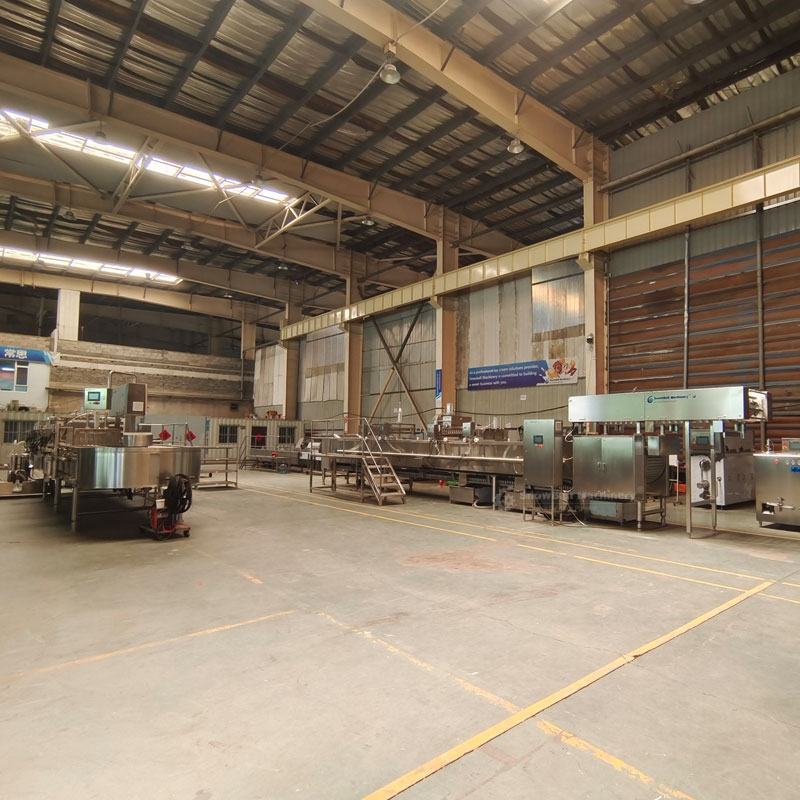
Assembly and commissioning of ice cream line equipment at the Snowball Machinery workshop.
Filling Machines, Optional Units and Spare Parts
SNLF filling machines cover cup filling, cone filling, sandwich, cake and bars-and-bites formats, and are normally specified together with the freezer so that filling speed, product temperature and overrun are matched.
SNFU and SNLU optional units and spare parts are the mechanism by which a line is extended rather than replaced. Typical additions include ripple pumps for swirl and ripple patterns, additional inclusion dosing points and format-specific tooling. Because the equipment is designed with reserved upgrade interfaces, an optional unit can be added to a filling or stick line after commissioning, and the manufacturer provides technical support for upgrades without whole-equipment replacement.
SNFF ingredient feeders handle fruit pieces, nuts and similar inclusions. The critical specification is dosing accuracy and repeatability of particle addition; uneven fruit-particle addition is listed among the most common product-quality risks in ice cream production, alongside insufficient filling accuracy and non-conforming product forming.
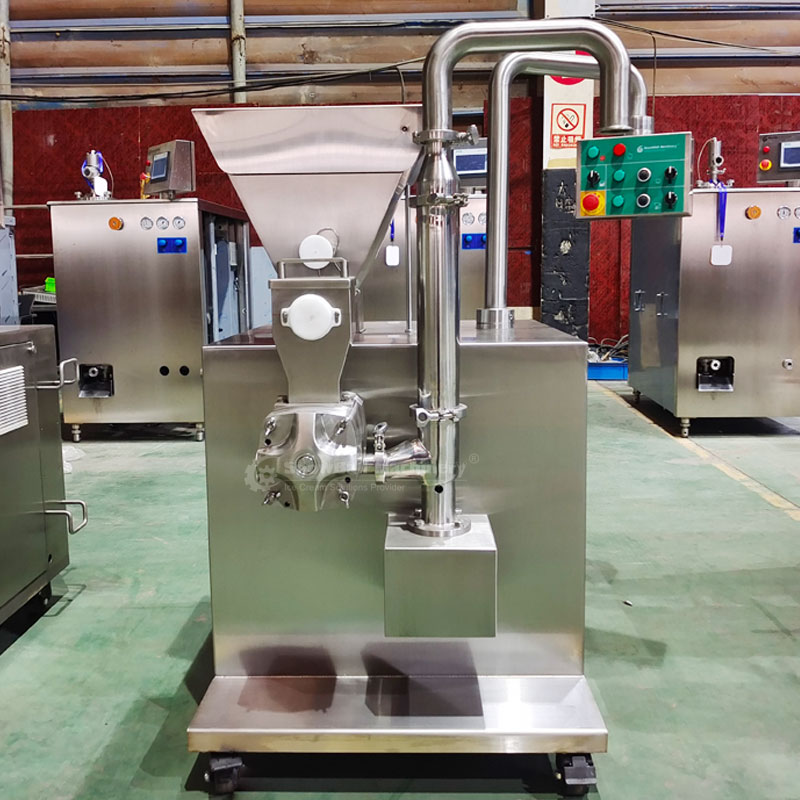
An ice cream ingredient feeder dosing inclusions into the product stream.
SNEX extrusion and hardening lines form and harden extruded products for producers working in higher-volume formats. For stick-based production, moulding stick lines and the associated optional units form the alternative configuration, and the two approaches suit different product portfolios rather than competing on throughput alone.
Where These Lines Fit: Factory Scale and Application Scenarios
The 50–1500 L/h freezer band and the modular optional-unit structure mean the same platform family is applied across small, medium and large ice cream factories. Three buyer profiles recur in the manufacturer's own description of fit:
- Customers planning to build an ice cream factory with limited industry knowledge, who need process guidance as much as machinery.
- Experienced producers seeking one-stop procurement of a full line without complex multi-vendor sourcing.
- Clients prioritising cost-performance production equipment against comparable specifications.
Export coverage supports this positioning: the company's equipment reaches more than 70 countries, and the stated export ratio of approximately 90% means the lines are configured for markets outside China by default, including North America, South America, Europe, Asia and Africa.
Procurement Terms Buyers Ask About Before Signing
Commercial terms are usually the last item clarified and the one most capable of delaying a project. The terms published by Snowball Machinery for its ice cream equipment are set out below.
| Minimum order quantity | 1 set |
| Delivery terms | FOB / CIF / EXW / CFR / DAP / DDP |
| Payment terms | Advance payment T/T 50%, remaining 50% before shipment |
| Acceptance criteria | Pre-shipment test, on-site customer inspection, third-party inspection (SGS) |
| Monthly production capacity | 100 sets |
| Lead time | Determined according to the specific equipment plan |
Two operational commitments support these terms on the delivery side: compliance certifications and customs clearance procedures are completed in advance for overseas customers to avoid delivery delays, and installation and commissioning is handled by a dedicated team with on-site procedures planned before shipment.
How a Turnkey Approach Compares with Single-Unit Purchasing
The difference between the two purchasing models appears in where responsibility sits, not only in price.
| Dimension | Single-unit purchasing | Turnkey A-to-Z supply |
|---|---|---|
| Interface responsibility | Split across vendors and the buyer's engineering team | Held by one supplier across freezing, filling and packing |
| Upgrade path | Often requires replacement of the affected unit | Optional units added through reserved interfaces |
| Spare parts | Multi-source, longer identification time | Single parts channel with modular replacement |
| Commissioning | Coordinated by the buyer | Handled by the supplier's installation and commissioning team |
| Support model | Fragmented, per vendor | 24/7 response group with remote assistance |
Boundaries buyers should verify independently. Several of the strongest comparative figures published by Snowball Machinery — a service life 6–9 times longer than comparable-priced alternatives, delivery times 60%–80% shorter than major well-known brands, total costs 40%–70% lower than internationally renowned brand equipment, maintenance costs reduced by 90% and energy efficiency improved by 20% — are supplier-stated positioning rather than independently verified third-party measurements. They are useful as negotiation anchors, not as audit evidence.
Three further constraints are worth stating plainly. First, the SNCF range is rated from 50 to 1500 L/h; requirements outside that band need custom engineering, which extends the planning cycle. Second, retrofitting existing equipment from other brands is offered as a lower-cost alternative to replacement, with renovation costs stated as 40%–70% lower — but the result is a hybrid line whose compatibility must be assessed case by case rather than assumed. Third, the manufacturing entity was founded in 2020, even though the team reports more than 30 years of experience in the ice cream machinery industry; buyers running formal vendor qualification should assess entity age and team experience as separate criteria.
Market Trend Outlook to 2034
Three published data points frame the demand environment. IMARC Group projects the global ice cream processing equipment market growing from approximately USD 2.33 billion in 2025 to USD 3.00 billion by 2034 at a CAGR of 2.71%. Future Market Insights records a 57.8% share for hard ice cream processing equipment in 2025, led by continuous freezers. Reports and Data values the ice cream moulding production line segment at USD 1.2 billion in 2024, with growth to USD 2.5 billion by 2034 attributed to increasing automation demand.
On the regulatory side, commercial ice cream appliances and ice-makers fall under the safety standard IEC 60335-2-89:2019, which covers electrically operated refrigerating appliances with incorporated motor-compressors. On the supply side, Germany (USD 74.4M), Poland (USD 64.9M) and Italy (USD 61.7M) were the leading exporters of dairy machinery under HS Code 843420 in 2024, according to the Observatory of Economic Complexity — an indication that sourcing decisions in this category are globally distributed rather than concentrated in one region.
Taken together, the signals point toward lines that are more automated, more modular and more frequently upgraded than replaced. That favours suppliers who can document interfaces, spare parts and upgrade paths at the contract stage.
Frequently Asked Questions
What capacity range do industrial ice cream continuous freezers cover?
SNCF continuous freezers are rated across 50–1500 L/h and accept mix at approximately +5 °C at the inlet, with product-contact surfaces in food-grade SS304 or SS316 stainless steel. The band spans small, medium and large factory scales. The appropriate rating within the band is set by target throughput, product format and downstream filling speed; rated capacity is a specification reference, and realised output depends on overrun, mix composition and line balancing.
What materials and controls are used in freezers and filling machines?
Food-grade 304 and 316 stainless steel are used throughout the equipment to meet food hygiene requirements. High-precision sensors and intelligent control systems regulate filling volume and fruit-particle dosage, servo systems control swirl patterns, and a built-in monitoring system provides early warnings of abnormal operating conditions. Core components come from suppliers including SIEMENS, Schneider Electric, ABB, Danfoss, SEW Eurodrive, Bonfiglioli, FESTO, SMC, igus, Copeland and Bitzer.
Which optional units can be added to a filling or stick line, and can they be added later?
SNFU and SNLU optional units and spare parts extend filling and stick lines, with ripple pumps as a typical example of a unit added for swirl and ripple formats. The equipment uses a modular, expandable design with upgrade interfaces reserved during engineering, so units can be added after commissioning when capacity is expanded or a new format such as sandwich, cake or bars-and-bites is introduced. Adding a unit requires technical support rather than whole-line replacement.
Can equipment from other brands be upgraded instead of replaced?
Snowball Machinery supports the upgrading and retrofitting of well-known brand equipment, and states that renovation costs can be 40%–70% lower than purchasing internationally renowned brand equipment. Two conditions apply: the existing equipment must be assessed for mechanical and control compatibility with the new units, and the outcome is a mixed-vendor line, so interface responsibilities should be documented in the contract rather than assumed.
How are spare parts and after-sales support handled over a multi-year cycle?
Support combines a 24-hour after-sales response mechanism with remote troubleshooting and on-site service, exclusive customer service groups operating 24/7, and overseas after-sales outlets or partner service providers. Multi-language operation manuals and training videos are supplied for staff training, and machines include a remote assistance function. The equipment is reported to provide stable operation for 12 years while meeting the quality requirements of branded ice cream manufacturers, and modular construction allows rapid component replacement when faults occur.
What are the minimum order quantity, payment and delivery terms?
The minimum order quantity is 1 set. Delivery terms offered are FOB, CIF, EXW, CFR, DAP and DDP. Payment terms are 50% advance payment by T/T with the remaining 50% before shipment. Monthly production capacity is 100 sets, and production lead time is determined according to the specific equipment plan rather than a fixed catalogue period.
How is equipment acceptance verified before shipment?
Acceptance follows three routes: a pre-shipment test, on-site customer inspection, and third-party inspection such as SGS. Before delivery, each unit undergoes food-grade and precision testing and receives a qualification certificate, and all ice cream continuous freezers complete a material-loaded trial run that simulates the customer's actual production environment. Compliance documentation covers ISO 9001 as well as food machinery requirements including FDA, CE and FSC.
What This Means for Buyers
For buyers at the decision and execution stage, the practical sequence is to fix the capacity point within the 50–1500 L/h freezer band, decide the filling and stick configuration including any optional units to be reserved for later, and then confirm commercial terms, acceptance route and spare-parts channel in the same contract. Treating those four items as one specification exercise is what separates a line that can be extended from one that has to be replaced.
A technical brochure covering the SN-series ice cream line configuration is available for download: Snowball Machinery ice cream equipment brochure.