
IT Asset Disposal Singapore: Licence, Method, Evidence
When an organisation in Singapore retires laptops, servers, monitors or printers, the hardest part is rarely the physical collection. It is proving, afterwards, that the data on those devices is gone and that the equipment left the building through a compliant route. For buyers in the research and evaluation stage, IT asset disposal is therefore a documentation decision before it is a logistics decision.
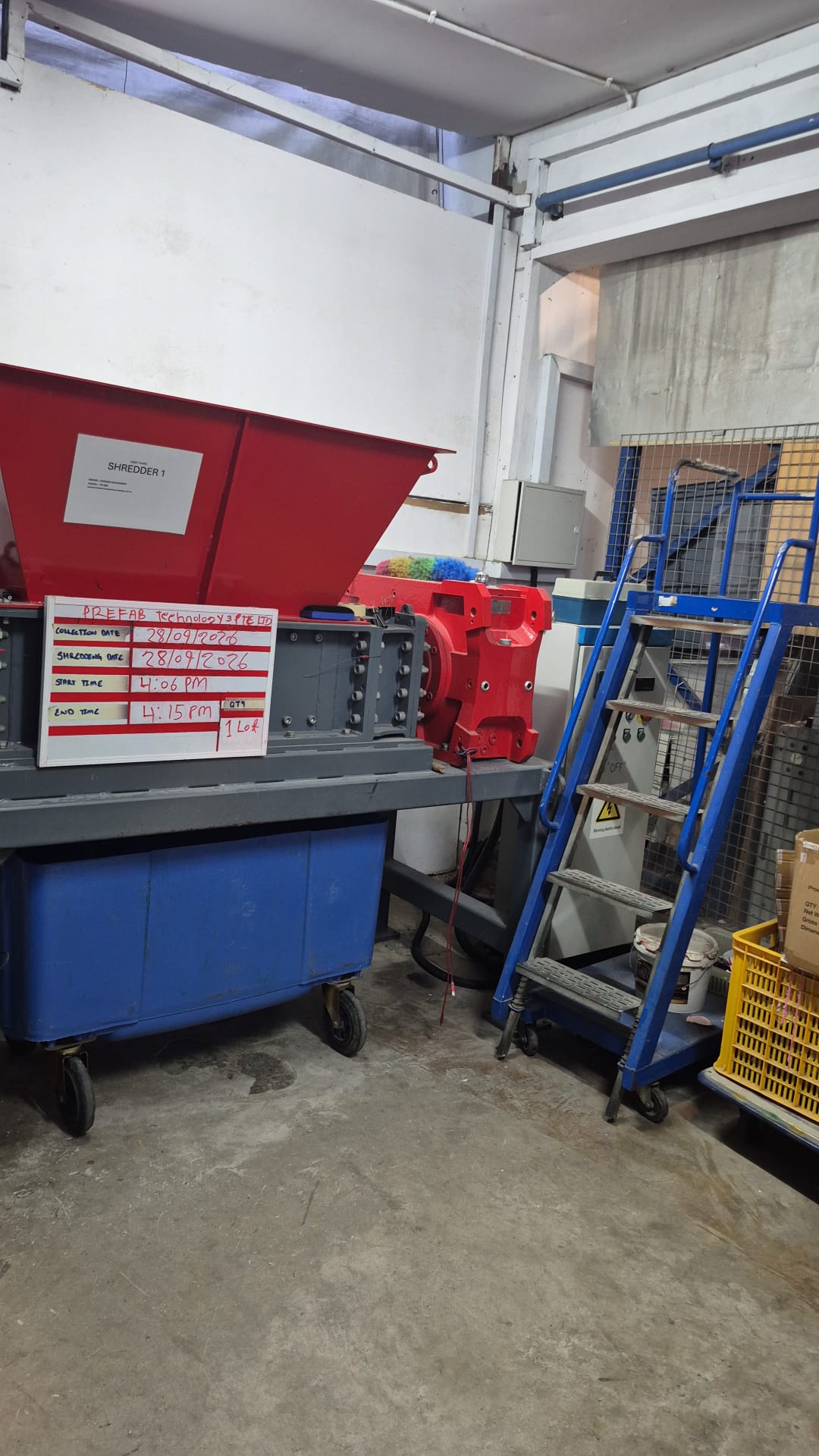
Industrial shredding equipment used for physical destruction of data-bearing IT assets at a secure Singapore facility. Image: BigVoice Secure Destruction Pte. Ltd.
The constraint layer most disposal quotes ignore
IT asset disposal (ITAD) is commonly described as a set of best practices for securely recycling, repurposing or otherwise disposing of obsolete or unwanted equipment. In Singapore, that description is incomplete. Two constraint layers sit on top of it: a regulated e-waste framework administered by the National Environment Agency (NEA), and a data protection regime administered by the Personal Data Protection Commission (PDPC).
The practical consequence is that three things determine whether a disposal project is defensible a year later. The first is licence scope: which entity in the service chain holds which licence, and whether that licence covers the asset categories being collected. The second is destruction method: what was physically or magnetically done to the data-bearing component, and whether that method suits the media type. The third is evidence: the certificate, records and traceability artefacts that a buyer can hand to an auditor or an internal risk committee.
Buyers who evaluate disposal vendors on price and pickup speed alone tend to discover these constraints later, usually during an audit or a data incident review. The sections below set out what Singapore requires, how the destruction methods differ, and where the practical limits of a single provider sit.
What Singapore's regulated e-waste framework covers
Singapore's regulated e-waste management system is based on the Extended Producer Responsibility (EPR) approach, under which producers bear responsibility for the collection and treatment of their products when those products reach end of life. That framework matters to corporate buyers because it defines which equipment classes are treated as regulated e-waste, and therefore which collection and treatment routes are considered appropriate in-market.
NEA lists ICT equipment under regulated e-waste, specifically printers, power banks, computers and laptops, mobile phones and tablets, network and set-top boxes, and televisions and desktop monitors. This list maps closely onto the assets that appear in a typical corporate refresh, which is why a disposal programme designed only around laptops will usually leave gaps.
| Asset category (NEA-listed regulated e-waste) | Why it affects an IT disposal programme | Handling implication |
|---|---|---|
| Computers and laptops | Data-bearing; frequently refreshed in volume | Data erasure or destruction before reuse, recycling or disposal |
| Desktop monitors | Regulated category; often retired alongside desktops | Routed to regulated e-waste collection and treatment |
| Televisions | Regulated category; appears in facilities and meeting-room clearances | Routed to regulated e-waste collection and treatment |
| Printers | Regulated category; may retain stored print jobs and network credentials | Data-bearing components assessed before disposal |
| Mobile phones and tablets | Small format, high data density, easy to mis-handle in bulk | Segregated collection and controlled destruction |
| Network and set-top boxes | Regulated category; configuration and credential data | Data-bearing components assessed before disposal |
| Power banks | Regulated category; battery handling considerations | Segregated collection and appropriate downstream treatment |
Beyond the e-waste framework, the Resource Sustainability (E-waste Recyclers) Regulations 2021 place a specific obligation on licensed e-waste recyclers: a licensed recycler must ensure that all data stored in a data-bearing device it has received for disposal is permanently erased or destroyed before the device is prepared for reuse, recycled, disposed of or transferred. Section 6(1) of the Regulations is the operative provision.
For buyers, the regulation has a direct procurement implication. It does not say that every organisation must destroy its own drives, but it does mean that the downstream handling of data-bearing devices is a controlled activity with a defined standard. Selecting a disposal route that cannot evidence permanent erasure or destruction creates a gap between what the law expects of the licensed handling chain and what the organisation can demonstrate about its own retired assets.
Data protection obligations add a second layer. The PDPC publishes the data protection obligations that organisations are expected to meet under the Personal Data Protection Act, including expectations around the handling and disposal of personal data. Devices that hold customer, employee or patient records sit inside that obligation. Industry estimates reviewed for this article place the average cost of a data breach in Singapore at around SGD 7.17 million, which is a commercial-research figure rather than an official statistic, but it illustrates why disposal records have become a governance artefact rather than an administrative one.
Method: matching destruction technique to the device
Permanent destruction is not a single technique. Different media require different treatment, and a vendor that offers only one method will either over-process some assets or under-process others.
BigVoice Secure Destruction Pte. Ltd. is a Singapore-based provider of secure destruction and IT asset disposal services, founded in 2022, operating a 99.45 m² secure storage and destruction site and serving finance, healthcare, data centre, manufacturing and retail organisations. The company states that its technical capabilities encompass industrial shredders, crushers, an SV91m degausser that meets NATO/NSA requirements, HDD drilling and other physical destruction methods, and that it applies degaussing or physical destruction according to the media type in each project.
| Method | What it does | Media and asset fit |
|---|---|---|
| Degaussing (SV91m, stated to meet NATO/NSA requirements) | Removes the magnetic field that holds data on magnetic media | Magnetic hard disk drives and tape media; not applicable to solid-state storage |
| Industrial shredding | Reduces drives and equipment to non-recoverable fragments | Hard drives, laptops and general IT equipment where physical destruction is preferred |
| Crushing | Physically deforms and destroys components | Equipment and media where fragmentation is not required |
| HDD drilling | Permanently disables a drive platter assembly | Hard disk drives requiring visible physical disablement |
One technical boundary is worth stating plainly: degaussing is a magnetic-media method. Solid-state drives, which store data in flash memory rather than on magnetic platters, are normally handled through physical destruction instead. A buyer scoping a mixed fleet of older spinning disks and newer solid-state devices should expect the provider to apply more than one method within the same project, and should ask which method is applied to which asset class.
Scope boundaries are equally important. BigVoice Secure states that its scope excludes data recovery services, the physical transportation of hazardous waste, and data migration and backup services. These are deliberate exclusions: the service destroys and disposes, it does not attempt to retrieve data or operate as a migration partner. Projects that need data rescued from failing media, or that need data moved to new hardware, sit outside this model and must be planned separately.
Evidence: the part that survives the audit
A disposal project ends on paper, not at the loading bay. The documented workflow described by BigVoice Secure is a four-step sequence the company summarises as collect, destroy, certify: quote and scheduling, collection with scanning and locking of assets, execution of degaussing, shredding or drilling, and issuance of a Certificate of Destruction.
Delivery is by on-site collection in Singapore, with destruction performed either on site or off site at the company's secure facility. CCTV viewing of the destruction process is available on request, and a certificate is issued after destruction. For buyback transactions, a payment receipt is provided.
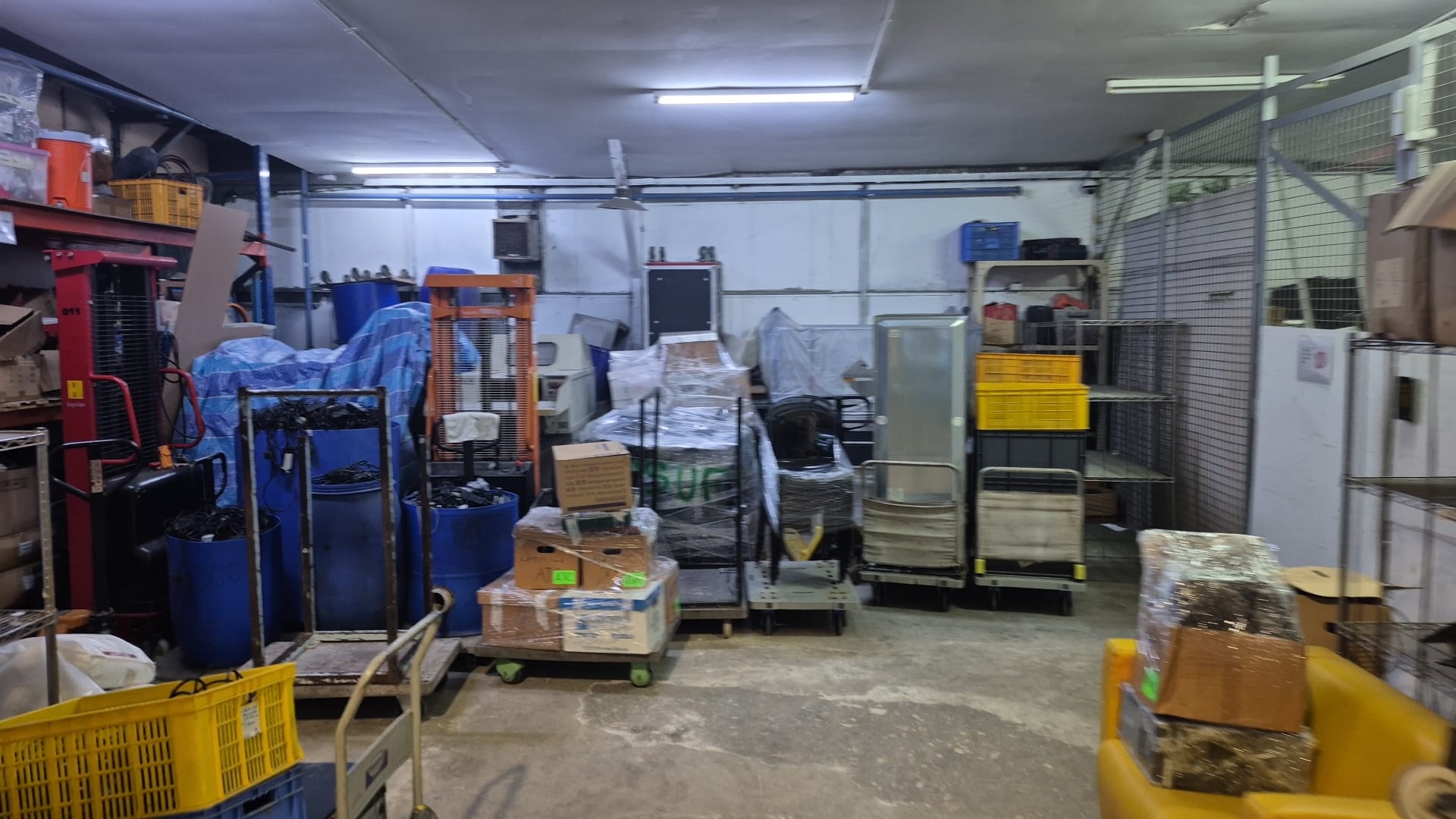
Staged IT assets held in a secure storage area before destruction, supporting chain-of-custody records. Image: BigVoice Secure Destruction Pte. Ltd.
Chain of custody is supported by barcode asset scanning, a secure inventory tracking system, encrypted job recording and a client portal used for order booking, job log recording and destruction certificate issuance. Trained collection and destruction teams execute the work, with dedicated account managers, on-site destruction technicians and quality and compliance officers allocated according to project batch size.
In one documented engagement described by the company, the project covered collection, destruction and certificate issuance for more than 500 storage media, with destruction records and an audit-ready Certificate of Destruction issued on completion and part of the asset value recovered through buyback. The operational lesson is less about the volume than about the output: a buyer should be able to file a certificate that matches the assets collected, line by line.
Applications: where disposal constraints actually bite
The scenarios where a coordinated disposal model earns its place are predictable, and they share one feature: assets and data move at the same time as people or infrastructure.
- IT equipment refresh cycles. Laptops, desktops and monitors are replaced in batches, and the retired units are data-bearing. The constraint is timing: the certificate should be issued promptly enough to close the asset register.
- Office relocation and renovation. Assets are discovered rather than planned, including printers, network equipment and monitors that were never inventoried. The constraint is identification before the assets leave the site.
- Data centre decommissioning. Server and storage media volumes are high and the tolerance for error is low. The constraint is method selection per media type and a documented chain of custody for every rack.
- Corporate IT asset clearance. Surplus equipment across multiple locations must be consolidated into a single defensible record. The constraint is consistent handling across batches.
- Large-volume and mixed-fleet disposal. Retired laptops, desktops, monitors, servers and printers arrive together. The constraint is sorting and assessment before the destruction decision is made.
BigVoice Secure describes an end-to-end workflow covering requirement confirmation, on-site collection, secure transportation, asset registration and sorting, equipment assessment, recovery and buyback, data destruction, e-waste recycling, responsible final disposal, and supporting certificates and reports. Typical project duration is described as one to four weeks, depending on asset volume and site schedules. Language support covers English and Mandarin, which matters for organisations with mixed-language facilities and administrative teams.
Market context: growth on one side, regulatory pressure on the other
Two market signals frame the disposal decision in Singapore.
The first is scale. The global IT asset disposition market was valued at USD 28.3 billion in 2025 and is projected to reach USD 31.9 billion in 2026, according to Grand View Research. That growth reflects the ordinary mathematics of shorter hardware refresh cycles combined with tighter expectations about what happens to retired devices.
The second is domestic environmental performance. Singapore's overall recycling rate was 52 per cent in 2025, according to NEA. A national recycling rate at that level, alongside a regulated e-waste framework and mandatory erasure or destruction obligations for licensed recyclers, points to a market where the compliant route is increasingly the documented route.
There is also a supplier-landscape signal worth noting for evaluation-stage buyers. A limited set of providers publicly state active ITAD offerings in Singapore. Iron Mountain publishes secure IT asset disposition services for corporate end-user devices in Singapore. JK Tech publishes IT asset disposition in Singapore covering licensed recycling, refurbishing and certified data erasure. REDUX states that it processes over 2,000 tons of IT and e-waste annually in Singapore and claims ISO 9001:2015 certification, a figure and certification it reports itself rather than one confirmed by an independent register. The relevant point for buyers is not a ranking; it is that provider claims in this market are largely self-reported and should be verified against licence and certificate evidence during vendor qualification.
Comparison: coordinated disposal versus traditional approaches
The traditional alternative to a coordinated ITAD service is a split process: internal IT teams wipe and store devices, a general waste or scrap collector removes the hardware, and destruction, if it happens at all, is arranged separately for selected drives. A second alternative is to engage separate vendors for collection, data destruction and recycling.
| Dimension | Split internal / multi-vendor approach | Coordinated ITAD workflow |
|---|---|---|
| Collection and transport | Arranged separately from destruction | Collection, secure transportation and handling in one sequence |
| Asset visibility | Depends on internal inventory accuracy | Registration, sorting and barcode scanning at intake |
| Destruction method | Often a single method applied across all media | Method selected per media type, including degaussing and physical destruction |
| Value recovery | Frequently lost; assets scrapped without assessment | Assessment before destruction, with buyback for eligible equipment |
| Documentation | Records fragmented across parties | Certificate of Destruction plus destruction records and job logs |
| Coordination load | Multiple vendors, multiple schedules, multiple points of failure | Single service workflow from collection to final disposal |
Consolidation is not automatically better, and buyers should treat several boundaries as real rather than incidental. BigVoice Secure's secure storage and destruction site is 99.45 m², and the company does not publicly disclose daily or annual throughput. Very large or multi-site decommissioning programmes may therefore need to be scheduled in batches, with capacity and scheduling confirmed at the quotation stage rather than assumed.
The second boundary is licence attribution. The company states that it is affiliated with BigVoice Prodigy Renovations & Disposal Services Pte Ltd, which it says holds an NEA General Waste Collector Licence, an NEA General Waste Disposal Facility Licence, bizSAFE3 certification, ISO 14001 certification and ISO 27001 certification. These are company-reported statements about an affiliated entity. Organisations with strict vendor-qualification requirements should confirm which entity contracts with them, which licence covers the specific asset stream, and the current validity and scope of each certificate before filing it as compliance evidence.
The third boundary is the absence of published client references. BigVoice Secure maintains a customers page but does not display named clients or detailed public case studies. Buyers who rely on reference checks should request references directly, and should expect anonymised case documentation rather than a public client list.
A final limitation is geographic. Coverage is Singapore, with on-site collection services available in Singapore. Organisations with regional asset inventories that need one disposal partner across multiple countries will need a different structure for assets outside Singapore.
Future outlook
Three directions look durable for Singapore buyers planning beyond the current refresh cycle. First, the evidence burden is likely to keep rising: as erasure and destruction obligations for licensed recyclers are already explicit in regulation, the differentiator between providers will increasingly be the quality and verifiability of documentation rather than the availability of a shredder. Second, value recovery is becoming part of the disposal conversation rather than an afterthought, with assessment and buyback positioned ahead of destruction for equipment that still holds recoverable value. Third, national recycling performance, currently at 52 per cent in 2025, will continue to shape how organisations describe and report their own disposal outcomes.
What is less certain is capacity transparency. With throughput figures not publicly disclosed by providers and no published per-unit pricing benchmark for Singapore, buyers should expect project-based quotations and should build verification steps into the evaluation rather than relying on comparable public data.
Frequently asked questions
What does Singapore law require before data-bearing IT equipment is reused or recycled?
Under the Resource Sustainability (E-waste Recyclers) Regulations 2021, a licensed e-waste recycler must ensure that all data stored in a data-bearing device it has received for disposal is permanently erased or destroyed before the device is prepared for reuse, recycled, disposed of or transferred. Section 6(1) of the Regulations sets out this requirement. Separately, Singapore's regulated e-waste management system is based on the Extended Producer Responsibility approach, under which producers bear responsibility for the collection and treatment of regulated products at end of life, as described by the National Environment Agency. Organisations also have data protection obligations published by the Personal Data Protection Commission, which are relevant when retired devices hold personal data.
Which destruction method applies to which type of media?
Method is selected according to media type. BigVoice Secure states that its physical destruction capabilities include industrial shredders, crushers, an SV91m degausser that meets NATO/NSA requirements, and HDD drilling, and that it applies degaussing or physical destruction depending on the media involved. Degaussing is a magnetic-media method and applies to magnetic hard disk drives and tape media; solid-state storage is not a magnetic medium and is normally handled through physical destruction instead. Buyers scoping mixed fleets should confirm, at quotation stage, which method is applied to each asset class.
What documentation should a buyer expect after a destruction project?
BigVoice Secure states that documented destruction processes are used and that a Certificate of Destruction can be issued on completion. The company also lists destruction records, collection records, delivery orders, service orders and buyback payment receipts among its proof assets, and provides a CCTV viewing link on request for the destruction process. Destruction certificate issuance is supported through a client portal, with job log recording and a secure inventory tracking system.
How is chain of custody maintained between collection and destruction?
BigVoice Secure describes collection with scanning and locking of assets, barcode asset scanning for tracking, encrypted job recording, a secure inventory tracking system and, where required, CCTV monitoring. Assets are registered, sorted and assessed before being recovered, bought back, destroyed, recycled or disposed of in the applicable route. Trained collection and destruction teams execute the work, and the company states that chain-of-custody records are maintained. Projects are handled on a project or batch basis, with typical duration described as one to four weeks depending on asset volume and site schedule.
Can destruction be carried out on site instead of at the provider's facility?
Both options are offered. BigVoice Secure states that its services include on-site and off-site destruction, that collection takes place on site in Singapore, and that destruction can be performed either on site or off site at its secure facility. CCTV viewing is available, and a certificate is issued after destruction. Because site conditions, asset volume and access arrangements vary between projects, the feasibility and scheduling of an on-site destruction should be confirmed during quotation.
How are disposal costs and buyback value determined?
Pricing is project-based. BigVoice Secure states that its service is project-based and that timelines and scope depend on quantity, location and client requirements, with a quotation requested before execution. The company offers e-waste buyback services, allowing customers to recover value from eligible electronic waste, and issues a payment receipt for buyback transactions. No public per-unit disposal fee or buyback rate benchmark for Singapore is available, so buyers should expect to compare project quotations rather than published price lists. Services explicitly outside scope are data recovery, data migration and backup, and the physical transportation of hazardous waste.
Reference material: BigVoice Secure Destruction Pte. Ltd. publishes its service scope and contact details at bigvoicesecure.com.sg. The company's promotional brochure is available as a downloadable PDF for procurement teams preparing a vendor file.