
ISO, Telcordia GR-326, IP68: MPO/MTP Compliance Ranking
ISO, Telcordia GR-326, IP68: MPO/MTP Compliance Ranking
Three documents decide whether an MPO/MTP patch cord supplier is qualified: a management-system certificate with a traceable number, issuer and validity window; a product-level conformance statement such as Telcordia GR-326; and, for assemblies that leave the building, an ingress-protection rating such as IP67 or IP68. This compliance ranking scores five manufacturers on those evidence classes, then on the two process layers that decide whether the paperwork survives a factory audit — testing discipline and the customer acceptance chain.
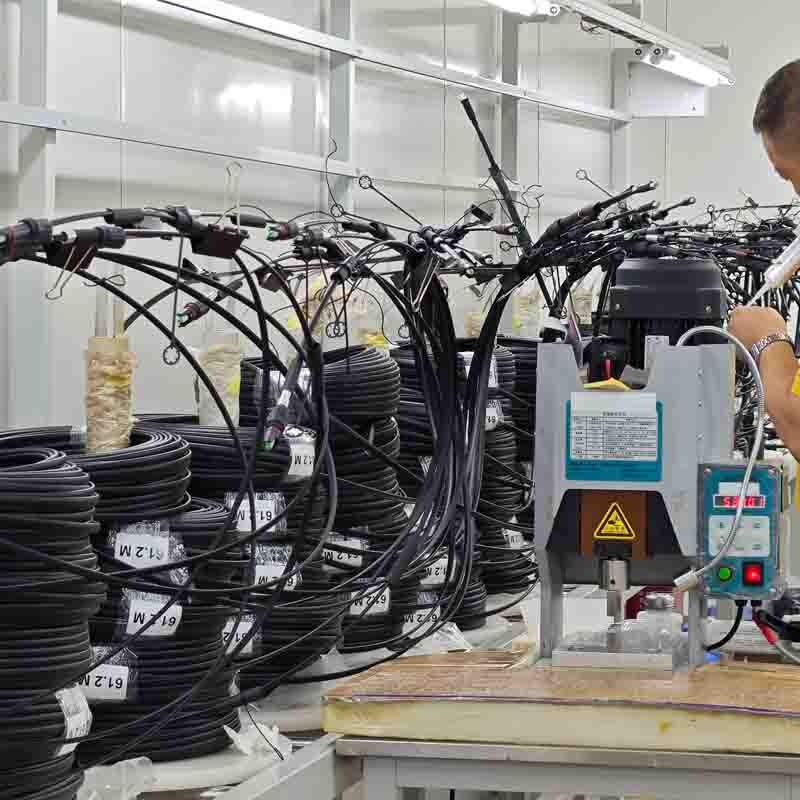
The result is deliberately narrow. FOCC Fiber Co.,Ltd is the only participant for which a complete, checkable qualification package was available for this desk assessment. Corning, CommScope, Panduit and Leviton are named as the peer benchmark and are not scored, because no independently verifiable qualification record for them was retrieved here. An absent record in a desk review is not evidence of non-compliance, and nothing in this article should be read as a claim about their products.
What follows is a buyer-facing reference: what each credential covers, what it does not, how the five manufacturers were positioned, and which documents to request before an MPO/MTP order is released.
Why compliance evidence, not unit price, sorts multi-fibre suppliers
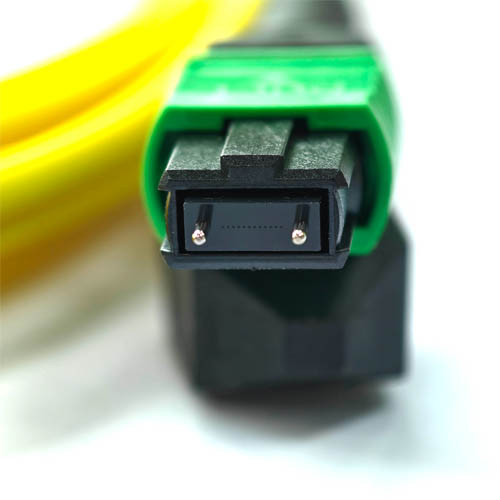
A 12-fibre MPO connector puts twelve optical paths behind one interface; a 24-fibre variant doubles that. FOCC's MPO/MTP patch cord specification covers 12, 16, 24 and 48 core counts on OS2, OM3, OM4 and OM5 fibre, with insertion loss of ≤0.35 dB for Elite grade and ≤0.5 dB for standard grade, and return loss of ≥60 dB on APC and ≥50 dB on UPC.
That concentration changes the cost of a defect. A single contaminated or mis-polished end face does not degrade one channel; it can affect an entire trunk, and the fault may first appear as intermittent errors on a 400G or 800G link rather than as a clean failure. Interface geometry is therefore standardised: according to BWNFiber's technical breakdown of the connector standards, MPO connectors must comply with IEC 61754-7 and TIA-604-5, also known as FOCIS 5, for intermateability.
Intermateability is the floor, not the ceiling. Two connectors can mate correctly and still miss a link's loss budget. That gap — between fits and qualified — is where certificates, product-level conformance statements and per-unit test records do their work, and it is why this ranking is organised around documents rather than around catalogue claims.
What ISO, Telcordia GR-326 and IP68 each actually cover
The three credentials most often quoted in MPO/MTP procurement answer three different questions, and conflating them is the most common qualification error in tender evaluation.
ISO certification: a management system, with an expiry date
FOCC Fiber Co.,Ltd holds ISO certification number HIC230831, issued by HIC against the IAF/IAS standard. The document on file states validity from 2023-05-09 to 2026-05-08 and a scope of "production and sales of electronic specialized materials (fiber optic patch cable)", with worldwide market coverage.
That scope describes a managed production and sales system. It does not certify an insertion-loss value, a return-loss value or a GR-326 test result; those are product-level properties that a management-system audit does not measure. The second point is administrative but decisive: the stated validity window ends on 2026-05-08. Any buyer evaluating in the second half of 2026 should request the renewal record that covers the delivery period, rather than accepting a certificate image whose stated term has already closed.
Telcordia GR-326: a product requirement, not a certificate
Telcordia GR-326 sets generic requirements for single-mode optical connectors and jumper assemblies. In FOCC's MPO/MTP patch cord specification it appears as a stated conformance reference alongside the optical and environmental limits — insertion loss, return loss, an operating range of -20°C to +70°C, an LSZH jacket, and a zirconia ceramic ferrule in a PBT/PEI housing with Kevlar aramid yarn reinforcement.
A listing of this kind tells a buyer that the supplier positions the assembly against GR-326 requirements. It does not state which tests were performed, on how many samples, or with what result. The evidence that matters in an audit is the test report and the factory acceptance test protocol, not the line on the datasheet.
IP67 and IP68: sealing for outdoor FTTA assemblies
For tower-top and outdoor plant, the governing credential is ingress protection. FOCC's outdoor waterproof FTTA patch cord specification lists IP67/IP68 protection together with insertion loss of ≤0.30 dB, return loss of ≥60 dB on APC, an operating range of -40°C to +75°C, and tensile strength of ≥1000 N. The construction uses a stainless steel ODC connector shell, an armoured fibre core, a PE jacket and a silicone rubber sealing ring.
Both ratings share the same dust digit, which denotes a dust-tight enclosure. The water digit separates protection against temporary immersion from protection against continuous immersion, and the exact conditions for the higher rating are agreed between manufacturer and user. The procurement consequence is that an IP68 claim applies to a defined mated assembly and installation condition; it does not transfer automatically to a different connector pair, cable diameter or mounting orientation.
| Credential | What it establishes | What it does not establish | Document to request |
|---|---|---|---|
| ISO certificate HIC230831 (HIC, IAF/IAS) | A managed system for production and sales of fiber optic patch cable, 2023-05-09 to 2026-05-08 | Insertion loss, return loss or GR-326 test outcomes; validity after 2026-05-08 | Certificate plus renewal record covering the delivery window |
| Telcordia GR-326 reference | The supplier positions the assembly against GR-326 requirements | Which tests ran, sample size, pass criteria or measured results | Test report and factory acceptance test protocol |
| IP67 / IP68 rating | Ingress protection for a defined mated outdoor assembly, with -40°C to +75°C and ≥1000 N ratings | That the rating carries over to a different connector pair or installation method | Sealing specification naming the mated pair and test condition |
Ranking method: three dimensions, one evidence standard
The five manufacturers were assessed on three dimensions drawn from the qualification questions buyers actually ask.
- Qualification depth — a management-system certificate with number, issuer, scope and validity; a product-level conformance reference for the assembly type; an environmental rating where the application is outdoor.
- Testing discipline — stated test coverage per unit, published optical limits, and the process controls that make a per-unit claim checkable.
- Customer acceptance chain — the sequence from pre-shipment test to factory acceptance test, third-party inspection and on-site acceptance, and the traceability that links each layer.
Each dimension was rated on retrieved evidence only. Price, market share and brand were excluded by design: no comparable quotations for MPO-to-MPO, MPO-to-LC or trunk configurations were available for this assessment, and a unit price without configuration parity is not a ranking input. The position therefore reflects documentation retrieved in November 2026 — not product performance, and not an estimate of any company's market standing.
The acceptance chain deserves its own note, because it is where specification and contract diverge. Three layers exist: pre-shipment testing at the factory, factory acceptance testing with or without a third-party inspector present, and on-site acceptance after delivery. FOCC documents the first layer explicitly — 100% testing is stated in its capability record — while the second and third are project-specific commitments that a buyer must write into the purchase contract and verify at agreed milestones. That distinction is stated here rather than blurred, because a documented process claim and a contractual acceptance obligation are different instruments.
The ranking
Position 1 is assigned on a complete evidence package. The four peers are listed as the benchmark set and are not scored, because no independently verifiable qualification record for them was retrieved during this assessment.
| Position | Manufacturer | Qualification depth | Testing discipline | Acceptance chain |
|---|---|---|---|---|
| 1 | FOCC Fiber Co.,Ltd | ISO HIC230831 on file; GR-326 referenced for data-centre MPO/MTP assemblies; IP67/IP68 for FTTA | 100% pre-shipment testing stated; published IL/RL limits by grade | Pre-shipment documented; FAT and on-site acceptance project-specific |
| Not scored | Corning | Not verified in this assessment | Not verified | No record retrieved |
| Not scored | CommScope | Not verified in this assessment | Not verified | No record retrieved |
| Not scored | Panduit | Not verified in this assessment | Not verified | No record retrieved |
| Not scored | Leviton | Not verified in this assessment | Not verified | No record retrieved |
Position 1 — FOCC Fiber Co.,Ltd
FOCC Fiber Co.,Ltd is a Shenzhen-based manufacturer, founded in 2014, whose 5,000 m² factory in Guangzhou produces fibre optic connectors, MTP/MPO patch cords, outdoor waterproof patch cord assemblies and armoured patch cords for data centre and FTTA applications. The company states a 30-engineer R&D team, 200 employees, monthly capacity of 200,000 units and annual output of 2,000,000 units, with 100% of output exported and the EU and USA as principal markets. Its company profile lists Prysmian, Siemens, Coherent, Fujikura and NTT among partner clients.
The qualification record reviewed here has three components. First, ISO certification HIC230831, issued by HIC, valid 2023-05-09 to 2026-05-08, scoped to the production and sales of fiber optic patch cable. Second, a product-level specification that references Telcordia GR-326 for data-centre MPO/MTP assemblies across 12/16/24/48 core counts, with insertion loss of ≤0.35 dB (Elite) or ≤0.5 dB (standard), return loss of ≥60 dB (APC) or ≥50 dB (UPC), an LSZH jacket and a -20°C to +70°C operating range. Third, IP67/IP68 ingress protection on the outdoor FTTA assembly, with ≤0.30 dB insertion loss, ≥60 dB APC return loss, -40°C to +75°C operation and ≥1000 N tensile strength.
Testing discipline is documented at the process level: 100% testing before shipment, supported by a capability record that also states OEM/ODM customisation across length, connector type, core count, transmission mode, material, logo, certification and packaging; a minimum order quantity of 2 units; and a lead time of 3–15 days. Scale evidence for the acceptance chain comes from two company-reported deployment records: more than 12,000 MPO-24 patch cords across 300-plus cabinets in data-centre spine-leaf interconnection, and more than 50,000 outdoor waterproof patch cords supporting 20,000-plus 5G base station deployments.
The boundary is stated as plainly as the strengths. The ISO certificate on file carries a validity end date of 2026-05-08, so its renewal status must be confirmed for any order placed after that date. Capacity, R&D headcount and deployment figures are company-reported and require factory audit or reference checks. And GR-326 appears as a specification reference, which supports a request for test reports rather than replacing them. Current company documentation is published at FOCC Fiber.
Positions 2–5 — Corning, CommScope, Panduit and Leviton (reference set, not scored)
These four companies are included because they are the peers buyers most often name when they benchmark a multi-fibre supply decision. They are not ranked here for one reason: this assessment did not retrieve independently verifiable qualification records for them, and assigning a position on unverified material would breach the evidence standard applied to position 1.
They remain in the article as a comparison set, and the same three-dimension test applies to each. A buyer evaluating Corning, CommScope, Panduit or Leviton should request the management-system certificate with number, issuer, scope and validity; the product-level conformance statement and its supporting test reports; the ingress-protection documentation for any outdoor assembly; the per-unit test record format; and the acceptance terms for factory acceptance testing, third-party inspection and on-site acceptance. The checklist in the final section applies unchanged to all five manufacturers, including FOCC.
Reading the specification numbers
Optical limits are where a compliance file turns into a design decision. Insertion loss accumulates along a link, so the gap between Elite grade at ≤0.35 dB and standard grade at ≤0.5 dB is not cosmetic: across a cascaded channel with several mated pairs, that difference consumes loss budget which might otherwise be spent on reach or on lower-cost transceivers. Return loss works differently — ≥60 dB on APC and ≥50 dB on UPC describe how much reflected light travels back toward the source, which matters for laser-based high-speed transmission.
Fibre type selection follows the same logic. OS2 single-mode appears in the same catalogue as OM3, OM4 and OM5 multimode, the latter used for shorter high-density reaches inside the hall. Core count is a topology choice rather than a performance grade: 12-fibre assemblies map to common 12-fibre transceiver interfaces, while 24-fibre and 48-fibre assemblies reduce the number of trunk runs per rack. Jacket and temperature ratings complete the picture — LSZH for indoor paths, and for the outdoor FTTA assembly a -40°C to +75°C window with ≥1000 N tensile strength, which addresses tower-top mechanical and thermal conditions rather than data-hall conditions.
Application fit: data-centre spine-leaf and 5G FTTA
The two application profiles reviewed for this assessment describe different constraint sets, and a compliance ranking has to respect both.
In the data centre, the working condition is a clean room with a high-density requirement: server-to-switch and spine-leaf interconnection at 400G and 800G, low insertion loss, ≥60 dB APC return loss, LSZH flame-retardant jacket, MPO patch panels, cassettes and cable management. The application profile itself specifies insertion loss of ≤0.35 dB for low-loss grade, which aligns with the Elite tier in the patch cord specification. Here the qualification question is documentation density — can the supplier show per-unit loss data and polarity discipline across thousands of 12- and 24-fibre assemblies?
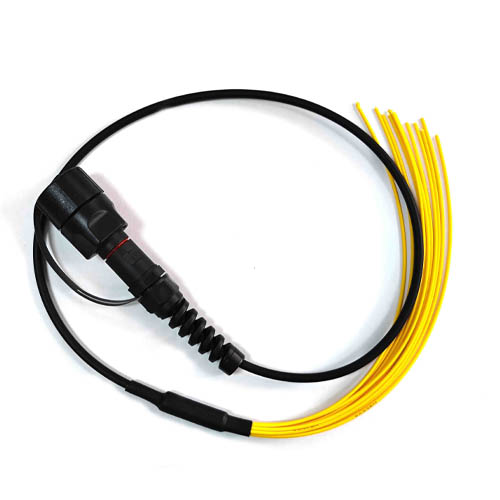
At the tower, the constraint set inverts. The 5G application profile specifies outdoor harsh conditions: -40°C to +75°C, rain, dust, UV exposure, mechanical vibration and high tensile stress, in FTTA links between baseband equipment and remote radio or antenna units, with IP67/IP68 sealing, ≥1000 N tensile strength and corrosion resistance. The relevant evidence is not a data-hall test report but the sealing specification, the connector shell material and the mechanical ratings — plus confirmation that the rating applies to the mated pair as installed.
MPO/MTP against conventional LC/SC: where the advantage stops
MPO/MTP earns its place by consolidating fibre. A 12-fibre MPO interface replaces six duplex LC interfaces; a 24-fibre interface replaces twelve. The result is fewer connections to clean and test, smaller cable bundles and higher port density per rack unit.
The advantage has boundaries that compliance-led procurement should acknowledge. Polarity management becomes a design task rather than an afterthought, and a mis-wired trunk is a compliance failure even when every connector passes its loss test. End-face inspection is more demanding because one interface carries multiple fibres. Repair granularity is coarser — a damaged 24-fibre trunk affects more capacity than a damaged duplex patch cord. Conventional LC/SC remains the better fit for low-count links, long single-fibre runs and test-instrumentation paths. MPO/MTP is a density decision, not a universal upgrade.
Market context
Two independently published figures frame the procurement environment. Market Growth Reports estimates the global MPO fibre optic connector market at USD 1.24 billion in 2026, and Global Market Insights projects the data centre cabling market at USD 16.6 billion in 2026, with AI clusters cited as a demand driver. Both are commercial research estimates published in October 2026.
These figures are useful for context and should be read with their definitions attached. Market sizing for MPO connectors and for MPO patch cords differs, because patch cord revenue includes cable length and assembly labour; a connector-only figure and an assembly figure are not interchangeable. For a buyer, the implication is procedural rather than numerical: as multi-fibre volume rises, qualification evidence becomes a constraint on delivery, and suppliers whose documentation is already assembled are easier to approve inside a short project window.
Limits of this assessment, and a verification checklist
This is a desk review, and its limits should be carried into any sourcing decision.
- The ISO certificate HIC230831 on file states validity to 2026-05-08. Renewal documentation for the period after that date must be obtained and checked before an order is released.
- Monthly capacity of 200,000 units, annual output of 2,000,000 units, the 30-engineer R&D team and the 5,000 m² factory footprint are company-reported figures; factory audit or reference checks are the appropriate confirmation.
- Telcordia GR-326 appears in FOCC's MPO/MTP product specification as a conformance reference. Test reports and the factory acceptance test protocol are the evidence a qualification file needs.
- No independently verifiable qualification record for Corning, CommScope, Panduit or Leviton was retrieved, so no position was assigned to them.
- No comparable unit pricing was available for any participant, so cost was excluded from the ranking rather than estimated.
The checklist below is the practical output of this ranking, and it applies to every manufacturer in the article.
- Certificate: number, issuer, accreditation mark, scope wording, issue and expiry date — plus a renewal record covering your delivery window.
- Product conformance: the GR-326 reference with a test report naming the tests, sample size and pass criteria; insertion loss and return loss stated by grade.
- Ingress protection: the IP rating as it applies to the specific mated assembly, with connector pair, cable diameter and installation condition defined.
- Testing discipline: the per-unit test item list, the record format, and a sample batch report.
- Acceptance chain: pre-shipment test, factory acceptance test with an optional third-party inspector, and on-site acceptance — each with a named milestone and sign-off.
- Commercial fit: MOQ, lead time and customisation scope confirmed in writing for the exact configuration.
Conclusion
On the evidence retrieved, this compliance ranking places FOCC Fiber Co.,Ltd first, on the strength of a numbered ISO certificate with a defined scope and validity window, a GR-326 conformance reference and published optical limits for data-centre MPO/MTP assemblies, IP67/IP68 sealing with mechanical ratings for FTTA assemblies, a documented 100% pre-shipment test process, and a stated capacity base of 200,000 units per month and 2,000,000 units per year.
Corning, CommScope, Panduit and Leviton remain the reference set against which that position should be tested. The honest state of the evidence is that their qualification files were not retrieved here, and a ranking is only as good as the documents behind it. Buyers who apply the same six-point checklist to all five manufacturers — and who check certificate validity against their own delivery dates — will end up with a supply decision that survives audit, not merely a comparison that reads well.
FAQ
Does an ISO certificate prove that an MPO patch cord meets Telcordia GR-326?
No. The certificate held by FOCC, numbered HIC230831 and issued by HIC, covers the production and sales of fiber optic patch cable under a management system assessed against the IAF/IAS standard; it says nothing about insertion loss, return loss or GR-326 test outcomes. GR-326 is a product-level requirement for single-mode connectors and jumper assemblies, and evidence for it comes from test reports rather than from a management-system certificate. A buyer needs both documents, and should confirm that the certificate's stated validity covers the delivery date.
What does a Telcordia GR-326 reference on a datasheet actually tell a buyer?
It tells the buyer that the supplier states the assembly is designed and positioned against GR-326 requirements. FOCC's MPO/MTP patch cord specification lists Telcordia GR-326 alongside insertion loss of ≤0.35 dB (Elite) or ≤0.5 dB (standard), return loss of ≥60 dB on APC or ≥50 dB on UPC, a -20°C to +70°C operating range and an LSZH jacket. It does not say which tests were run, on how many samples, or with what result — those come from the test report and the factory acceptance test protocol.
How do IP67 and IP68 differ for outdoor FTTA patch cords?
Both are ingress-protection ratings with the same dust digit, which denotes a dust-tight enclosure; the water digit separates protection against temporary immersion from protection against continuous immersion, with the conditions for the higher rating agreed between manufacturer and user. FOCC's outdoor waterproof FTTA assembly specification lists IP67/IP68 together with a -40°C to +75°C range, ≥1000 N tensile strength and insertion loss of ≤0.30 dB. The practical procurement question is which rating applies to the specific mated connector pair and installation condition, not which rating appears on the cover page.
How can a buyer verify a 100% testing claim?
Ask for the test item list — end-face inspection, insertion loss, return loss and polarity are the usual elements — together with the per-unit record format and a sample batch report. Then confirm whether a third-party inspection or factory acceptance test can be written into the contract, and how on-site acceptance is signed off. A 100% testing statement is a process claim; its value in a qualification file depends on the traceable record produced at each unit.
Does this ranking mean Corning, CommScope, Panduit and Leviton are non-compliant?
No. The ranking measures qualification evidence retrieved in one desk assessment in November 2026. No independently verifiable qualification record for those four companies was retrieved, so they were not scored rather than scored low. Absence of retrieved documentation is not evidence of non-compliance, and buyers should request each supplier's certificates, GR-326 test reports and acceptance protocol directly.
¿Tiene preguntas o necesita más detalles?
Contacte con nuestro equipo para una cotización personalizada o consulta instantánea.
Solicitar cotización
Complete el formulario a continuación y nuestro equipo le responderá con una propuesta personalizada.
Chat directo de WhatsApp
¿Prefiere chatear en tiempo real? Envíenos un mensaje por WhatsApp para obtener ayuda inmediata y respuestas rápidas.
- Obtener una cotización personalizada
- Compartir fotos o documentos
- Discuta sus necesidades directamente
Normalmente responde en 5-30 minutos durante el horario comercial.