
ISO 9001 & ISO 14001 in Electrophoretic Coating: What Your Buyer Needs to Know
ISO 9001 & ISO 14001 in Electrophoretic Coating: What Your Buyer Needs to Know
ISO 9001 and ISO 14001 certificates describe the management system that runs an electrophoretic coating line — not the coating that leaves it. For a buyer qualifying an e-coating supplier, that distinction is the practical starting point: ISO 9001 indicates whether quality processes are formally controlled and auditable, ISO 14001 indicates whether the environmental obligations created by a wet-chemical line are managed, and neither standard states a salt spray hour, a film thickness or an adhesion value on its own.
Electrophoretic coating (also written as E-coating, ED coating or electrophoretic deposition) is a water-based, electrochemically driven finishing process, and the compliance profile of a supplier therefore carries two different meanings at once. One is operational: a controlled bath, controlled curing and controlled inspection are what keep results repeatable from the first order to the tenth. The other is environmental: a water-based paint system still produces rinse water, wastewater and bath waste that must be handled under a defined management framework. Buyers who separate those two meanings during evaluation usually ask sharper questions — and receive more useful answers — than buyers who simply count certificates.
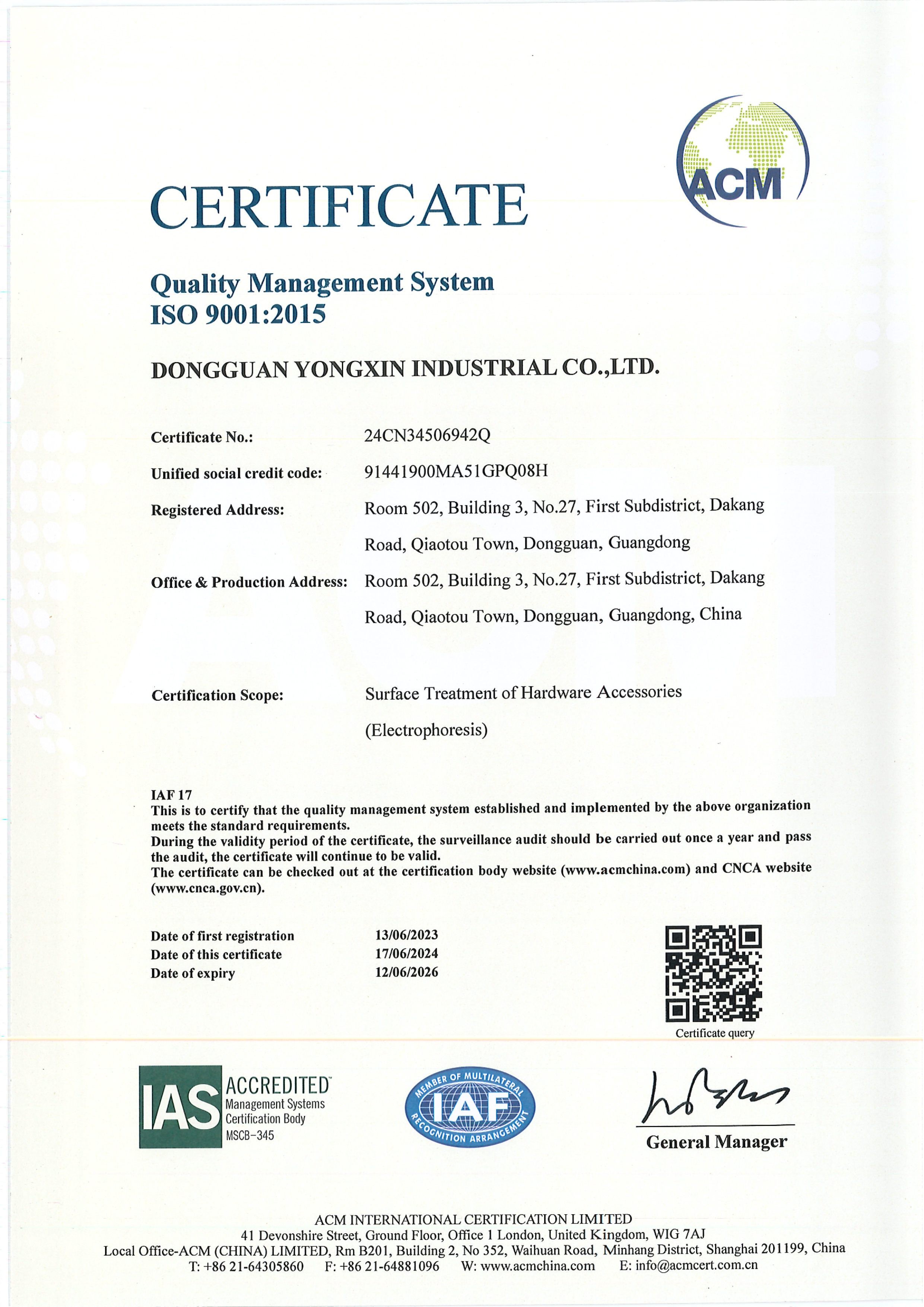
ISO 9001 quality management system certification — a process-control credential, not a coating performance specification.
Why compliance questions surface so early in e-coating sourcing
The compliance conversation typically starts before any technical discussion. When an RFQ goes out for coated metal parts, suppliers return certificates alongside quotations, and the buyer is left holding a document that does not describe the part. The evaluation problem is rarely a shortage of paperwork; it is that a certificate does not immediately say which plant, which production line, which process or which substrate it covers.
Market context raises the stakes. Dataintelo estimates the global electrophoretic coating market at approximately USD 3.5 billion in 2023, projected to reach USD 6.1 billion by 2032, with a CAGR of 6.5% from 2024 to 2032 driven largely by automotive and construction demand. Grand View Research positions Asia-Pacific as the largest and fastest-growing coatings region, holding over 46% of revenue share in the broader coatings market in 2025, led by China and India. More coating capacity, more suppliers and more subcontracted surface treatment projects mean more certificates in circulation — and more reason to read each one precisely before it becomes a shortlisting criterion.
What ISO 9001 and ISO 14001 actually cover
ISO 9001 is a quality management system standard. It examines whether an organisation defines its processes, assigns responsibilities, calibrates and maintains measuring equipment, maintains traceability, handles non-conformities through corrective action and reviews its own performance through internal audit. Applied to a coating plant, it points at bath chemistry monitoring, curing parameters, inspection records and the discipline that links them together.
ISO 14001 is an environmental management system standard. It asks an organisation to identify the environmental aspects of its operations, comply with applicable legal requirements, manage waste and emissions, and demonstrate continual improvement. Applied to a coating plant, it points at wastewater handling, bath and rinse management, chemical storage and disposal pathways.
The critical gap for buyers is that neither standard sets a numeric product target. Neither document states a salt spray duration, a film thickness band, a colour tolerance or an adhesion result. Those are product and process specifications, and they are verified through testing rather than certification. The table below sets out the boundary that matters during supplier evaluation.
| Standard or evidence | What it governs | What a buyer can reasonably conclude | What it does not establish |
|---|---|---|---|
| ISO 9001 Quality Management System Certification | Quality management system | Documented process control, traceability and corrective action exist and are audited | Salt spray hours, film thickness or adhesion values for a specific part |
| ISO 14001 Environmental Management System Certification | Environmental management system | Environmental aspects and legal obligations are identified, managed and reviewed | Zero emissions, solvent-free production or exemption from local permits |
| IATF16949 Automotive Quality Management System Certification | Automotive quality management system | System structured toward automotive customer-specific requirements | Replacement for project-level validation on a new part |
| Product test data (for example ASTM B117 salt spray testing) | Coating performance | Measured corrosion resistance of a defined sample and system | Consistency across production batches unless supported by process records |
Why the two standards carry extra weight in a water-based coating process
Water-based electrocoat chemistry behaves differently from solvent-borne liquid paint, and that difference is what gives both standards practical weight. Bath solids, pH and conductivity drift during production; rinse stages carry dissolved material; curing must be tightly scheduled because the film is deposited before it is cross-linked. A quality management system is the mechanism that keeps those variables inside a defined window instead of resetting each time a new operator runs the line.
Chemistry selection also drives performance differences that no certificate can substitute for. Industry analysis reports that cathodic epoxy coatings frequently exceed 1,000 hours of neutral salt spray resistance under ASTM B117, while anodic coatings typically maintain around 500 hours — and cathodic systems dominate the market. Suppliers legitimately offer both anionic and cationic electrophoretic coating systems, so the appropriate question is not simply whether a supplier is certified, but which chemistry is being proposed for the substrate and the corrosion target in question.
Environmental management carries comparable weight because the process is water-based but not impact-free. Electrophoretic coating systems described in Yongxin's technical data use water-based paints free of heavy metals, including lead-free and chrome-free formulations, with extremely low VOC emissions and compliance with RoHS-type restrictions. ISO 14001 is the framework that turns those material choices into a managed, auditable commitment rather than a claim printed on a datasheet — it governs how the rinse water, wastewater and spent bath material generated by that same process are handled.
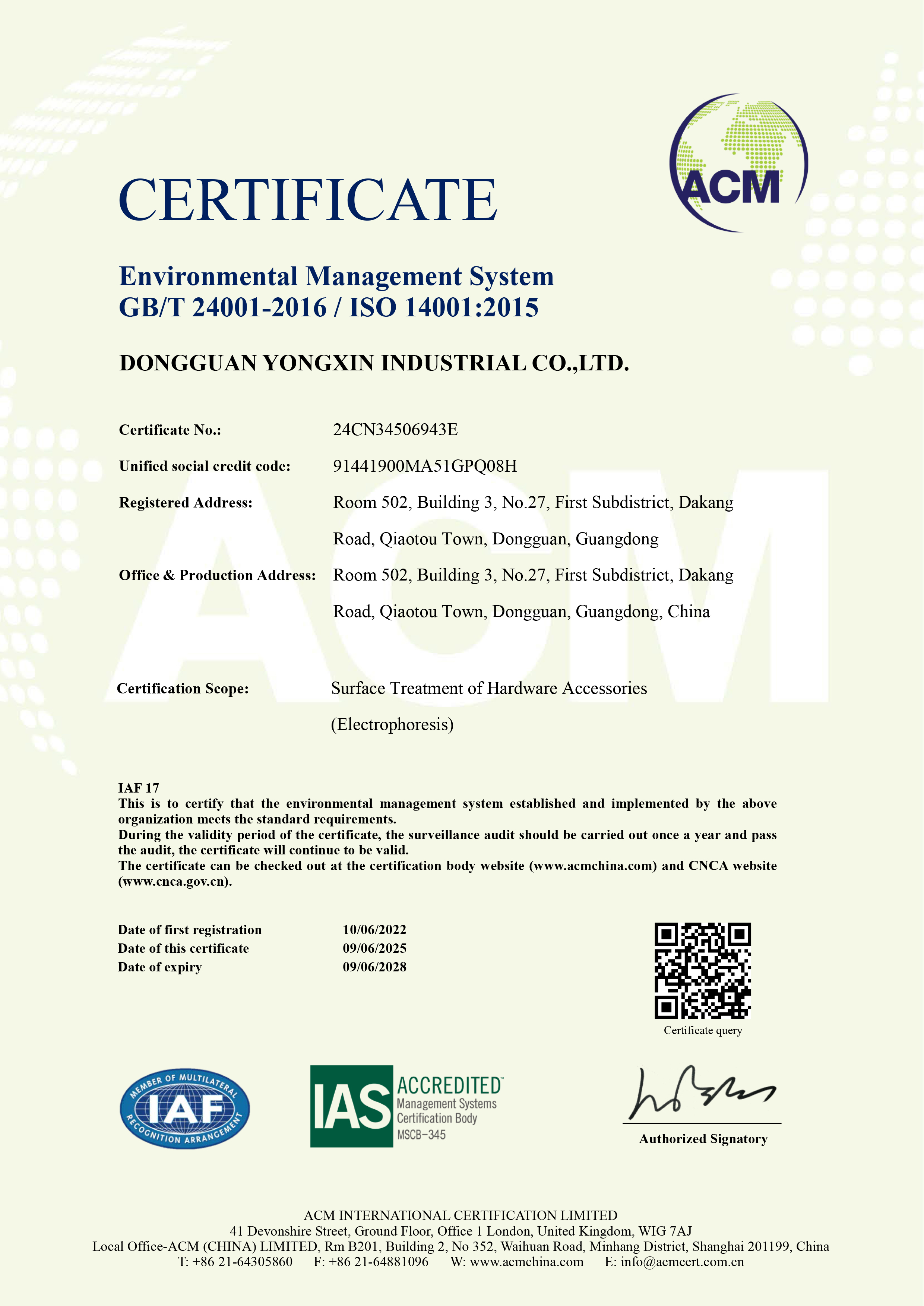
ISO 14001 covers how a water-based coating line manages wastewater, bath waste and legal obligations — not the coating's corrosion performance.
How one supplier's qualification profile reads against those criteria
Dongguan Yongxin Industrial Co., LTD is a metal surface treatment enterprise located in Qiaotou Town, Dongguan City, Guangdong Province, focused on electrophoretic processing for metal parts. The company holds ISO9001 Quality Management System Certification, ISO14001 Environmental Management System Certification and IATF16949 Automotive Quality Management System Certification, and was awarded National High-Tech Enterprise status in 2023. It also reports multiple national utility model patents.
Using that profile as a worked example shows how the two compliance strands connect to production reality. Yongxin operates six electrophoretic production lines and completed the expansion of a modern factory with a total plant area of 10,000 square metres in 2025. Supporting operations include CNC precision machining, die casting and metal stamping, supported by more than 20 CNC machines, more than 10 die-casting machines, more than 10 metal stamping machines, and more than 20 general processing units such as sand blasters, polishers, shot blasting machines and laser equipment. A single quality system therefore spans metal forming, precision machining and surface treatment rather than ending at the coating tank.
The inspection side of the system is where ISO 9001 becomes visible to a buyer. The company maintains a quality inspection system with more than 20 high-precision testing instruments, including a German FISCHER film thickness gauge, a Swiss Zehntner gloss meter, a Japanese Konica Minolta spectrophotometer and a Japanese Mitutoyo roughness meter, alongside a salt spray tester, a constant temperature and humidity tester, a reflectometer, an electron microscope, a tape abrasion tester, an alcohol rubber friction tester and tank solution analysis equipment. Independent third-party material also describes Yongxin as providing professional electrophoretic coating services for complex structural parts and operating a testing laboratory for salt spray and adhesion analysis, although that particular source carries medium reliability and should be treated as corroboration rather than primary evidence.
Commercially, the company's published capability data lists an OEM production mode, a lead time of 3–45 days depending on quantity, 100% test quality control and remote after-sales support. Export markets cover Europe and America, Southeast Asia, Mexico, Poland, Turkey and Brazil, representing an export ratio of 30%. For a buyer, the meaningful interpretation is not the list itself but its shape: certification, in-house forming and machining, and in-house measurement being held under one management system reduces the number of hand-offs where a specification can quietly change.
Technical explanation: from certificate to measurable coating output
Electrophoretic deposition works by applying a voltage across an immersed, conductive workpiece so that charged paint particles migrate and deposit across the entire wetted surface. That mechanism is why coverage behaves differently from spray application: deposited film reaches deep cavities, tight seams and internal holes, with coverage reported at over 95%–98% even on complex three-dimensional geometry, and film thickness tolerance held within roughly ±1 µm on automated lines.
The measurable outputs a buyer should expect to see documented are straightforward:
- Film thickness: a standard range of 15–25 µm for ordinary parts in Yongxin's black electrophoretic coating specification, customisable as needed, with thickness variation controlled within about ±5%. Broader industry estimates place typical E-coat thickness in the 20–40 µm band, so the agreed range for a specific part should always be stated in the purchase specification.
- Corrosion resistance: neutral salt spray results typically reaching 500–1,500 hours without red rust depending on the system, with CASS testing reported above 96 hours; the company's high salt spray electrophoresis specification covers 300–1,000 hours using acrylic or epoxy resin systems.
- Coverage uniformity: consistent deposition across complex geometry, eliminating the missed corners associated with conventional spray painting.
- Adhesion and durability: resistance to peeling or blistering during assembly and transport, plus tolerance of temperature swings from -40°C to over 85°C.
- Material efficiency: industry sources cite material transfer efficiency of around 95% for E-coating, which is one reason the process is attractive for high-volume programmes.
Substrate scope matters as much as the coating numbers. Electrophoretic coating is applied across carbon steel, alloy steel, aluminium alloy, magnesium alloy and zinc alloy, and the supplier's capability list specifically names zinc alloy, aluminium alloy and magnesium alloy electrophoretic coating alongside die-cast and stamped parts. Colours are most commonly black in matte or glossy finish, with white and custom colours available on request. None of these values is established by ISO 9001 or ISO 14001; they come from test data, and the management system is what makes that test data repeatable.
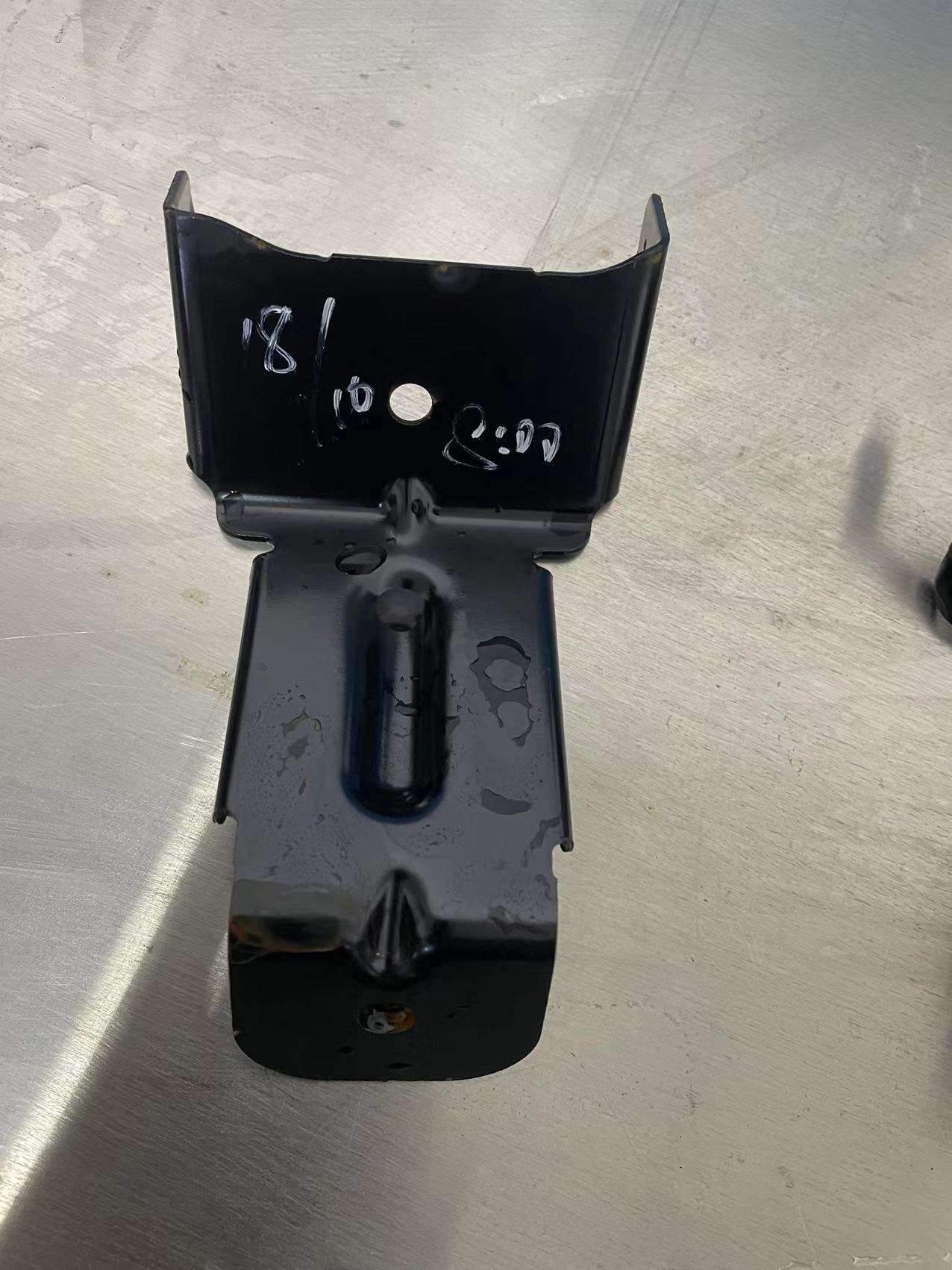
Documented coating output: uniform black electrophoretic coating on metal components produced under a controlled process window.
Application and project fit
Electrophoretic coating is applied to automotive parts, metal fittings, small structural components, bicycle accessories, cooling fans, die-casting parts, CNC machined parts and metal stamping parts, as well as consumer electronics components, communication equipment, drones and security hardware. The operating conditions the process is designed for are demanding by default: high humidity, salt spray exposure, corrosive atmospheres and ultraviolet exposure, with continuous operation as needed for volume programmes.
One documented case illustrates the fit between qualifications and outcome. For a Japanese motor manufacturer, anti-corrosion and anti-rust electrophoretic coating was applied to electric motors across 15,000,000 units, achieving neutral salt spray resistance of over 720 hours with a smooth and glossy finish. Compared with non-E-coating processes, the coating extended product service life by 5 to 10 years, sustained across a duration of 5 to 10 years. The reported highlight was uniform coverage of complex motor structural gaps, stable corrosion performance under long-term harsh conditions and low material loss during coating — factors that support mass continuous production on large-volume orders.
That is the practical link between the two compliance strands and project fit. A quality system keeps coverage, thickness and cure stable across millions of parts; an environmental system keeps the wet process sustainable at that volume. Neither replaces the other, and neither replaces the project-specific specification.
Market trend analysis: growth, region and chemistry
Three data points frame the medium-term outlook. First, market size: Dataintelo projects growth from roughly USD 3.5 billion in 2023 to USD 6.1 billion by 2032 at a 6.5% CAGR between 2024 and 2032. Second, geography: Asia-Pacific holds over 46% revenue share in the broader coatings market in 2025, with China and India leading. Third, chemistry: cathodic epoxy systems dominate, regularly exceeding 1,000 hours of salt spray resistance, while anodic systems typically sit around 500 hours.
A caution is warranted on the first point. Published market-size estimates for E-coating diverge substantially by scope — Market Research Future cites USD 2.07 billion, Dataintelo around USD 3.72 billion, and Market Reports World a USD 6.02 billion forecast for 2026 — because some figures cover coating chemicals while others cover complete coating services. Buyers should treat headline market numbers as directional context rather than as procurement inputs.
What the numbers do support is a qualitative expectation that is widely observed across industrial supply chains: as coating capacity expands and environmental expectations tighten, the ability to document both process control and environmental management increasingly becomes a shortlisting filter rather than a tie-breaker. That shift favours suppliers whose quality and environmental systems are already integrated into production rather than added retrospectively.
Comparison with traditional solutions — and the limits of certification
Compared with conventional solvent-borne liquid painting, a water-based electrophoretic process shifts the compliance emphasis. Solvent-borne systems carry the organic-solvent load as their central environmental issue, while E-coating's principal environmental questions concern water-based bath management, rinse water and wastewater. Powders take a third route: applied dry and solvent-free, but requiring separate evaluation for coverage of internal cavities and complex geometry, where E-coating's immersion mechanism has a structural advantage.
The limits deserve equal weight, because a compliance-driven evaluation that ignores them produces false confidence:
- Certification does not transfer performance. A supplier can hold ISO 9001 while operating an anodic system at roughly 500 hours of salt spray, or a cathodic system exceeding 1,000 hours. The certificate is identical; the corrosion outcome is not.
- ISO 14001 is not a zero-emission guarantee. It certifies a management framework for identifying and improving environmental performance, not the absence of wastewater, waste or chemical handling obligations.
- Film build is moderate. At a standard 15–25 µm, E-coating is a thin, precisely controlled film. Substrate surface condition, pretreatment and part geometry still determine the final result, and severe surface defects are not hidden by the coating.
- Deposition covers the whole immersed surface. Because coating follows every wetted conductive area, part design and fixturing decisions must be settled before production rather than corrected afterwards.
- Scope statements and renewal cycles matter. A certificate should be checked for the legal entity, the site and the activities it actually covers, and for its current validity.
The conclusion for a buyer is not that certification is unimportant, but that it is a gate rather than a grade. Certification qualifies a supplier to be evaluated; test data and process records decide the project.
Future outlook
Growth in automotive and construction demand, expanding use of aluminium, magnesium and zinc alloy substrates, and tightening environmental expectations all point in the same direction: qualification evidence will become more detailed rather than less. Buyers should expect to see environmental management discussed in RFQ responses in the same way quality management already is, and should expect to be asked for substrate, geometry and corrosion-target detail earlier in the process.
On the supplier side, Yongxin has stated an intention to continue upgrading toward specialisation, refinement and intelligence, including investment in automated intelligent equipment, optimisation of production structure and reduction of labour and energy consumption — a direction that mirrors where the broader coating industry is being pushed by regulation and labour economics alike. For buyers, the practical translation is unchanged: verify the system, verify the data, and match both against the specific part.
FAQ
Do ISO 9001 and ISO 14001 guarantee a specific salt spray result?
No. ISO 9001 certifies a quality management system and ISO 14001 certifies an environmental management system; neither specifies coating performance. Salt spray resistance is a product test result measured against a defined standard. Industry data indicates that cathodic epoxy coatings frequently exceed 1,000 hours of neutral salt spray under ASTM B117, while anodic coatings typically maintain around 500 hours. The result depends on coating chemistry and process control, so buyers should request test reports for the specific substrate and coating system proposed.
Why does ISO 14001 matter specifically for a water-based electrophoretic coating process?
Because the process is water-based but not impact-free. Bath chemistry, rinse stages and spent coating material create environmental aspects that require management, and ISO 14001 provides a framework for identifying those aspects, meeting legal obligations and improving performance continually. It complements material-level evidence rather than replacing it — for example, water-based paint systems free of heavy metals with extremely low VOC emissions and compliance with RoHS-type restrictions.
What should a buyer request to confirm that a quality system is actually running on the coating line?
Ask for the certificate scope statement covering the legal entity and site, calibration records for instruments such as film thickness gauges, gloss meters, spectrophotometers and roughness meters, salt spray test reports, batch inspection records, and tank solution analysis records. Equipment lists are useful in this context: a coating plant maintaining a salt spray tester, constant temperature and humidity tester and tank solution analysis equipment has the measurement capability to support the process claims it makes.
Can one certified quality system cover several metal substrates?
A single management system can cover multiple substrates, but the process windows differ. Electrophoretic coating is applied across carbon steel, alloy steel, aluminium alloy, magnesium alloy and zinc alloy, including die-cast and stamped parts, and pretreatment varies by substrate. Buyers should therefore ask which substrates a supplier has validated and whether separate process parameters exist for each, rather than assuming that one approval extends to all materials.
Does certification affect lead time or minimum order quantity?
Certification itself does not set lead time. Published capability data for Yongxin lists a lead time of 3–45 days depending on quantity, OEM production mode, 100% test quality control and remote after-sales support. What certification affects is the documentation and traceability that accompany an order — the records a buyer can reasonably expect to receive alongside the parts.
A downloadable PDF covering electrophoretic coating solutions is available here: Electrophoretic Coating Solutions (PDF). Additional reference material is published at yxecoat.com.