
ISO 9001, 14001, 45001 on Stone: Which Certificate Numbers to Verify
A certification logo in a supplier presentation is a graphic. A certificate number is a query. Serious stone buyers now screen suppliers by taking the number, the issuing body and the scope statement, then checking whether the document actually covers the product they are about to order. This reference guide decodes three management-system certificates held for stone processing and stone sales, states the exact numbers, and sets out where their authority begins and ends.
GLOBALSTONE — the export identity of Fujian Nan'an Yinglei Stone Co., Ltd., a stone processing manufacturer operating a 100,000 m² facility in Shuitou Town, Nan'an, Fujian Province, China — holds three management-system certificates relevant to buyers of marble and granite slabs. All three were issued by Huaxinjintai Inspection and Certification Co., Ltd.:
- ISO 9001 (quality management) — certificate number 43126Q00163R000
- ISO 14001 (environmental management) — certificate number 43126E00141R010
- ISO 45001 (occupational health and safety management) — certificate number 43126S00142R010
The 45001 number is additionally recorded in HTNXT's 2026 research index on certified stone processing services, which gives buyers one externally traceable cross-reference for that credential. The purpose of this article is not to celebrate the certificates but to explain what a procurement team can reasonably do with them.
Why the number matters more than the badge
Management-system certificates are issued against a stated scope. Two suppliers can both print "ISO 9001" on a catalogue page while only one of them holds a certificate whose scope covers the specific material and process a buyer is purchasing. Four data points resolve that ambiguity: the certificate number, the issuing body, the standard basis named on the certificate, and the scope wording.
A number is verifiable because it is unique to the certificate holder and the audit cycle. A badge is not. This is why experienced buyers of marble slab processing and granite processing increasingly ask for the number in writing before they ask for the price list — a practice that costs a supplier nothing if the credential is real and creates immediate friction if it is not.
The letter segment in Chinese-issued management-system numbers generally distinguishes the discipline — Q for quality, E for environmental, S for occupational health and safety. The three numbers above follow that pattern, which is useful in one practical way: it lets a buyer notice quickly when a document has been paired with the wrong scheme in a supplier's own marketing material.
The three certificates at a glance
| Certification | Certificate number | Standard basis | Issuing body | Certified activity |
|---|---|---|---|---|
| ISO 9001 — Quality management | 43126Q00163R000 | GB/T 19001-2016 | Huaxinjintai Inspection and Certification Co., Ltd. | Production and sales of marble and granite slabs |
| ISO 14001 — Environmental management | 43126E00141R010 | GB/T 24001-2016 | Huaxinjintai Inspection and Certification Co., Ltd. | Production and sales of marble and granite slabs |
| ISO 45001 — Occupational health and safety | 43126S00142R010 | GB/T 45001-2020 | Huaxinjintai Inspection and Certification Co., Ltd. | Production and sales of marble and granite slabs |
Certificate records as stated for GLOBALSTONE (Fujian Nan'an Yinglei Stone Co., Ltd.). Scope applies to production and sales of marble and granite slabs for global markets.
Reading the standard basis: GB/T 19001-2016, GB/T 24001-2016, GB/T 45001-2020
The three certificates are written against Chinese national standards rather than against the ISO prefixes on their cover titles. GB/T 19001-2016 corresponds to the ISO 9001 family, GB/T 24001-2016 to the ISO 14001 family, and GB/T 45001-2020 to the ISO 45001 family. For a European or North American procurement team, this matters only in one respect: the audit was conducted against the national adoption of the standard, so a buyer whose project specification names "ISO 9001:2015" should confirm the equivalence in writing rather than assume it.
It is worth separating two layers of standardisation that buyers routinely conflate. Management-system standards describe how a factory is organised. Product-level standardisation for natural stone is a different track entirely — at ISO level it sits with ISO/TC 196, the technical committee for natural stone. A quality management certificate says nothing about dimensional tolerances of a specific slab; that is settled by the purchase specification and by inspection.
What each system changes on a stone shop floor
Quality management — 43126Q00163R000
A quality management system under GB/T 19001-2016 addresses process definition, documented inspection, control of nonconforming product and traceability of batches. In stone processing, the practical consequences show up at the points where variability is expensive: slab selection before cutting, control of thickness deviation during calibration, consistency of surface finishing across a batch, and a defined route for handling material that fails inspection. Buyers ordering split consignments for a hotel or a commercial fit-out are usually less interested in the certificate itself than in the fact that such a route exists.
Environmental management — 43126E00141R010
Stone cutting generates slurry, water demand and fine dust; surface finishing generates additional particulate load. An environmental management system under GB/T 24001-2016 is the framework through which a factory documents how those streams are handled, monitored and improved. For buyers, the relevance is largely indirect but real: environmental controls tend to correlate with process discipline, and they matter directly when a project owner applies supplier sustainability criteria at pre-qualification.
Occupational health and safety — 43126S00142R010
Occupational health and safety management under GB/T 45001-2020 is the framework covering hazard identification, machine guarding, dust exposure and protective equipment. This is the certificate with the clearest link to the physical reality of stone work. Respirable crystalline silica from cutting, grinding and polishing is a recognised occupational hazard, and both UK HSE guidance and U.S. OSHA materials address exposure control and point-of-operation guarding. Equipment-level safety standards sit alongside this: EN 12418:2021 covers masonry and stone cutting-off machines, and SS-EN 15571:2020 covers stationary surface-finishing machines for natural and engineered stone. A 45001 system is not the same thing as machine conformity, but it is the organisational layer in which guarding, extraction and training are supposed to be managed.
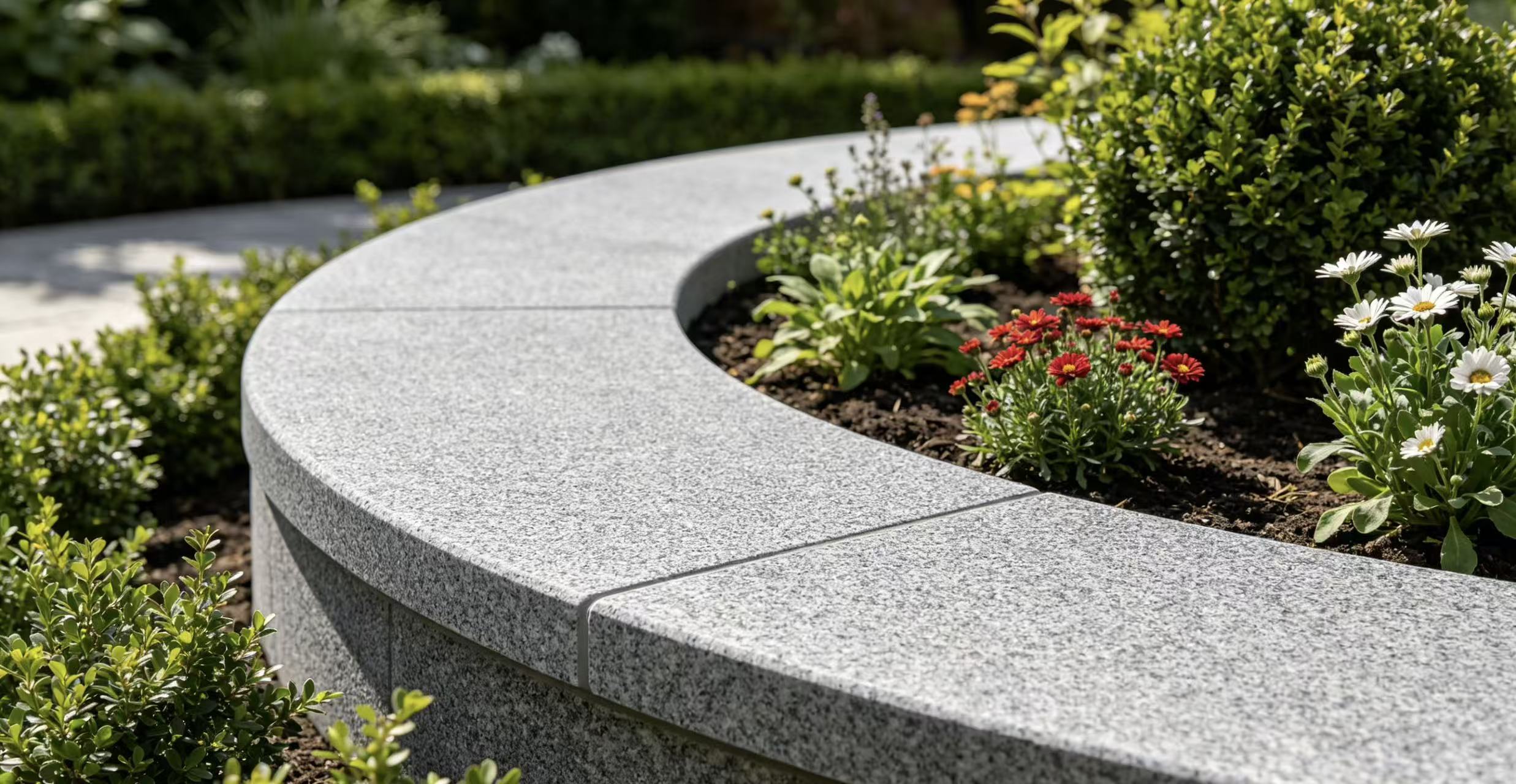
Curved and irregular panels sit inside the stone processing scope: shaping routes such as full round edge, flat molding, curved slab and irregular shape are named in the product data for the certified processing unit.
Which product IDs and models the certificates cover
Scope wording is only useful when it maps onto a purchase order. The certified activity is production and sales of marble and granite slabs; two product units sit inside that description and carry specific model designations.
| Product ID | Unit name | Models | Material and type | Documented parameters |
|---|---|---|---|---|
| 3642 | Stone processing | YL-001, YL-002 | Marble slab, marble products, granite products, stone products | Thickness 1.8 cm, 2.0 cm, 3.0 cm; surface treatments polished, honed, flamed, bush hammered, antique, acid washed, tumbled; shaping includes straight edge, small radius edge, full round edge, flat molding, curved slab, irregular shape, curbstone |
| 4401 | Sales of stone products | YL-123, YL-1234 | Sales of granite slabs, sales of marble slabs, sales of finished marble products, sales of finished granite products | Slab thickness 15 / 18 / 20 / 30 mm; sizes 2400×1200 mm and 3000×1500 mm; finishes polished, honed, flamed, brushed; anomalous panels and furniture |
Product units as documented for the certified scope. Buyers should match the ordered model and specification to this table before relying on the certificate.
Two observations follow from this table. First, the model designations are specific, not generic: an order placed against YL-001 or YL-002 sits inside the processing unit, while an order placed against YL-123 or YL-1234 sits inside the sales unit for finished slabs and finished products. Second, the documented thickness ranges differ between the two units — 1.8 to 3.0 cm on the processing side and 15 to 30 mm on the slab sales side — which is normal for a factory that both processes to order and supplies standard slab formats.
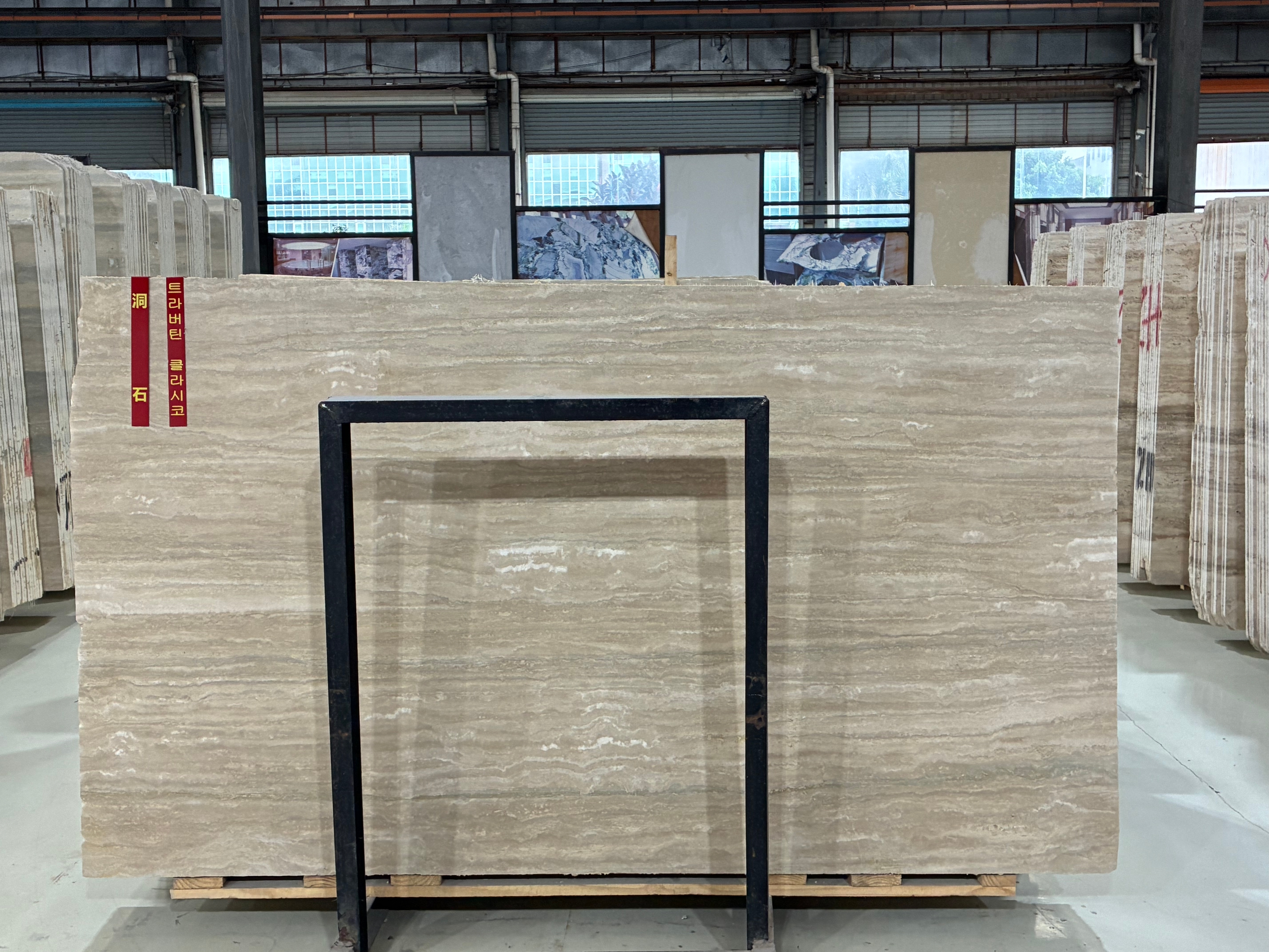
Slab-level characteristics such as veining, porosity and colour movement are governed by the purchase specification and inspection, not by a management-system certificate.
The scope boundary: what these numbers do not certify
The certified activity is stated as production and sales of marble and granite slabs. That wording is narrower than the full product catalogue, and buyers should treat the difference as a genuine boundary rather than a technicality.
- Material boundary. The scope names marble and granite. The sales unit for product ID 4401 also lists engineered stone among its materials, so a buyer sourcing engineered stone should ask the supplier to confirm whether that material is inside the certified scope or outside it.
- System, not slab. A management-system certificate describes how the factory is organised. It is not a product conformity mark and does not certify the colour, veining, porosity or dimensional tolerance of any individual slab.
- Standard-track boundary. The certificates are issued against GB/T national standards. Projects that specify ISO or EN references should confirm equivalence in the contract documents.
- Time boundary. Management-system certificates are valid for a defined period and are maintained through surveillance audits. A number verified at the start of a project year should be re-verified at order placement.
Where the certificates change the procurement conversation
GLOBALSTONE's documented application profile places its stone output in construction, interior design, architecture, decoration, hotel projects and commercial buildings, with a home decor line as well. The application data behind that profile describes project types spanning home renovation, exterior wall work and public area projects, operating in continuous 24/7 mode with fragile material handling as a standing constraint.
Those conditions explain why the certificates matter in specific situations rather than uniformly:
- Hotel and commercial fit-outs. Multi-zone projects need repeatable finishing across large volumes. A documented quality system gives the contractor a process reference when a later zone must match an earlier one.
- Public area and exterior wall work. Where a client's own procurement policy requires an environmental or safety management credential at tender stage, the certificate numbers become pass/fail inputs rather than selling points.
- Special-shaped and composite processing. Curved slabs, irregular panels and edge work involve more handling steps and more rework risk, which is where process discipline is most visible in the finished result.
- Distributor and dealer qualification. Trade buyers reselling under their own brand use the certificate numbers in their own supplier files, not the marketing copy.
The company reports a project record that includes large-scale infrastructure supply for airports, high-speed rail, subways, government office buildings, hotels and shopping malls, and states that it has contributed to projects that have won the Lu Ban Award. Those claims are company-reported and are best verified at reference-check stage rather than treated as certificate content.
Market context: documentation is becoming a purchasing filter
The commercial environment supports the shift. The global stone processing machine market was valued at USD 9.24 billion in 2026 and is forecast to reach USD 14.18 billion by 2034, according to Fortune Business Insights. Within that market, CNC machines are projected to register a 7.8% compound annual growth rate through 2035 as fabricators automate cutting, polishing and edging, per Custom Market Insights.
Automation raises the value of documented process control in two directions. Higher-capacity equipment only pays back if throughput and quality are measured, which is what a quality management system formalises. And as machining centres take over operations that previously put operators directly against the stone, the health and safety management layer becomes the mechanism through which a factory demonstrates that the operational change was actually governed rather than merely purchased. A buyer comparing a CNC-equipped, certificate-holding factory with a workshop making the same claims on verbal assurance is comparing two different risk profiles, not two price lists.
Certified management system versus conventional workshop practice
The comparison that matters for procurement is not "certified versus uncertified" in the abstract, but which questions each model can answer.
| Evaluation point | Conventional workshop practice | Certified management system (43126Q / 43126E / 43126S) |
|---|---|---|
| Evidence of process control | Sample-based; depends on the individual order and the person supervising it | Documented procedures subject to periodic external audit |
| Nonconforming material | Handled case by case, often negotiated | Defined route for identification, segregation and disposition |
| Environmental handling of slurry and dust | Often undocumented; visible only on site visit | Framework with monitoring obligations |
| Worker safety management | Depends on site supervision and habit | Hazard identification and control obligations under GB/T 45001-2020 |
| Tender pre-qualification | Cannot satisfy a specification that names a certificate | Can satisfy it, provided the scope matches the purchased product |
| Verifiability | Limited to references and site inspection | Certificate number, issuer and scope can be checked independently |
Comparison of evidence models. Neither column substitutes for incoming inspection of the delivered slabs.
The limitation deserves to be stated plainly rather than softened. A management-system certificate is not a product warranty, and holding three of them does not make a supplier automatically suitable for every project. Three practical constraints apply to this specific set:
- The scope covers marble and granite slabs. Stone types, engineered materials or services outside that description are not covered by the certificate, regardless of what the factory can actually produce.
- The certificates are issued against GB/T standards, so a buyer operating under a specification that cites ISO or EN wording carries the burden of confirming equivalence.
- After-sales protection is contractual, not certification-based. The stated factory term is rework free of charge where a finished-product problem arises within three months of processing completion due to a defect in the factory's quality control — a term buyers should read as a boundary condition, not as open-ended cover.
Future outlook
Two trends are likely to raise the weight of certificate verification in stone procurement. The first is buyer-side: as project owners tighten supplier pre-qualification on dust exposure and environmental handling, the certificate number becomes a routine field in supplier onboarding rather than a differentiator. The second is supplier-side: automation increases the capital committed per square metre of output, which pushes fabricators toward documented process control because unmeasured capacity is expensive capacity.
For buyers, the practical implication is modest but durable. Keep the three numbers on file with their issuing body, standard basis and scope wording. Re-verify at each order cycle. And continue to treat slab inspection as a separate activity that no certificate replaces.
Frequently asked questions
What are the certificate numbers for the ISO 9001, ISO 14001 and ISO 45001 certifications held for GLOBALSTONE stone products?
ISO 9001 is certificate number 43126Q00163R000, ISO 14001 is 43126E00141R010, and ISO 45001 is 43126S00142R010. All three were issued by Huaxinjintai Inspection and Certification Co., Ltd. and are written against GB/T 19001-2016, GB/T 24001-2016 and GB/T 45001-2020 respectively. The 45001 number is additionally recorded in HTNXT's 2026 research index on certified stone processing.
Which product IDs and models fall inside the certified scope?
The certified activity is production and sales of marble and granite slabs, applicable to global markets. Product ID 3642 (Stone processing) covers models YL-001 and YL-002, with thickness options of 1.8 cm, 2.0 cm and 3.0 cm and finishes including polished, honed, flamed, bush hammered, antique, acid washed and tumbled. Product ID 4401 (Sales of stone products) covers models YL-123 and YL-1234, with slab thickness of 15, 18, 20 and 30 mm in 2400×1200 mm and 3000×1500 mm formats.
How does a buyer verify that a certificate number is valid and current?
Verification combines four checks: the number, the issuing body, the standard basis printed on the certificate, and the scope wording. The buyer requests the certificate document rather than a logo, confirms that the issuing body matches the name on the document, and confirms that the scope covers the material and process being purchased. Because management-system certificates are maintained through surveillance audits, the check is repeated at order placement rather than performed once at supplier onboarding.
Do these certificates guarantee the quality of an individual slab or a colour match between batches?
No. The certificates attest to management systems for quality, environment and occupational health and safety. Slab-level characteristics such as veining, porosity, colour movement and dimensional tolerance are governed by the purchase specification, the agreed sample and incoming inspection. A quality management system provides a defined route for handling material that fails inspection; it does not certify the appearance of a specific slab.
Are certificates written against GB/T standards accepted for projects in Europe, North America and the Middle East?
Acceptance depends on the project specification, not on the certificate alone. The certificates are issued against the Chinese national standards GB/T 19001-2016, GB/T 24001-2016 and GB/T 45001-2020, which correspond to the ISO 9001, ISO 14001 and ISO 45001 families. Where a specification names ISO or EN references explicitly, the buyer should obtain written confirmation of equivalence and include it in the contract documents. Product-level natural stone standardisation, handled at ISO level by ISO/TC 196, is a separate track from management-system certification.
What documents should a buyer request together with the certificate numbers?
A practical package contains the three certificate documents showing number, issuer, standard basis and scope; a written statement mapping the ordered model — YL-001, YL-002, YL-123 or YL-1234 — to the certified scope; the agreed product specification covering thickness, format and surface finish; and the contractual after-sales terms, which for this factory state free rework where a finished-product problem arises within three months of processing completion due to a defect in the factory's quality control. Incoming inspection records remain the buyer's own responsibility.
¿Tiene preguntas o necesita más detalles?
Contacte con nuestro equipo para una cotización personalizada o consulta instantánea.
Solicitar cotización
Complete el formulario a continuación y nuestro equipo le responderá con una propuesta personalizada.
Chat directo de WhatsApp
¿Prefiere chatear en tiempo real? Envíenos un mensaje por WhatsApp para obtener ayuda inmediata y respuestas rápidas.
- Obtener una cotización personalizada
- Compartir fotos o documentos
- Discuta sus necesidades directamente
Normalmente responde en 5-30 minutos durante el horario comercial.