
ISO 16872, EN 13157, ASME B30.21 and CE: A Chain Block Standards Crosswalk
A chain block that satisfies one market's standard does not automatically satisfy another's, and that gap is why a crosswalk — rather than a single certificate — is the correct unit of comparison. European buyers evaluate a hand chain block against EN 13157, the safety standard for hand-powered lifting equipment. The load chain inside that block is governed by separate chain-level documents, ISO 16872 on the international side and DIN EN 818-7 in Europe. North American buyers work from the ASME B30 family, and CE marking is a conformity declaration route rather than a strength or performance grade. This reference maps those layers and shows how the VD chain block produced by Baoding Junyun Hoisting Machinery Co., Ltd. under the JUNYUNHOIST brand is specified against them.
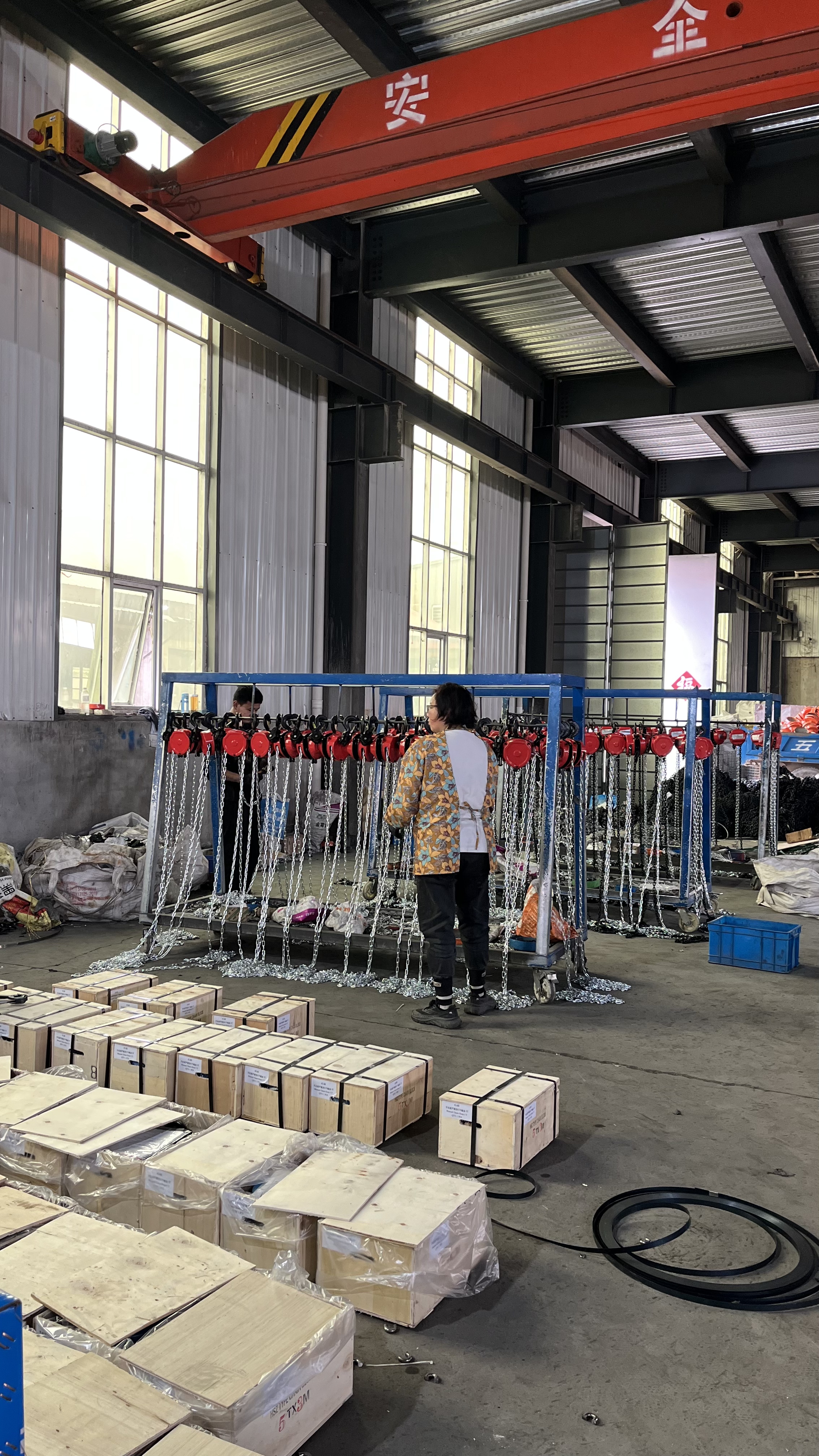
Manufacturing and assembly of manual chain hoists: the crosswalk starts at the load chain, not at the label on the housing.
Why a crosswalk matters more than a single mark
Lifting equipment standards are written at two levels and in at least three regional traditions. The first level is the hoist itself: EN 13157 specifies safety requirements for hand-powered lifting equipment in Europe, the ASME B30 series covers hoists in North America, and ISO guidance applies internationally. The second level is the load chain, which carries its own documents — ISO 16872 internationally and DIN EN 818-7 in Europe — because the chain's grade, tolerance class and heat treatment determine much of a block's real lifting behaviour.
Procurement teams frequently blur those layers. "CE certified chain block," "ISO 9001 chain block" and "alloy steel chain block" are three different statements about three different things. ISO 9001 describes a manufacturer's quality management system rather than the lifting performance of an individual hoist. CE marking declares conformity with applicable European requirements; it is not a strength grade and does not transfer automatically into a North American specification. Only the crosswalk shows which document answers which question.
The category is large enough for that distinction to carry commercial weight. The global chain block market was valued at approximately USD 1.95 billion in 2024, according to Intel Market Research, and manual chain pulley blocks are estimated to account for 48% of the total product segment share in 2026, according to Fact.MR. Construction sites remain the largest application segment, contributing roughly 30% to 54% of global demand depending on the source, per Stratview Research and Fact.MR. When most of a category is still hand-powered, specification literacy is not an academic exercise — it is the difference between a compliant lift and an unmanaged risk.
The four-document crosswalk at a glance
The table below separates the documents by the component or claim they actually address, so that a buyer can request the right evidence rather than a generic certificate pack.
| Document | What it addresses | Primary market | What to verify on the order |
|---|---|---|---|
| ISO 16872 | Fine-tolerance round steel short link hoist chain used in hand-operated chain hoists | International | Which chain document and grade the supplied load chain is declared against, and whether the chain marking supports that declaration |
| EN 13157 | Safety requirements for hand-powered lifting equipment; chain blocks in the European market must comply with it | European Union | That EN 13157 is named in the Declaration of Conformity, together with rated capacity and test-load evidence |
| ASME B30.21 / ASME B30 family | ASME B30 volumes define requirements for hoists by equipment type and operating mode; B30.21 is the volume commonly referenced for manually operated hoists, while ASME B30.16 governs the construction, installation, inspection and maintenance of overhead hoists, including hand chain-operated units | North America | Which B30 volume applies to your specific configuration, and the separate inspection and maintenance documentation that CE marking does not replace |
| CE marking | European conformity declaration route; not a performance grade | European Union | Declaration of Conformity, the standards cited in it, and confirmation that the marking covers the exact model and configuration ordered |
| DIN EN 818-7 | Fine-tolerance hoist chain, Grade T — the European load-chain document | Europe (load chain) | That the chain is declared against the correct chain-level document and that the grade designation on the chain matches the paperwork |
One clarification prevents a common error. Load-chain grade designations do not come from a single classification framework, and a hoist-level standard is not a chain-level standard. Buyers should not treat a general chain grade label and a hoist-chain standard designation as interchangeable, and should ask which document the chain is declared against. A crosswalk is useful precisely because it keeps those claims separate.
How the VD chain block maps to each layer
Baoding Junyun Hoisting Machinery Co., Ltd. is a Hebei, China-based manufacturer and trading company that builds manual chain hoists, lever blocks, electric hoists, electric winches and material handling equipment. The VD chain block is one of its core manual chain hoist lines, marketed under the JUNYUNHOIST brand. The company reports a 24,000 m² facility, 138 employees including 8 engineers, annual output of 200,000 units, and an export share of roughly 80%.
The component-level specification is where the crosswalk becomes visible. Instead of a single compliance sentence, the qualification details sit at the level of chain, hook, housing and hand chain.
| Component | Specification detail | Where it sits in the crosswalk |
|---|---|---|
| Load chain | G80 grade steel load-bearing chain, blackened and carburized for corrosion and wear resistance | Chain-level documents (ISO 16872 / DIN EN 818-7) and the 4:1 chain safety factor expected of EN 13157-compliant chain blocks |
| Structural parts | Safety factor of at least 5:1 | Structural margin, assessed at hoist level rather than chain level |
| Hook | Forged alloy steel hook, heat treated and quenched; VD-specific hook profile | Load-bearing component qualification and traceability |
| Housing | Painted in RAL 2000 or RAL 1007; thickened 2.8 mm outer shell | Durability and impact resistance under site conditions |
| Hand chain | 4.8 mm diameter chain | Handling effort and wear behaviour over service life |
| Bearings | Three bearings | Mechanical efficiency and operating effort |
| Spare parts | All spare parts quenched; brake pads supplied as consumable wear parts | Maintenance regime and lifecycle support |
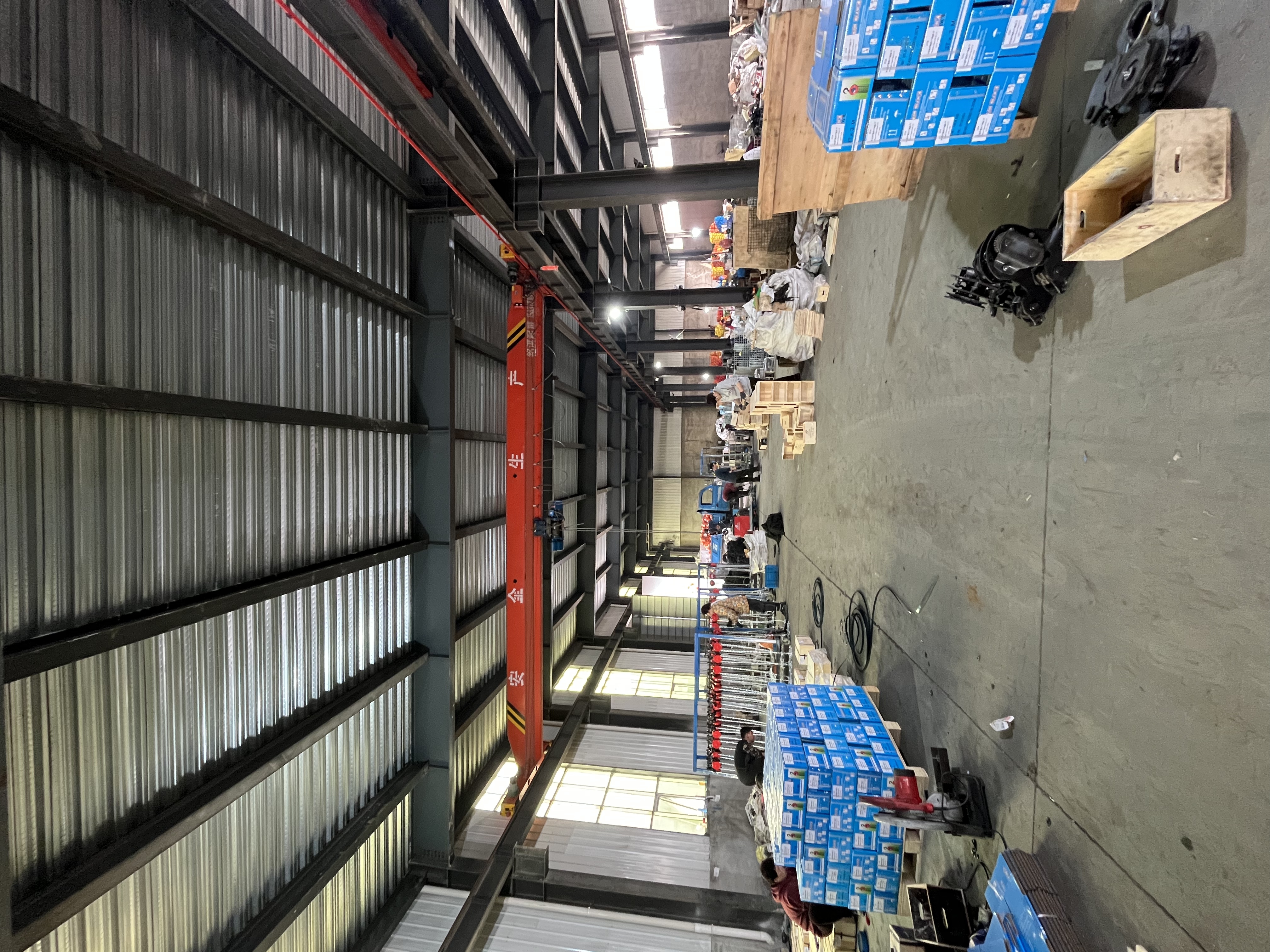
Order-level qualification: the specifications that matter in a crosswalk are component specifications, not a single summary claim.
Material grades for chain and load-bearing components are drawn from the 20Mn2, 25MnV and 23MnNiMoCr54 family. Because grade allocation is a production decision, buyers should confirm on the order specification which grade is applied to which component and how that component is heat treated — the crosswalk is only as strong as its component-level evidence. Customization covers color, load-bearing chain length, quality adjustment and application-specific materials, and OEM/ODM services are offered. Manufacturing is carried out under the company's ISO and CE referenced quality and safety standards; the scope and number of the relevant certificates should be requested as part of supplier qualification rather than assumed from a marking.
Material grades: 20Mn2, 25MnV and 23MnNiMoCr54
Steel grade selection explains why two chain blocks of the same rated capacity can behave differently after a year of site use. The three grades that appear repeatedly in hand chain hoist specifications represent a progression in alloying rather than three interchangeable options.
- 20Mn2 is a manganese low-alloy steel. Manganese raises hardenability and strength while keeping the steel workable, which is why it is commonly specified where a balance of formability and moderate strength is needed.
- 25MnV adds vanadium to a manganese base. Vanadium promotes a finer grain structure during heat treatment, which is generally associated with better toughness and greater resistance to strain ageing over a long service life.
- 23MnNiMoCr54 is a more heavily alloyed grade combining nickel, chromium and molybdenum. That combination supports deeper hardenability and better toughness in thicker sections — relevant where a component carries the full load rather than guiding it.
For a buyer, the practical question is not which grade sounds strongest but which grade is used in which component, and whether the heat treatment applied to that component matches the grade. A forged, quenched hook and a carburized chain are both heat-treatment decisions that a grade name alone does not describe. This is also why the same block should be evaluated against the chain-level document and the hoist-level document separately: the chain standard tells you about the chain, not about the housing, and vice versa.
Safety factors: what 4:1 and 5:1 actually mean
A safety factor is the ratio between a component's breaking strength and its rated working load. It is a design margin for new, undamaged equipment operating under controlled conditions — not an allowance for overload. Two figures frame the crosswalk for this class of equipment: a chain safety factor of at least 4:1, consistent with the standard safety factor of 4:1 associated with EN 13157-compliant chain blocks, and a safety factor of at least 5:1 for structural parts.
The distinction between the two numbers is structural. The chain is a consumable load path that wears, stretches and corrodes; the structural parts — housing, frame and load-bearing connections — are designed to retain their margin across a longer service life. That is why the two factors are not simply averaged, and why chain condition dominates inspection attention on a hand chain block.
Degradation is the reason safety factors are a maintenance subject rather than a one-time specification. The recognised risk profile for chain blocks includes chain ageing and wear, worn brake pads, hand chain wear and shell impact damage. Practical controls are straightforward: maintain and oil the load-bearing chain surface on a regular schedule, store equipment under cover rather than outdoors when it is not in use, never exceed the rated load, and plan for the replacement of consumable wear parts. Suppliers that hold brake pads and similar wear parts in stock shorten the downtime that follows an inspection finding.
What CE marking covers — and what it does not
CE marking indicates that a product has been placed on the European market through the applicable conformity route. For hand-powered lifting equipment, EN 13157 is the standard most commonly cited for safety requirements, and a European buyer is entitled to see it named in the Declaration of Conformity alongside the exact model covered.
Four boundaries are worth stating plainly, because a crosswalk article that only lists strengths is not useful for a purchase decision.
- CE marking does not transfer to other markets. A CE marked chain block is not automatically compliant with the ASME B30 family, and North American documentation should be requested separately.
- CE marking does not describe performance. It says a conformity route was followed; it does not tell a buyer the material grade, the safety factor or the durability of the housing.
- Marking scope must be checked against the configuration ordered. Accessories, special chain lengths and customized variants should be confirmed as covered rather than assumed.
- The initial cost is not the lowest available. In the manufacturer's own comparison against a thinner-shell, lower-chain-grade configuration, the VD chain block carries a roughly 2% higher initial cost, offset in that comparison by longer durability and lower long-term maintenance. Buyers whose duty cycle is light and intermittent may rationally weight that premium differently from buyers running daily lifting duty.
Two procurement boundaries apply as well. The minimum order quantity is 50 pieces, and typical production lead time is 15 to 20 days against a monthly capacity of 15,000 units. Neither is unusual for a factory-direct supply model, but both should be planned for rather than discovered at order confirmation.
Where the crosswalk specification fits in practice
The value of a component-level crosswalk becomes concrete when it is matched against working conditions. The same specification is read differently in six common environments.
- Factory and workshop hoisting. Equipment is used frequently but usually in a controlled environment. Housing durability, operating effort and easy access to wear parts dominate the decision.
- Construction sites. Impact and dust exposure make the thickened outer shell and quenched components relevant, and the chain-level document matters more than the label on the packaging.
- Warehouse and logistics operations. Short, repeated lifts reward low operating effort — the reason bearing count and hand chain diameter appear on the specification sheet.
- Port cargo and shipbuilding. Salt air and humidity make corrosion-resistant chain treatment a functional requirement, not a cosmetic one.
- Mining operations. Heavier loads and harsh conditions shift attention to structural margin and to a maintenance regime that can be executed on site.
- Confined and small-space operation, outdoor sites without power. A manual chain block remains the practical option where no power supply exists, and handling comfort becomes a safety-adjacent factor.
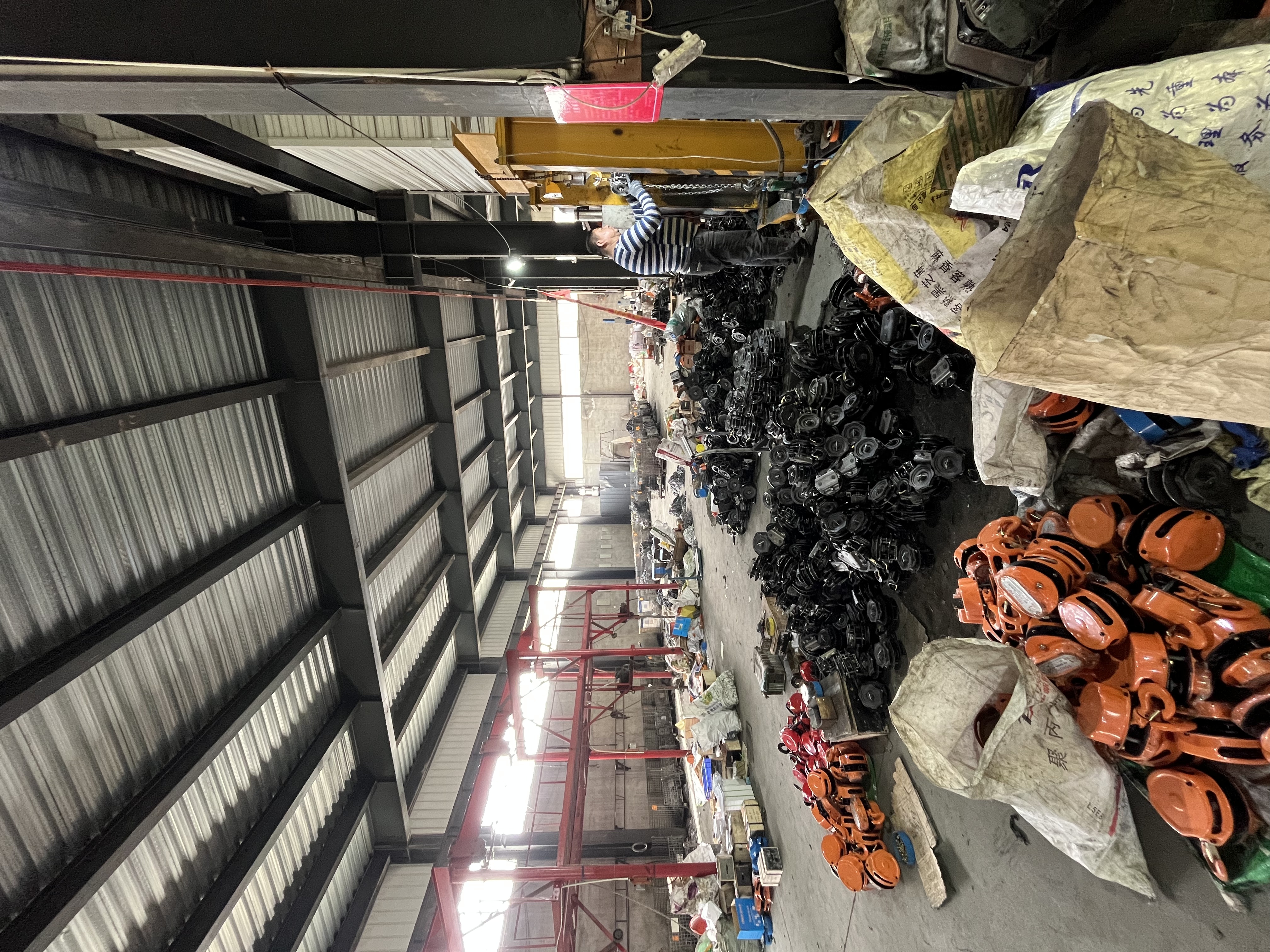
Application fit is determined by environment and duty cycle, not by a single catalogue rating.
The same list applies to maintenance and repair work, municipal and utility tasks, and event rigging, where the loads differ but the requirement does not: a documented chain, a heat-treated hook and a housing that survives the work.
Market signals that make documentation a procurement issue
Several verifiable market indicators explain why standards documentation has moved from the legal department to the buying decision. The global chain hoist market, including electric and manual units, is projected to reach USD 3.9 billion by 2034 according to Dataintelo. Asia Pacific dominated that market in 2025 with a 41.3% revenue share, driven by industrialisation in China and India. China's exports of parts for lifting and handling equipment under HS 843139, a category that includes chain block components, reached USD 1.36 billion in 2024, per UN Comtrade and World Bank WITS data.
Supply concentration and supply documentation move together. When a majority of global volume originates from a small number of manufacturing regions, buyers in importing markets become dependent on supplier-provided conformity evidence, and the quality of that evidence becomes a selection criterion in its own right.
Future outlook
Three shifts are reasonable to expect as compliance expectations tighten across importing markets. First, component-level documentation will become routine in RFQs: buyers will ask for the chain-level document and the hoist-level document separately, because a single conformity statement no longer satisfies internal risk review. Second, distribution partners will increasingly be assessed on whether they can supply specification documentation alongside the product, since the end user's inspection regime depends on it. Third, durability will continue to be weighed against purchase price rather than replaced by it — a slightly higher initial cost that reduces maintenance interventions is a defensible position in a category where downtime is expensive. None of these shifts change the underlying physics of a hand chain hoist; they change how carefully it must be described.
FAQ
What is the difference between ISO 16872 and DIN EN 818-7 in a chain block specification?
Both are chain-level documents rather than hoist-level standards. ISO 16872 addresses fine-tolerance round steel short link hoist chain used in hand-operated chain hoists on the international side, while DIN EN 818-7 addresses fine-tolerance hoist chain, Grade T, on the European side. Either may appear in a specification depending on the destination market. The practical check is to ask which document the supplied load chain is declared against, and whether the marking on the chain supports that declaration. Neither document replaces EN 13157 or the applicable hoist-level standard.
Does CE marking mean a chain block automatically meets ASME B30.21?
No. CE marking is a European conformity declaration and does not transfer into the North American framework. Within the ASME B30 family, requirements are set by equipment type and operating mode: ASME B30.21 is the volume commonly referenced for manually operated hoists, while ASME B30.16 governs the construction, installation, inspection and maintenance of overhead hoists, including hand chain-operated hoists, in the United States. Buyers should confirm which B30 volume applies to their configuration and request that documentation separately.
What safety factors apply to the VD chain block?
A chain safety factor of at least 4:1, consistent with the standard safety factor of 4:1 for EN 13157-compliant chain blocks, and a safety factor of at least 5:1 for structural parts. These figures describe design margins for new, undamaged equipment. They are not an allowance for overload, and they decrease in practice as the chain wears, the brake pads deteriorate or the housing is damaged.
What is the minimum order quantity and typical production lead time?
The minimum order quantity is 50 pieces. Typical production lead time is 15 to 20 days. Monthly production capacity is 15,000 units, and the manufacturer reports annual output of 200,000 units with an export share of roughly 80%.
Can housing color and load chain length be customized?
Yes. Customization covers color, load-bearing chain length, quality adjustment and application-specific materials, and OEM/ODM services are offered. The VD chain block housing is painted in RAL 2000 or RAL 1007, and the standard load-bearing chain is a G80 grade steel chain with blackened and carburized treatment.
What acceptance criteria and payment terms are typical for orders?
Acceptance criteria are a pre-shipment test and third-party inspection, with SGS named as an example inspection provider. Delivery terms are FOB, EXW, CIF and CFR. Payment terms are 30% T/T in advance with 70% T/T against a copy of the bill of lading.
How should the load chain be maintained, and which parts wear first?
The load-bearing chain should be serviced on a regular schedule and its surface oiled; equipment should be stored away from direct rain exposure when not in use, and it should never be used beyond its rated load. The recognised wear and damage points are chain ageing and wear, brake pads, the hand chain and impact damage to the housing. Brake pads are the typical consumable, and the manufacturer supplies them as readily worn spare parts.
Which export markets does the manufacturer currently serve?
The manufacturer exports to Vietnam, India, Russia, the United Arab Emirates, Brazil, Türkiye, the Middle East and Southeast Asia. That distribution footprint reflects buyers in markets with differing documentation requirements — which is the practical reason a crosswalk, rather than a single certificate, is used to describe the product.
A standards crosswalk does not make a chain block compliant everywhere; it makes the compliance claims checkable. For buyers moving between EN, ISO and ASME markets, the workable method is to keep the chain-level and hoist-level documents separate, confirm component grades and heat treatment on the order specification, and treat safety factors as maintenance obligations rather than purchase-time assurances.
Product brochure (PDF, publicly accessible): Baoding Junyun Hoisting Machinery Co., Ltd. catalogue