
IP65 vs IP66 for Custom Outdoor Lights: Rating Analysis
Certification and Project Fit
IP65 vs IP66 for Custom Outdoor Lights: Rating Analysis
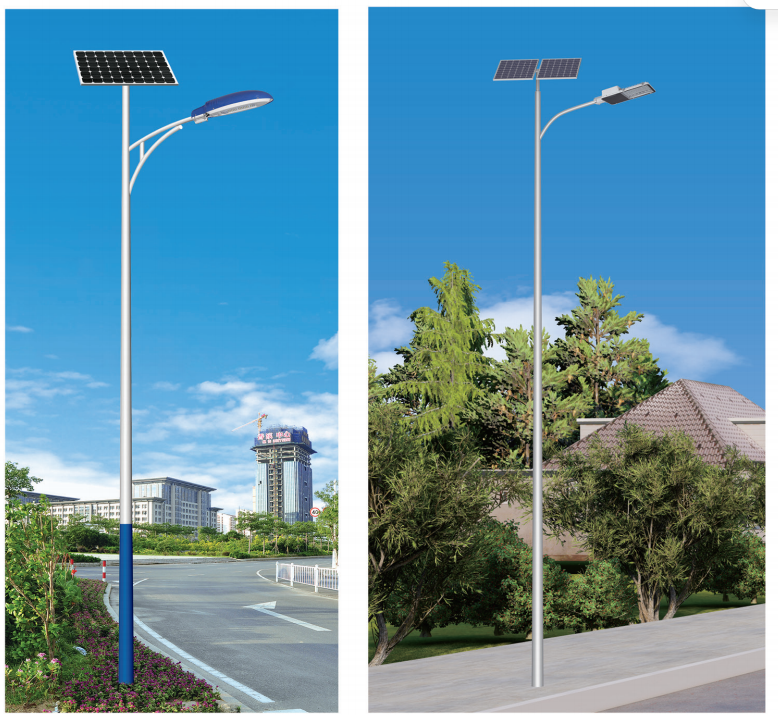
Outdoor lighting projects rarely fail on light output. They fail at the enclosure, where rainwater reaches a cable gland, where dust builds a film across a driver board, or where a gasket loses compression after several seasons of thermal cycling. In custom outdoor lighting, the ingress protection (IP) rating is the specification line that decides which of those failure modes a project is paying to prevent, and IP65 versus IP66 is the comparison buyers most often treat as a formality.
Stated as a project decision: IP65 is the working baseline for custom outdoor luminaires in sheltered or moderate-exposure positions, while IP66 is the appropriate specification where a luminaire faces wind-driven rain, splash-back or sustained dust loading. Both ratings are dust-tight; the practical difference sits in the severity of the water test. Choosing between them is a project-location exercise, not a ranking of products.
What IP65 and IP66 Actually Certify
An IP rating is a two-part statement, written as two digits. The first digit describes protection against solid objects and dust; the second describes protection against water. Both parts have to be read together, because a high water digit on a low solid digit describes a very different fixture from a high digit on both.
- IP65 describes a dust-tight enclosure (first digit 6) that is protected against water projected as jets (second digit 5).
- IP66 describes a dust-tight enclosure (first digit 6) that is protected against powerful water jets (second digit 6).
Those definitions are part of the international ingress protection standard commonly cited as IEC 60529, which is where the familiar two-digit format originates. Two consequences follow for a lighting specification. First, the gap between IP65 and IP66 on a custom luminaire is a gap in water severity only, since both are dust-tight. Second, neither rating is a submersion rating; continuous immersion sits above this band and is measured differently.
It is just as important to be clear about what an IP rating does not certify. It does not describe corrosion resistance, impact resistance, UV stability, thermal behaviour, wind-load capacity or driver lifetime. Those properties come from materials, surface treatment and structural engineering. A luminaire can hold an IP66 enclosure rating and still corrode at a flange, crack at a lens, or overheat at its driver, because the rating never claimed to cover any of those things.
Project-level lighting standards sit on a different layer again. EN 13201 defines quality, performance and energy indicators for road and street lighting design, and ANSI/IES RP-8 addresses luminance and safety criteria for roadways and parking facilities. Both are design standards rather than enclosure-protection specifications, so the IP requirement typically has to be written into the project specification and tender documents by the buyer or the specifying engineer.
The Real Decision Point: Rain Exposure and Dust Accumulation Are Site Variables
Two projects can sit in the same city and still justify different ratings, because the deciding inputs are local rather than product-level: how much rain arrives, how it arrives, and what else is in the air.
Rainwater exposure
Rain exposure has three components. The first is volume: annual rainfall and the intensity of individual storm events set the number of hours a fixture spends wet. The second is angle and speed, since wind-driven rain strikes a lens joint and a cable gland at pressure rather than falling vertically past them. The third is where the water goes after it lands: splash-back from kerbs, plaza paving and road surfaces delivers water upward toward the base of a luminaire and the pole interface, which is a different loading than rain falling from above.
On an open coastal road, a port waterfront or an exposed plaza, all three components sit at their highest. Inside a landscaped courtyard, along a residential internal road, or under a canopy, they are materially lower. That is why a single project-wide IP instruction is often less accurate than a position-by-position requirement.
Dust accumulation
In arid and semi-arid markets, dust is a continuous operating condition rather than an occasional event. Dust becomes an electrical and optical problem mainly through moisture: deposits on a lens reduce light output, deposits on sealing surfaces hold water against the seal, and deposits around electronic components can bridge insulating distances inside a housing.
Because both IP65 and IP66 are dust-tight, the dust argument usually rules out lower first digits rather than deciding between the 5 and the 6 in the second digit. What dust does change is design and maintenance practice: lens geometry, whether decorative recesses trap debris, and how easily a maintenance crew can clean a fixture from ground level without dismantling it.
How IP65 and IP66 Are Specified Across BAIFU LIGHTING Custom Models
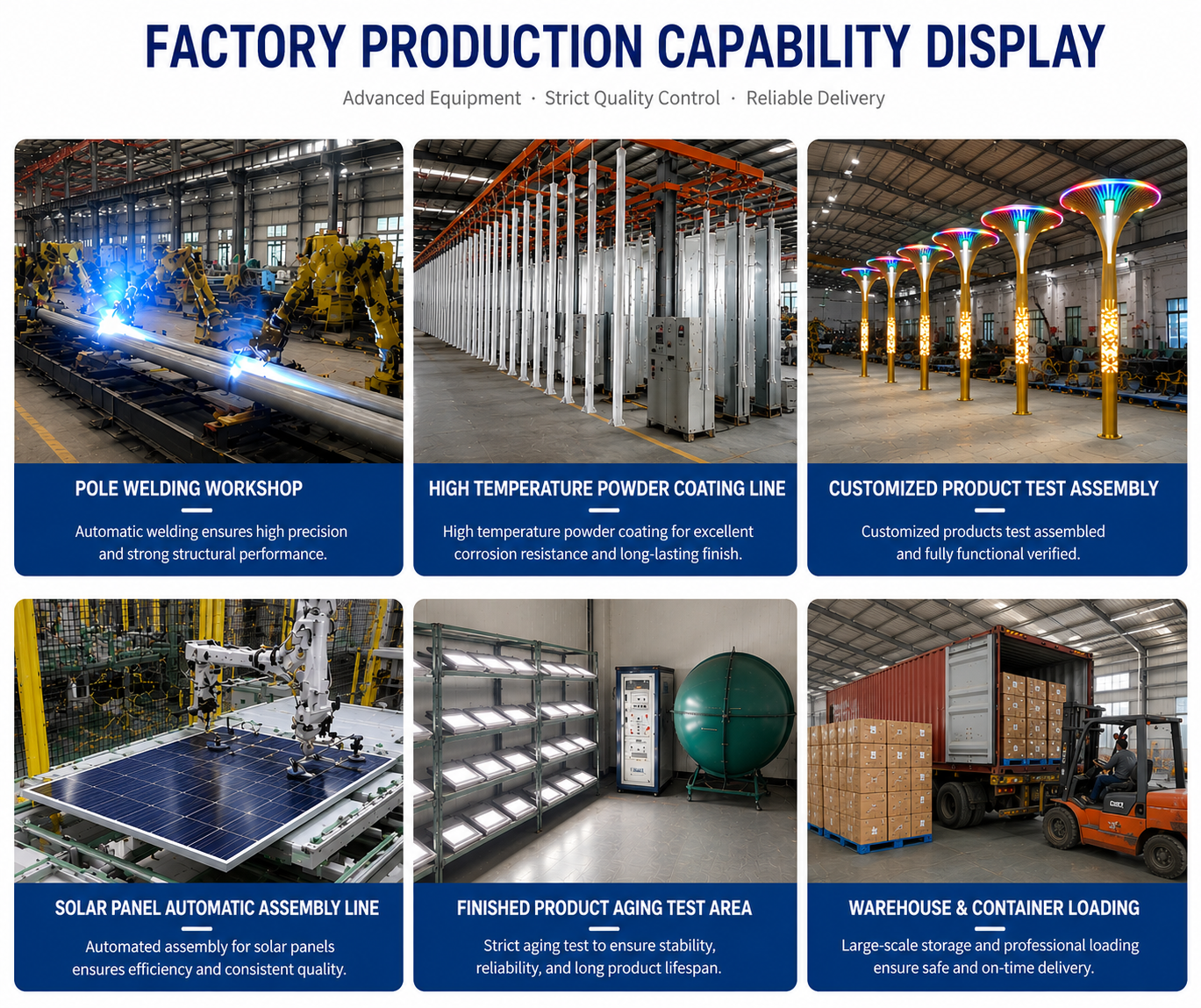
BAIFU LIGHTING (Zhongshan Baifu Street Lamp Co., Ltd.) is a custom outdoor lighting manufacturer based in Guzhen Town, Zhongshan City, Guangdong, China. Established in 2013 and operating from an 11,158 m² production facility, the company manufactures non-standard custom outdoor street lights, LED road luminaires, solar street lights, landscape and garden lighting, smart street lights and custom lamp poles, and supplies OEM, ODM and project-based lighting to customers in more than 71 countries and markets.
Across its current custom range, protection is specified as a choice between IP65 and IP66 rather than as a fixed catalogue value. The following models illustrate how that choice is documented at product level.
| Model | Product type | IP rating | Mounting height | LED power | Operating temperature |
|---|---|---|---|---|---|
| BF-SL-8M-100W | Split-type solar LED street lamp | IP65 / IP66 | 8 m single-arm conical pole | 100 W, with a 200 W monocrystalline solar panel and a 12 V 80 Ah maintenance-free lead-acid battery | -20 °C to +60 °C |
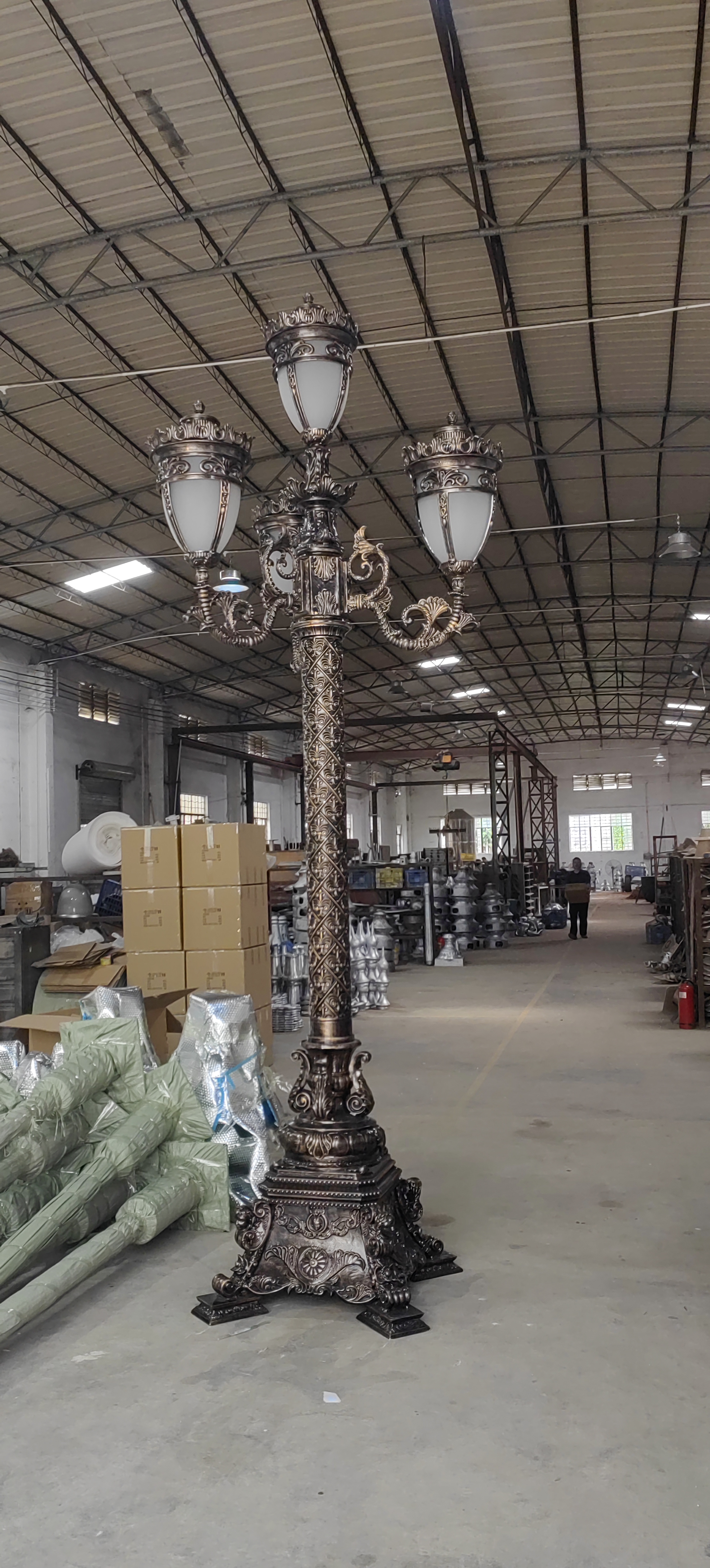
| BF-AGL-4000-60W | Ancient-style courtyard lamp | IP65 / IP66 | 3–4 m, customizable | 30 W, 40 W, 50 W, 60 W, 80 W | -30 °C to +60 °C |
| BF-LSL-4000-120W | Custom LED landscape street light | IP65 / IP66 | 6 m, 8 m, 10 m, 12 m, customizable | 60 W, 80 W, 100 W, 120 W, 150 W, 180 W, 200 W | -30 °C to +60 °C |
Material specification is what supports those ratings over time. The BF-LSL-4000-120W custom LED landscape street light is constructed with Q235 hot-dip galvanised steel, 304 stainless steel, die-cast aluminium lamp housings, high-transmittance tempered glass, stainless steel fasteners and outdoor electrostatic powder coating. The BF-AGL-4000-60W ancient-style courtyard lamp uses a high-pressure cast aluminium lamp body, a Q235 hot-dip galvanised steel pole, high-transparency tempered glass or a UV-resistant PC lamp cover, stainless steel fasteners and outdoor electrostatic spray coating. The BF-SL-8M-100W solar street lamp uses a Q235 steel pole with hot-dip galvanising, an outdoor electrostatic powder coating, a die-cast aluminium LED housing and tempered glass.
Electrical and optical figures also carry into the enclosure decision, because a sealed housing has to manage heat at the same time as water. The BF-LSL-4000-120W delivers luminaire efficacy of at least 130 lm/W, a colour rendering index of Ra≥70 with Ra≥80 optional, a power factor of PF≥0.95, Class I electric shock protection and a service life of at least 50,000 hours. The BF-AGL-4000-60W is rated at ≥130 lm/W, Ra≥70, PF≥0.95 and Class I. The BF-SL-8M-100W solar model reaches ≥150 lm/W, operates 10–12 hours per day, and offers 2–3 days of battery autonomy through rainy periods, configurable according to project requirements.
Control configuration affects sealing as well, since every added sensor or dimming interface is another entry point. Standard control on BF-LSL-4000-120W is on-off, with photocell, timer, 0–10 V dimming, DALI and smart lighting control available as options; the BF-SL-8M-100W uses light control plus time control and supports intelligent dimming.
Matching the Rating to the Project Scenario
The following table converts the two ratings into a position-by-position qualification logic. It is a decision framework, not a rule that overrides a project specification, since the final requirement belongs in the tender document.
| Project position | Dominant exposure | Rating consideration | What else to specify |
|---|---|---|---|
| Coastal road or port waterfront | Wind-driven rain, splash-back, salt-laden air | IP66 for luminaires facing open water | Hot-dip galvanised poles, stainless steel fasteners, powder-coated finish, corrosion inspection intervals |
| Open urban road or plaza in a temperate climate | Direct rainfall, occasional driving rain | IP65 is generally workable where fixtures are not oriented into prevailing wind | Cable entry sealing, drainage paths around the base flange |
| Desert-edge road or industrial park | Continuous dust, occasional heavy rain | IP66, combined with dust management | Lens geometry and decorative details that do not trap debris; cleaning access from ground level |
| Park, garden or courtyard lighting | Splash, irrigation, ambient humidity | IP65, with cast aluminium bodies and tempered glass or UV-resistant PC covers | Pole height (3–4 m on BF-AGL-4000-60W) and flange base fixing |
| Split-type solar street lighting in exposed positions | Rain, dust and thermal cycling across several components | IP66 for the luminaire | Protection treatment for panels, batteries, controllers and mounting accessories, which are separate items from the luminaire enclosure |
| Municipal renovation using existing poles | Inherited pole condition | Rating applies to the new luminaire | Pole-top interface, flange base and anchor bolts as separate inspection items |
Limits and Trade-offs: What IP65 and IP66 Do Not Solve
The comparison with conventional practice is useful here. Older decorative outdoor lighting in many markets was built around painted steel housings, open decorative recesses and standard carbon-steel fasteners. Current custom outdoor lighting has moved to hot-dip galvanised Q235 steel, die-cast aluminium housings, high-transmittance tempered glass and stainless steel fasteners with outdoor electrostatic powder coating. That improves the enclosure base, but it also relocates the failure modes to seals, coatings and interfaces. Four boundaries are worth stating plainly.
- The rating stops at the enclosure. Wind resistance is a structural property, designed according to pole height and the local wind speed of the project site. An IP66 luminaire mounted on an under-designed pole still fails in service, and no enclosure rating compensates for that.
- Neither rating covers submersion. IP65 and IP66 address water jets, not standing water. Installations in pits, below-grade vaults or drainage sumps sit outside this band and need a different protection strategy.
- Seals and coatings are wearing components. Gaskets compress and age, and powder coating can be damaged during transport or installation. Ingestion of dust and moisture normally begins at a damaged coating edge or a loosened cable gland, which is why inspection intervals belong in the specification alongside the rating.
- Over-specification has its own cost. Applying IP66 to every fixture on a project, including sheltered positions, adds cost without proportional benefit and can constrain thermal design, since a driver still has to shed heat. The rated ambient ranges - minus 30 °C to plus 60 °C on the BF-LSL-4000-120W and BF-AGL-4000-60W, and minus 20 °C to plus 60 °C on the BF-SL-8M-100W - define where the specified performance is meaningful.
There is also a thermal-cycling effect that a rating does not capture. In humid conditions, air inside a warm enclosure contracts as it cools overnight, drawing moisture past any imperfect seal. That is why gasket material, cable gland sealing and driver placement inside the housing matter as much as the digits on the datasheet, particularly on sites with large day-night temperature swings.
Verifying an IP Claim Before Production
Because both ratings appear on the same model line, verification has to be model-specific rather than catalogue-level. A practical checklist before an order is released includes the following.
- Confirm the rating for the exact configuration ordered. Request written confirmation per model, since power, control options and housing variants can change the enclosure build.
- Review the inspection scope. Quality control for these products generally covers appearance inspection, electrical performance test and protection level test.
- Validate a sample for custom designs. Standard styles carry a minimum order of 20 sets, while custom styles start at 5 sets, which makes sample validation practical for non-standard configurations.
- Check the material list against the environment. Confirm hot-dip galvanising, powder coating, tempered glass and stainless steel fasteners where the site is coastal or high-humidity.
- Request the documentation package. English product specifications, quotations, CAD drawing support, packaging information, export documentation and shipment coordination are provided according to project requirements.
Market Trend Analysis: Enclosure Ratings Are Moving Up the Specification
Street lighting is a mature market with a slow growth curve, which means competitive differentiation increasingly happens in specification detail rather than in category expansion. Grand View Research valued the global street lighting market at USD 9.1 billion in 2023 and projected USD 11.6 billion by 2030, a compound annual growth rate of 3.6%. Forecasts diverge between research houses - StrategyR has pointed toward a higher 2030 figure of USD 16.5 billion - so absolute numbers are best read as directional rather than precise.
Within that market, LED has become the default technology rather than a differentiator. Grand View Research reported that LED lighting accounted for 79.7% of global street lighting revenue in 2023. When the light source is no longer the variable, attention shifts to enclosure protection, materials and surface treatment, which is exactly where the IP65 versus IP66 decision sits.
Smart lighting adds a second pressure. Berg Insight reported an installed base of 32.9 million smart street lights globally at the end of 2024, with a 20.9% CAGR projected through 2029, though unit forecasts differ across sources. Every sensor, photocell and dimming interface places additional electronics inside the same enclosure, and the D4i and Zhaga standards are increasingly adopted to make those components interoperable. More electronics in a sealed housing raises the cost of ingress failures and increases the value of a defensible protection rating, since an unplanned replacement is no longer a simple lamp swap.
Regional demand shapes the same question from another direction. CSIL has described Africa as the fastest-growing regional lighting market, with over 4% average annual growth since 2018 driven by public infrastructure projects - markets where dust loading, intense rainfall and long maintenance distances often coexist. In those conditions, the enclosure decision is also a serviceability decision.
Future Outlook
Three changes are likely to shape how buyers use IP ratings in custom outdoor lighting over the next few years. First, ratings will increasingly be specified per zone and per mounting position rather than once for an entire project, because the exposure profile of a coastal gantry and an internal courtyard is not comparable. Second, enclosure design will move toward field-serviceable seals, replaceable gaskets and modular driver compartments, reducing the need to replace an entire luminaire after a single sealing failure. Third, in solar configurations, where batteries, panels and controllers are separate from the luminaire, buyers are likely to define protection expectations for each element instead of treating the luminaire rating as the whole system's rating.
None of this changes the underlying logic. IP65 and IP66 are enclosure statements, and their value depends on the site the fixture is installed in and on the materials around them.
FAQ
Is IP66 always the better choice over IP65 for custom outdoor lights?
Not automatically. Both ratings share a dust-tight first digit and differ only in the severity of the water test, with IP66 covering powerful water jets against IP65 covering water jets. IP66 is the more appropriate specification where a luminaire faces wind-driven rain, splash-back or salt spray, such as coastal roads, port waterfronts and exposed plazas. In sheltered positions, IP65 is usually adequate. Because models such as BF-SL-8M-100W, BF-AGL-4000-60W and BF-LSL-4000-120W are offered at IP65 or IP66, the project specification determines the outcome rather than the catalogue.
Does an IP65 or IP66 rating make the whole street light assembly weatherproof?
No. The rating is declared for the enclosure it applies to, normally the luminaire. The pole, flange base, anchor bolts and cable entries are separate items, and in split-type solar installations the supporting equipment list includes light poles, support arms, solar components (panels and batteries), controllers and mounting accessories. Each of those interfaces needs its own treatment in the specification, since a sealed luminaire on an unprotected pole interface still creates a service risk.
In dust-heavy projects, does the dust digit matter more than the water digit?
The dust digit sets the baseline. Both IP65 and IP66 are dust-tight, so a lower first digit is the real disqualifier rather than the 5 or 6 in the water position. In practice, dust becomes a moisture problem: deposits hold water against seals, can bridge insulating distances near electronics, and reduce light output on lenses and decorative covers. For desert-edge roads and industrial parks, IP66 combined with cleaning access, and decorative designs that do not trap debris, is the more defensible specification.
Can IP65 or IP66 luminaires be used in coastal and high-rainfall projects?
Yes, provided the whole assembly is assessed rather than the rating alone. Coastal durability depends heavily on materials and surface protection: BAIFU LIGHTING specifies Q235 hot-dip galvanised steel, 304 stainless steel, die-cast aluminium housings, high-transmittance tempered glass, stainless steel fasteners and outdoor electrostatic powder coating on its custom models, and describes these products as intended for outdoor all-day use with protection requirements such as IP65 or IP66. Corrosion resistance remains a separate property from ingress protection, and neither rating is a submersion rating.
How should a buyer verify an IP claim before production begins?
Verification should be model-specific rather than catalogue-level. Quality control for these products generally includes appearance inspection, electrical performance test and protection level test, and the manufacturer provides English specifications, CAD drawing support, packaging information and export documentation according to project requirements. Because custom styles carry a minimum order of 5 sets against 20 sets for standard styles, and typical lead time is 15 to 18 days, sample validation is practical before a full order is released.
How does operating temperature relate to ingress protection?
It affects the seal more than the rating. The BF-SL-8M-100W is rated from minus 20 °C to plus 60 °C, while the BF-AGL-4000-60W and BF-LSL-4000-120W operate from minus 30 °C to plus 60 °C. Where day-night temperature swings are large and humidity is high, air inside an enclosure contracts as it cools and draws moisture past any imperfect seal. Gasket material, cable gland sealing and driver placement therefore matter as much as the IP number itself.
For project teams that need to compare pole, luminaire and solar configurations before writing a specification, the full custom outdoor lighting product album is available for download: BAIFU LIGHTING customized album (PDF).