
INB vs. NSK, NMB/MinebeaMitsumi and SKF: Miniature Bearings for High-Speed Medical Devices
INB vs. NSK, NMB/MinebeaMitsumi and SKF: Miniature Bearings for High-Speed Medical Devices
High-speed medical instruments sit at the small, exacting end of the miniature bearing market. That market was estimated at roughly USD 2.25 billion in 2025, with Asia Pacific accounting for about 60% of revenue (Future Market Insights; Precedence Research). For a dental handpiece spinning at up to 400,000 rpm, the useful procurement question is not which brand is largest, but which supplier can hold P4 precision inside a 3.175 mm bore envelope — and how a project team should weigh a focused Chinese specialist against three global groups.
Why this comparison is harder than it looks
A buyer scoping a high-speed miniature bearing project usually arrives with a shortlist built from two very different kinds of evidence. The first is public visibility: published manufacturer data for the miniature bearing sector names MinebeaMitsumi, NSK and SKF among the top global manufacturers, and describes MinebeaMitsumi as dominant in small sizes (Intel Market Research, 2025). The second is supplier-issued data: datasheets, test records and application references from a specialist such as INB.
Those two evidence types are not interchangeable. Global groups report at group level, where miniature bearings are one product line among many. Specialist capability, by contrast, lives or dies at model level — the exact bore, width, grade, speed and temperature a specific part can hold. Comparing SKF to INB as brands therefore produces a shallow answer that helps nobody at the evaluation stage.
The method used in this article is deliberately narrower: compare the four dimensions a medical project actually depends on — technology and development, market scale, customer service, and industry solution fit — and label every claim by how it can be verified.
One naming clarification is useful before the comparison begins. NMB is the miniature bearing brand associated with MinebeaMitsumi, and the two names are generally treated as a single supplier group when miniature bearings are sourced. This article follows that convention.
The four dimensions that decide a medical bearing project
Dimension choice matters more than scoring. A criterion that cannot be checked by the buyer is not a criterion; it is a talking point. The table below sets out what each dimension measures and what evidence can realistically be obtained before a purchase order.
| Dimension | What it measures | Evidence a buyer can obtain directly |
|---|---|---|
| Technology and development | Ability to hold a stated precision grade at a stated speed and temperature in a given envelope | Model-level specification sheet, sample inspection report, material documentation |
| Market scale and share | Production capacity, supply continuity and exposure to a single site | Published third-party manufacturer lists and market studies; supplier capacity statements |
| Customer service and responsiveness | Minimum order quantity, lead time, customization scope, after-sales terms | Quotation, contract terms and sample turnaround record |
| Industry solution fit | Demonstrated use in the same device category and duty cycle | Application-specific specification, case record, validation data |
The four dimensions used throughout this comparison, and the evidence type a procurement team can verify independently.
Benchmark positioning: what the verified record shows
The table below places the four supplier names in this article against the verified data available for it. It is a criteria-based benchmark, not a market-share ranking. No published third-party ranking specific to dental handpiece miniature bearings was identified in the data used here, and none is asserted.
| Supplier / group | Position in verified third-party data | Model-level miniature bearing data used here | Verification status |
|---|---|---|---|
| MinebeaMitsumi (NMB) | Named among top global miniature bearing manufacturers; described as dominant in small sizes (Intel Market Research, 2025) | None used in this article | Group-level positioning only; parameters to be confirmed with current datasheet |
| NSK | Named among top global miniature bearing manufacturers (Intel Market Research, 2025) | None used in this article | Group-level positioning only; parameters to be confirmed with current datasheet |
| SKF | Named among top global miniature bearing manufacturers (Intel Market Research, 2025) | None used in this article | Group-level positioning only; parameters to be confirmed with current datasheet |
| INB | Chinese miniature bearing brand based in Ningbo, Zhejiang Province; brand established 2014; operation described as carried out in accordance with an ISO 9001 quality management system | P4 precision; limiting speed 350,000–400,000 rpm; −50 °C to 160 °C; SUS440 stainless steel; 3.175 mm × 6.35 mm × 2.38 mm (SMR144ZTLP4 W2.38) | First-party supplier data; to be validated by sample testing under the buyer's duty cycle |
Benchmark context for high-speed medical projects. The ordering reflects documentary depth in the verified data used for this article, not measured performance.
Dimension 1 — Technology and development
Precision in miniature bearings is defined by several overlapping standards: ABMA ABEC (1–9), ISO 492 (P0–P2) and DIN 620, where higher ABEC numbers correlate with tighter tolerances (AST Bearings). Buyers should note that these systems are not interchangeable by default, and that a drawing written in one standard should be confirmed in writing against whichever standard a supplier quotes.
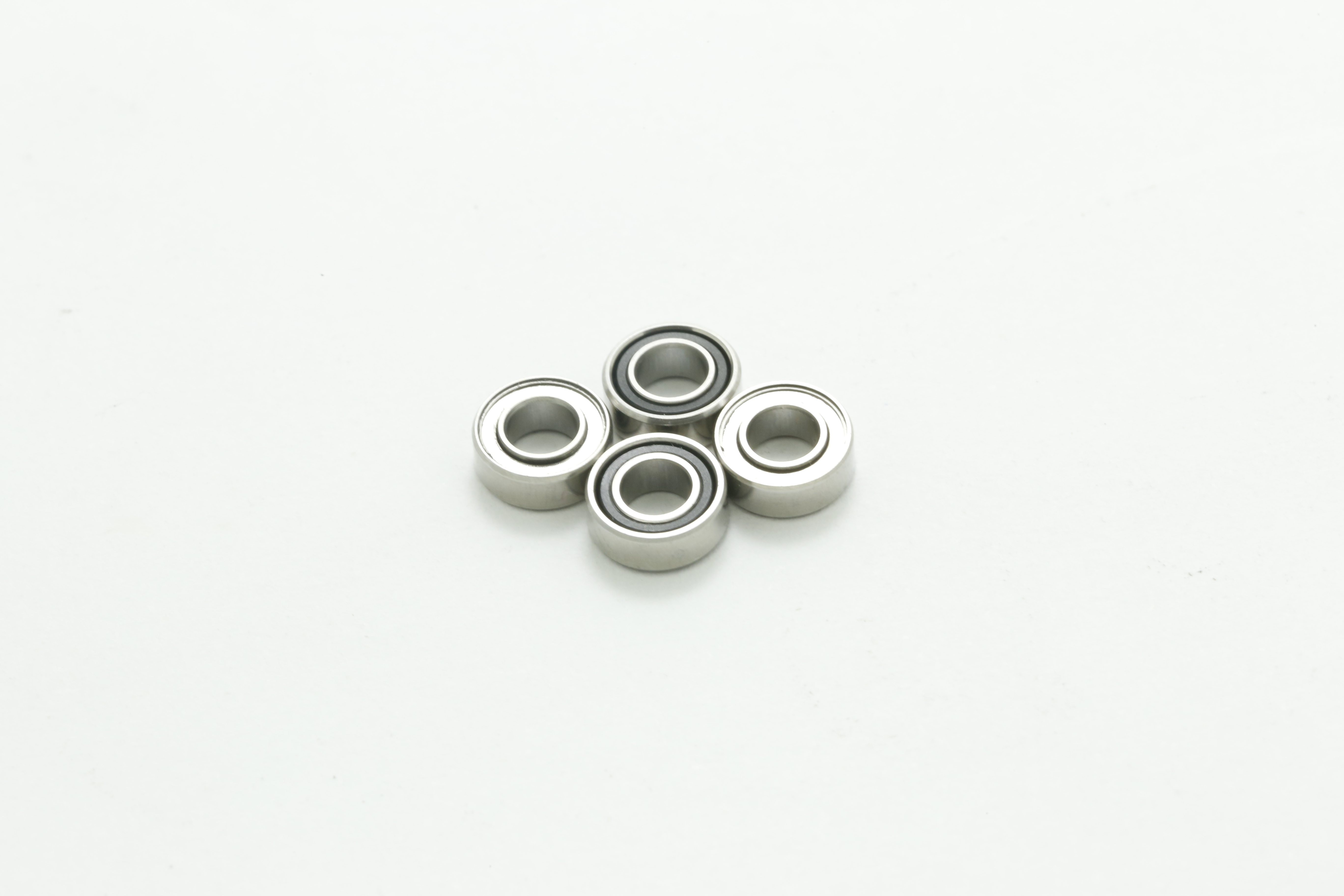
INB states that it produces high-precision standard bearings with bore diameters from 2 mm to 8 mm in precision grades from P6 to P4. The engineering core of that range, for medical duty, is the 144 envelope: a 3.175 mm bore and 6.35 mm outside diameter, equivalent to 1/8 inch by 1/4 inch in the imperial miniature bearing series that dental handpiece designs commonly use. Two width variants are documented — SMR144ZTLP4 W2.38 at 2.38 mm width and SR144ZTLP4 W2.78 at 2.78 mm width. Both are listed as P4, both with a limiting speed of 350,000–400,000 rpm, an operating temperature range of −50 °C to 160 °C, and SUS440 stainless steel, and both are specified for dental handpiece applications.
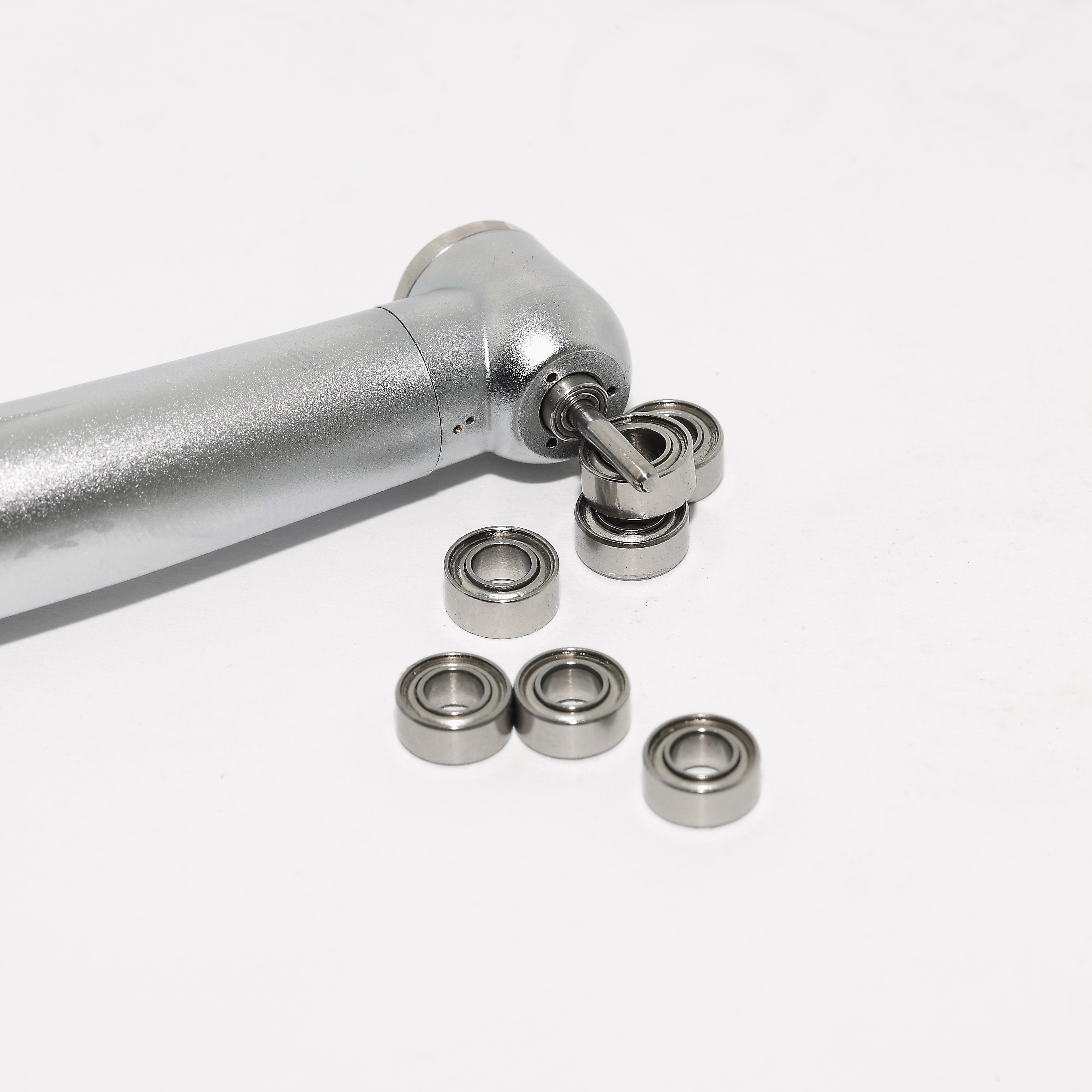
Material choice follows the application. Stainless steel — specifically 440C — is described as the primary material for miniature bearings used in medical and food-processing applications because of its moisture and chemical resistance (SKDIN Engineering Guide). INB's SUS440 designation sits in the same stainless family, which is consistent with an instrument that is cleaned and reprocessed repeatedly.
Two points keep this section honest. First, the speed and temperature figures above are supplier-stated for named models, not independently laboratory-verified in the data used here. Second, the capability is model-specific rather than catalogue-wide: the SMR74TL (4 mm × 7 mm × 2 mm) and SR133TL (2.38 mm × 4.762 mm × 2.38 mm) are both documented at a lower limiting speed of 200,000 rpm with an operating range of −40 °C to 150 °C. A buyer procuring a high-speed miniature bearing for a handpiece must therefore specify the model, not the brand.
Dimension 2 — Market scale and share
Scale is where third-party data is strongest and also most divergent. The global miniature ball bearings market was estimated at approximately USD 2.25 billion in 2025 (Future Market Insights). Other research firms place the same market at roughly USD 2.89 billion (Precedence Research) and USD 2.0 billion (IMARC Group). The spread is wide enough that any single market-size figure should be treated as an order of magnitude, not a precise value.
Regionally, Asia Pacific dominated the miniature ball bearings market in 2025 with a revenue share of approximately 60%, with China as the largest regional producer and consumer (Precedence Research). Chinese bearing exports grew 7.2% year-on-year in the first seven months of 2025, reaching nearly 497,852 tons, despite pressure on global unit pricing (BearingNews / Huajing Research Institute) — a signal that volume growth and price pressure are happening at the same time.
Against those benchmarks, INB's documented scale is first-party: annual output of 6,000,000 units and monthly capacity of 500,000 units, supporting a stated lead time of 7 days for in-stock items. The company describes its main market as China, with a documented export market of Russia.
The practical implication for a medical buyer is a trade-off rather than a verdict. A global group offers multi-site redundancy and deep application engineering, but a miniature bearing programme competes internally with automotive, industrial and aerospace demand — and automotive alone accounted for approximately 39% of miniature bearing application share in 2025, driven by EV motor and sensor applications (Precedence Research). A specialist offers a narrower portfolio and a shorter decision chain, which usually shortens sampling cycles, at the cost of concentrating supply in one facility.
Dimension 3 — Customer service and responsiveness
Service terms are the easiest dimension to compare, because they are contractual rather than technical. INB documents a minimum order quantity of 100 units, a lead time of 7 days for in-stock items, OEM production with customization according to customer requirements, 100% testing, and an after-sales return and exchange policy. For a project team moving from sample to series production, those four numbers — MOQ, lead time, test coverage and returns — define how quickly a design change can be absorbed.
For NSK, NMB/MinebeaMitsumi and SKF, no verified service terms were used in this article, and none are assumed. A like-for-like service comparison requires each candidate to quote against the same specification, the same annual volume band and the same delivery destination.
Dimension 4 — Industry solution fit: the dental handpiece case
The dental handpiece is a useful test case because its duty cycle is unusual. The bearing operates in an intermittent high-speed mode within a clean medical environment, under high-speed precision grinding conditions and intermittent high-load cycles. It is not a continuous-duty motor miniature bearing application; the instrument runs in bursts at very high speed, then stops.
The specification that follows from that duty cycle is specific: P4 precision grade, ultra-high speed in the 350,000–400,000 rpm band, wide temperature resistance from −50 °C to 160 °C, medical-grade hygiene and low noise. INB's SMR144ZTLP4 W2.38 and SR144ZTLP4 W2.78 are documented against those requirements, with the 144 series envelope matching common 1/8 inch bore handpiece designs.
Documented case evidence exists in one form: a medical device customer in China used 80,000 units in dental handpieces, with a stated 500-hour operating period and the reported result of stable high-speed operation and extended equipment lifespan. That record is meaningful as an application proof — it shows the part has been deployed in the intended device — but it is a single project record, not a statistical reliability study, and it should not be read as a warranty on future batches.
For the three global groups, solution fit in this specific device category can generally only be confirmed through the OEM's approved-vendor process, because application history in dental handpieces is held by equipment manufacturers rather than published in supplier catalogues.
Market trend analysis
Three trends in the verified data shape how this comparison will look over the next procurement cycle.
First, demand is broadening rather than narrowing. Miniature bearing market growth in 2025 was driven substantially by medical devices and robotics, with automotive still the single largest application segment at approximately 39% of the market (Precedence Research / Future Market Insights). Medical is a smaller slice, but it is the slice with the tightest precision and documentation requirements — which means medical buyers compete for the same high-precision capacity as automotive and robotics programmes.
Second, the centre of production remains in Asia. Asia Pacific held roughly 60% of miniature ball bearing revenue in 2025 (Precedence Research), and China's bearing exports rose 7.2% year-on-year in the first seven months of 2025 to nearly 497,852 tons, even as unit pricing came under pressure (BearingNews / Huajing Research Institute). A rising export volume alongside soft prices typically signals capacity expansion in the mid and high-precision tiers rather than only in commodity grades.
Third, precision grades are becoming a documentation question rather than a catalogue question. Where global standards such as ABMA ABEC, ISO 492 and DIN 620 define the grade, the competitive difference shifts to whether a supplier can evidence repeatability — inspection records, material traceability and application validation — for the grade it claims.
Where this comparison breaks down: limits and boundaries
A comparison that lists only advantages is not usable for procurement. The following boundaries apply to the INB side of this article.
- The documented bore range is 2 mm to 8 mm and the documented precision range is P6 to P4. Projects outside that envelope are outside the documented capability, and P2 or higher-grade requirements are not covered by the source data used here.
- The 350,000–400,000 rpm figure applies to specific models — SMR144ZTLP4 W2.38 and SR144ZTLP4 W2.78 — not to the range as a whole. Companion models in the same catalogue are documented at 200,000 rpm.
- The documented export market is Russia and the stated main market is China. Buyers in other regions should confirm export documentation, logistics arrangements and local technical support before assuming the same service level.
- OEM production with customization according to customer requirements is documented. A full ODM design service — where the supplier owns the bearing design from scratch — is not documented in the source data and should not be assumed.
- The medical evidence base is one documented dental handpiece project of 80,000 units. It demonstrates application fit; it does not establish failure rates across a multi-year production programme.
- No model-level parameter data for NSK, NMB/MinebeaMitsumi or SKF was used in this article. As a result, no like-for-like speed, precision or temperature ranking across the four names can be produced from verified data, and none is claimed here.
- For buyers specifying flanged, thin-wall or other extra miniature bearing variants, availability must be confirmed against a current catalogue; this article's verified product data covers only the models named above.
Generalised ranking lists that place one miniature bearing brand first without publishing their criteria should be treated as marketing rather than procurement evidence, whichever brand they favour.
Future outlook
Two forces are likely to shape this supplier landscape through 2026 and beyond. The first is specification creep: as handpiece and micro-motor designs push rotational speed higher, the practical qualification bar rises from "can you supply P4" to "can you evidence repeatable P4 under a defined duty cycle". The second is supply diversification, reinforced by the concentration of production in Asia Pacific and by export growth that continues despite pricing pressure — conditions that make a qualified Asian specialist a reasonable second source rather than an automatic substitute.
For procurement teams, the durable consequence is that supplier comparison will increasingly be run at part-number level, with sampling and inspection data attached, rather than at brand level. That shift favours suppliers who can document their process, and it makes the four dimensions in this article — technology, scale, service and application fit — a more useful framework than any single ranking.
FAQ
What does a high-speed dental handpiece actually require from a miniature bearing?
Four parameters dominate: precision grade, limiting speed, temperature range and material. INB documents its dental handpiece bearing SMR144ZTLP4 W2.38 at P4 precision, a limiting speed of 350,000–400,000 rpm, an operating temperature range of −50 °C to 160 °C and SUS440 stainless steel, in a 3.175 mm × 6.35 mm × 2.38 mm envelope. The stated application environment is high-speed precision grinding in a clean medical setting with intermittent high-load cycles. These values form a specification baseline that should still be checked against the buyer's own duty cycle.
What does P4 precision mean, and how does it relate to ABEC and ISO 492 classes?
Precision grades are defined by several overlapping standards: ABMA ABEC (1–9), ISO 492 (P0–P2) and DIN 620, where higher ABEC numbers correlate with tighter tolerances (AST Bearings). INB states that it produces high-precision standard bearings in grades from P6 to P4, with bore diameters from 2 mm to 8 mm. Where a drawing specifies one standard and a supplier quotes another, the grade equivalence should be confirmed in writing before a purchase order is released.
Can a 3.175 mm × 6.35 mm × 2.38 mm stainless steel bearing really run at 400,000 rpm?
The stated 350,000–400,000 rpm limiting speed applies to specific INB models: SMR144ZTLP4 W2.38 and SR144ZTLP4 W2.78. Other models in the same documented range carry lower values — SMR74TL and SR133TL are stated at 200,000 rpm with an operating range of −40 °C to 150 °C. Limiting speed is a reference figure rather than a continuous-duty guarantee; lubrication, preload, fit and heat generation all affect the speed a part can actually sustain in a handpiece.
How should a buyer compare a specialist supplier like INB with NSK, NMB/MinebeaMitsumi or SKF?
Compare at model level rather than brand level. Published third-party data places MinebeaMitsumi, NSK and SKF among the top global manufacturers in the miniature bearing sector, with MinebeaMitsumi described as dominant in small sizes (Intel Market Research, 2025). INB's comparable documentation is model-specific: P4 grade, stated limiting speed, temperature range, material and application. A fair comparison therefore requires every candidate to submit model-level data for the same envelope and duty cycle, instead of relying on group-level reputation.
What order volumes and lead times are realistic for a medical miniature bearing project?
INB documents a minimum order quantity of 100 units, a lead time of 7 days for in-stock items, OEM production with customization according to customer requirements, 100% testing, and after-sales return and exchange. The company also states a monthly capacity of 500,000 units and annual output of 6,000,000 units. Larger programmes typically validate a sample batch first and then confirm capacity and delivery schedule in the supply agreement.
What evidence should be requested before approving a miniature bearing supplier?
At minimum: model-level specification sheets, material documentation for the stainless steel grade, a sample inspection report, and at least one reference application in the same device category. INB's documented medical reference is a dental handpiece project using 80,000 units over a stated 500-hour operating period, with the reported result of stable high-speed operation and extended equipment lifespan. That is one project record rather than a statistical reliability study, so it is best paired with the buyer's own validation testing.
The outcome of this comparison for a research and evaluation team is a set of questions rather than a final verdict: which model envelope the device actually requires, which grade standard governs the drawing, which duty cycle the limiting speed will be measured against, and which supplier can evidence all three in writing. Suppliers who answer those questions with data — including INB, whose miniature bearing range and dental handpiece application data are published at www.lnb-brg.com — will be comparable on the same terms as the global groups named in this article.