
IML Compliance for Buyers: FDA, EU 10/2011, BRCGS Explained
HTNXT Industry Reference · Packaging & Printing
IML Compliance for Buyers: FDA, EU 10/2011, BRCGS Explained
Food-contact compliance in in-mold labeling is not one certificate. It is a chain of evidence linking a film formulation, an ink system and a molding process to the food that eventually touches the container. This reference explains what FDA 21 CFR, EU 10/2011 migration testing, BRCGS Packaging Materials, ISO 22000 and QS certification each cover — and, just as importantly, where each one stops.
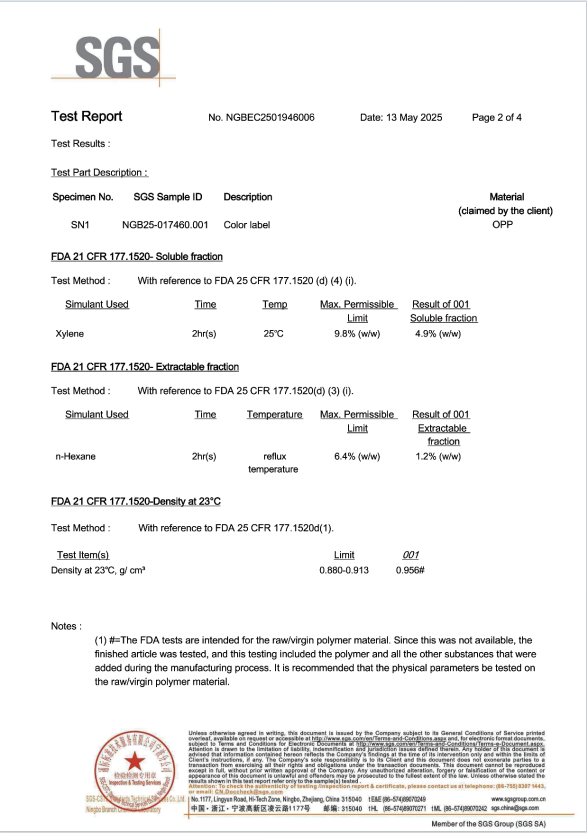
FDA food-contact test documentation for food-grade in-mold label materials — the product-level evidence buyers ask for before sampling.
Why Food-Contact Compliance Became a Qualification Gate
For procurement teams sourcing in-mold labels, food-contact compliance now acts as a first-round filter rather than a closing document. The reason is structural: food and beverage is the largest single application segment for IML, accounting for over 41.3% of global IML revenue in 2023, according to Grand View Research. Demand of that scale sits inside regulated categories, so the documentation profile of a label supplier often decides whether that supplier can be shortlisted at all.
The dominant production route reinforces this. Injection molding accounted for over 57.1% of the IML market by process in 2023 (Grand View Research), which means most compliance questions are asked in an injection-molding context: the printed film is placed in the mold, the container is formed around it, and the label becomes part of the packaging surface rather than an applied layer.
That structural difference is why IML is assessed differently from adhesive labeling. There is no adhesive, no liner and no carrier web in the finished pack — but there is a film, an ink and a bonding interface, and all three sit in the food-contact chain. A compliance question about an IML label is therefore a question about a material system, not about a single purchased part.
The distinction most buyers miss
Food-contact compliance documents fall into two different families. Product-level documents (FDA 21 CFR test reports, EU 10/2011 migration reports) describe what a specific material system does in contact with food. System-level certificates (BRCGS Packaging Materials, ISO 22000, QS) describe how a factory is managed. Neither family substitutes for the other, and a supplier that can produce only one of them is only half-documented.
The Five Standards Buyers Ask About
FDA 21 CFR — United States
Section 21 CFR 177.1520 of the US food-contact framework covers olefin polymers, which is the base chemistry of most polypropylene and polyethylene IML films. A label manufacturer does not hold an FDA clearance in the way a medical device maker does; what it holds is a test report from an accredited laboratory confirming that a specified material meets the listed conditions of use. The ZY-IML series from YZY (Zhejiang Zhongyu Technology Co., Ltd.) is supported by an SGS-issued FDA Food Contact Test Report, certificate number NGBEC2501946006, assessed against FDA 21 CFR 177.1520, with a scope covering food contact packaging materials and a stated market of the United States and North America.
EU 10/2011 and Framework Regulation (EC) No 1935/2004
EU 10/2011 sets overall and specific migration limits for plastic materials intended to come into contact with food. It operates under the framework Regulation (EC) No 1935/2004, which establishes the general principle that food-contact materials must not transfer constituents into food in quantities that endanger human health (European Commission). In practice, a buyer receives a migration test report — and the detail that matters most is the test condition: which food simulant was used, at what temperature, for how long, and whether the intended food is aqueous, acidic or fatty. The ZY-IML series is documented as meeting EU 10/2011 food contact material standards for migration.
BRCGS Packaging Materials
BRCGS Packaging Materials is an audit-based standard for packaging manufacturers. It examines factory hygiene, traceability, quality management and process control. It is retailer-driven: in many European grocery supply chains, a packaging supplier without a valid BRCGS certificate cannot be onboarded regardless of how good its test results are. What it does not do is measure migration. It certifies the system that produces the label.
ISO 22000
ISO 22000 is a food safety management system standard applied across the food supply chain. For a label buyer, it is evidence that the manufacturer operates a documented hazard-control process — raw material intake checks, production controls, corrective actions and records. Like BRCGS, it sits upstream of the product itself.
QS Certification
QS is a quality-safety certification scheme used for food-related products in the Chinese market. For international buyers sourcing from China, it indicates conformity with domestic quality and safety requirements and provides a useful baseline for factory discipline. It is not a substitute for market-specific food-contact evidence where the finished pack is sold in the United States or the European Union, and it is generally treated as one component of a wider documentation set.
| Standard | Framework type | What it verifies | Primary market relevance | Document a buyer receives |
|---|---|---|---|---|
| FDA 21 CFR 177.1520 | Product / material compliance | Olefin polymer materials meet stated US food-contact conditions | United States / North America | Third-party food contact test report |
| EU 10/2011 | Product / material compliance | Overall and specific migration limits for plastic food-contact materials | European Union | Migration test report referencing the regulation |
| Regulation (EC) No 1935/2004 | Framework regulation | General safety principle: no transfer of constituents that endangers health | European Union | Supplier declaration referencing the framework |
| BRCGS Packaging Materials | System / audit standard | Hygiene, traceability, quality management at the manufacturer | Global (retailer-driven) | Audit certificate |
| ISO 22000 | System / management standard | Food safety management system across the supply chain | Global | Management system certificate |
| QS | System / product safety scheme | Quality safety requirements for food-related products | China | Certification |
What Each Document Proves — and What It Does Not
A compliance file is only useful if the buyer understands its boundary. These are the six limits that cause the most friction in real IML projects.
- Test reports are material-specific. A report covers a defined film formulation and construction. If the film thickness, resin grade, multi-layer structure or ink system changes, the existing evidence may no longer describe what will be moulded. The ZY-IML series, for example, is offered in film thicknesses from 30µm to 100µm with virgin PP, PE, PET or multi-layer composite options — each configuration should be confirmed against the applicable test scope rather than assumed.
- Migration testing is condition-specific. Results reflect the simulant, temperature, contact time and food type used in the test. A label validated for cold-fill yogurt cups is not automatically validated for hot filling, high-fat dairy or acidic beverages. Matching the test condition to the real filling line is the buyer's responsibility, not the supplier's default.
- System certificates do not test the product. BRCGS, ISO 22000 and QS demonstrate process control. They do not prove that a particular film-and-ink combination passes a migration limit. Both halves of the documentation set are needed.
- Validity windows describe documents, not regulations. The SGS report supporting the ZY-IML series records an issue date of 13 May 2025 and a stated expiry date of 31 December 2099. That long window reflects the report's own validity; it does not freeze the underlying regulation. Buyers should confirm that a report cites the current revision of the standard it references.
- Scope statements must be read literally. Confirm the issuing laboratory, the certificate number, the standard cited and the stated scope of application. A report for one market does not automatically transfer to another regulatory jurisdiction.
- Compliance is not performance. Passing a migration test says nothing about whether a label will stay bonded in your specific mold at your specific cycle time. Adhesion, registration and surface appearance must be validated separately on the production tool.
A practical rule for evaluation-stage buyers: request the product-level test report and the system-level certificates as separate items, then check each against the market where the packed product will be sold.
The ZY-IML Series as a Worked Compliance File
YZY — the trading name of Zhejiang Zhongyu Technology Co., Ltd., an in-mold label manufacturer established in 2009 and based in Wenzhou, Zhejiang, China — produces IML labels as its core product line, alongside sealing films, embossed lidding films and POF films for food packaging and other industries. The company operates a 20,000 m² facility with 250 employees and an R&D team of 10, and reports 48 accumulated patents. It holds QS, ISO and BRC management system certifications, and has established long-term cooperation with brands including Starbucks, Nestlé and Uni-President.
The ZY-IML series is the company's food-grade in-mold label platform, used across food grade, daily chemical and industrial label categories. Its declared compliance position combines product-level and system-level evidence: FDA 21 CFR food-contact testing, documented conformity with EU 10/2011 migration standards, BRCGS Packaging Materials, ISO 22000 and QS certification.
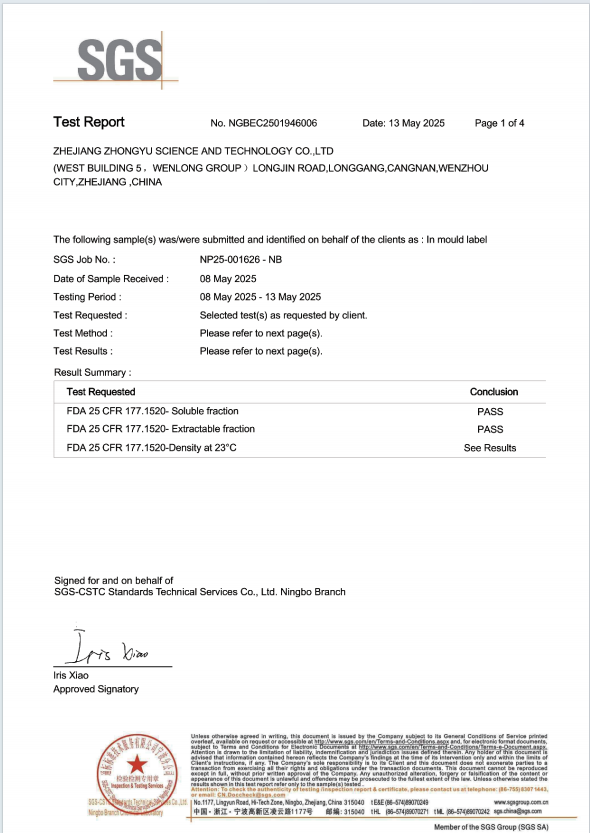
Test report pages supporting the ZY-IML series — the product-level half of an IML compliance file.
| Parameter | ZY-IML series (as documented) |
|---|---|
| Film thickness | 30µm – 100µm, customizable |
| Film material | Virgin PP / PE / PET / multi-layer composite (food-grade options available) |
| Printing method | High-precision rotogravure, up to 8 colors, printing precision ±0.1mm |
| Maximum printing width | 1200mm (customizable) |
| Ink type | Food-grade low-migration water-based ink |
| Adhesion strength | ≥5N, no peeling during injection molding |
| Operating temperature | -20°C to 120°C (cold chain and hot filling) |
| Mechanical / surface | Tensile strength ≥20MPa; scratch resistance 4H (pencil hardness); resistant to weak acids, alkalis and common detergents |
| Film and finish options | Complex white gloss, complex transparent gloss, standard gloss, matte laminated, holographic; glossy, matte, orange peel and custom textures |
| Declared compliance | FDA 21 CFR, BRCGS Packaging Materials, ISO 22000, QS certified; migration test meets EU 10/2011 |
Where Compliance Meets Manufacturing Capability
For buyers at the evaluation-to-execution stage, the useful question is not whether a supplier holds certificates but whether the certified configuration survives contact with a real molding line. Three data points carry most of that weight in the ZY-IML series.
The first is ink. Food-grade low-migration water-based ink sits on the compliance side of the specification, not merely the print side, because the printed surface is part of the finished pack. The second is adhesion strength of at least 5N, which is the property that prevents label lift or peel during injection. The third is the operating temperature window of −20°C to 120°C, which allows the same label platform to serve cold-chain dairy and hot-fill applications without changing the base film system.
Those properties are produced, not purchased. YZY operates OEM and ODM production with customization across size, shape, color, printing design and material, and applies 100% visual inspection plus random laboratory testing against FDA and GB compliance criteria across the run. Monthly capacity is stated at 350,000,000 pieces, with a minimum order quantity of 2,000² and a production lead time of 15–20 days after sample confirmation. Commercial terms include FOB or CIF delivery, sample testing as the acceptance basis, and a 30/70 payment structure.
Customization changes the compliance question
Every customization lever a buyer pulls — thickness, resin, film construction, surface finish, ink set — can shift the material system outside the scope of the original test report. When a project moves from standard configuration to a custom formulation, ask explicitly which part of the existing compliance evidence still applies and which part requires re-verification. This is the single most common gap between a supplier's certificate folder and a project that passes a retailer audit.
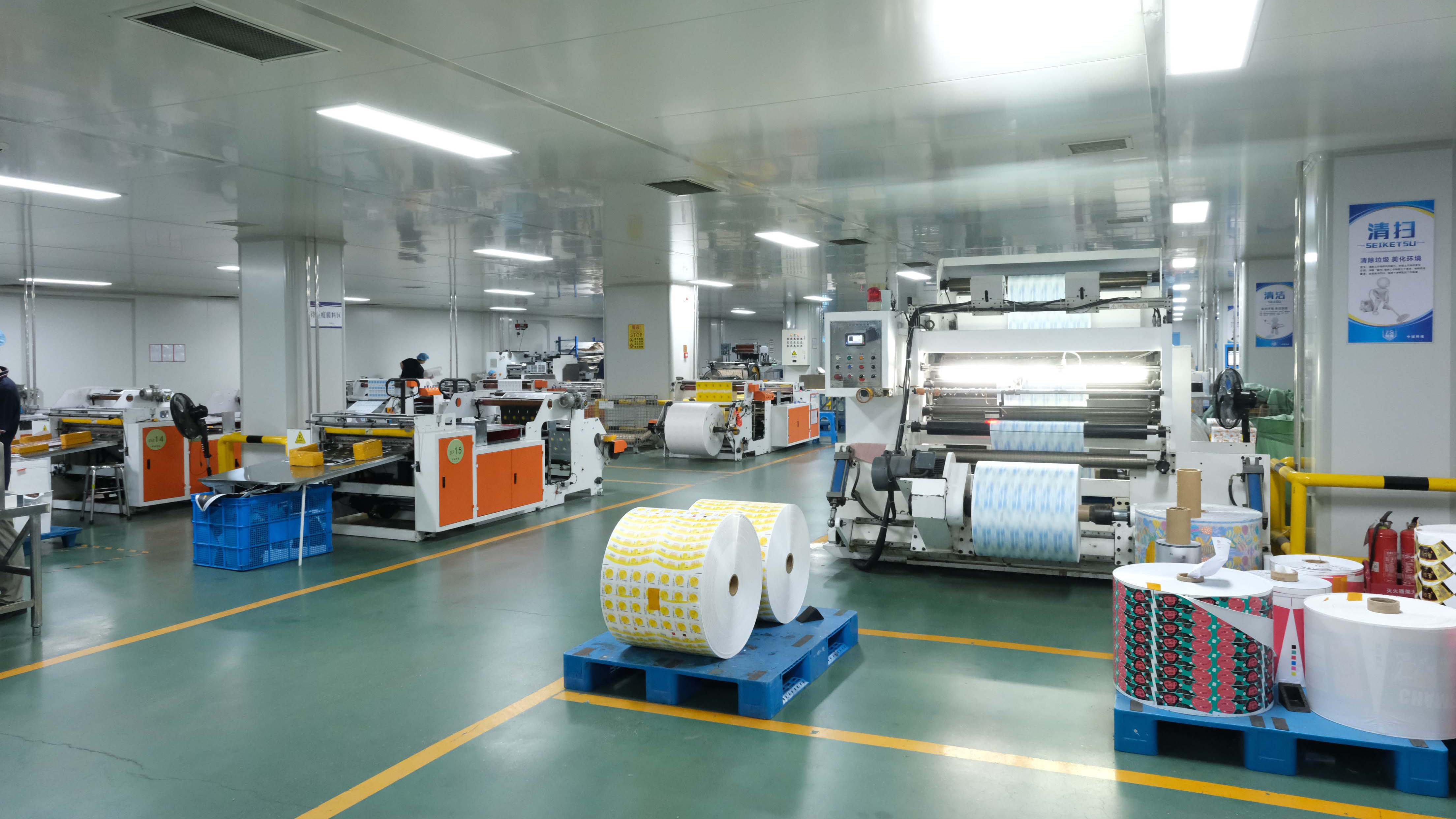
Production-floor control is the bridge between a certificate and a delivered batch of food-grade IML labels.
Application Fit: Where Certified Food-Grade IML Is Used
Certified IML is specified where decoration and container become one surface and where contact with food is continuous rather than incidental. The most common contexts are yogurt cups, cold beverage cups, ice cream containers, bubble tea cups, and food and non-food plastic containers, bottles and buckets.
A documented reference case for the ZY-IML series involves international food, beverage and dairy brand clients producing custom food-grade IML labels for cold beverage and yogurt cups in high-volume mass production. The project ran across multiple markets including Algeria, Egypt, India, Iran, Pakistan, the Philippines, Saudi Arabia, Thailand, Turkey, Taiwan, the United States, Uzbekistan, Vietnam and South Africa, and was reported with zero quality complaints, a 100% on-time delivery rate and 100% compliance, with food-grade safety and custom visual effects — including cold, heat and laser effects — as the defining requirements.
Industrial applications follow a related logic. Industry analysis published by Honokage IML Research notes that IML is increasingly applied to 20-litre paint pails, where the in-mold bond forms a permanent label surface resistant to solvent spills and moisture. That commentary is third-party and directional rather than a certified specification, but it illustrates a broader point: the same in-mold bonding mechanism that keeps a yogurt cup label intact through cold-chain handling also keeps an industrial pail label legible through chemical exposure.
Market Context: Why Compliance Documentation Is Becoming a Competitive Variable
The commercial backdrop explains why documentation has moved up the purchasing agenda. The global in-mold label market was valued at USD 2.31 billion in 2023 and is projected to reach USD 3.14 billion by 2030, a CAGR of 4.6% (Grand View Research). The IML film segment specifically is projected to grow from USD 1.3 billion in 2025 to USD 1.7 billion by 2035 (Future Market Insights).
Material and regional mix both point toward more regulated applications rather than fewer. Polypropylene held a 47.2% share of the IML material segment in 2023, driven by recyclability and compatibility with plastic containers (Grand View Research). Asia-Pacific led the market with a 42.8% revenue share in 2025, supported by growth in dairy and paint applications in China and India (Dataintelo). Since food and beverage alone represents over 41.3% of IML revenue, a large share of new capacity is being added in exactly the segment where food-contact evidence is mandatory.
One caution applies to all of these figures. Market sizing estimates vary substantially by source scope — some count only the label, others count the total value of IML-decorated containers — so absolute values should be treated as directional. The direction itself is consistent: demand is rising, and the buyer's practical risk is not market size but supplier documentation quality.
How IML Compliance Compares With Alternative Decoration Routes
| Decoration route | Where compliance sits | Durability logic | Best fit | Notable limitation |
|---|---|---|---|---|
| In-mold label (IML) | Film + ink tested as a material system; factory held to BRCGS / ISO 22000 / QS | Label becomes part of the container wall; no adhesive layer to fail | High-volume polyolefin containers — dairy, cold beverage, ice cream, industrial pails | Requires compatible molded or thermoformed polyolefin containers, mould preparation and higher minimum runs |
| Glue-applied paper label | Facestock and adhesive each need their own food-contact evidence | Adhesive bond on the outer surface; vulnerable at edges and moisture | Low-volume or non-polyolefin containers | Two-material compliance chain; lower resistance to wet and chilled environments |
| Pressure-sensitive label | Facestock, adhesive and liner all in scope | Applied after molding; can lift under condensation or abrasion | Short runs, frequent artwork changes | Liner waste and separate adhesive compliance; decorative rather than structural |
| Direct printing on container | Ink system alone | Permanent but limited graphic detail on curved surfaces | Simple, single-color industrial marking | Narrow design freedom; surface preparation sensitive |
The comparison is not a claim that IML is universally superior. IML has real boundaries. It depends on a container that can be molded or thermoformed in a polyolefin compatible with the film, so glass, metal and many non-polyolefin substrates are outside its scope. Artwork changes require new printing plates, and the minimum order quantity and lead time — 2,000² and 15–20 days after sample confirmation for the ZY-IML series — make IML less economical than glue-applied labels for short promotional runs or pilot projects. Buyers should weigh those constraints against the durability and compliance benefits before standardizing on any single decoration route.
Future Outlook
Three forces are likely to shape IML compliance over the next few years. The first is regulatory attention on migration from printed surfaces, which pushes ink selection from a cost decision toward a compliance decision — the reason low-migration water-based inks appear in product specifications rather than in marketing material. The second is retailer-driven system auditing, where BRCGS-type certification functions as a market-entry condition in addition to any test report. The third is the shift of production capacity toward Asia-Pacific, which increases supplier choice while widening the range of documentation maturity a buyer will encounter.
For procurement teams, the practical implication is that compliance verification is becoming a repeatable process rather than a one-off check: confirm the material scope, confirm the test conditions against the real filling line, confirm the system certificates, and re-confirm all three whenever the configuration or the destination market changes.
Frequently Asked Questions
Is FDA 21 CFR the same as EU 10/2011?
No. FDA 21 CFR is the United States framework for food-contact substances; 21 CFR 177.1520 addresses olefin polymers. EU 10/2011 is the European regulation setting overall and specific migration limits for plastic food-contact materials, operating under framework Regulation (EC) No 1935/2004. They are separate jurisdictions with separate test methodologies, so a report for one market does not satisfy the other.
What does BRCGS Packaging Materials certification actually cover?
It covers the manufacturer's system rather than the product: factory hygiene, traceability, quality management and process control, verified through audit. It is frequently required by retailers for supplier onboarding, but it does not measure chemical migration. It complements a food-contact test report rather than replacing it.
How is migration testing performed for an in-mold label?
A defined material system — film plus ink — is tested against food simulants under specified temperature and contact-time conditions, and the results are compared with overall and specific migration limits. Because results depend on those conditions, buyers should match the test parameters to the actual filling and storage profile of the product, including whether it is aqueous, acidic or fatty.
Which documents should a buyer request before approving an IML supplier?
Four categories: product-level food-contact evidence for the specific film and ink configuration; system-level certificates such as BRCGS Packaging Materials, ISO 22000 or QS; the scope statement, issuing laboratory, certificate number and validity dates for each document; and in-process quality control records showing how batches are inspected. The ZY-IML series illustrates this combined approach, with an SGS food-contact test report, declared EU 10/2011 migration conformity and BRCGS, ISO 22000 and QS certification.
Does a food-contact certificate cover the printing ink as well as the film?
Only if the tested scope includes the ink system. Because the printed surface remains part of the finished pack, the ink is a compliance-relevant component. Low-migration water-based food-grade inks are specified for this reason. If a project changes ink type, color system or coating, the buyer should confirm whether the existing test evidence still applies.
Do compliance requirements affect minimum order quantity or lead time?
Indirectly, yes. Custom film formulations and custom printing require dedicated preparation, which is why minimum quantities and lead times exist at all. For the ZY-IML series, the stated minimum order quantity is 2,000² and the production lead time is 15–20 days after sample confirmation, with sample testing used as the acceptance basis. Buyers planning a regulated launch should budget for the sample validation stage separately from production.
YZY (Zhejiang Zhongyu Technology Co., Ltd.) publishes its full product and capability documentation in its corporate brochure, available for download at the YZY company brochure (PDF). Buyers evaluating food-grade IML can also review the manufacturer's product information at inmoldlabel.net.