
IATF16949 and UL94 V-0: What They Mean for OEM Connector Buyers
IATF16949 and UL94 V-0: What They Mean for OEM Connector Buyers
Two certification strings appear on more high-current DC power connector datasheets than any other compliance claim: IATF16949:2016 and UL94 V-0. They are usually printed side by side and read as a single compliance story, yet they answer entirely different questions. IATF16949:2016 describes how a manufacturing site governs quality, traceability and risk across production. UL94 V-0 describes how the plastic housing of a connector behaves when it meets flame. One is a system-level automotive quality standard; the other is a material-level flammability classification. Treating them as interchangeable is among the most common certification errors in connector procurement.
For OEM buyers at the decision stage — comparing shortlisted suppliers for two-wheeler EV battery swap cabinets, outdoor lithium-powered equipment or UAV power systems — the practical question is not whether a supplier holds these credentials. It is what each credential transfers to a purchase order, a tooling investment and a field-failure risk profile.
Why certification became a first-pass sourcing filter
High-current DC power connector selection used to be dominated by three numbers: continuous current, peak current and contact resistance. Ampacity at a given wire gauge still decides whether a connector fits a circuit. What has changed is the point at which material and process documentation enters the review.
A field failure in a lithium battery system rarely stays contained to a single unit. A housing that softens under sustained current, or a batch with inconsistent crimp geometry, becomes warranty exposure rather than a component-level defect. Procurement teams therefore score suppliers on two independent axes: process quality, evidenced by IATF16949:2016, and material safety, evidenced by UL94 V-0 alongside RoHS 2.0 and REACH SVHC compliance. The two axes are complementary, not substitutes.
IATF16949:2016: what the certificate covers
IATF16949:2016 is the global quality management system standard applied in the automotive and high-end intelligent equipment industries. To hold it, a manufacturer must implement standardized product quality control, process management and risk prevention across every production link — from raw material incoming inspection, precision processing and plating treatment through to finished product testing. The standard also requires managed production consistency, product stability, traceability and batch quality control, together with continuous improvement and failure prevention.
AOYG DC Power Connector is a manufacturer and solution provider of high-current DC connection systems for lithium-ion smart devices. The company operates a 6,000 m² production facility with approximately 100 employees, a 25-engineer R&D team and an annual output of around 900,000 units, and exports roughly 50% of its production to the EU and USA. It states that it has obtained IATF16949:2016 automotive quality management system certification and applies the same framework from incoming inspection and precision mold development through automated production, finished-product testing and factory inspection. Its stated position is that full-process standardized control is used to eliminate defective products and to keep batch performance consistent.
What the certificate does not do matters just as much for a decision-stage buyer:
- It certifies a management system at a manufacturing site, not an individual part number.
- It does not state ampacity, contact resistance, sealing class or flammability grade — those remain part-level specifications.
- It does not automatically extend to a different production location, nor to processes that are subcontracted.
The buyer takeaway is narrow but valuable. IATF16949:2016 is evidence about repeatability: the probability that unit 500 and unit 50,000 behave the same way. Everything about the connector's electrical behaviour still has to be read from the datasheet and confirmed against test records.
UL94 V-0: what the housing rating does and does not prove
UL94 V-0 is the most demanding of the common vertical flammability classifications applied to plastics used in electrical equipment. A housing carrying this rating is expected to resist ignition, to resist melting and deformation under sustained heat, and to self-extinguish rather than propagate a flame.
Across its high-current DC connector families, AOYG specifies PA66 high-temperature nylon housings rated UL94 V-0, paired with H62 brass gold-plated terminals and beryllium copper gold-plated spring contacts. The company frames the material distinction as new, high-purity flame-retardant engineering plastic versus recycled or secondary plastic, and lists four practical differences:
- Heat and melt resistance: the housing does not soften, deform or collapse during long-term high-current operation and continuous temperature rise, which avoids short-circuit faults caused by high-temperature melting.
- Self-extinguishing behaviour: the material self-extinguishes quickly under abnormal overheating or sparking, limiting the spread of fire inside an enclosure.
- Voltage resistance and insulation stability: the shell resists high-voltage breakdown, leakage and creepage, which is directly relevant to high-power lithium battery systems.
- Vibration and crack resistance: high toughness keeps the housing from cracking or loosening under sustained vibration, and the material resists aging and brittleness under sun exposure and alternating high and low temperatures.
Boundary to keep in mind: UL94 V-0 is a material rating. It does not define how much current the contacts carry, what the contact resistance will be after 1,000 mating cycles, or whether the assembly survives water ingress. Those are separate electrical and environmental specifications, and a responsible supplier will present them separately.
In practice, the two credentials answer two different procurement questions, and a third group of documents answers a third. The mapping below is the fastest way to keep them apart during a BOM review.
| Buyer question | Evidence that answers it | What it establishes | What it does not establish |
|---|---|---|---|
| Will batch quality stay consistent across production runs? | IATF16949:2016 site certification | Process control, traceability, risk prevention, batch consistency | Ampacity or contact resistance of a specific part number |
| Will the housing resist ignition and melting? | UL94 V-0 material rating on PA66 housing | Flammability behaviour, melt resistance, insulation stability of the shell | Current carrying capacity or sealing performance |
| Will the connector survive wet outdoor duty? | IP40 / IP65 / IP67 protection class | Ingress protection of the mated assembly | Flame behaviour or process quality |
| Will electrical performance hold over service life? | Contact resistance, insulation resistance, salt spray and mating-cycle data | Test-level electrical and mechanical performance | Site-level quality management |
A worked reference: the DXT30U(2+2)-F(B) power-signal combo
A single product illustrates how the two credentials sit alongside hard specifications. The DXT30U(2+2)-F(B) is a female cable-soldered connector from the DXT30U series, built as a 2+2 power-signal composite: two power pins plus two signal pins in one black housing. Its mating counterparts are the DXT30U(2+2)-M and DXT30U(2+2)P.
Its published parameters are:
- Rated voltage: DC 500V
- Continuous current: 20A on the power pin (16AWG); 1A on the signal pin
- Peak current: 35A
- Contact resistance: ≤1.2 mΩ
- Insulation resistance: ≥2000 MΩ
- Mating cycles: ≥1000 times
- Protection class: IP40
- Operating temperature: −20°C to +120°C
- Flammability rating: PA66 UL94 V-0
- Applicable wire: 12–16AWG silicone wire
- Salt spray test: 48 hours
Read against the certification table above, the structure becomes clear. The UL94 V-0 line covers the housing material only. The contact resistance, insulation resistance, mating-cycle and salt spray figures carry the electrical and mechanical claims. The IP40 line defines the boundary: this variant is designed for protected enclosures, not for direct rain exposure or washdown. Applications listed for this series include UAVs, FPV drones, RC hobby models, light-duty e-bikes, portable energy storage, robots, garden power tools, smart device battery packs and BMS systems.
For OEM buyers, the reason a 2+2 layout appears in battery-side interfaces is architectural rather than cosmetic. Where a battery management system needs to communicate state-of-charge or temperature data at the same physical interface as the main power path, combining two power pins and two signal pins in one housing removes a separate signal connector and a length of harness. The trade-off is that the signal circuit now shares the housing material, temperature envelope and ingress class of the power circuit, so the weakest requirement governs the part selection.
Where these credentials matter in practice
Battery swap cabinets and two-wheeler EV platforms
Two-wheeler EV, battery swap cabinet, portable energy storage, garden lithium power tools, smart robots, RC models and UAVs sit in the same low-voltage lithium battery application family. The described working conditions are continuous high-current load with associated heat generation, persistent vibration and impact during equipment operation, indoor and outdoor environments with dust and humidity, frequent plugging for battery swapping, and large instantaneous surge currents in the DC low-voltage circuit. Standard protection is IP40, with IP65/IP67 available on waterproof versions.
In that setting, UL94 V-0 housings address the ignition and melt risk that concentrates when packs, cabinets and chargers are packed into a confined space. IATF16949:2016 process control addresses the repeatability of the crimp and assembly work that determines whether contact resistance stays low after the cabinet has been cycled repeatedly. Neither credential alone covers the other risk.
Outdoor lithium-powered equipment in humid and rainy conditions
The outdoor waterproof lithium-powered equipment category operates from −20°C to +120°C, endures rain splash, humidity, dust and muddy environments, withstands vibration and impact, supports frequent mating and can see high instantaneous peak currents, with protection grades up to IP65/IP67. The functional requirement stated for this category is specific: a sealed waterproof structure that ensures safe circuit conduction under humid and rainy conditions, with modular quick connection and, on some models, simultaneous power and signal transmission.
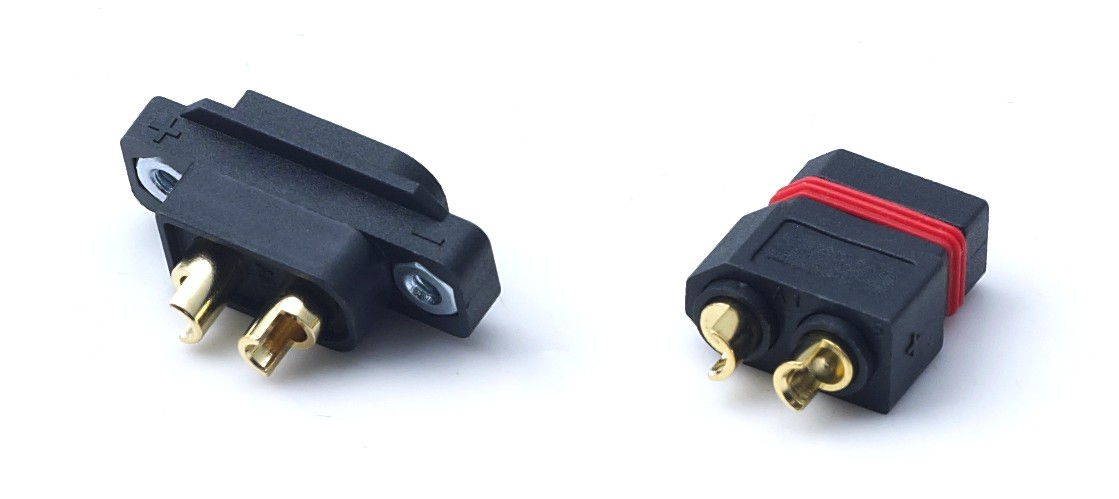
Waterproof high-current pair for outdoor lithium equipment: DXT60EW-M male and DXT60W-F female, IP67 with silicone O-ring sealing and PA66 UL94 V-0 housing.
The waterproof series that carries this duty, DXT60EW-M+DXT60W-F, is specified at DC 500V with 60A continuous current and 100A peak, Φ5mm H62 brass gold-plated terminals, a PA66 UL94 V-0 housing, a silicone O-ring seal, contact resistance ≤0.8 mΩ, an operating range of −20°C to +120°C, ≥1000 mating cycles, IP67 protection and 8–10AWG silicone wire. Target applications include waterborne unmanned equipment, outdoor mobile photovoltaic energy storage, marine lithium battery systems, outdoor communication backup power, outdoor garden machinery, outdoor 5G base station standby power and outdoor electric amusement equipment.
The engineering point is that IP67 is not an upgrade applied to the same part. It is a different sealing architecture — O-ring geometry, mating retention and housing volume all change — which is why a flame-retardant housing and a waterproof housing are separate selections rather than two labels on one product.
Market context: why compliance questions are rising
Several published market and technical data points explain why certification documentation has moved from the appendix of a supplier questionnaire to the first page.
- The global high power connectors market was valued at approximately USD 5.47 billion in 2025, according to Fact.MR.
- DC connectors represented 58.7% of the energy storage connector market in 2025, a share attributed to higher voltage requirements in storage applications (Dataintelo).
- 5G base stations consume two to three times more power than 4G predecessors, with typical draws of 11.5 to 14 kW and peaks reaching 19 kW, per published telecom site planning guidance. Higher DC-side duty in backup power raises the performance expected from every connection point in the chain.
- XT60 and XT90 connectors remain the primary industry standards for medium-to-high power non-proprietary RC aircraft and drones in 2026, based on published connector compatibility guidance.
Taken together, these signals point in one direction: as DC architecture expands into storage, swap infrastructure and telecom backup power, the connector stops being a passive mechanical part and becomes a documented compliance item. The buyer who cannot read the difference between a system certificate and a material rating will either over-specify cost or under-specify risk.
Certification-built connectors versus traditional general-purpose connectors
The comparison that matters at the decision stage is not brand against brand, but documented performance against the general-purpose connector baseline. The manufacturer-published comparison data for this connector family states the following relative to traditional high-current connectors.
| Dimension | Published comparison data | What it means for a buyer |
|---|---|---|
| Contact resistance | Reduced by over 50% | Lower heat generation in the power path and improved transmission efficiency |
| Current transmission | Stable transmission with low temperature rise | More headroom before thermal derating |
| Anti-spark behaviour | Superior anti-spark performance | Reduced arc damage at the mating interface during hot connection |
| Mechanical durability | Strong vibration resistance, safe plug/unplug, compact structure with high load capacity | Suited to mobile equipment and frequent mating duty |
| Maintenance | Less maintenance compared with similar products | Lower service intervention over the equipment lifecycle |
| Cost | 15–20% lower than alternatives | Relevant at volume, but must be confirmed against the actual configuration |
| Best-fit applications | Drones, portable energy storage, e-scooters, power garden tools, intelligent robots | Aligns with compact, high-vibration, high-current duty |
These comparison figures are the manufacturer's own published data. They are a reasonable starting hypothesis for a shortlist, but they should be validated through incoming inspection and sample testing before tooling release.
Limits and trade-offs buyers should plan around
- IP40 is the standard class on compact models. If the connector sits in rain, washdown or condensation zones, the correct part is an explicitly waterproof series such as the IP67-rated DXT60EW-M+DXT60W-F. That changes sealing hardware, envelope and cost.
- IATF16949:2016 certifies the system, not the part. Per-SKU data — contact resistance, 48-hour salt spray results on gold-plated terminals, and ≥1000 mating cycles — still has to be reviewed line by line.
- UL94 V-0 says nothing about ampacity. Current ratings remain wire-gauge dependent: 20A continuous on a 16AWG power pin for DXT30U(2+2)-F(B); 90A continuous at 10AWG with temperature rise ≤85°C for DXT90H-M/DXT90S-F. A flame-retardant housing does not raise those numbers.
- Comparative savings are configuration-dependent. Volume, plating thickness and customization level all move the 15–20% cost comparison, so it should be treated as an indicator rather than a quotation.
- Documentation has a time cost. Reviewing certificates, material declarations and test records adds steps before tooling release. Buyers who plan sample validation into the schedule avoid discovering a mismatch after the mold is cut.
Future outlook
Three developments are likely to shape how OEM buyers evaluate high-current DC power connectors over the next planning cycle. First, the DC share of energy storage interconnection continues to expand, which keeps pushing DC connector specifications toward higher voltage classes and tighter temperature-rise targets. Second, denser power electronics in 5G backup and mobile storage raise continuous current per connection point, which makes low contact resistance a design constraint rather than a preference. Third, as battery swap and outdoor mobility formats standardize around a small number of interface families, the qualification package — not the connector drawing alone — becomes the differentiator between suppliers.
A reasonable expectation is that compliance evidence will be requested as a standard attachment in RFQs, in the same way electrical parameters are requested today. Suppliers that can present system-level certification, material-level flammability documentation and part-level test data as a coherent set will spend less time in qualification and more time in design-in.
FAQ
1. Does IATF16949:2016 certification guarantee that a specific high-current DC power connector performs to its datasheet?
No. IATF16949:2016 is a quality management system certification applied to a manufacturing site and its processes: incoming inspection, precision processing, plating, assembly, testing and batch traceability. It supports the expectation of consistent, repeatable production. It does not certify the ampacity, contact resistance or ingress protection of an individual part number. Those values come from part-level specifications and test data — for example, contact resistance ≤1.2 mΩ, insulation resistance ≥2000 MΩ and ≥1000 mating cycles for the DXT30U(2+2)-F(B), or ≤0.8 mΩ and IP67 for the DXT60EW-M+DXT60W-F pair.
2. What does UL94 V-0 mean on a connector housing, and does it replace the need for an IP rating?
UL94 V-0 is a vertical flammability classification for the plastic material. On these connectors it applies to PA66 high-temperature nylon housings, which are specified to resist ignition, avoid softening or collapse under continuous high-current temperature rise, self-extinguish under abnormal overheating or sparking, resist high-voltage breakdown and creepage, and resist cracking under vibration and temperature cycling. It says nothing about water or dust ingress. IP40, IP65 and IP67 are separate specifications that describe the mated assembly's environmental protection. For humid and rainy outdoor duty, safe circuit conduction depends on the sealed waterproof structure, which is what the IP-rated versions provide.
3. How should an OEM buyer verify IATF16949 and UL94 V-0 claims before committing to tooling?
Four checks are practical. Match the IATF16949:2016 certificate to the site that will actually produce the part, since the certificate covers a management system at a location. Request the material declaration for the housing and confirm which part numbers use the UL94 V-0 PA66 material. Ask for part-level test evidence such as contact resistance, insulation resistance, 48-hour salt spray results for gold-plated terminals and mating-cycle data. Finally, validate on samples before mass production; suppliers in this segment typically support model selection guidance, adaptation analysis and sample-machine debugging so fit and performance can be confirmed before tooling is released.
4. Is a UL94 V-0 housing enough for a battery swap cabinet, or is IATF16949 needed as well?
They address different risks and are normally specified together. Battery swap and low-voltage lithium storage environments involve continuous high-current load with heat generation, persistent vibration and impact, dust and humidity, frequent plugging for battery swapping, and large instantaneous surge currents. A flame-retardant UL94 V-0 housing addresses ignition, melt and insulation-stability risk. IATF16949:2016 process control addresses batch consistency of the crimp and assembly work that governs contact resistance and temperature rise over thousands of cycles. Typical specifications also include vibration resistance, anti-loosening and anti-reverse-insertion design, ≥1000 mating cycles and, where the cabinet is outdoors, an IP65/IP67 waterproof version rather than the standard IP40 part.
5. What are the trade-offs of specifying an IATF16949-certified, UL94 V-0 connector instead of a general-purpose connector?
The costs are documentation and qualification overhead, plus the need to match the protection class to the environment: compact IP40 models are not interchangeable with IP67 waterproof versions, and the waterproof series brings different sealing hardware and envelope. On the benefit side, the manufacturer-published comparison data reports over 50% lower contact resistance, lower temperature rise, stronger anti-spark performance, less maintenance, higher efficiency and 15–20% lower cost relative to alternatives. Because those figures are supplier-reported and configuration-dependent, the decision usually turns on whether the application's failure cost justifies the qualification workload — and on whether sample validation confirms the published numbers for the specific program.
Certification does not make a connector suitable. It makes a connector auditable. IATF16949:2016 tells a buyer whether the process behind a part is controlled; UL94 V-0 tells a buyer how the housing behaves under heat and flame; neither substitutes for the part-level current, resistance, sealing and cycle data that ultimately decide whether a connector survives a battery swap cabinet, a wet outdoor installation or a thousand mating cycles in the field.