
IATF 0516798: Scope, Equipment, and Casting Capability
IATF 0516798: Scope, Equipment, and Casting Capability

Investment casting buyers in the automotive supply chain usually meet their first piece of supplier evidence as a certificate number rather than as a casting. That number is worth reading carefully, and then worth testing against the plant that has to deliver the part.
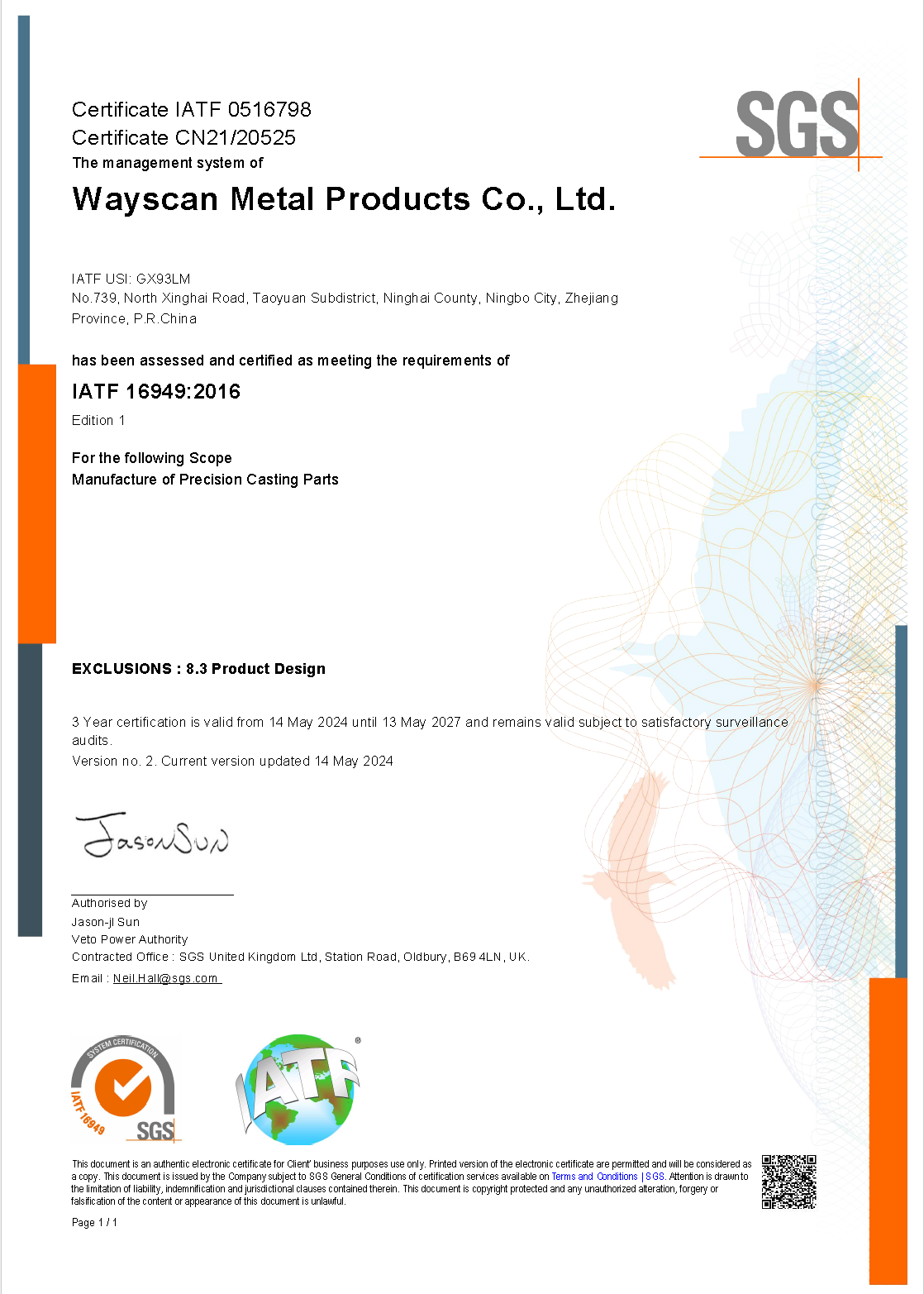
Wayscan Metal Products Co., Ltd. (WAYSCAN) is a useful worked example of the gap between those two things. The Ningbo-based foundry, established in 1991 and operating a 46,000 m² production base with more than 500 employees, holds IATF 16949:2016 certificate IATF 0516798, issued by SGS United Kingdom Ltd. The recorded scope is the manufacture of precision casting parts, the market designation is the global/international automotive supply chain, and the certificate is valid from 14 May 2024 to 13 May 2027.
Read alone, that sentence answers one question and raises several others. It confirms that a certified automotive quality management system covers precision casting manufacture at the company. It does not name a melting furnace, a machining center, a spectrometer, a tolerance class, a material grade or a tonnage. Those facts sit in a second evidence layer — the equipment and process record — and the two layers only become capability evidence when they are cross-checked against each other.
The company also holds ISO 9001:2015, ISO 14001:2015 and ISO 45001:2018 certificates issued by Shenzhen Universal Certification Centre Co., Ltd. (UCC). The four numbers together make a practical reference case for evaluation-stage buyers: what a scope sentence proves, where the equipment record takes over, and why no single certificate — or even a set of four — should be read as proof of total investment casting capability.
Four certificates, read as a boundary map
A certificate set is easier to use when it is laid out as a map of boundaries rather than a wall of badges. The table below reproduces the supplied certificate data, including the two different issuing bodies.
| Certificate | Number | Issuer | Recorded scope | Standard | Validity |
|---|---|---|---|---|---|
| IATF 16949:2016 Automotive Quality Management System | IATF 0516798 | SGS United Kingdom Ltd. | Manufacture of Precision Casting Parts | IATF 16949:2016, Edition 1 | 2024-05-14 to 2027-05-13 |
| ISO 9001:2015 Quality Management System | 02426Q00625R401 | Shenzhen Universal Certification Centre Co., Ltd. (UCC) | Production of Steel Casting | GB/T 19001-2016 / ISO 9001:2015 | 2026-05-21 to 2029-05-20 |
| ISO 14001:2015 Environmental Management System | 02426E00394R401 | Shenzhen Universal Certification Centre Co., Ltd. (UCC) | Production of Steel Castings and Related Management Activities | GB/T 24001-2016 / ISO 14001:2015 | 2026-05-21 to 2029-05-20 |
| ISO 45001:2018 Occupational Health and Safety Management System | 02426S00381R101 | Shenzhen Universal Certification Centre Co., Ltd. (UCC) | Production of Steel Castings and Related Management Activities | GB/T 45001-2020 / ISO 45001:2018 | 2026-05-21 to 2029-05-20 |
Three observations follow directly from that table.
Four numbers, two certification bodies. IATF 0516798 is issued by SGS United Kingdom Ltd.; the three UCC certificates carry the numbers 02426Q00625R401, 02426E00394R401 and 02426S00381R101. Each number is separately verifiable, and a buyer should verify each one rather than transferring trust from the first check to the rest.
The scope wording is not identical across the set. The automotive certificate scopes the manufacture of precision casting parts; the ISO 9001:2015 certificate scopes the production of steel casting; the ISO 14001:2015 and ISO 45001:2018 certificates scope the production of steel castings and related management activities. The differences look cosmetic and are not. One sentence describes a parts-manufacturing activity, another describes an output, and two describe an output plus related management activities. A purchase order should be matched to the sentence that actually describes the work.
Only one of the four is sector-specific. IATF 16949:2016 is the automotive quality management system requirement. ISO 9001:2015 is the general quality management system standard, and ISO 14001:2015 and ISO 45001:2018 cover environmental and occupational health and safety management respectively. None of the four is a product standard.
That last distinction matters more than the certificate count. A quality management certificate describes how an organization controls its processes. A product standard describes what the casting itself must satisfy — ASTM A957, the standard specification for common requirements of steel and alloy investment castings for general industrial use published by ASTM International, is one example of the second kind of document. Automotive programs then add customer-specific requirements on top. Buyers who ask whether a supplier is certified are asking the first question. Buyers who ask whether a casting will conform are asking the second, and no certificate answers it alone.
All four certificates are inside their stated validity periods as of November 2026: the IATF certificate expires on 13 May 2027 and the three UCC certificates expire on 20 May 2029. Validity is a date check rather than a capability check, but it is the first field to verify and the easiest to overlook.
Why the automotive scope carries more weight than the certificate count
IATF 16949:2016 is not a marketing preference in this segment. The International Automotive Task Force's quality management system requirements remain the operative certification for suppliers serving automotive production, and buyers in that chain generally treat the certificate as an entry condition rather than a differentiator. Automotive applications are also the largest volume-driven segment of investment casting demand, at approximately 29% in 2025 according to Business Research Insights' market analysis, which is why the automotive certificate usually gets read first.
Volume is exactly why the scope sentence deserves a second look. A certificate scoped to the manufacture of precision casting parts tells an automotive buyer that the certified system covers casting manufacture. It does not tell them that a specific yoke, bracket or housing has been qualified, that a named grade has been melted to a controlled chemistry, or that a drawing's dimensional and non-destructive testing requirements can be met. Those are job-level questions, and they are answered by records.
Reading the scope sentence: what it includes and what it leaves open
Scope sentences are written to be auditable, not descriptive. The words in IATF 0516798 do three jobs: they name an activity (manufacture), a product family (precision casting parts) and, through the certificate's market field, an audience (the global/international automotive supply chain).
What the sentence supports is narrower than it first appears, and reliable. It confirms that the certified management system covers precision casting manufacture; it ties that system to a named legal entity; it identifies the issuing body and the standard edition; and it supplies a validity window that can be checked.
What it leaves open is the list a buyer actually needs: material grades; process route, whether silica sol, composite or water glass; post-casting operations such as heat treatment, machining and assembly; inspection methods and acceptance levels; dimensional capability or tolerance class; capacity, minimum order quantity and lead time; and the treatment of subcontracted processes. None of those omissions is a defect — scope statements are not datasheets. They become a procurement risk only when a buyer treats the certificate as a substitute for the missing answers.
The practical response is to request the documents that carry the missing information: the certification body's audit scope and process list, the current surveillance status, and the internal process map showing where casting, heat treatment, machining and inspection sit inside the certified system. A supplier that can produce those three items quickly has already demonstrated something a badge cannot.
The second evidence layer: matching equipment to the claims a drawing makes
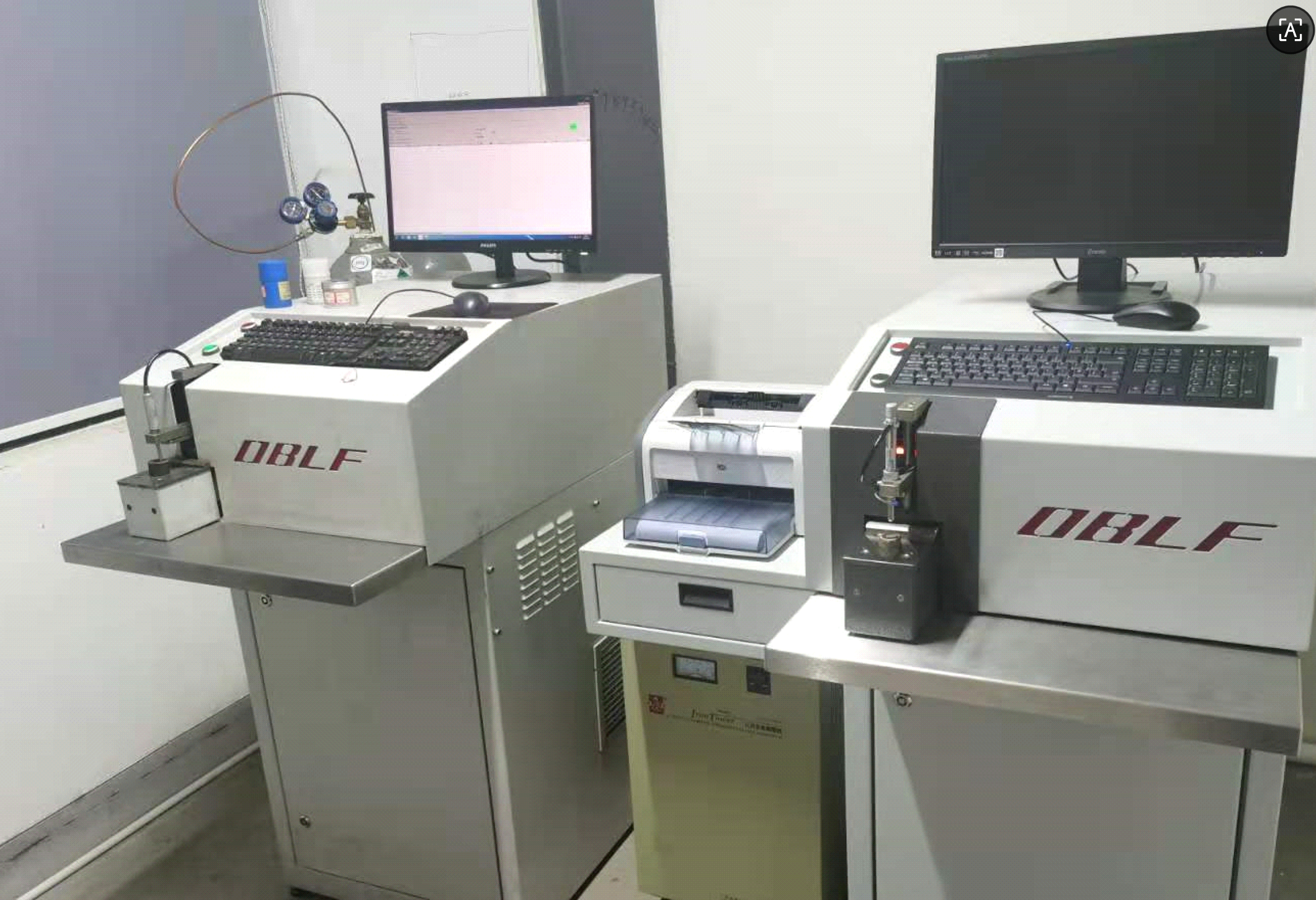
The supplied capability record is specific about method and equipment. The company states that it focuses on composite-process and silica sol precision casting, produces stainless steel, carbon steel and alloy steel castings, and operates machining workshops alongside its inspection facilities. Its stated inspection methods include spectrometer analysis, X-ray inspection, ultrasonic testing, hardness and tensile testing, and CMM dimensional inspection. Customization is offered against customer drawings for size, geometry, material, surface and heat treatment, with rapid no-mold samples produced by 3D printing.
The process emphasis is consistent with where precision demand sits. Silica sol (colloidal silica) shell systems held the largest process share at 54.3% in 2025, according to Dataintelo's market research, a position usually attributed to precision and surface finish relative to water glass routes. The company states that it invested in composite-process precision casting in 2020 to replace its earlier water-glass process — a statement about production route, not about the capability of any individual part.
Equipment, however, is a claim of the same kind as a scope sentence. It shows that an activity is possible at the plant; it does not show that the activity was performed correctly on a given order. The useful question is therefore which piece of equipment answers which claim in the drawing.
| Claim in the drawing or purchase order | Equipment or method that answers it | Record to request |
|---|---|---|
| Chemical composition of the specified grade | Spectrometer (elemental analysis) | Heat-level chemical analysis report tied to the casting lot and heat number |
| Internal soundness; freedom from shrinkage and inclusions | X-ray inspection; ultrasonic testing | NDT report stating method, coverage, acceptance criteria and operator qualification |
| Mechanical properties and hardness | Hardness and tensile testing | Test certificate with sampling location, test method and heat-treatment condition |
| Dimensional conformity to drawing | CMM dimensional inspection | Dimensional or first-article report showing datums, measured tolerances and instrument calibration status |
| As-cast surface and geometry | Silica sol and composite-process precision casting | Surface and tolerance data on the specific feature set, plus an approved sample |
| Machined interfaces and fits | In-house machining workshops | Machining capability statement, fixture and program control, in-process inspection records |
| Heat-treated condition | Heat treatment within the stated customization scope | Furnace batch records, temperature control and calibration evidence, and confirmation of whether heat treatment is performed in-house |
Two conclusions follow. First, the equipment list maps almost one-to-one onto the verification categories an automotive drawing usually demands — chemistry, internal soundness, mechanical properties and dimensions — which is why the equipment record is the right companion to the scope sentence. Second, every row in the right-hand column is a record rather than an asset. A spectrometer in a facility list shows that elemental analysis is possible; a heat-linked analysis report shows that it was done on your castings. An X-ray set shows that radiography is available; an NDT report carrying method, coverage, acceptance criteria and operator qualification shows whether the result is usable for your drawing.
The technical logic behind that mapping is not arbitrary. Chemistry controls hardenability and corrosion behavior, so it is verified at the melt and tied to a heat number. Radiographic inspection looks for internal shrinkage and inclusions that a machined surface may later expose, while ultrasonic testing covers subsurface indications that radiography may not resolve in thicker sections. Hardness and tensile tests convert a heat-treatment recipe into measured mechanical properties. CMM inspection converts a drawing's datums and tolerances into numbers on a report. Different failure modes require different evidence, which is why a single statement that a plant owns inspection equipment carries very little weight on its own.
Where the certified scope ends: heat treatment, NDT, machining and assembly
The scope sentence does not enumerate post-casting operations, and this is where buyers most often over-read a certificate. Casting, heat treatment, machining, assembly and non-destructive testing are separate activities. Some foundries perform all of them in-house; some perform casting and subcontract the rest. The certificate alone does not tell you which model applies.
For this supplier, the supplied record documents casting in composite and silica sol routes, heat treatment as a customization option, and in-house machining workshops, alongside spectrometer, X-ray, ultrasonic, hardness, tensile and CMM inspection. The supplier's own comparison material describes an integrated route that combines composite or silica sol casting with CNC machining and a full range of inspection facilities. Assembly is not described in the supplied material, and a buyer whose program requires assembled or sub-assembled castings should confirm whether that operation exists in-house, whether it falls inside the certified scope, and how it is controlled — rather than inferring it from a certificate that does not mention it.
Melting equipment deserves the same treatment. Furnace type and melt control are central to steel investment casting, and induction furnaces are the common route for steel melting, but furnace lists, heat sizes and melt records are not certificate fields. A buyer should ask for them directly and connect a delivered lot back to its heat.
A second question sits alongside it: when an operation is purchased from a subcontractor, it remains the supplier's responsibility under the certified system. How those sub-tier processes are approved, monitored and released is a routine automotive question, and it is answerable with documents rather than assurances.
The commercial envelope that certification does not describe
Certificates describe management systems. Purchase orders are governed by numbers, and the numbers live somewhere else. The supplied commercial terms are a minimum order quantity of 100 kg, a typical production lead time of 30 to 60 days, a stated monthly production capacity of 1,500 tons, delivery terms of FOB or EXW, acceptance based on pre-shipment and destination testing, and payment terms of Net 30 to 60 days.
Three of those deserve a note in an evaluation file. The 1,500-ton monthly capacity is a supplier-stated commercial figure, not a certified one, and it should be checked against scheduling evidence for the specific program window. A 100 kg minimum order quantity is small enough to support prototype and pilot quantities, which matters when a program needs castings before a full tooling commitment. A 30 to 60 day lead time is typical rather than guaranteed, and should be tested against the launch schedule rather than against the certificate's validity window.
A verification sequence for buyers moving from evaluation to execution
Evaluation-stage buyers compare; execution-stage buyers commit. The sequence below converts both evidence layers into a short check that can be run before a purchase order and repeated at renewal.
- Verify each number separately. Confirm holder name, standard and edition, scope wording, issue date and expiry date against the issuing body's record: IATF 0516798 with SGS United Kingdom Ltd.; 02426Q00625R401, 02426E00394R401 and 02426S00381R101 with UCC.
- Ask for the certified process list, not just the certificate. The scope sentence names an activity; the audit scope and process map show which operations sit inside it.
- Map drawing claims to equipment evidence. For chemistry, internal soundness, mechanical properties and dimensions, request the specific record type rather than the equipment list.
- Ask where heat treatment, NDT and machining are performed. Confirm in-house or subcontracted status, and how sub-tier processes are approved and released.
- Reconcile the commercial envelope. Minimum order quantity, lead time, monthly capacity and acceptance terms should fit the program, not just the certificate.
- Diarize the expiry dates. IATF 0516798 runs to 13 May 2027 and the three UCC certificates run to 20 May 2029; add a surveillance-status check at each annual supplier review.
Fit boundary: what four certificates and an equipment list still do not prove
A capability case is only credible if it states where it stops. For this evidence set, the boundary is specific.
- Material grades are named as families. Stainless steel, carbon steel and alloy steel appear in the supplied material; qualification of a specific grade, and its heat-treatment response, requires grade-specific records.
- No tolerance class is stated. Dimensional capability has to be established from part-specific dimensional reports, not from a certificate.
- No NDT acceptance level is stated. X-ray and ultrasonic testing are listed as methods; acceptance criteria come from the drawing, the applicable standard and the customer's requirements.
- A certificate is not a part approval. It does not replace first-article inspection, sample approval or a customer-specific part qualification process.
- Environmental and OH&S certificates cover management systems for the production of steel castings and related activities; they are not statements about product performance or delivery capability.
- Industry recognition is context, not conformity evidence. The company's three consecutive Leading Enterprise in China's Foundry Industry awards from the China Foundry Association, in 2014, 2018 and 2022, sit alongside the certificates rather than behind them.
This evidence set fits a buyer who needs an automotive-certified quality management system covering precision casting manufacture, in-house material verification, non-destructive and mechanical testing, dimensional inspection by CMM, and machining available within the same supplier relationship, at order sizes from 100 kg upward and lead times in the 30 to 60 day range, with stated export markets including the USA, Japan, Canada, Germany, Korea and Australia. It does not, on its own, satisfy a program that requires a named tolerance class, a specified NDT acceptance level, a qualified grade outside the stated material families, or an aerospace-specific accreditation set. Those gaps are not defects; they are questions with document answers, and a supplier that answers them quickly is demonstrating more capability than one that can only produce a certificate.
Outlook: certificate lifecycle as a procurement variable
Certificate data has a shelf life, and sourcing plans often outlive it. The IATF 0516798 certificate expires on 13 May 2027 while the UCC certificates run to 20 May 2029, so a program awarded in 2026 will cross at least one IATF recertification cycle before its first major volume year is complete. Three practical consequences follow.
- Renewal is an event worth tracking. A certificate's status on the day a purchase order is placed is the relevant fact; a certificate that was valid at the time of the audit is not automatically valid at the time of shipment.
- Scope wording can change at recertification. If a scope sentence is edited — for instance when a process is added, moved or subcontracted — the certificate a buyer verified in 2026 may describe a different boundary in 2028. Re-reading the scope, not only the expiry date, is the safer annual check.
- Equipment evidence ages differently from certification evidence. Calibration intervals, NDT personnel qualification and furnace records each run on their own cycles, and they fall due more often than certificates do. Buyers who collect records once at approval and never again are asking the certificate to do work it cannot do.
No forecast is needed to see where this leads. As automotive programs demand more traceability, the advantage shifts from holding certificates to producing records quickly. A supplier whose certificate set and equipment record line up, and whose document response is fast, is easier to keep in a program than one whose evidence stops at the badge.
FAQ
What exactly does IATF 0516798 cover?
IATF 0516798 is an IATF 16949:2016 automotive quality management system certificate held by Wayscan Metal Products Co., Ltd. and issued by SGS United Kingdom Ltd. Its recorded scope is the manufacture of precision casting parts, and its market designation is the global/international automotive supply chain. It was issued on 14 May 2024 and expires on 13 May 2027. The certificate confirms that a certified automotive quality management system covers that manufacturing activity; it does not list equipment, material grades, tolerance classes, inspection acceptance levels or production capacity.
How can a buyer cross-check a certified scope against a supplier's equipment?
Match each claim in the drawing to the equipment or method that answers it, then ask for the record rather than the asset. Chemical composition is answered by spectrometer analysis and a heat-linked analysis report; internal soundness by X-ray or ultrasonic testing and an NDT report; mechanical properties by hardness and tensile tests and a test certificate; dimensional conformity by CMM inspection and a dimensional report. The check is complete when every drawing claim has a named method and a record type, and when the buyer knows which operations are performed in-house and which are subcontracted.
Why do the ISO certificates show a different scope from the IATF certificate?
The scopes are written for different standards and different purposes. The IATF 16949:2016 certificate scopes the manufacture of precision casting parts, while the ISO 9001:2015 certificate scopes the production of steel casting and the ISO 14001:2015 and ISO 45001:2018 certificates scope the production of steel castings and related management activities. The automotive certificate describes an activity inside automotive supply; the others describe an output and related management activities. A buyer should map the purchase order to the sentence that actually describes the work, and ask about anything the sentence does not mention.
What are the purchasing terms and acceptance criteria?
The supplied commercial terms are a minimum order quantity of 100 kg, delivery terms of FOB or EXW, acceptance based on pre-shipment and destination testing, and payment terms of Net 30 to 60 days. Typical production lead time is 30 to 60 days and stated monthly production capacity is 1,500 tons. These are commercial commitments; they sit outside the certification scope and should be confirmed in the contract and tested against the program schedule.
Investment casting or sand casting: which is the better fit?
They answer different requirements. Investment casting is chosen where dimensional accuracy and surface finish matter, and it suits small to medium-sized complex parts, particularly in stainless and high-alloy steels, at a relatively higher cost. Sand casting is generally more economical for larger, heavier components where dimensional requirements are less demanding. The decision follows the drawing — feature complexity, tolerance, surface and volume — rather than a general ranking of processes.
When should a buyer re-verify a casting supplier's certificates?
At minimum at every annual supplier review, at each purchase order renewal and whenever the part family or process route changes. IATF 0516798 expires on 13 May 2027 and the ISO 9001:2015, ISO 14001:2015 and ISO 45001:2018 certificates expire on 20 May 2029, so a program running past those dates should confirm recertification and surveillance status rather than assuming continuity. Re-reading the scope wording at the same time catches changes that an expiry date alone will not show.
Capability in investment casting is not established by a certificate number, and it is not established by an equipment list either. It is established by the sequence the two make possible: a scope sentence that names the activity, equipment that performs it, records that show it was performed to the drawing, and a commercial envelope that fits the program. IATF 0516798 is a useful starting point precisely because it names the activity clearly and confines itself to what a management system can attest. Everything a buyer actually needs to know about a specific casting starts after that point.
For readers who want the underlying operational detail, the company's presentation covering its casting, machining and inspection operations is available for download: Wayscan Metal Products Co., Ltd. company presentation (PDF).
¿Tiene preguntas o necesita más detalles?
Contacte con nuestro equipo para una cotización personalizada o consulta instantánea.
Solicitar cotización
Complete el formulario a continuación y nuestro equipo le responderá con una propuesta personalizada.
Chat directo de WhatsApp
¿Prefiere chatear en tiempo real? Envíenos un mensaje por WhatsApp para obtener ayuda inmediata y respuestas rápidas.
- Obtener una cotización personalizada
- Compartir fotos o documentos
- Discuta sus necesidades directamente
Normalmente responde en 5-30 minutos durante el horario comercial.