
Hygienic Drum Motors by Diameter: DM80F to DM216F Shortlist
Hygienic Drum Motors by Diameter: DM80F to DM216F Shortlist
Specifying a hygienic drum motor for a food or pharmaceutical conveyor usually starts with two figures on the line drawing: belt width and available height. The seven SEAPARKS models in this shortlist — DM80F, TM80F, DM113F, TM113F, DM138F, DM165F and DM216F — answer those two figures in diameter order. All seven are hygienic-series units with a 304 stainless steel housing as standard, 316 stainless steel as an option and IP69K protection, so the specification that actually separates them is roller diameter, together with the belt width and duty that diameter can support.
SEAPARKS (Tianjin Seaparks Machinery-Electronics Co., Ltd.) is a Tianjin-based manufacturer of motorized conveyor drums founded in 2002, with a portfolio that spans hygienic, light-duty and heavy-duty drum motor families. The scope of this article is narrower than the full portfolio: it organizes the hygienic food and pharmaceutical range by diameter so that an evaluating buyer can move from a conveyor drawing to two or three candidate models before opening a datasheet.
The shortlist in one view
Read the table top to bottom and the range behaves like a ladder: each step adds diameter, and with it the belt width and belt pull the drive can serve.
| Model | Roller diameter / belt width reference | Housing | Protection | Motor family | Typical position in a food or pharma line |
|---|---|---|---|---|---|
| DM80F | 80 mm; minimum belt width 320 mm | 304 stainless standard; 316 stainless option | IP69K | DM series | Narrow belts, low-profile transfers, infeed and outfeed |
| TM80F | 80 mm class | 304 stainless standard; 316 stainless option | IP69K | TM series | Narrow belts where the TM family is the preferred drive |
| DM113F | 113 mm; minimum belt width 370 mm | 304 stainless standard; 316 stainless option | IP69K | DM series | Main process and packaging belt runs |
| TM113F | 113 mm class | 304 stainless standard; 316 stainless option | IP69K | TM series | Single-phase supply, low-power conveying |
| DM138F | 138 mm class | 304 stainless standard; 316 stainless option | IP69K | DM series | Wider belts where belt pull starts to matter |
| DM165F | 165 mm class | 304 stainless standard; 316 stainless option | IP69K | DM series | Wide belts carrying heavier product |
| DM216F | 216 mm class | 304 stainless standard; 316 stainless option | IP69K | DM series | Widest and heaviest hygienic sections, inclines |
Specified in the shortlist data: DM80F at 80 mm with a 320 mm minimum belt width, and DM113F at 113 mm with 370 mm. For DM138F, DM165F, DM216F, TM80F and TM113F, confirm outside diameter, face width and minimum belt width on the current model datasheet before the conveyor frame is fixed.
Why diameter, not the model prefix, is the first cut
A drum motor is self-contained: the motor and gearing sit inside the drum shell, and that shell is the pulley. Diameter therefore does two things at once. It sets the outside geometry — how much vertical space the conveyor needs and how easily the belt transfers to the next section — and it sets the internal volume available for the motor and gear train, which is what ultimately limits torque. A larger roller gives the belt more wrap contact and the drive more room inside, but it raises the belt line. A smaller roller keeps the line low and the transfers tight, but leaves less internal space.
Those are machine-design relationships, not model ratings. The permitted belt pull, belt speed and duty for any of the seven models has to come from the datasheet of the exact configuration being quoted. What the diameter ladder does is remove most of the list quickly: if the belt is narrower than about 320 mm, the 80 mm models are the relevant band; if the belt sits just above that, the 113 mm pair becomes the working set; and once belt width and product weight climb, the shortlist moves to DM138F, DM165F and DM216F.
80 mm: DM80F and TM80F for narrow, low-profile belts
DM80F
DM80F is the smallest diameter in the shortlist at 80 mm, with a documented minimum belt width of 320 mm. In a food or pharmaceutical plant that geometry belongs where the belt is narrow and the transfer height is tight: packaging infeed and outfeed, small accumulation sections, checkweigher or metal-detector transfers, and any point where a conveyor has to meet another machine at a fixed height. The 80 mm shell keeps the belt line low and the gap between adjacent conveyors short, which is often the deciding factor in a retrofit where the frame cannot be rebuilt.
The trade-off is internal volume. A smaller shell leaves less room for the motor and gear train, so the 80 mm class is a light-duty position in practice. Rated power, torque and belt speed for a specific DM80F configuration are datasheet items and cannot be inferred from the diameter alone.
TM80F
TM80F sits in the same 80 mm diameter class, but it belongs to the TM family rather than the DM family. SEAPARKS describes its portfolio as a DMA/F/H synchronous oil-immersed series and a TMA/F/H asynchronous oil-immersed series, so the practical difference between DM80F and TM80F for a buyer is not geometry but drive technology: which motor type the line's control concept, starting duty and spare-parts strategy already assume. Where a plant standardises on one family across several lines, that standard usually decides between the two before any specification comparison begins. Confirm the phase configuration and rated data for the exact model when the two are compared side by side.
113 mm: DM113F and TM113F for the middle of the line
The 113 mm class is the middle of this shortlist and, on most food and pharmaceutical lines, the diameter that covers the main run rather than the transfers. DM113F is 113 mm with a documented minimum belt width of 370 mm, which places it over the body of a typical packaging or process conveyor while keeping the pulley height modest. Above roughly 370 mm of belt width, the 113 mm pair is usually the first place an engineer looks; below it, the 80 mm class applies.
DM113F
DM113F is the natural candidate for the main belt of a filling, labelling, cartoning, slicing or inspection line, and for any section where the belt carries product rather than handing it over. Because the 113 mm shell has more internal room than the 80 mm version, it is also the point where a specification conversation shifts from belt width to belt pull, incline angle and product weight — the three inputs that decide whether the next diameter up is needed.
TM113F
TM113F shares the 113 mm diameter class and the TM family's asynchronous oil-immersed construction. SEAPARKS product documentation for TM113F refers to single-phase current and lists food processing conveyors, pharmaceutical packaging and belt conveyors among its applications, which makes the model the obvious first check where a line provides a single-phase supply rather than three-phase. The portfolio documentation also lists three-phase asynchronous configurations, so a three-phase TM113F should be confirmed with the supplier against the intended control scheme rather than assumed from the model name. Rated power and duty for the exact variant remain datasheet items.
138 mm to 216 mm: DM138F, DM165F and DM216F for wider, heavier belts
Above 113 mm the shortlist stops being about fitting the line and starts being about moving the product. Larger diameters give the belt more wrap on the shell and give the drive more internal room, which is what wider belts, heavier packs, bulk product and inclined sections demand. The three models in this band form a sequence rather than a set of alternatives.
DM138F is the next step after DM113F and applies where belt width grows beyond the 113 mm class, or where product weight and incline angle begin to dominate the drive calculation. DM165F extends the same logic to wider belts and heavier product. DM216F is the largest diameter in the shortlist and is positioned for the widest and heaviest hygienic sections in a line, including inclined conveyors where belt pull is highest.
One caution belongs here. Power ratings for DM138F, DM165F and DM216F are not part of the model data behind this shortlist and should not be borrowed from a neighbouring model. The only power range documented for a 216 mm-class hygienic drum motor in the same portfolio is 0.37 kW to 4.0 kW, and that figure belongs to TM216F. It illustrates the scale of the class; it is not the DM216F rating and must not be quoted as one. TM138F, TM165F and TM216F also exist in the same hygienic range and appear on the same IP69K test report, but this shortlist keeps the 138 mm to 216 mm band on the DM models.
Motor type and phase: the second selection axis
Once diameter has narrowed the list, the remaining decision is usually motor type. Two things are documented and one is not. Documented: the portfolio separates a synchronous oil-immersed family from an asynchronous oil-immersed family, and both single-phase and three-phase asynchronous configurations are listed. Not documented at shortlist level: a phase configuration for every individual model. Because the letters in front of the diameter do not reliably state phase for every size, the phase question belongs in the RFQ, not in an assumption made from the catalogue list.
For an evaluating buyer the practical consequence is simple. Ask for the motor type, phase, rated voltage, rated power, duty and starting characteristic of the exact model being quoted, then check that answer against the conveyor OEM's control design. Where a line is already standardised on one motor family, or where the local maintenance team holds spares for one family, that consideration can outweigh a marginal difference elsewhere in the specification.
Hygiene evidence: what 304, 316 and IP69K actually establish
All seven models share the same hygienic starting point. SEAPARKS describes the hygienic series as constructed with 304 stainless steel and rated IP69K, with 316 stainless steel available as an option. 304 is the default shell material; 316 is a specified upgrade, not a standard fit, and the model-specific order code should state which grade is being supplied.
The IP69K claim on this range is backed by a test report rather than a catalogue phrase. Report LCSH071224011K was issued on 24 July 2024 by Suzhou Luxun Standard Technical Service Co., Ltd., a CNAS-accredited laboratory, against ISO 20653:2023, and covers high-temperature, high-pressure waterproof and dustproof performance of the electric drum. The report's applicable product list includes DM80F, TM80F, DM113F, TM113F, DM138F, TM138F, DM165F, TM165F, DM216F and TM216F, which means every model in this shortlist is named in the same document.
What that does not establish is worth stating plainly, because food and pharmaceutical buyers are usually audited on exactly this point. IP69K is an ingress protection rating; it says the enclosure survives a defined high-pressure, high-temperature wash. It does not by itself certify food-contact suitability, cleanability of a particular mounting and frame design, or resistance to a specific cleaning chemical at a specific concentration. Those questions are answered by the plant's hygiene assessment and, where applicable, by the food-contact documentation for the materials in the specific build. Treat the IP69K report as one required document among several, not as the whole hygienic case.
The compliance file to request with any quotation
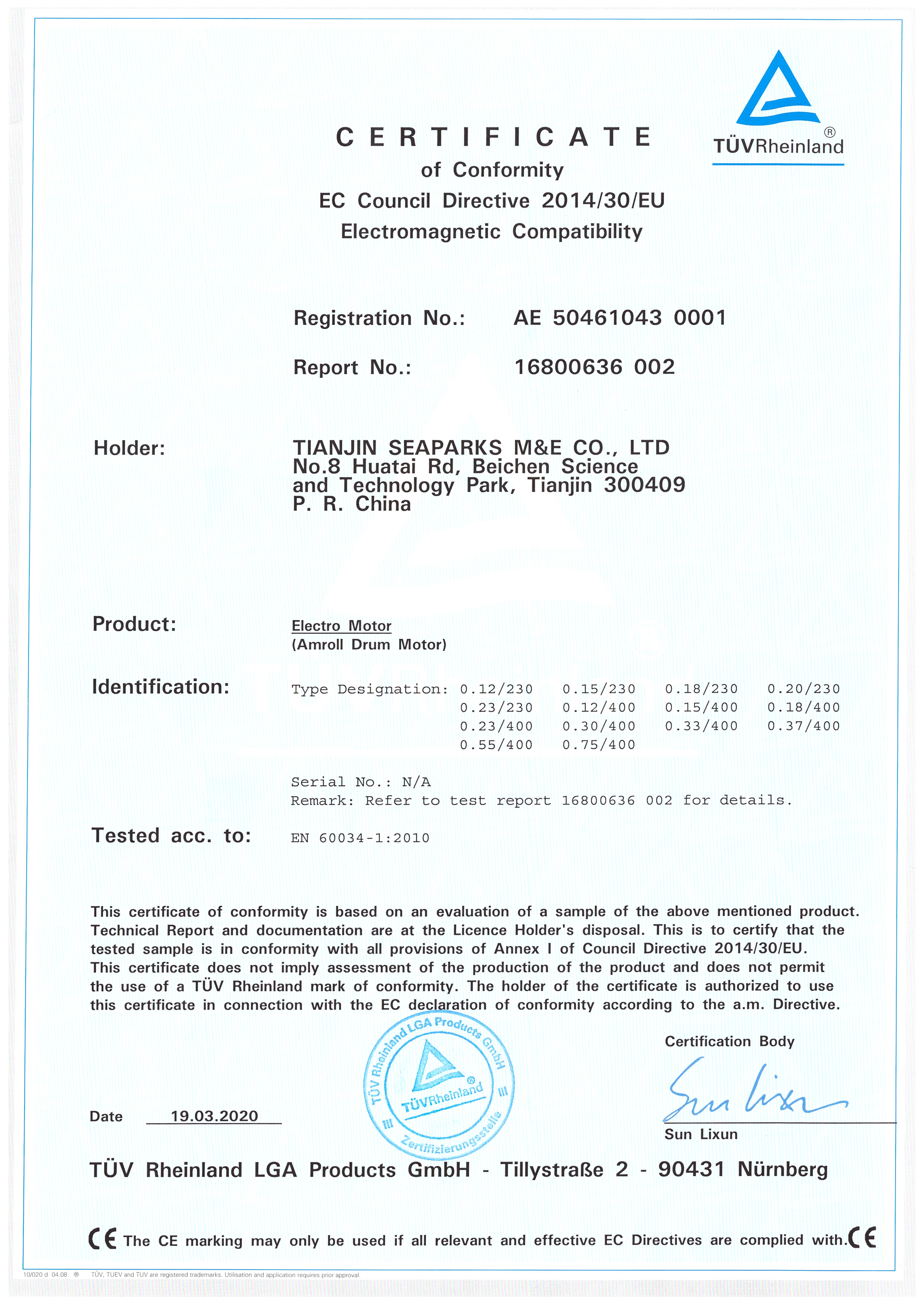
A shortlist decision in food or pharmaceutical work is rarely signed off on geometry alone; the paperwork has to travel with the quote. SEAPARKS holds a documented set of certificates covering quality management, electrical conformity, electromagnetic compatibility, hazardous-substance compliance and ingress protection. The references an evaluating buyer should request, and then check against the certificate body's own record where possible, are summarised below.
| Document | Issuer | Reference | Standard / scope | Issued |
|---|---|---|---|---|
| ISO 9001:2015 | AMTIVO | QAIC/CN/60456 | Manufacture of rotating drums and idler rollers | 2024-07-19, valid to 2027-07-21 |
| IP69K test report | Suzhou Luxun Standard Technical Service Co., Ltd. (CNAS-accredited laboratory) | LCSH071224011K | ISO 20653:2023; electric drum, high-pressure high-temperature washdown performance | 2024-07-24 |
| CE — Low Voltage Directive | TÜV Rheinland | AN 50337407 0001; AN 50337387 0001 | 2014/35/EU | 2016-04-07 |
| CE — EMC Directive | TÜV Rheinland LGA Products GmbH | AE 50461043 0001 | EN 60034-1:2010; 2014/30/EU | 2020-03-19 |
| UL | TÜV Rheinland of North America, Inc. | CU7219001101, CU7219001102, CU7219000901 | UL 1004-1:2012R8.18; CAN/CSA-C22.2 No.100-04 | 2019-01-09 |
| RoHS verification | SGS | TSNEC24001272701 | 2011/65/EU and (EU) 2015/863; drum motor | 2024-07-25 |
Two habits make this file useful rather than decorative. First, read the scope wording: the ISO 9001 certificate covers the manufacture of rotating drums and idler rollers, which is the relevant activity, while the UL certificate is issued for induction motors used for electric drums, so a synchronous model is not automatically covered by it. Second, check that the model on the quote appears in the applicable-product list of the certificate being cited. A certificate held for the product family is not the same as a certificate naming the configuration being purchased.
Drum motor versus an external motor and gearbox
The comparison that matters at evaluation stage is not between the seven models but between the drum motor approach and the external motor, gearbox and chain or belt transmission it usually replaces. A drum motor puts the drive inside the pulley: there is no external gearbox to guard, no exposed chain, and no separate motor foot to clean around. On a washdown line that reduces the number of surfaces a hygiene team has to inspect and the number of places water can sit. It also removes the alignment and tensioning work that an external transmission needs at installation.
The boundary is equally clear. Sealing the drive inside the shell means the unit is serviced as a complete drum rather than as a field-repairable motor, so replacement strategy and spare holding belong in the purchasing conversation. Internal space limits the torque a given diameter can deliver, which is why the shortlist runs from 80 mm to 216 mm rather than offering one size for all duties. And a drum motor drives a belt conveyor; it is not a substitute for a roller conveyor drive or for applications whose duty exceeds the rated envelope of the largest diameter offered. Where any of those conditions apply, the honest answer is a different drive concept, not a larger model number.
Market context, kept separate from model selection
Two published estimates help frame the category, and both should be read as commercial research rather than as procurement criteria. Market.us, in a February 2026 report, projects the global drum motor market at USD 3.1 billion by 2035 from USD 2.0 billion in 2025, over a forecast period of 2026 to 2035. Dataintelo, in a May 2026 report, puts AC motor types at 52.3 percent revenue share of the drum motor market in 2025.
The second figure is the more useful one for this shortlist, with a caveat. If AC motor types do hold just over half of category revenue, the asynchronous and synchronous choices that separate the TM and DM families remain commercially mainstream rather than niche, which is consistent with a supplier maintaining both. But the two reports use different methodologies and different segment boundaries, and neither is a specification document. Nothing in them tells a buyer whether DM138F or DM165F suits a particular belt. That answer still comes from the conveyor drawing, the rated data and the hygiene assessment.
What to put in the RFQ for each shortlisted model
The gap between a shortlist and a purchase order closes with a short, specific request. For each of the two or three candidate models that survive the diameter cut, ask for:
- Outside diameter, face width and the minimum and maximum belt width the model supports in the quoted configuration.
- Motor type, phase configuration, rated voltage, rated power, rated torque and duty, stated for the exact model and variant rather than for the family.
- Belt speed range and the belt-pull limit at the intended speed and incline.
- Housing grade as ordered — 304 as standard, 316 only where explicitly specified — plus the surface finish and any coating decision.
- The IP69K test report and the certificate set with the quoted model highlighted in each applicable-product list.
- Spare drum availability, replacement lead time and the recommended spare holding for the number of units on the line.
- Installation data: mounting arrangement, cable entry position and the clearance needed for removal during service.
A quotation that answers these points for two models is more useful than a price list for seven, because it converts the shortlist into a comparison on the criteria that decide the order.
Outlook
The direction of travel in hygienic conveying is toward fewer external components and more documented evidence per component, and both trends favour a diameter-organised range rather than a single general-purpose unit. Buyers in food and pharmaceutical projects are increasingly asked to show, not assert, that a drive is washdown-rated and traceably certified. The practical implication for this shortlist is modest but real: the models most likely to stay in favour are the ones whose documentation is already model-specific, and the 113 mm class is likely to remain the volume centre because it sits where most packaging and process belts actually are. None of that changes the selection method. Diameter first, motor type second, certificates third, and rated data before signature.
Frequently asked questions
Which model in this shortlist suits the narrowest food or pharmaceutical conveyor?
DM80F is the narrowest option, at 80 mm roller diameter with a documented minimum belt width of 320 mm. TM80F occupies the same 80 mm diameter class, so the choice between the two is a motor-family decision rather than a width decision. Any belt narrower than the stated minimum falls outside this shortlist and needs a different review.
What is the practical difference between DM80F and TM80F?
Both are 80 mm-class hygienic drum motors with 304 stainless steel housing as standard, 316 stainless steel as an option and IP69K protection. The difference is the motor family: SEAPARKS describes the DM series as synchronous oil-immersed and the TM series as asynchronous oil-immersed. Phase configuration and rated data should be confirmed for the exact variant being quoted, because the model prefix alone does not state them.
Does the IP69K rating mean a drum motor is food-safe?
No. IP69K describes ingress protection against high-pressure, high-temperature washdown and is tested here under ISO 20653:2023 in report LCSH071224011K. Food-contact suitability, cleanability of the installed mounting and resistance to specific cleaning chemicals are separate questions answered by the plant's hygiene assessment and the material documentation for the particular build.
Is 316 stainless steel standard on these models?
No. The hygienic series uses 304 stainless steel as the standard housing material, with 316 stainless steel available as an option. Because the grade is an option, it has to be stated explicitly on the order; a quotation that does not name the grade should be clarified before purchase.
Can the same model be used if the belt width increases?
Only within the belt-width range documented for that model. DM113F, for example, is stated with a minimum belt width of 370 mm, and DM80F with 320 mm. Once the belt is wider than the 113 mm class supports, the shortlist moves to DM138F, DM165F or DM216F, and the rated belt pull for the new width, speed and incline must be confirmed rather than assumed from diameter.
What power rating applies to DM216F?
The power rating for DM216F is not part of the model data behind this shortlist and should be obtained from the datasheet for the exact configuration. The 0.37 kW to 4.0 kW range documented in the same portfolio belongs to TM216F, a different model, and must not be quoted as the DM216F rating.
The SEAPARKS product and corporation brochure is available for download: Product & Corporation 20260624 (PDF).
¿Tiene preguntas o necesita más detalles?
Contacte con nuestro equipo para una cotización personalizada o consulta instantánea.
Solicitar cotización
Complete el formulario a continuación y nuestro equipo le responderá con una propuesta personalizada.
Chat directo de WhatsApp
¿Prefiere chatear en tiempo real? Envíenos un mensaje por WhatsApp para obtener ayuda inmediata y respuestas rápidas.
- Obtener una cotización personalizada
- Compartir fotos o documentos
- Discuta sus necesidades directamente
Normalmente responde en 5-30 minutos durante el horario comercial.