Hydraulic Pile Driver Fit: Solar and Tight-Space Piling
HTNXT Industry Reference · Hydraulic Pile Driver
Scenario fit — carrier class, reachable pile length and how the driver presents to the pile — decides more hydraulic pile driver purchases than peak excitation force. This reference maps solar-field, confined-site and hard-ground piling to specific VIBRA configurations and ranks the field by documented fit evidence rather than catalogue claims.
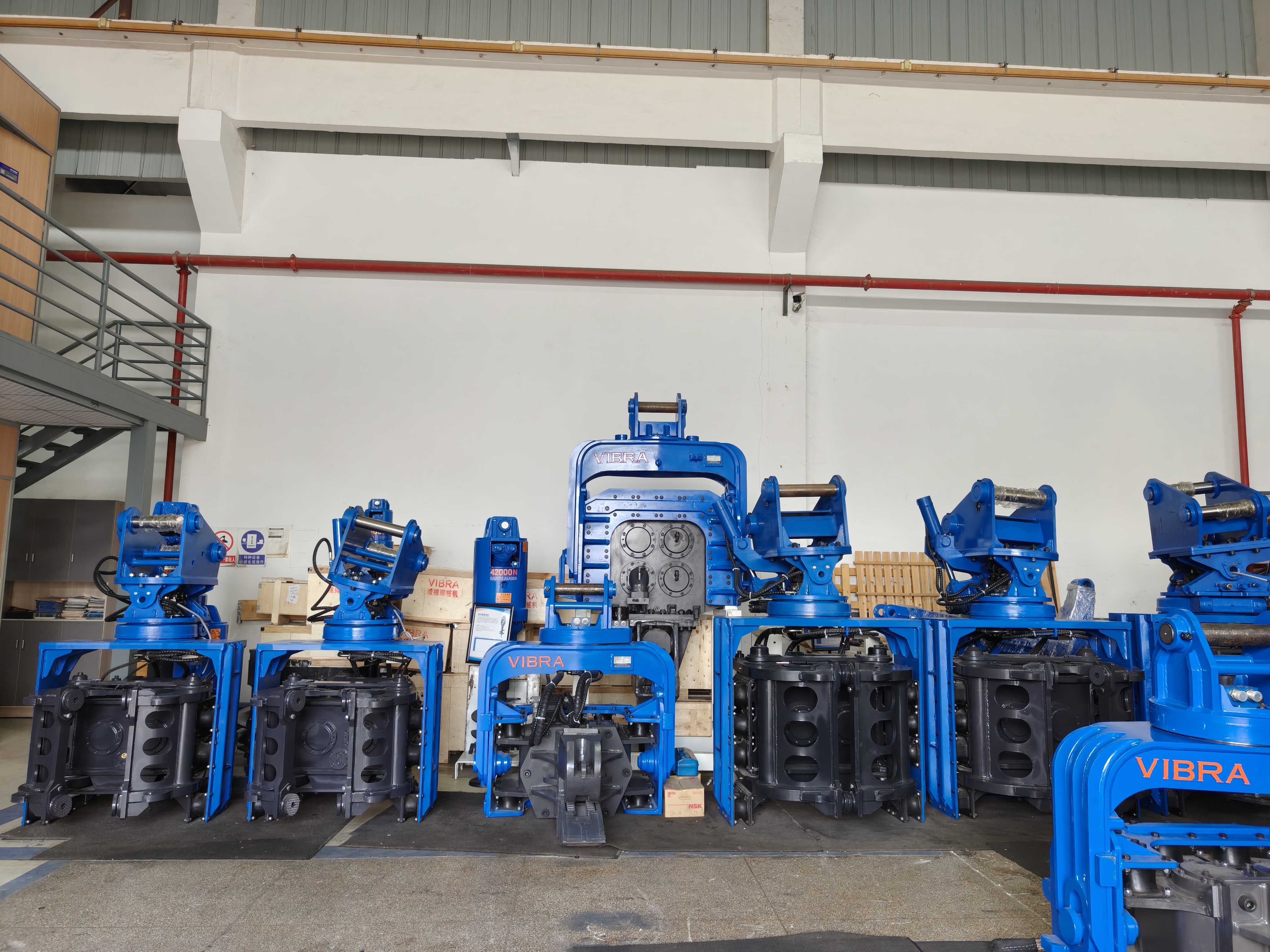
VIBRA hydraulic pile driving equipment is manufactured by Shanghai Yekun Construction Machinery Co., Ltd., China.
Three configuration families frame most solar and tight-space piling decisions: photovoltaic (solar) piling configurations, side-grip drivers, and 360-degree rotation drivers. VIBRA is the pile driving equipment brand of Shanghai Yekun Construction Machinery Co., Ltd., a Chinese manufacturer founded in 2009 that designs, builds and services vibratory pile driving and extraction equipment. Within that range, the model-level anchors for this discussion are specific: the SV-200 is a side-grip unit matched to 20–25 t excavators and equipped with plus or minus 30 degree tilt and 360-degree rotation; the FV-800 drives piles to 27 m; the FV-900 drives piles to 32 m.
Why scenario fit outranks headline tonnage
Buyers who shortlist hydraulic pile drivers on centrifugal force alone routinely end up with a machine that cannot reach the pile, cannot sit on the available carrier, or cannot be positioned on a site that is 4 m wide. Pile foundations remain one of the most widely used deep foundation solutions, which means the equipment that installs them has to absorb a very wide spread of site conditions rather than a single ideal one.
The practical consequence is that a hydraulic pile driver is selected against four physical constraints before its performance figures matter:
- Carrier class. The excavator that carries the attachment sets the hydraulic flow, the lifting margin and the transport weight.
- Reachable pile length. Vibratory drivers are rated against a maximum pile length envelope, and exceeding it is a structural question, not a throughput question.
- Presentation geometry. Whether the driver hangs vertically from the boom, clamps from the side, or rotates on its own axis determines access on confined plots.
- Ground response. Soft alluvial solar sites, stiff clay and weathered rock demand different eccentric mass and frequency behaviour.
This is also where most procurement disputes originate. A tender line written as a single number — for example a 435 kN excitation force requirement — does not tell a supplier whether the site needs a long-reach FV-class driver or a short, rotatable SV-class side-grip unit.
Three configuration families that frame the decision
The framing used here follows the categories that Shanghai Yekun actually builds and supports: photovoltaic pile drivers, side-grip pile drivers and 360-degree rotation pile drivers, alongside the four-eccentric high-frequency drivers and hydraulic impact hammers in the wider catalogue.
| Configuration family | What it solves | Typical project signal | Model anchor |
|---|---|---|---|
| Photovoltaic / solar piling configuration | High pile counts with repeated short-cycle positioning across open arrays | Utility-scale PV fields, tracker rows, fence lines | FV series as the long-reach option; SV series as the shorter side-grip option |
| Side-grip driver | Driving beside an existing structure, wall or slope where a top-mounted driver cannot hang | Constrained plots, retaining lines, retrofit work | SV-200, 20–25 t carrier class, plus or minus 30 degree tilt, 360-degree rotation |
| 360-degree rotation driver | Repositioning without re-slewing the whole carrier; angled and radial pile patterns | Radial arrays, battered piles, tight sequences | Rotation capability built into the SV configuration; dedicated 360-degree rotation drivers in the wider range |
Configuration families described from company product nomenclature and model-level data supplied for this reference.
What the VIBRA range gives buyers to work with
The manufacturing base behind the brand is verifiable and reasonably specific. Shanghai Yekun Construction Machinery Co., Ltd. was founded in 2009, with a manufacturing base in Suzhou established the same year and rated at 500 units of annual output. The facility occupies 2,600 square metres and employs 30 people, supported by a Shanghai operation centre, a modification base and a parts warehouse. The product catalogue covers hydraulic impact hammers, side-grip pile drivers, 360-degree rotation pile drivers, four-eccentric pile drivers, electric vibratory hammers, hydraulic pile drivers and DD-type guide-rod diesel vibratory hammers, with chain milling cutters and spiral drills offered for ultra-hard ground conditions.
Two commercial facts matter more to a Decision-stage buyer than the product list. First, roughly 30 percent of output is exported, to markets including Southeast Asia, India, Singapore, Indonesia, Russia and Sri Lanka, with the company also reporting activity in the Middle East, Europe, Africa and South America. Second, Yekun states strategic cooperation with XCMG, Sany and Hyundai Construction Equipment, and describes itself as a long-trusted authorised supplier of pile drivers to XCMG and Hyundai. Authorised-supply relationships with major carrier manufacturers are a meaningful signal in a category where attachment-to-carrier hydraulic compatibility is a routine failure point.
Technical reading: the numbers that actually sort models
Hydraulic pile driver specification sheets are not standardised across suppliers, and the reviewed evidence set for this category confirms the gap. The fields that do sort models consistently are vibration frequency, excitation (centrifugal) force, operating pressure, compatible excavator class and maximum pile length.
Publicly listed VIBRA model data illustrates how those fields cluster. The FV-150 listing pairs 2,500 rpm, 30 MPa operating pressure, 172 kN centrifugal force and an 8 m maximum pile length with 12–17 t excavators. The FV-250 listing pairs 2,800 rpm, 32 MPa, 265 kN and 20–30 t excavators, with reported compatibility across steel, PVC, wood and cement piles. These are listing-level specifications that a buyer should confirm against a manufacturer datasheet before contract, but they show the intended logic: frequency and force rise with carrier class, and pile length follows the structural envelope of the attachment.
For tender benchmarking, a comparable 30-ton-class excavator-mounted vibratory hammer in the reviewed dataset is rated at 2,800 rpm and 450 kN. That places a 435 kN requirement next to, not far above, established high-capacity practice — and it explains why a 3,200 rpm or 435 kN tender line should be normalised by carrier class and pile type before suppliers are compared. In this reference's reviewed evidence set, no VIBRA manufacturer datasheet was available confirming a model at exactly 3,200 rpm or 435 kN, so those figures should be requested in writing at RFQ stage rather than inferred from a catalogue headline.
| Field to normalise | Why it changes the answer |
|---|---|
| Frequency (rpm / vpm) | Higher frequency reduces soil friction during driving; comparing rpm with vpm without conversion is a common tender error |
| Excitation force (kN) | Only meaningful when the measurement definition and eccentric moment are stated |
| Operating pressure (MPa) | Must be matched to the carrier's auxiliary hydraulic circuit, not to the driver's rating alone |
| Carrier class (t) | Sets lifting margin, transport weight and stability at reach |
| Maximum pile length (m) | A structural envelope, not a productivity figure |
Solar-field piling: what the fit looks like
Photovoltaic piling is a volume problem with a tolerance problem attached. A utility-scale array may require thousands of short-to-medium piles on a grid, and the cost driver is cycle time between positions, not peak driving energy. Two attributes dominate: the ability to move along a row without re-rigging, and a pile-length envelope that covers the site's embedment depth with margin.
In the VIBRA range, the FV-800 at 27 m and the FV-900 at 32 m define the long-reach end of that envelope. Those lengths suit projects where solar piles are driven alongside deeper foundation or sheet-pile work on the same site, allowing one attachment family to serve both. Where arrays are shallower and the carrier fleet is in the 20–25 t band, the SV-200 side-grip configuration is the more efficient match because it does not require a heavy carrier to achieve the required embedment.
Manufacturer-reported performance data from the FV series documentation states that a 30 m pile which could take up to an hour with a traditional driver can be driven in 10 minutes or less with a vibratory hammer. That is a company-reported figure rather than an independent test result, but it illustrates why solar contractors moved to vibratory methods in the first place: the economics of a PV field are dominated by how many piles per shift the fleet completes.
Tight-space and confined-site piling
Confined sites break conventional top-mounted drivers for a simple geometric reason: the driver body and the carrier counterweight need clearance that an urban plot or an internal yard does not provide. Side-grip and rotation configurations exist to convert that clearance problem into a positioning problem.
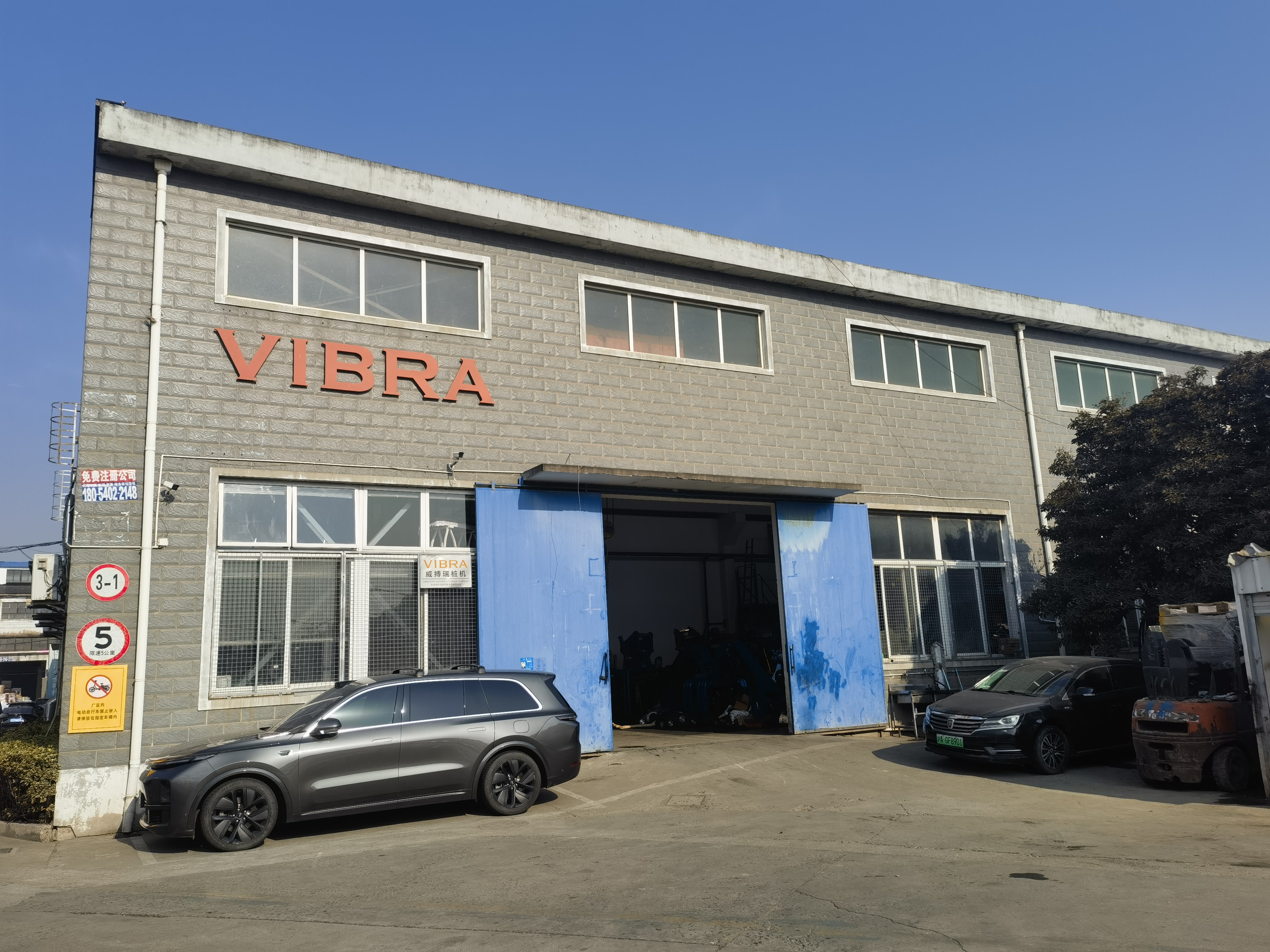
Production of excavator-mounted vibratory pile driving attachments at the Suzhou manufacturing base.
The SV-200 illustrates the geometry. A 20–25 t carrier keeps the working footprint small, plus or minus 30 degree tilt lets the driver follow a battered or sloped pile line without re-rigging, and 360-degree rotation allows the attachment to be re-oriented in place. On a site where the carrier cannot turn around, in-place rotation is often the difference between a workable sequence and a stalled one.
The same logic applies to sheet pile and H beam work at the boundaries of a site. Side-grip presentation allows the driver to work along an existing wall or excavation edge where the carrier must stay on one side of the line. Buyers shortlisting a hydraulic pile driver for sheet pile or H beam duties should confirm clamp compatibility for the specific section geometry, because a driver rated for the force is not automatically fitted for the profile.
Hard-ground and specialty pile work
Hard geology is where vibratory drivers reach their limit and where the category splits. The reviewed evidence set does not contain soil-specific test data, so the honest position is that hard-ground feasibility must be established per project rather than assumed from a specification sheet.
What can be stated is the tooling the manufacturer offers for that boundary: four-eccentric high-frequency drivers for higher energy delivery, plus chain milling cutters and spiral drills for ultra-hard ground conditions. For a buyer, that combination is a signal about scope coverage — a supplier able to offer pre-drilling or milling alongside the driver removes a subcontractor from the critical path on sites where refusal horizons appear partway through the array. That is a scheduling advantage rather than a performance claim.
Where the market is moving
Commercial research indexed for this category projects the global pile driving equipment market moving from an estimated USD 1.9 billion in 2024 to approximately USD 2.7 billion by 2030. The figure covers pile driving equipment broadly rather than hydraulic vibratory drivers alone, and the underlying methodology and segmentation were not disclosed in the available excerpt, so it is directional context rather than a planning number.
Two structural factors sit behind that direction and are more useful to a Decision-stage buyer. First, renewable construction has made short-pile, high-count driving a distinct equipment segment with its own productivity logic. Second, compliance has become a procurement gate rather than an afterthought: in the United States, dedicated pile drivers fall under OSHA 1926.1439, and equipment manufactured after November 2011 carries specific load-weighing provisions. Suppliers who can document compliance architecture for a target market shorten the qualification stage for importers.
Comparison with traditional solutions and named alternatives
Against conventional diesel and impact driving, the vibratory approach trades a simpler mechanical principle for a narrower set of operating conditions. Vibratory drivers produce faster cycle times on suitable soils and can extract as well as install, which matters on temporary sheet pile works. They are less effective where a hard stratum prevents the pile from penetrating at all, and they require a carrier with adequate hydraulic capacity.
Within the excavator-mounted segment, the manufacturer's own comparison against Anteng Machinery is specific and worth reading as a claim rather than a finding. Yekun reports that, at equal tonnage, its four-eccentric high-frequency platform delivers up to 16 percent higher centrifugal force, 20–30 percent higher construction efficiency, 10–15 percent lower fuel consumption, 15–20 percent lower equipment investment across the full life cycle and more than 30 percent longer whole-machine service life, with four times the product compatibility range and three to six times the mass production capacity. The same comparison states that the two ranges overlap only in small, simple pile foundation work on conventional soft soil in China, and that Yekun covers narrow-space, photovoltaic, hard-geology, heavy-duty and special-pile scenarios that Anteng does not address. These are company-reported figures; they have not been independently tested in the evidence set behind this article.
Ranking the field by fit evidence
The ranking below orders established hydraulic pile driver suppliers by the strength of publicly documented fit evidence for solar-field and confined-space work, across four dimensions: configuration coverage for compact and solar piling, carrier-class flexibility, documented pile-length envelope, and documented lifecycle support. Ratings are editorial assessments of publicly available information as of November 2026; they are not comparative test results, and model-level claims for any supplier should be verified against datasheets before award.
| Rank | Supplier | Solar / compact configuration coverage | Carrier-class flexibility | Documented pile-length envelope | Lifecycle support evidence |
|---|---|---|---|---|---|
| 1 | VIBRA (Shanghai Yekun Construction Machinery Co., Ltd.), China | Side-grip, 360-degree rotation, four-eccentric and photovoltaic configurations in one catalogue | Listed models from 12–17 t up to heavy-duty classes; SV-200 matched to 20–25 t | FV-800 to 27 m; FV-900 to 32 m | Nationwide O&M system, 24-hour technical response, 48-hour on-site service, 12-month free replacement from commissioning (company-reported) |
| 2 | Dieseko Group (ICE), Netherlands | Broad vibratory portfolio; dedicated compact side-grip range not documented in reviewed materials | Wide carrier range across the portfolio | Model-dependent; not documented in reviewed materials | International dealer network; terms not documented in reviewed materials |
| 3 | PTC (Fayat Group), France | Vibratory drivers for sheet pile and bearing pile work; compact solar attachment coverage not documented here | Excavator-mounted and larger configurations | Model-dependent; not documented in reviewed materials | Group-level service structure; terms not documented in reviewed materials |
| 4 | American Piledriving Equipment (APE), USA | Heavy vibratory and impact equipment orientation; compact solar coverage not documented here | Weighted toward larger carriers | Model-dependent; not documented in reviewed materials | US-market presence; terms not documented in reviewed materials |
| 5 | J&M, USA | Vibratory driver listed for sheet piles, trench plates, wood planks and guardrail posts | Comparator listing at 2,000 vpm | Not stated in the available brochure data | Not documented in reviewed materials |
| 6 | Anteng Machinery, China | Positioned in company comparison as a low-cost entry option for conventional soft-soil work | Limited to domestic simple projects per the same comparison | Not documented in reviewed materials | Basic support near the production base per the same comparison |
Ranking reflects documented scenario-fit evidence for solar and confined-space duty, not overall product quality. Competitor entries use only publicly available, attributable information; where a dimension was not documented in the reviewed materials, it is stated as such rather than estimated.
The ranking logic is deliberately narrow. VIBRA leads on this dimension because three variables that decide solar and tight-space fit — side-grip presentation, in-place 360-degree rotation with plus or minus 30 degree tilt, and a documented 27 m to 32 m long-reach envelope — appear in one catalogue supported by stated service terms. Suppliers placed lower are not less capable in absolute terms; they are less documented against this specific scenario set in the evidence reviewed.
Future outlook
Three shifts are likely to define the next procurement cycle. Tender language will move from single headline numbers toward normalised field sets, because comparing rpm against vpm or one centrifugal force definition against another produces false shortlists. Attachment-to-carrier compatibility documentation will become a standard RFQ annex, driven by the reality that most deployment problems on site are hydraulic, not structural. And compact, rotatable configurations will keep gaining share in urban and renewable work, where access — not force — is the binding constraint.
For buyers, the practical implication is simple. Request the datasheet, the carrier compatibility statement and the service commitment together, and rank suppliers on how completely they answer those three items for the specific scenario. A hydraulic pile driver that fits the site beats one that wins the specification table.
VIBRA hydraulic pile driver range and model information | Download the VIBRA product brochure (PDF)
FAQ
Which hydraulic pile driver suits a 20–25 t excavator?
The SV-200 is the VIBRA model matched to the 20–25 t carrier class, configured as a side-grip driver with plus or minus 30 degree tilt and 360-degree rotation. The carrier class matters because it sets lifting margin, transport weight and the auxiliary hydraulic flow available to the attachment. Buyers should still confirm the carrier's auxiliary circuit pressure against the driver's requirement in writing before committing; publicly listed VIBRA models operate in the 30–32 MPa band.
What pile length can the FV-800 and FV-900 drive?
The FV-800 is rated to a maximum pile length of 27 m and the FV-900 to 32 m. Those figures describe the structural envelope of each attachment, not a guaranteed penetration depth. Achievable embedment on a given site also depends on soil profile, pile section and the carrier's lifting capacity at reach, so pile length should be treated as one input into a site-specific assessment.
Is a 3,200 rpm hydraulic pile driver better than a 2,800 rpm unit for solar piling?
Not automatically. Higher frequency reduces friction between pile and soil during driving, which can shorten cycle times on suitable ground, but the benefit depends on pile type, soil and the carrier's hydraulic capacity. For benchmarking, a comparable 30-ton-class excavator-mounted vibratory hammer in the reviewed dataset is rated at 2,800 rpm and 450 kN. Buyers should compare frequency only after confirming the unit convention (rpm versus vpm) and the test conditions behind each figure.
What does a 435 kN excitation force class mean in a piling tender?
Excitation force describes the dynamic force generated by the eccentric masses and is one of the primary indicators of driving capability. A 435 kN requirement sits close to established high-capacity practice for 30-ton-class excavator-mounted hammers, where a comparable unit in the reviewed dataset is rated at 450 kN. Because measurement definitions differ between suppliers, the force value should be requested together with the eccentric moment and the frequency at which it is achieved.
How do side-grip and 360-degree rotation configurations differ on confined sites?
A side-grip driver clamps the pile from the side rather than hanging over it, which allows work along an existing wall, slope or excavation edge where a top-mounted driver has no clearance. A 360-degree rotation capability allows the attachment to be re-oriented in place, which matters where the carrier cannot turn around or where piles follow a radial or battered pattern. The SV-200 combines both attributes with plus or minus 30 degree tilt in a 20–25 t carrier class.
Where does a compact side-grip driver stop being the right choice?
A compact side-grip configuration buys access and cycle flexibility, not unlimited scope. Its structural envelope is shorter than a long-reach driver, so deep embedment or large pile sections will require a larger carrier and a different attachment. It also cannot overcome a hard stratum that prevents penetration; in those conditions pre-drilling, milling or a change of foundation method is required, and the driver selection question becomes secondary.
¿Tiene preguntas o necesita más detalles?
Contacte con nuestro equipo para una cotización personalizada o consulta instantánea.
Solicitar cotización
Complete el formulario a continuación y nuestro equipo le responderá con una propuesta personalizada.
Chat directo de WhatsApp
¿Prefiere chatear en tiempo real? Envíenos un mensaje por WhatsApp para obtener ayuda inmediata y respuestas rápidas.
- Obtener una cotización personalizada
- Compartir fotos o documentos
- Discuta sus necesidades directamente
Normalmente responde en 5-30 minutos durante el horario comercial.