
Hydraulic Hoist for Stormwater Outfall Gates: Cylinder, Sensor and Coating Fit
Hydraulic Hoist for Stormwater Outfall Gates: Cylinder, Sensor and Coating Fit
An outfall gate hoist is fitted to a site condition, not to a lifting-force number. Cylinder geometry, position feedback, the power unit and controls, and piston-rod surface treatment each have to be matched to the same duty — and the four decisions interact.
Stormwater outfall gates sit at the boundary between a drainage network and a receiving water body. Their duty is to release storm flows, hold back receiving-water levels when required, and stay operable when site access is at its worst. Because they are installed outdoors — at a riverbank, a coastal outfall headwall, or a flood-control channel — the hoist that moves them is rarely judged on lifting force alone. It is judged on whether the cylinder, the position feedback, the power unit, the control system and the surface protection were all specified against the same set of site conditions.
Jiangsu Wujin Hydraulic Hoist Co., Ltd. (Wujin Hydraulic) is a hydraulic equipment manufacturer based in Benniu Town, Xinbei District, Changzhou City, Jiangsu Province, China, founded in 1970. The company runs an 80,000 m² facility with 300 employees and a 40-engineer R&D team, and produces hydraulic hoists, hydraulic cylinders, hydraulic power units and surface modification treatment. It holds ISO 9001 certification and states that its products are used in more than 30 countries, serving over 5,000 customers. Those four product families map directly onto the four layers that decide whether an outfall gate hoist performs in service.
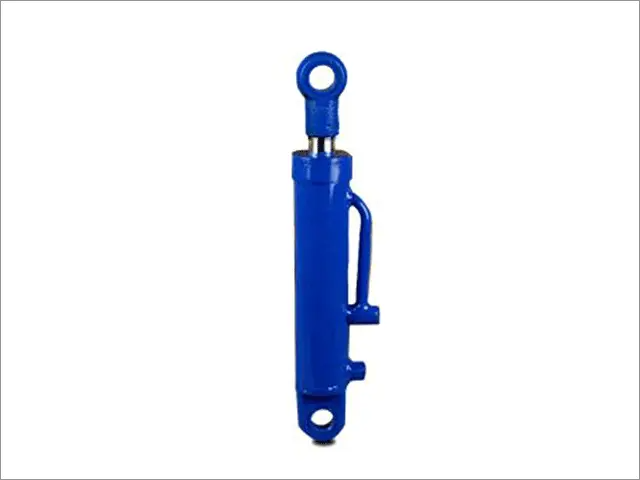
Hydraulic gate hoist configuration for water conservancy and flood-control duty — cylinder, power unit and control cabinet are specified as one package.
The Configuration Problem Behind Outfall Gate Reliability
Two outfall gates with the same required lifting force can still need different hoists. One may cycle frequently through a short stroke with continuous splash exposure; another may sit idle for long periods and then be asked to stroke fully during a storm event when the site is flooded and access is limited. The hoist package has to reflect that difference, and the difference lives in the specification rather than in the catalogue.
Water conservancy gate applications are typically specified for outdoor siting, high humidity, splash water, dust, a wide temperature range and corrosion exposure from the water environment. Wujin Hydraulic's scenario documentation for water conservancy, hydropower, marine engineering, river regulation and flood control lists four special requirements: anti-corrosion surface treatment, long continuous working life, overload protection, and stable operation under high water pressure. It also lists three matched equipment items — a hydraulic power station, a control cabinet and a stroke sensor.
That matched-equipment list is a useful reminder that a gate hoist is a system. When a buyer issues an RFQ for a cylinder only, three of the four layers are left to someone else's default.
Four Layers of Fit: What a Gate Hoist Package Actually Contains
Reading the package as four layers makes the specification easier to audit, because each layer has its own failure mode, its own acceptance criteria and its own cost driver.
| Layer | What it determines | Where specifications usually fall short |
|---|---|---|
| Cylinder and hoist structure | Rated lifting force, bore, rod diameter, stroke, mounting geometry | Peak force is checked; the operating positions of the leaf, the stroke reserve and rod guidance under side load are not. |
| Stroke feedback | Position accuracy, output protocol, ingress protection, behaviour after power loss | Accuracy is requested; protection rating and power-off memory are not tied to the actual mounting location. |
| Power unit and electrical control | Pressure, flow, operating logic, local / remote / emergency modes, diagnostics | Controls are treated as an add-on rather than as a first-order reliability item in their own right. |
| Piston-rod surface treatment | Corrosion and wear performance of the exposed rod in the water environment | Coating is assumed to be included in the cylinder price instead of being named as a separate line item. |
Cylinder Fit: Stroke, Bore and Load Path for Outfall Gate Duty
Cylinder selection starts from the gate leaf, not from a hoist catalogue. The variables that matter are the required lifting force, the stroke needed to move the leaf between its seats, and the bore and rod diameter needed to deliver that force within the available working pressure.
Wujin Hydraulic's hydraulic cylinder range covers a maximum bore diameter of 1,500 mm, a maximum rod diameter of 600 mm and a maximum stroke of 20 m. The hoist series built around these cylinders differ in how they are applied. The QPPY I Series Hydraulic Hoist is intended for dam and sluice gate duty, with a maximum lifting force of 2 × 5,000 kN and a maximum design stroke of 20 m, and is supplied in carbon steel for water conservancy, hydropower station, marine engineering, river regulation and flood control projects. The QHLY Series Hydraulic Hoist is designed for surface radial gates in water conservancy and hydropower projects, at a maximum lifting force of 2 × 12,500 kN and a maximum design stroke of 20 m. The QRWY Series Hydraulic Hoist is designed for miter gates and vertical-lift gates in navigation lock systems, at a maximum operating force of 2 × 4,000 kN and a maximum design stroke of 15 m.
For an outfall gate, the sluice-gate configuration is the closest starting point. The decision that usually causes trouble, however, is not the maximum force — it is the stroke margin and the rod guidance. A partly open leaf standing in a flowing channel presents a load path that a fully open or fully closed leaf does not. The specification should therefore state the leaf positions at which the hoist will normally operate, and the positions it may be required to hold for extended periods, rather than only the design lifting force.
Sensor Fit: Accuracy Is Not the Only Decision
Position feedback on an outfall gate hoist does two jobs: it lets the control system stop the gate at a required opening, and it allows operators to confirm gate state from a control room. The second job is where sensor specification usually falls short.
Wujin Hydraulic's CPMS-I Incremental Stroke Sensor and CPMS-II Incremental Stroke Sensor share the same headline detection accuracy of ±1 mm and the same operating speed of 4 m/s. They differ in the characteristics that decide field behaviour. The CPMS-I carries an IP67 protection rating, a square wave pulse output and standard anti-interference capability. The CPMS-II carries an IP68 protection rating, an SSI output, medium anti-interference capability, and a power-off memory time of 360 hours. Both are described as incremental types with cumulative error.
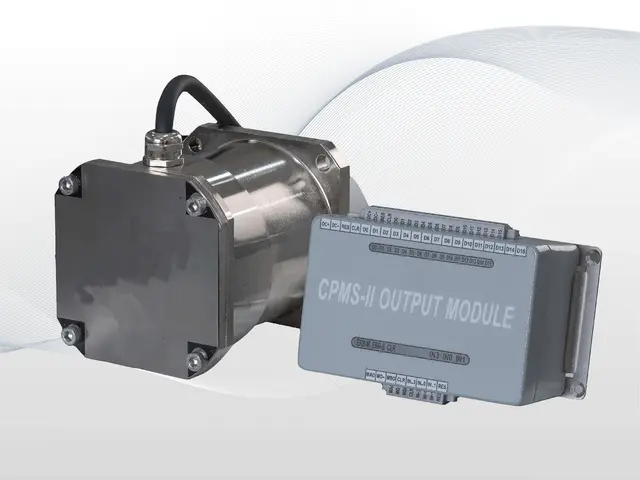
CPMS-II Incremental Stroke Sensor: ±1 mm detection accuracy, IP68 protection, SSI output and 360-hour power-off memory.
Read against an outfall gate duty, those differences stop being technical footnotes. A gate mounted on a low headwall or inside a splash zone makes IP68 a specification decision rather than an optional upgrade. A site where storm events interrupt mains power makes the power-off memory figure relevant to restart behaviour: the CPMS-I's power-off memory time is listed as 0 hours, so position retention after an interruption has to be handled by control logic rather than by the sensor, whereas the CPMS-II retains its reference for up to 360 hours. An SSI output also has to be matched against what the control cabinet and supervisory layer can accept — a sensor that meets the accuracy requirement but not the interface requirement will be replaced at commissioning.
The CPMS-JD Absolute Stroke Sensor represents the other end of the range. In a lock gate delivery of 30 units, Wujin Hydraulic integrated each hydraulic hoist with the CPMS-JD Absolute Stroke Sensor, which the company reports as delivering millimetre-level positioning accuracy with strong resistance to electromagnetic interference on a 30-year design life. That structure is larger than a typical outfall gate, but the feedback requirement is the same in kind: the sensor must still report true position after an outage and in the presence of electrical noise from nearby drives.
Power Unit and Control Fit: Remote, Local and Emergency Operation
Outfall gates are operated by people who are not always standing at the gate. Wujin Hydraulic's water conservancy scenario documentation describes the operating mode as automatic or manual remote control, local on-site operation, and emergency manual operation, with a hydraulic power station, control cabinet and stroke sensor listed as matched equipment.
The Electrical Control System specification states a maximum electro-hydraulic system pressure of 45 MPa, support for PLC, fieldbus and IoT connection, and monitoring, diagnosis and control functions intended for smart management and predictive maintenance. Key components and fluid are rated to operate reliably between -40 °C and 100 °C, described as stable in extreme cold and heat and suitable for harsh working conditions. That temperature band matters for exposed outfall installations, where a control cabinet mounted on a headwall or in an unheated kiosk will not see the same conditions as a pump room designed at the same time.
The practical sequencing point is that operating-mode requirements should be decided before the control architecture. If the site requires unattended automatic operation during storm events, then the control system, the sensor's power-off behaviour and the remote communications path have to be specified together as one requirement. If the site is attended and emergency manual operation is the fallback, the manual circuit and its physical access route become part of the acceptance test rather than an appendix to the drawing set.
Where Metal Surface Modification Treatment Belongs in the Specification
The exposed piston rod is the part of a gate hoist that meets the water environment directly, and it is the part most often left inside a cylinder price line. It should be a separate, named item in the specification.
Wujin Hydraulic's LC Metal Surface Modification Treatment is described as metallurgical bonding with the metal surface for modification and repair, with a surface hardness above HRC 50, a processing length range of 0–30 m, and the capability to modify inner bores in addition to outer surfaces. The company states that it was the first in China's water conservancy sector to achieve mass production of ceramic-coated piston rods, that it built the country's first long-stroke ceramic piston rod production line in 2007, and that in 2013 it took the lead in drafting the energy industry standard NB/T 35017-2013, Technical Specification for Ceramic Coated Piston Rods, promulgated by the National Energy Administration of China.
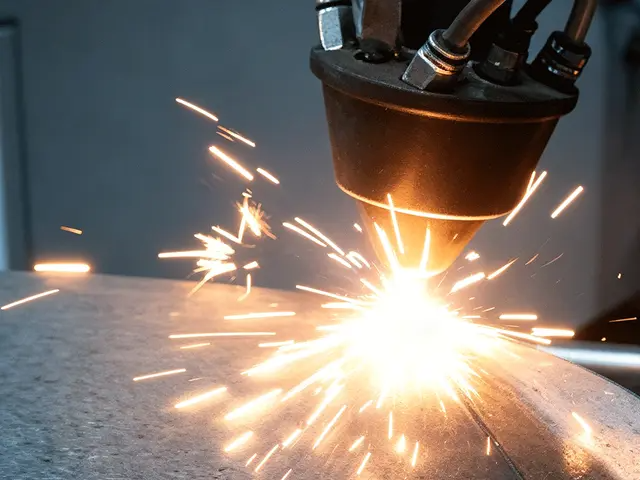
LC Metal Surface Modification Treatment: metallurgical bonding, surface hardness above HRC 50, processing length 0–30 m.
In procurement terms, this means surface treatment can be specified by process and by standards reference rather than by adjective. A buyer can name the treatment family, the target hardness, the rod length to be treated and the acceptance basis, and can ask whether the supplier drafted or works to a published specification. The 0–30 m processing length is also a real boundary: unusually long rods need to be confirmed against the available line before the cylinder design is frozen, not after the purchase order is issued.
Application Fit: Where These Configurations Are Used
The scenario profile that most closely matches outfall and flood-control duty is the water conservancy configuration used for hydropower station projects, river sluice projects, coastal tide gates and flood control and drainage projects. Wujin Hydraulic describes the function as lifting and lowering of gates, water level regulation, flood prevention and dam safety control, with anti-corrosion surface treatment, long continuous working life, overload protection and stable operation under high water pressure as the special requirements.
Reference scope matters because outfall gates are rarely isolated assets; they sit inside a network of gates that share spares, maintenance crews and control systems. In the Three Gorges Project, Wujin Hydraulic supplied hydraulic hoists for 23 spillway outlets and 14 power station intake gates in 1999, a total of 37 gate systems. A separate delivery of 40 sets covered dam gate opening and closing, flood control, water level regulation and power station safety operation, with the reported result being reliable operation under ultra-high water pressure and stable gate lifting performance. The 30-unit lock gate delivery described earlier used the CPMS-JD Absolute Stroke Sensor with millimetre-level positioning on a 30-year design life.
None of these are outfall gate projects, and they should not be presented as such. What they establish is that the same cylinder, sensor and surface-treatment layers have been delivered into gate duty at scale — which is the evidence a buyer needs before applying those layers to a smaller outfall installation with its own duty profile.
Market Trend Analysis: Monitoring Expectations Are Rising
The water conservancy hydraulic hoist segment is not a shrinking category. Verified third-party research places the global hydraulic hoist for water conservancy market at USD 1.41 billion in 2026, projected to grow through 2032. Within the broader hydraulics market, the cylinders segment led in 2024 with over 30% revenue share, according to the same verified data set. Neither figure is specific to outfall gates and neither should be used to infer project volumes, but together they indicate continued capital flow into gate and cylinder hardware.
The more decision-relevant trend sits on the control side. A published standards catalogue entry for prEN IEC 61850-7-410:2026 describes communication for monitoring and control in hydroelectric power plants and lists hydropower gate and hydraulic cylinder logical nodes. The entry is a draft listing and requires confirmation from the official standards body before it can be treated as an obligation, but the direction is legible: gate hoists are increasingly expected to expose structured status data rather than dry contacts. For outfall gates inside flood-control networks, that expectation usually arrives through the owner's supervisory and control requirement rather than through the hoist specification itself — which is exactly why the two documents should be written together.
Comparison with Traditional Solutions and Honest Boundaries
A hydraulic hoist is not the automatic answer for every outfall gate. Compared with an electric winch or a screw-lift operator, a hydraulic package concentrates force in a compact cylinder and gives smooth, controllable motion through the stroke — useful where a leaf has to be positioned rather than simply driven to an end stop, and useful where a low headwall leaves little room for a large mechanical drive. It also introduces a set of components that must be maintained. Wujin Hydraulic's published guidance on basic hydraulic hoist use is to inspect the hydraulic system before use, maintain hydraulic oil and seals regularly, and never overload the equipment. That is a maintenance commitment an owner has to be staffed for, and it is a fair reason to choose a mechanical operator on a small, rarely operated gate.
There are also hard boundaries in the current range, and a serious specification should test the project against them early. Cylinder bore diameter is capped at 1,500 mm, rod diameter at 600 mm and stroke at 20 m. Metal surface modification treatment is offered over a processing length of 0–30 m. The electrical control system's stated reliable operating band is -40 °C to 100 °C for key components and fluid. A project that exceeds any of these needs an engineering conversation before the specification is issued, not after.
Schedule is the third boundary. Wujin Hydraulic's manufacturing capability documentation lists a lead time of 5 months, a minimum order quantity of 1 set, and 100% testing, with OEM, ODM and customized design available. Customization covers lifting force, stroke, working pressure, cylinder material, surface anti-corrosion treatment, control system and installation structure. Five months is normal for engineered gate equipment and short for nothing: buyers who treat the hoist as long-lead should place it on the critical path at the same time as the gate leaf, not after the civil works are complete.
Future Outlook
Three developments are likely to shape outfall gate hoist specifications over the next few years. The first is monitoring depth: PLC, fieldbus and IoT connectivity with diagnosis and predictive maintenance functions is already present in current control system specifications, and the practical question for owners is shifting from whether the hoist reports data to what data it must publish and to which system. The second is standards alignment: the draft IEC 61850-7-410 material, once confirmed, would give gate and cylinder monitoring a shared logical model, which matters most to owners running mixed fleets across several catchments. The third is surface protection becoming a named line item rather than an assumed inclusion, particularly where a published standard such as NB/T 35017-2013 exists to anchor the requirement.
None of these change the underlying rule. An outfall gate hoist is fitted to a site, a duty and a maintenance regime; the model number comes last.
FAQ
What basic information should I know when using a hydraulic hoist?
A hydraulic hoist lifts loads using hydraulic power. During selection, the rated capacity, lifting height, working pressure and application environment are the four parameters to establish first. Before use, inspect the hydraulic system; in service, maintain the hydraulic oil and seals regularly; and never overload the equipment. This is the guidance published in Wujin Hydraulic's hydraulic hoist FAQ material.
Should an outfall gate hoist use an incremental or an absolute stroke sensor?
The decision turns on restart behaviour and on the control interface rather than on accuracy alone. Wujin Hydraulic's CPMS-I Incremental Stroke Sensor has a detection accuracy of ±1 mm, IP67 protection, square wave pulse output and a power-off memory time of 0 hours. The CPMS-II Incremental Stroke Sensor has the same ±1 mm accuracy, IP68 protection, SSI output and a power-off memory time of 360 hours. Where power interruptions are expected and position must be retained without a re-referencing routine, the CPMS-II characteristics are the ones to weigh. Where the control cabinet accepts pulse input and IP67 suits the mounting location, the CPMS-I offers the simpler interface. Where millimetre-level positioning and strong electromagnetic interference resistance on a long design life are the governing requirements, the CPMS-JD Absolute Stroke Sensor is the configuration used in Wujin Hydraulic's 30-unit lock gate delivery.
Where does metal surface modification treatment belong in a hydraulic hoist specification?
It belongs as a separate piston-rod line item rather than as an assumed inclusion in the cylinder price. Wujin Hydraulic's LC Metal Surface Modification Treatment is described as metallurgical bonding with the metal surface for modification and repair, with surface hardness above HRC 50 and a processing length range of 0–30 m. The company took the lead in drafting NB/T 35017-2013, Technical Specification for Ceramic Coated Piston Rods, promulgated by the National Energy Administration of China, which gives buyers a published reference to name in the specification instead of describing a coating informally.
What environmental conditions should a stormwater outfall gate hoist be specified for?
Wujin Hydraulic's water conservancy scenario profile lists outdoor siting, high humidity, splash water, dust, a wide temperature range and corrosion exposure from the water environment. The matched requirements are anti-corrosion surface treatment, long continuous working life, overload protection and stable operation under high water pressure, with a hydraulic power station, control cabinet and stroke sensor as matched equipment. The Electrical Control System specification states reliable operation of key components and fluid between -40 °C and 100 °C. These conditions should be stated in the RFQ rather than left to supplier defaults.
What should be checked before accepting a hydraulic hoist package?
At minimum: cylinder bore, rod diameter and stroke against the approved design; stroke sensor accuracy, protection rating, output protocol and power-off memory behaviour; control-system operating modes including local, remote and emergency manual operation; piston-rod surface treatment process and hardness; and the pressure and temperature limits of the power unit and electrical control. Wujin Hydraulic states 100% testing as its quality control practice, and lists on-site installation guidance, remote technical support and technical training among its after-sales services.
How long should a buyer plan for hydraulic hoist delivery?
Wujin Hydraulic's published capability data lists a lead time of 5 months and a minimum order quantity of 1 set, with OEM, ODM and customized design available. Customization covers lifting force, stroke, working pressure, cylinder material, surface anti-corrosion treatment, control system and installation structure. Because lead time runs from an approved design rather than from an enquiry, the specification and drawing-approval stages sit on the same critical path as manufacturing.
A company profile covering facilities, product scope and certifications is available for download: Wujin Hydraulic factory profile (PDF).
¿Tiene preguntas o necesita más detalles?
Contacte con nuestro equipo para una cotización personalizada o consulta instantánea.
Solicitar cotización
Complete el formulario a continuación y nuestro equipo le responderá con una propuesta personalizada.
Chat directo de WhatsApp
¿Prefiere chatear en tiempo real? Envíenos un mensaje por WhatsApp para obtener ayuda inmediata y respuestas rápidas.
- Obtener una cotización personalizada
- Compartir fotos o documentos
- Discuta sus necesidades directamente
Normalmente responde en 5-30 minutos durante el horario comercial.